
The worked examples method means learning a maths technique by studying a complete, fully explained solution before you attempt similar questions alone. Done well, it is one of the most reliable ways to learn a new topic: you see the problem, every step and the final answer together, then you gradually take over the thinking yourself. This guide explains why it works, how to study an example properly for GCSE and A-Level, and how teachers, tutors and parents can use it.
TL;DR
- A worked example shows the question, each step of the method and the answer, so you can focus on understanding rather than hunting for a starting point.
- It works best when you are new to a topic, and only if you actively explain each step to yourself rather than just reading.
- Move on in stages: study a full example, complete a partial one, then solve a similar question with the model covered.
- Use several varied examples of the same idea, and switch towards independent practice as you become confident.
- On Mathvault, the worked solutions, video walkthroughs and past papers are free, so you can run the whole cycle on real exam questions.
Table of Contents
- What the worked examples method is
- Why worked examples help you learn maths
- How to study a worked example (the part most students skip)
- What makes a good worked example
- From studying to solving: fading the support
- When to use examples and when to just practise
- A worked example in miniature
- How teachers, tutors and parents can use the method
- Our perspective
- Practise on real exam questions
- FAQ
- Sources
What the worked examples method is
A worked example is a step-by-step illustration of how to complete a task. According to the MIT Teaching + Learning Lab, it gives the task, the procedure and the solution. In maths, that is the familiar “Example 1” in a textbook: a question followed by the working, line by line, with the reasoning alongside.
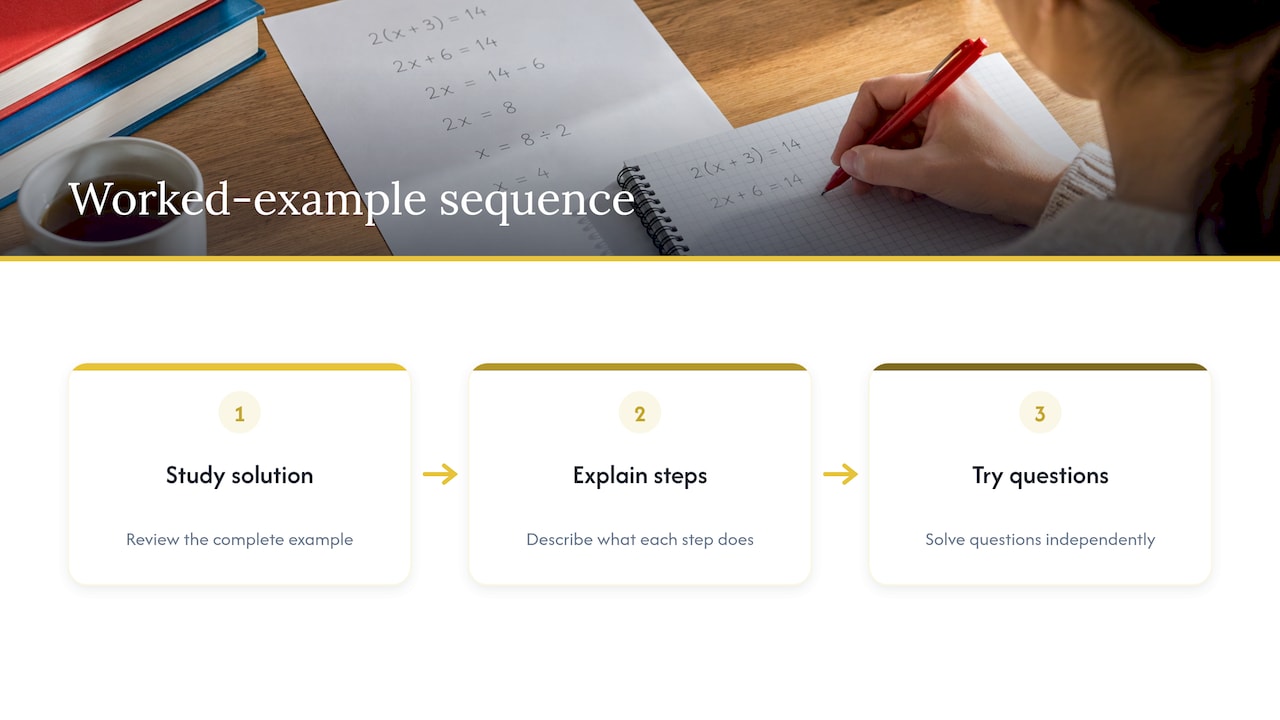
The method is simply a decision about order. Instead of handing a learner a new type of question and asking them to work it out, you show a complete solution first. The learner studies it, explains it, and only then tries questions of their own.
This matters because a blank page and an unfamiliar question ask you to do two jobs at once: learn the method and apply it. Worked examples separate those jobs.
Why worked examples help you learn maths
They reduce the load on your working memory
The Education Endowment Foundation explains that putting the problem and solution together lowers pupils’ cognitive load. You no longer carry out every procedure to reach the answer, so you can concentrate on the reasoning and strategy behind it.
The MIT Teaching + Learning Lab says the same about novices: when you are meeting new concepts and procedures at once, load is high, and a model to follow frees up attention for understanding.
The research evidence is solid
A few findings worth knowing:
- Early work by Sweller and Cooper in 1985, summarised by MIT, found that learners given problems to solve took almost six times longer to complete the learning sequence and made more errors than those studying worked examples.
- A 2023 meta-analysis by Barbieri and colleagues reported a medium effect of worked examples on mathematics performance (g = 0.48).
- The US What Works Clearinghouse algebra guide notes that solved problems let students see the problem and many solution steps at once, and that discussing them can build a deeper understanding of the logic used to solve algebra problems.
None of this is magic. It is a well-tested way of organising practice so that early effort goes into understanding.
How to study a worked example (the part most students skip)
Reading a solution and nodding along feels like learning, but it is not enough. The MIT Open Learning summary states that worked examples are effective only when learners self-explain the solutions and when several varied examples of the same concept are provided. The MIT Teaching + Learning Lab adds that when features get students to actively study the solutions, the effect nearly doubles.
Here is a routine you can use on any GCSE or A-Level example.
- Read the question and predict. Before looking at the working, say what type of question it is and what you would try first. Even a wrong guess primes you to notice the real method.
- Cover the solution and reveal one line at a time. After each line, ask: what was done, and why was that move allowed?
- Label the purpose of every step. Write a few words beside each line: “factorise to find roots”, “substitute back to check”, “rearrange to make x the subject”. This is self-explanation in practice.
- Note the mark-earning moves. In exam solutions, look for where method marks and accuracy marks are likely to sit: the setting up of an equation, the correct substitution, the final rounded answer. Our guide on banking AO3 marks by showing working goes into this for GCSE.
- Close the page and rebuild it. Rewrite the solution from memory, or explain it aloud. Where you get stuck is exactly what you have not yet understood. This is active recall for maths applied to a single example.
- Try a near-twin question. Same structure, different numbers. If you can do it without looking, you have the model.
We cover the revision side of this in more depth in how to use worked solutions to revise GCSE and A-Level maths.
What makes a good worked example
If you write your own notes, or you are a tutor choosing material, the quality of the example matters. The Australian Education Research Organisation says an effective worked example demonstrates the task clearly and concisely, with every step fully explained and shown, and that each new example should introduce only one new point at a time.
A useful checklist:
| Feature | What it looks like in maths |
|---|---|
| Every step shown | No “it follows that” jumps; algebraic manipulation written out |
| Reasons stated | A short note on why each step is chosen, not just what is done |
| One new idea | Solving a quadratic by factorising before moving to the formula |
| Variation | Several examples of the same concept with different surface features |
| Exam style | Wording, mark allocation and layout matching real papers |
Variation deserves emphasis. If a learner only ever sees one version of a method, they may attach it to surface details, such as the particular numbers, rather than to the structure of the problem. Seeing the same idea in different clothes teaches them to recognise it.
From studying to solving: fading the support
Worked examples are a starting point, not a destination. The goal is to solve unseen exam questions alone, so the support has to be removed in stages. The Australian Education Research Organisation advises gradually removing scaffolding as students become more proficient, by taking steps out of the examples and replacing them with independent problem-solving.
A 2025 study by Miller-Cotto and Medrano found that fading produced the largest pre-to-post-test gains in maths performance, and that prior knowledge was the only factor that moderated the effect.
Here is a practical fading sequence for a single topic, such as simultaneous equations or differentiating from first principles:
- Full example. Study a complete solution using the routine above.
- Completion problem. Take a similar question where the first steps are done for you and you finish it.
- Reverse the balance. Take one where only the first step is shown.
- Independent with the model covered. Solve a related question with the example hidden. Check afterwards.
- Correct the earliest error. If your answer is wrong, find the first line where it went wrong, not just the last. Fix that line and carry on.
- Return later to a mixed set. Come back after a few days and meet the topic among others, so you also practise choosing the method. Our guide to topic versus mixed practice suggests mixing three to five topics once you are ready.
One caution from a practice-cycle guide published by The School Calendar: avoid jumping to a much harder independent question before you understand the model. If you cannot explain the example, go back a step rather than pushing on.
When to use examples and when to just practise
The method suits some stages better than others. The MIT Teaching + Learning Lab notes that worked examples are most valuable in the early acquisition of a skill and that, once students have sufficient prior knowledge, studying examples can become less useful. MIT Open Learning likewise says experts gain more from attempting problems than from studying solutions.
In practice for exam students:
- New topic, or one you keep getting wrong: start from worked examples.
- Topic you understand reasonably well: attempt the question first, then use the worked solution to check your method and mark-scoring.
- Final weeks before the exam: mostly timed papers and mixed questions, with worked solutions used to mark yourself and to learn from the errors.
The question of whether to read or watch the solution is also worth thinking about. Our page on written versus video solutions suggests trying the question first, then choosing the format that fits what went wrong.
A worked example in miniature
Here is the kind of example, and the kind of annotation, we mean. Take a GCSE-style question: solve 3x + 5 = 20.
- Line 1: 3x + 5 = 20. The unknown is trapped inside two operations: multiplied by 3, then 5 added.
- Line 2: 3x = 15. Subtract 5 from both sides to undo the addition first.
- Line 3: x = 5. Divide both sides by 3 to undo the multiplication.
- Check: 3 × 5 + 5 = 20. Substitute back to confirm.
The working is trivial. The annotations are the learning. A completion problem follows naturally: “Solve 4x − 7 = 21. The first line is done for you: 4x = 28.” Then a covered-model question: “Solve 5(x + 2) = 35.” That one introduces a new point, expanding or dividing first, which a good set of varied examples would show both ways.
At A-Level the same logic applies to longer chains, for example integration by substitution. The steps are more numerous, so labelling each step’s purpose matters even more. Our A-Level walkthroughs guide shows how to use video walkthroughs to gain marks on questions like these.
How teachers, tutors and parents can use the method
The Kapor Foundation recommends presenting worked examples when introducing new concepts, having students use them on similar problems, practising self-explanation, providing varied examples and removing support as students become proficient. It also notes that a teacher can create an example live by demonstrating a task step by step and explaining the reasoning, like a think-aloud.
For teachers and tutors
- Pair each example with a prompt that makes students explain it: “Why subtract before dividing?”
- Include a question afterwards about choices made. The EEF blog quotes Colin Foster’s idea that the lesson begins when the problem is solved, meaning the richest learning often lies in reflecting on why a method was chosen, per the EEF.
- Compare strategies. The same EEF post, citing the What Works Clearinghouse, says regularly examining multiple strategies helps pupils become more confident, efficient and flexible in choosing an approach.
- If you plan lessons in phases, you can slot a modelled example into the explanation stage of a 5E lesson plan and use fading tasks for the elaboration stage.
For parents
You do not need to be a maths expert. Ask your child to explain an example to you, line by line. If they can say why each step happens, they understand it. If they stall, that is the line to revisit together. Then hand over a similar question and let them lead.
For homeschooling families
Build each topic as a short sequence: one full example, one completion problem, one independent question, then a mixed set a few days later. It gives structure without needing a classroom.
Our perspective
We built Mathvault around a simple belief: students learn exam maths best when they can see how a full-mark answer is constructed, and then practise until they can build one themselves.
That is why our past papers come with fully worked step-by-step solutions, and why many are paired with video walkthroughs. A mark scheme tells you what earns marks. A worked solution shows you how to get there, in the order an examiner expects to see it.
We also think the order matters. Try the question, or study the model, depending on where you are with the topic. Then explain it, cover it, and redo it. Our free live weekly Q&A sessions exist for the moments when an example still does not click, because a step you cannot explain is the one worth asking about.
Every student we want to reach, across England, Wales and Scotland, deserves the same quality of worked explanation, which is why the core materials stay free.
Oloru
Practise on real exam questions
The method is most powerful when the examples match what you will actually face. On Mathvault you can study fully worked solutions and video walkthroughs for past papers across the main UK exam boards, all organised by board and year, and take part in live weekly Q&A sessions.
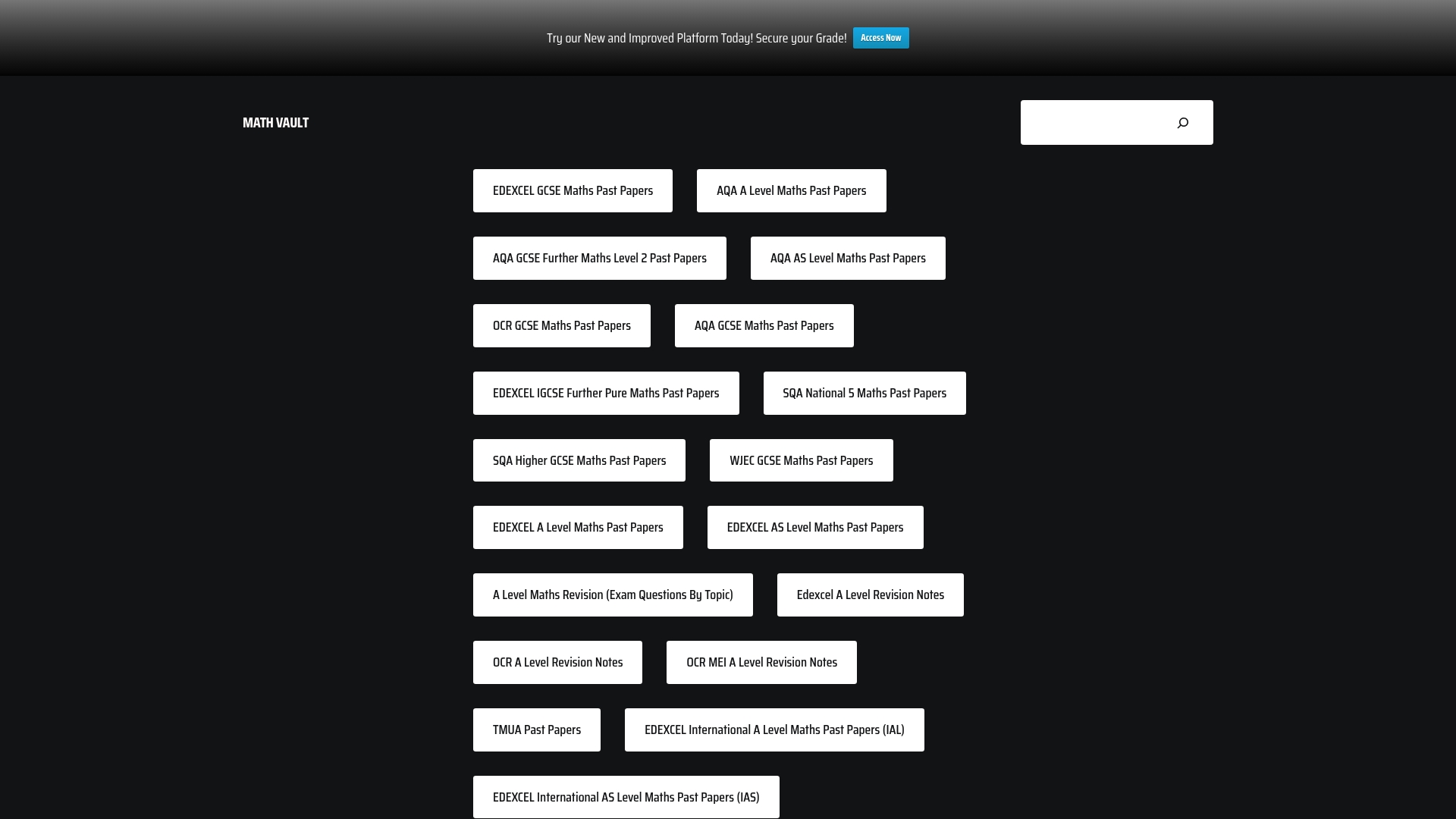
Start with GCSE maths past-paper questions or A-Level maths past-paper questions, or browse all past papers by exam board. If a worked solution leaves you stuck, bring the question to a live session: our guide to asking maths questions live explains how.
FAQ
What is the worked examples method in maths?
It is a way of learning where you study a complete solution, with every step explained, before attempting similar questions yourself. The worked example shows the question, the method and the answer together, so you can concentrate on understanding why each step is used.
Do worked examples work for GCSE and A-Level revision?
Yes, particularly when you are new to a topic or keep making the same mistakes in it. Research summarised in a 2023 meta-analysis found a medium positive effect on maths performance. They work best alongside active explanation and then independent practice.
How many worked examples should I study before practising alone?
There is no fixed number, but use more than one and make them varied. Study a few examples of the same idea with different surface features, then move to completion problems and finally independent questions. If you cannot explain the steps, study another example before moving on.
Should I always read the solution before trying the question?
Not always. For a brand-new topic, studying an example first is usually more efficient. Once you have a reasonable grasp, attempt the question first and use the worked solution to check your method, as experienced learners tend to benefit more from solving than from studying, according to MIT Open Learning.
How can a parent help without knowing the maths?
Ask your child to teach you the example, line by line, and to say why each step happens. Where they hesitate, they have found the gap. Then ask them to try a similar question with the solution covered.
Sources
- Worked Examples, MIT Teaching + Learning Lab
- Learning through step-by-step solutions to solved problems, MIT Open Learning
- Using worked examples to support mathematical problem solving, Education Endowment Foundation
- Explicit instruction practice guide, Australian Education Research Organisation
- Does working memory moderate the effect of fading on math performance, PMC
- A Meta-analysis of the Worked Examples Effect on Mathematics, Barbieri et al. 2023
- Teaching Strategies for Improving Algebra Knowledge, What Works Clearinghouse
- A Worked-Example Practice Cycle for Maths and Science, The School Calendar
- Worked Examples, Kapor Foundation
- 5E Lesson Plan: How to Write One, Phase by Phase
Leave a Reply