Use video to learn how to think through a problem, and use written solutions to check exact steps and revise quickly. Video suits first explanations, seeing how an expert reason, and recovering from a mistake mid-practice. Written solutions suit line-by-line checking, quick look-ups and timed revision. Choose by your goal and your level, not just by what feels comfortable.
TL;DR:
- One controlled experiment found that video learners recovered from errors and finished tasks in about half the time, although overall performance sometimes matched text.
- For unfamiliar methods, choose a short segmented video, then pause and predict each step; for exam revision, written solutions help locate errors faster.
- Experts tend to prefer text, while novices benefit more from video; as familiarity grows, shift toward unaided attempts and concise written checks.
- If two attempts leave you stuck, switch formats; after checking a written solution, mark the first wrong line and redo the problem under timed conditions.
Table of Contents
- Which format suits which maths study task?
- How do you get the most from video solutions?
- How do you get the most from written solutions?
- What do the evidence and learning theory say?
- How do you combine both formats in a daily routine?
- How I use both formats before exams
- How can we help you pair video walkthroughs with written solutions?
- FAQ
- Sources
Which format suits which maths study task?
The honest answer depends on the job you are doing. A video models pacing and flow: you hear why the first line is a substitution, not merely see that it is. That matters most when a method is new to you. In one controlled experiment, video tutorials helped participants detect and recover from errors, and users finished step-by-step tasks in about half the time of those working from text or screenshots. Overall performance was sometimes similar, so the gain lay mainly in speed and recovery.
Written solutions win on scanning. You can jump to line four, spot where your sign went wrong and move on in seconds. That makes them the natural tool for exam revision, when you are checking dozens of answers rather than learning one idea.
Both formats have weak points:
- Poorly designed videos present information that disappears before you can process it.
- Fast narration with no pause points encourages nodding along without following.
- Written solutions invite copying, because reading a neat chain of steps feels like understanding.
- Either format becomes passive if you open it before attempting the question.
A simple rule of thumb: for an unfamiliar topic, start with a short, segmented video. For revision close to the exam, prioritise written worked solutions and timed practice. Where you have both, use the video to understand and the page to verify.
How do you get the most from video solutions?
Watching is not the same as learning. Treat a video as a second opinion you consult after you have tried the question honestly, not before.
- Attempt the problem first, even if you only get halfway. Your stuck point tells you what to listen for.
- Pause after each step and write it down in your own words, then check it against the screen.
- Predict the next step before the presenter reveals it. A wrong prediction is useful information.
- Replay short clips when a calculation moves too fast, rather than rewinding the whole video.
- Close the video and redo the question from a blank page straight afterwards.
Choose your videos with care. Look for clear on-screen notation, chapter markers and a steady pace. Research on multimedia design recommends signalling key points, segmenting complex content and cutting redundancy, which in practice means avoiding clips where the narrator reads aloud exactly what is already written on screen. Design guidance for secondary maths videos also stresses on-screen mathematical notation and writer-paced segments so you can write along.
Pro Tip: Set a rule that you may only watch a clip twice. The second time, pause and copy every line before the presenter does.
How do you get the most from written solutions?
A written solution is easiest to misuse, because it looks so tidy. The aim is to turn reading into retrieval, which means producing steps from memory rather than recognising them on the page.
- Cover and recall: read one step, cover it, then reproduce it from memory and compare.
- Backwards fading: the Education Endowment Foundation highlights backwards fading and self-explanation as ways to make worked examples more effective. Take a full solution, remove the last step and complete it yourself, then remove the last two, and so on until you can do the whole question.
- Compare approaches: when two written methods solve the same problem, note why each works. This builds flexible strategy knowledge, which helps when an exam question looks unfamiliar.
- Verify, do not discover: after an attempt under exam conditions, use the solution only to mark your answer and locate errors.
Our own past-paper collections are built for this kind of checking, for example the WJEC past papers with worked solutions and the SQA National 5 collection.
Pro Tip: Keep a “first wrong line” column in your notebook. Writing down where your working diverged from the solution is far more useful than recording the mark.
What do the evidence and learning theory say?
The practical advice above rests on a fairly consistent body of research. Multimedia and cognitive-load work identifies five design strategies: multimedia, spatial contiguity, redundancy reduction, signalling and segmenting. Further guidance on evidence-based principles for instructional videos recommends removing extraneous material, signalling key points, segmenting complex content and using conversational narration.
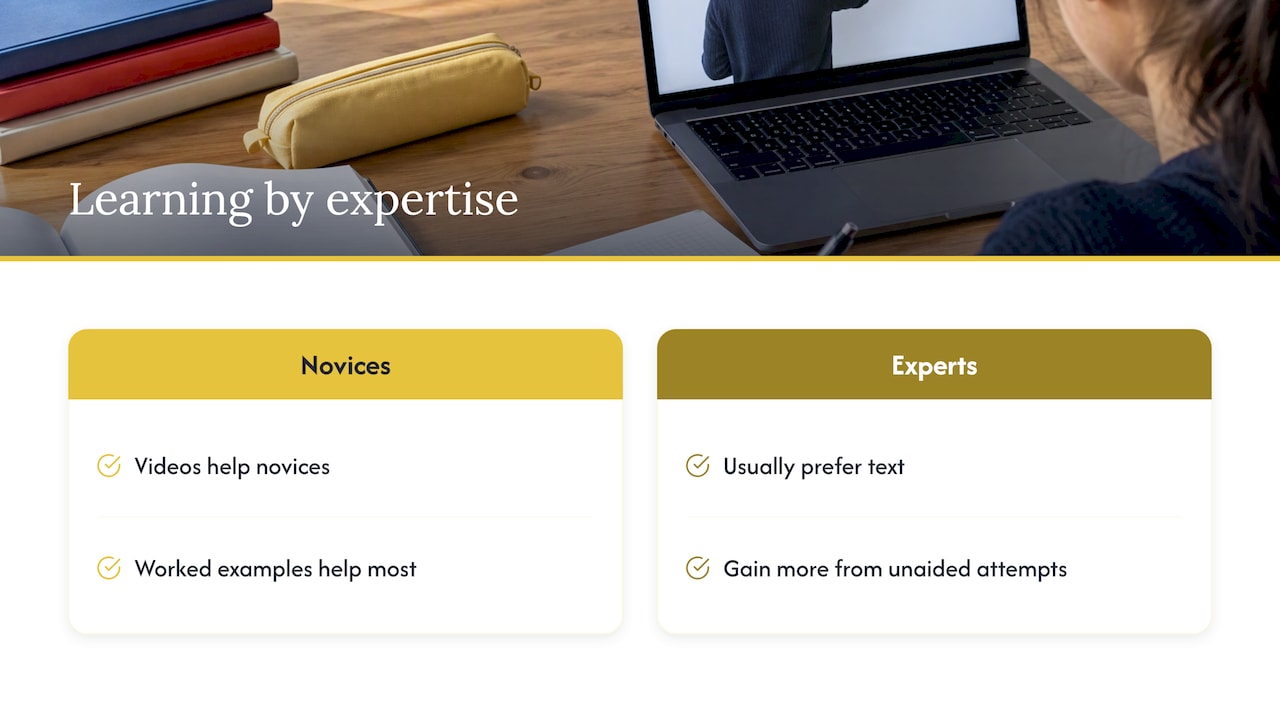
On worked examples, the Education Endowment Foundation advises that they work best as scaffolds for most students, and that modelling your thinking aloud and using faded or incorrect examples deepens understanding. Their blog also notes that worked examples help non-experts most, whereas experts often gain more from trying problems unaided first.
That points to the expertise reversal effect. One analysis found that experts usually prefer text, while videos help novices, and that media preference tracks familiarity with the content.
Both written and video worked examples can become passive if misused; active techniques such as self-explanation and attempting problems before consulting solutions are essential to convert worked examples into learning opportunities.
As you grow more confident in a topic, expect to lean less on video and more on concise written solutions. That shift is a sign of progress, not a lapse in method.
How do you combine both formats in a daily routine?
Here is a compact routine for a single problem, which fits a short evening session:
- Attempt the question alone, writing down where you get stuck.
- Watch a short walkthrough of that method, pausing and writing along.
- Check your working against the written solution and mark the first wrong line.
- Close both and reattempt the question under time pressure.
- If you are still stuck after two passes, switch format: try a different video or a different written method.
For a whole topic across a week, begin with a video-led overview, then move to mixed practice using written worked solutions, and return to the same topic on separate days for spaced retrieval. A sensible split is a short video segment, a longer practice block, and a brief timed check at the end. When progress stalls, change the format before you add more hours.
How I use both formats before exams
In my own revision I begin with a short walkthrough of the topic that is giving me trouble, then work through the written solution line by line, covering each step and reproducing it. Finally I redo the question against the clock. Neither format does the job alone. What matters is choosing the right one for the task in front of you and using it actively, not committing to one format for good.
— Oloru
How can we help you pair video walkthroughs with written solutions?
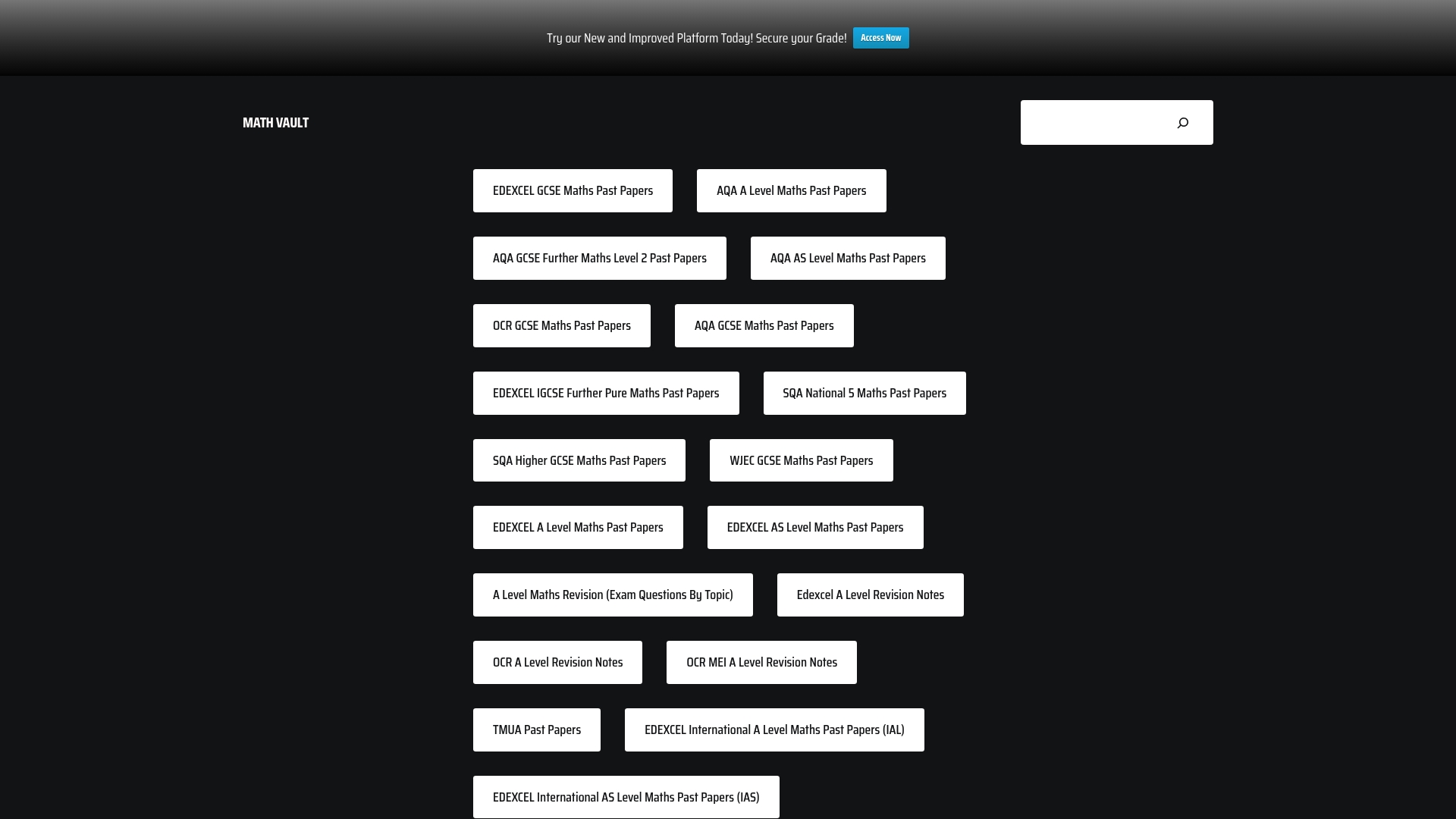
We built Mathvault around pairing written solutions, video walkthroughs and past papers, all aimed at GCSE and A-level students.
- Start with our plan of exam-aligned video walkthroughs to build understanding topic by topic.
- Move on to our GCSE self-mark past papers with board-aligned solutions and live Q&A for timed practice and line-by-line checking.
Pick one topic you find hard this week and try the routine above.
FAQ
Why is video better than text for learning maths?
Video is better for seeing how an expert reasons, because you hear the thinking behind each step. In one experiment, video users completed tutorials in about half the time of those using text. Text is still easier to scan and reference, so neither format wins on every task.
Do experienced students still need video solutions?
Often less so. Research suggests experts tend to prefer text, while videos help novices. If you already know a method well, a concise written solution is usually the faster check.
Can video or written solutions become passive study?
Yes, both can. Watching or reading a solution feels like understanding, but the Education Endowment Foundation stresses that attempting problems first and explaining steps to yourself is what turns a worked example into learning.
Should I use video or written solutions to check my working?
Use written solutions. You can scan to the exact line where your answer diverged, which is much quicker than scrubbing through a video. Save video for when you cannot see why a step works.
Sources
- Video Tutorials Improve Students’ Ability to Recover from Errors
- Mistakes and explanations | EEF
- Five Strategies for Optimizing Instructional Materials: Instructor- and Learner-Managed Cognitive Load – PMC
- Evidence-Based Principles for How to Design Effective Instructional Videos
Leave a Reply