
Stop rereading your notes. The single most effective change you can make to your maths revision right now is to put the textbook face-down and attempt problems unaided, then check your work and correct every error before moving on. That is active recall in practice: retrieval practice combined with immediate feedback, not passive review.
Here is a micro-plan you can start in the next ten minutes:
- Pick one question. Pull a past-paper question from an AQA, Edexcel, OCR, or WJEC paper (or from Mathvault’s topic-sorted bank) and set a timer for the mark allocation.
- Attempt it without notes. Write every step, even if you are unsure. Leaving a blank is less useful than a flawed attempt.
- Self-mark against the mark scheme. Identify exactly which step broke down, not just whether the final answer is right.
- Rework the error immediately. Redo the specific step you lost marks on before moving to the next question.
- Log it. Write the topic and error type in a notebook or spreadsheet. This becomes your priority list for the next session.
Pro Tip: Set your timer before you open the question. The moment you read the problem and reach for your notes, the retrieval attempt is over. Commit to the unaided attempt first, even if it feels uncomfortable.
Key takeaways
Active recall for maths works when you combine unaided problem-solving with immediate correction, spaced revisits, and a consistent error log — not when you simply do more questions.
| Point | Details |
|---|---|
| Retrieval beats rereading | Attempt problems unaided, then correct every error before moving on. |
| Space your revisits | Revisit topics after 2–4 days, then 1–2 weeks, then monthly for reliable retention. |
| Track errors specifically | Log the exact step that failed, not just the topic, to prioritise your next session. |
| Mix topics deliberately | Interleaved mixed sets build strategy selection; blocked practice alone does not. |
| Mathvault closes the loop | Free past papers, worked solutions, and video walkthroughs give you both the question and the feedback. |
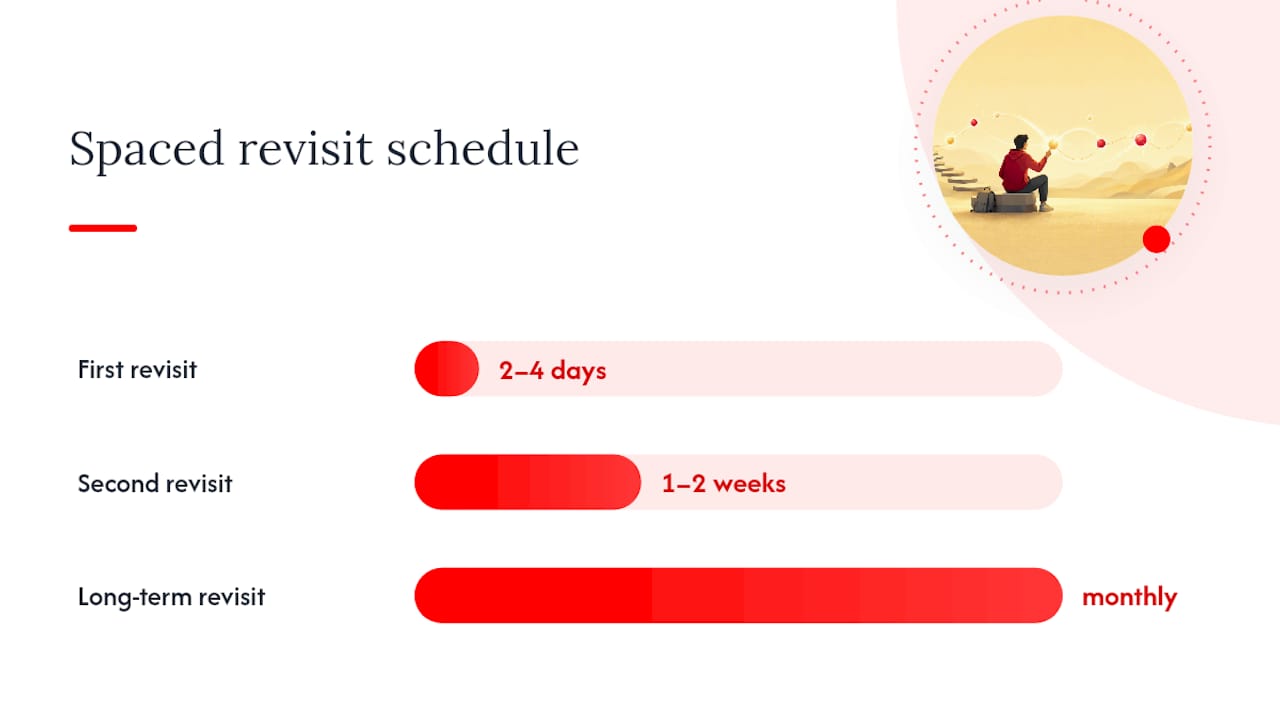
Table of Contents
- Why does active recall work so well for maths?
- How to run a 25–40 minute active recall session
- Concrete active recall techniques for every maths topic
- How to handle formulae, derivations, and multi-step procedures
- What does a sensible spacing schedule look like?
- How do you know if your revision is actually working?
- Common mistakes students make with active recall in maths
- Which tools and resources should you use?
- Ten active recall prompts you can use right now
- An honest perspective on active recall and real exam work
- Mathvault gives you the resources to close the loop
- Sources
Why does active recall work so well for maths?
Retrieval practice means deliberately pulling information from memory rather than re-exposing yourself to it. The spacing effect means distributing those retrieval attempts across time rather than cramming them into one sitting. Together, they form the backbone of evidence-based revision.
A 2025 meta-analysis from the University of York synthesised 27 studies and 53 effect sizes on spaced and retrieval practice in mathematics. It found an overall positive effect for spaced versus massed practice, with stronger effects in isolated learning contexts than in course-embedded settings. The evidence for a consistent testing effect in maths was less robust than in other domains, which is worth knowing: spacing your practice reliably helps, but simply doing more tests without spacing them out may not be enough on its own.
Statistic to know: The University of York meta-analysis found a weighted mean effect of g ≈ 0.28 for spaced versus massed practice across mathematics studies, with isolated learning showing effects nearly twice that size.
Separate classroom research published in the International Journal of Science and Mathematics Education found that short retrieval tasks at the end of lessons helped lower-entry students close the gap with higher-entry peers over a first-year mathematics course. Retrieval practice appears to act as a metacognitive scaffold: it forces students to confront what they do not yet know, which is precisely the skill that separates stronger from weaker performers.
There are real limits to acknowledge. Maths is procedurally complex. Retrieval practice works best once you have had some initial instruction on a topic; attempting to retrieve something you have never properly learned produces confusion rather than learning. The practical rule: use active recall to consolidate and space out topics you have already been taught, not to replace first exposure.
Pro Tip: After any retrieval attempt, always check your work against a mark scheme or worked solution. The correction step is where the learning happens. Retrieval without feedback is half the process.
How to run a 25–40 minute active recall session
This session structure is replicable. Use it every time you sit down to revise maths, adjusting the question difficulty as your confidence grows.
Session timeline
- Minutes 0–3: Warm-up. Write down, from memory, the key formula or procedure for the topic you are about to practise. Do not check notes yet.
- Minutes 3–20: Unaided attempt. Work through one to three past-paper questions (or a timed mixed set) without any reference material. Show every step.
- Minutes 20–28: Self-mark. Compare your work against the mark scheme or worked solution. Circle every step where you lost a mark or made an error.
- Minutes 28–35: Targeted rework. Redo only the steps you got wrong. Do not copy the solution; reconstruct the correct method yourself.
- Minutes 35–40: Spaced review note. In your error log, record the topic, the specific error type (e.g. “sign error in completing the square”, “forgot to add constant of integration”), and the date. Write a one-line rule to remind yourself what to do differently.
What to do when things go wrong mid-session
- If you blank completely: Write down what you do know about the topic (any formula, any related concept). Then attempt the question using only that. Do not open your notes until after you have made a genuine attempt.
- If you run out of time: Mark the question as incomplete in your log, note the step you reached, and count it as a partial attempt. Partial attempts still generate useful feedback.
- If you rely on hints: Treat any hint as a signal that the topic needs more spaced revisits, not as a failure. Reduce the question difficulty for the next session and rebuild from there.
Session checklist
- No notes or textbook open during the attempt
- Every working step written out in full
- Mark scheme consulted only after the attempt is complete
- Errors recorded with a specific description, not just “got it wrong”
- Next revisit date noted before closing the session
Concrete active recall techniques for every maths topic
The session loop above is the container. These techniques are what you put inside it. Each one maps directly to the kinds of tasks you will face in AQA, Edexcel, OCR, and WJEC papers.
- Past papers under timed conditions. Work through full papers or topic-specific question sets against the clock. The time pressure forces you to retrieve methods quickly, which is exactly what exams require. Mathvault’s Edexcel GCSE past paper questions by topic let you isolate a single topic for focused retrieval before moving to mixed sets.
- Worked-example hiding. Find a fully worked solution, cover the last two or three steps, and reconstruct them. Then uncover and compare. For integration questions, for instance, hide the substitution and simplification steps and attempt them from the integral alone.
- Deliberate variation. Take a question you have already solved correctly and change one element: swap a coefficient, reverse the question (give the answer and ask for the setup), or remove a given piece of information. This forces you to select a strategy rather than pattern-match to a memorised solution.
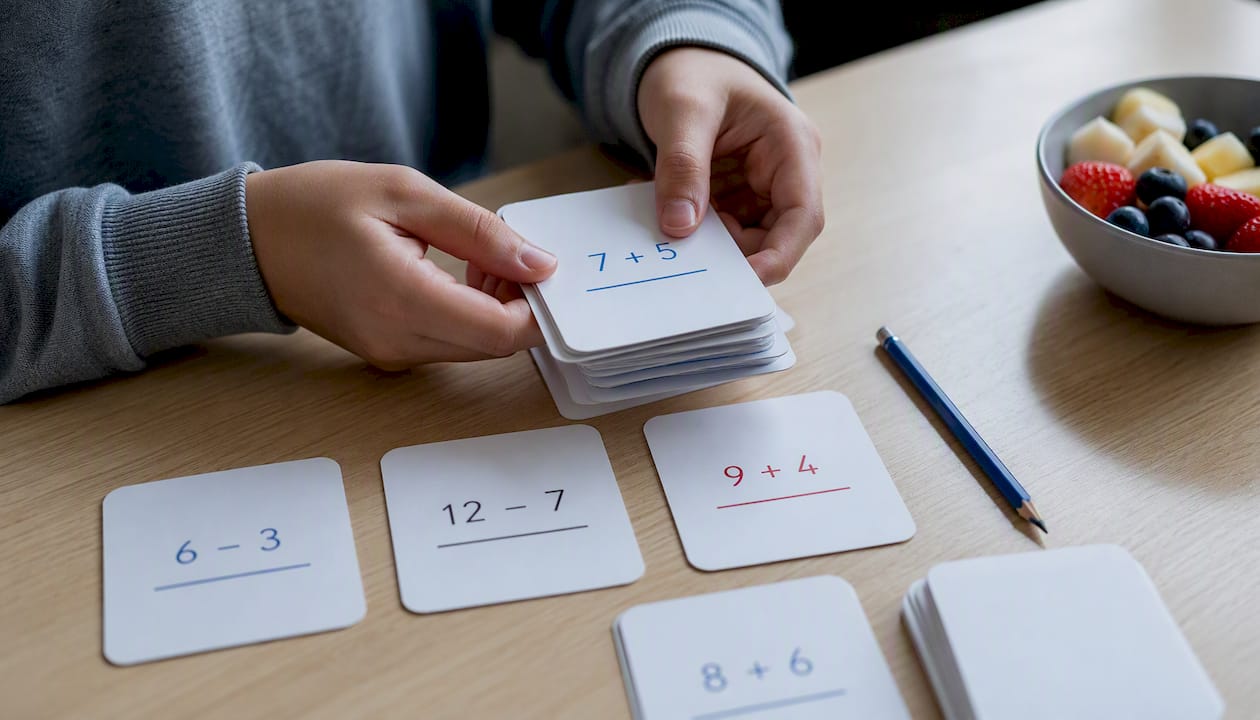
- Concept-check flashcards. Use flashcards for definitions, conditions, and theorems rather than for full procedures. A card asking “State the conditions for a binomial distribution” tests conceptual knowledge; a card asking “Solve this integral” is just a mini-problem. Both have their place, but keep them separate.
- Teach-back. Explain a solution aloud as if to someone who has never seen the topic. Gaps in your explanation reveal gaps in your understanding more reliably than a silent read-through.
- Error log review. At the start of each session, spend three minutes reviewing your error log from the previous two sessions. Attempt one question from each error category before starting new material.
Pro Tip: When designing variations, try reversing the question first. If the original asks “Find the gradient of the curve at x = 2”, your variation asks “At which point does the curve have gradient 4?” This single swap shifts the cognitive demand from substitution to equation-solving and catches a different class of error.
Mixing conceptual and procedural practice matters. Flashcards and teach-back suit conceptual knowledge (what a theorem states, when a method applies). Timed past-paper questions and worked-example hiding suit procedural knowledge (how to execute a method accurately under pressure). Use both within the same week, not in separate revision blocks.
How to handle formulae, derivations, and multi-step procedures
Not every formula needs to be derived from scratch. Knowing which ones to reconstruct and which to memorise is a practical exam skill.
Derive, do not just memorise, when:
- The formula is not given in the exam formula booklet (e.g. the quadratic formula for GCSE, sum of an arithmetic series for A-level).
- Understanding the derivation helps you reconstruct the formula if memory fails under pressure.
- The derivation itself is examinable (e.g. deriving a result from first principles in A-level calculus).
Memorise the final form when:
- The formula is provided in the booklet and the derivation is not assessed.
- The procedure is a standard algorithm (e.g. long division of polynomials) where speed matters more than reconstruction.
A simple workflow for formula retrieval practice
- Attempt. Close the formula booklet and write the formula or derivation from memory.
- Check. Open the booklet or worked solution and compare step by step, not just the final expression.
- Correct. Rewrite the derivation correctly, annotating the step you missed.
- Schedule. Add the formula to your spaced revisit list with a date two to four days ahead.
Mini exercises worth building into your sessions:
- Re-derive the quadratic formula from completing the square (three to four steps from memory).
- Reproduce the product rule and chain rule from their definitions, then apply each to a function you have not seen before.
- Write out the binomial expansion for (1 + x)ⁿ and state the conditions for convergence without looking.
Birmingham City University’s active recall guidance recommends writing out answers without notes and checking mistakes immediately. For formulae, that means the correction step must include rewriting the correct derivation in full, not just ticking a box.
What does a sensible spacing schedule look like?
Controlled course studies published in Educational Psychology Review confirm that spacing retrieval attempts across a semester improves both short- and long-term retention of mathematics knowledge, with spacing showing stronger effects than simply increasing the total amount of practice. The practical implication: revisiting a topic three times over three weeks beats doing three sessions on the same day.
Here is a four-week spacing template for a single topic:
| Week | Activity | Notes |
|---|---|---|
| Week 1 | Learn the topic, then attempt 3–5 unaided questions at the end of the session | First retrieval attempt within 2–4 days of initial learning |
| Week 2 | Revisit with 2–3 questions from a different question source | Aim for 5–7 days after Week 1 |
| Week 3 | Mixed practice set including this topic alongside two others | Interleaving increases difficulty but strengthens strategy selection |
| Week 4 | Full past-paper section or cumulative review including this topic | Confirms retention under exam-like conditions |
Practical interval rules of thumb, drawn from classroom research:
- First revisit: 2–4 days after initial learning.
- Second revisit: 1–2 weeks after the first.
- Subsequent revisits: monthly, or whenever your error log flags the topic as a recurring weakness.
Adjust intervals based on topic difficulty. A topic you answered correctly on the first attempt can wait two weeks before the next revisit. A topic where you made errors on three consecutive sessions needs a shorter gap (two to three days) and a simpler question to rebuild from.
One caveat worth repeating: the University of York meta-analysis found that maths may show smaller retrieval effects than some other subjects. Repeated mixed practice, not just repeated testing, is what drives exam performance in mathematics. Use spacing to distribute your practice, but make sure the practice itself involves varied, unaided problem-solving rather than passive review.
How do you know if your revision is actually working?
Progress in maths revision is measurable. You do not need to wait for a mock exam to know whether your active recall sessions are paying off.
Simple metrics to track each session:
- Accuracy on unaided problems: What percentage of steps did you complete correctly without any reference?
- Time-to-start latency: How long before you wrote your first line? Long hesitation suggests the method is not yet consolidated.
- Steps correct per question: Track this separately from the final answer. You can reach a correct answer via a flawed method, and examiners award method marks at every step.
- Frequency of repeated errors: If the same error type appears in your log across three or more sessions, it is a priority topic.
Decision rules for when to change tactics
- If accuracy is not improving after four sessions on the same topic: Switch to worked-example hiding or teach-back before returning to unaided problems.
- If you plateau on mixed sets: Increase the spacing interval and add interleaving (mix three or four topics per session rather than one).
- If time-to-start latency is consistently high: The topic needs more foundational work. Return to a simpler question type and rebuild procedural fluency before attempting exam-level questions.
- If repeated errors cluster around one step type: Isolate that step. Practise it in isolation for one session, then reintegrate it into full questions.
Keep your progress log compact: a date, a topic, a score out of steps attempted, and one error note. A spreadsheet with these four columns is enough. Review it at the start of every session to set your priority for that day.
Common mistakes students make with active recall in maths
Most students who try retrieval practice in maths undermine it in one of four predictable ways.
- Passive rereading disguised as revision. Reading through worked solutions and nodding along feels productive. It is not retrieval practice. Fix: close the solution after reading the first step and attempt the rest unaided.
- Skipping steps when self-marking. Checking only the final answer and marking yourself correct misses method errors that cost marks in exams. Fix: compare every line of working against the mark scheme, not just the answer box.
- Over-reliance on worked solutions as a crutch. Looking at the solution before making a genuine attempt means you are recognising a method, not retrieving it. Fix: set a rule that the worked solution is only opened after a full attempt, even an incomplete one.
- Blocked practice only. Doing twenty quadratic equations in a row builds speed on that one question type but does not prepare you for an exam that mixes topics unpredictably. Fix: after mastering a topic in isolation, move to mixed sets within the same week.
A note on maths anxiety
Anxiety before a blank page is common, and it can make the unaided attempt feel impossible. The fix is not to make the attempt easier by looking at notes; it is to make the first question easier. Start with a question one difficulty level below your target, complete it successfully, and then move up. Scaffolded attempts (where you are given the first step) are a legitimate starting point, provided you withdraw the scaffold over subsequent sessions as confidence builds. The goal is to reach fully unaided attempts, not to stay comfortable indefinitely.
Which tools and resources should you use?
The tools below cover the full range of retrieval practice needs for GCSE and A-level maths in the UK.
- Mathvault. Free past papers organised by exam board (AQA, Edexcel, OCR, WJEC) with fully worked step-by-step solutions and video walkthroughs. Best used for timed past-paper attempts followed by worked-solution comparison. The GCSE revision guides provide structured topic coverage to pair with your spacing schedule, and the best maths revision apps page helps you choose digital tools to complement your sessions.
- AQA, Edexcel, OCR, and WJEC past papers. Available directly from each exam board’s website and through Mathvault’s organised topic banks. Use these as the primary source of unaided practice questions. Pair each attempt with the official mark scheme for accurate self-marking.
- Anki. A spaced-repetition flashcard app that schedules cards based on how well you recalled them. Best for concept-check cards (definitions, conditions, theorems) and formula retrieval. The algorithm handles spacing automatically, which removes the need to manage revisit dates manually for flashcard content.
- Quizlet. Offers ready-made maths flashcard sets covering algebra, arithmetic, and calculus, useful for quick concept retrieval and procedural prompts. Less suited to multi-step problem practice than Anki, but faster to get started with.
Usage guidance:
- Use Anki or Quizlet for concept-check flashcards (definitions, conditions, short formulae). Keep these sessions to 10–15 minutes as a warm-up or cool-down.
- Use Mathvault past papers for the core 25–40 minute session loop: timed attempt, self-mark against worked solution, error log.
- Use Carnegie Learning’s retrieval practice activities (exit tickets, cumulative review grids) as templates for structuring solo sessions, adapting classroom formats to individual study.
Pro Tip: When you download or compile practice packs from published worked solutions, check the licensing terms. Many published resources carry a Creative Commons Attribution-NonCommercial-ShareAlike 4.0 licence, which permits personal study use but restricts redistribution.
Ten active recall prompts you can use right now
Rotate through these across sessions to keep practice varied and prevent pattern-matching to a single question type.
- Timed single question. Set a timer equal to the mark allocation (one minute per mark). Attempt the question without notes. Stop when the timer ends, even if incomplete.
- Reconstruct a derivation. Choose a formula you use regularly. Write the full derivation from memory, step by step, without the formula booklet.
- Create three variants. Take a question you solved correctly last session. Write three versions of it by changing one element each time (a coefficient, a constraint, the direction of the question).
- Explain the solution aloud. Work through a question and narrate every step as if teaching it. Pause wherever your explanation becomes vague.
- Timed mixed mini-set. Pick four questions from four different topics. Set a 20-minute timer and work through all four without switching topics mid-question.
- Error log replay. Open your error log, pick the three most recent entries, and attempt one question from each topic without looking at the original error.
- Worked-example reconstruction. Find a worked solution, read only the first two steps, then cover the rest and complete the solution yourself.
- Reverse the question. Take a standard question and swap the given and the unknown. If the original gives you the equation and asks for the roots, your version gives you the roots and asks for a possible equation.
- Formula recall sprint. Set a five-minute timer and write every formula you can recall for one topic area (e.g. all trigonometric identities, all differentiation rules). Check against the formula booklet and note any gaps.
- Peer-teach simulation. Write a step-by-step explanation of a method as if producing a worked solution for a classmate who has never seen it. Compare your explanation to a published worked solution and identify where your reasoning diverged.
Rotate these prompts deliberately. Using the same two or three every session builds familiarity with the format rather than genuine retrieval of the mathematics.
An honest perspective on active recall and real exam work
There is a version of active recall advice that sounds rigorous but produces anxious, unproductive students: the advice that says you should always attempt everything unaided, never look at a worked solution until you have spent 45 minutes stuck, and treat any hint as a moral failure. That version misreads the research.
The evidence, including the University of York meta-analysis, shows that retrieval practice works best when it is followed by feedback. The correction step is not optional. A student who attempts a question, gets it wrong, and moves on without understanding why has practised the error, not the correct method. The unaided attempt creates the retrieval cue; the correction creates the learning.
What actually separates students who improve from those who plateau is not how long they sit with a blank page. It is whether they close the loop: attempt, check, correct, log, revisit. Students who do that consistently, even with shorter unaided attempts, outperform students who attempt more questions but skip the correction and logging steps.
The other thing worth saying plainly: past papers are not just for mock conditions. They are the best source of retrieval prompts available, because they reflect exactly the question styles, mark distributions, and examiner expectations of your actual exam. Using Mathvault’s worked solutions as a feedback tool after a timed attempt is not cheating. It is the correction step, and it is half the process.
Mathvault gives you the resources to close the loop
Every active recall session needs two things: a good question and reliable feedback. Mathvault provides both, entirely free, for GCSE and A-level students across England, Wales, and Scotland.
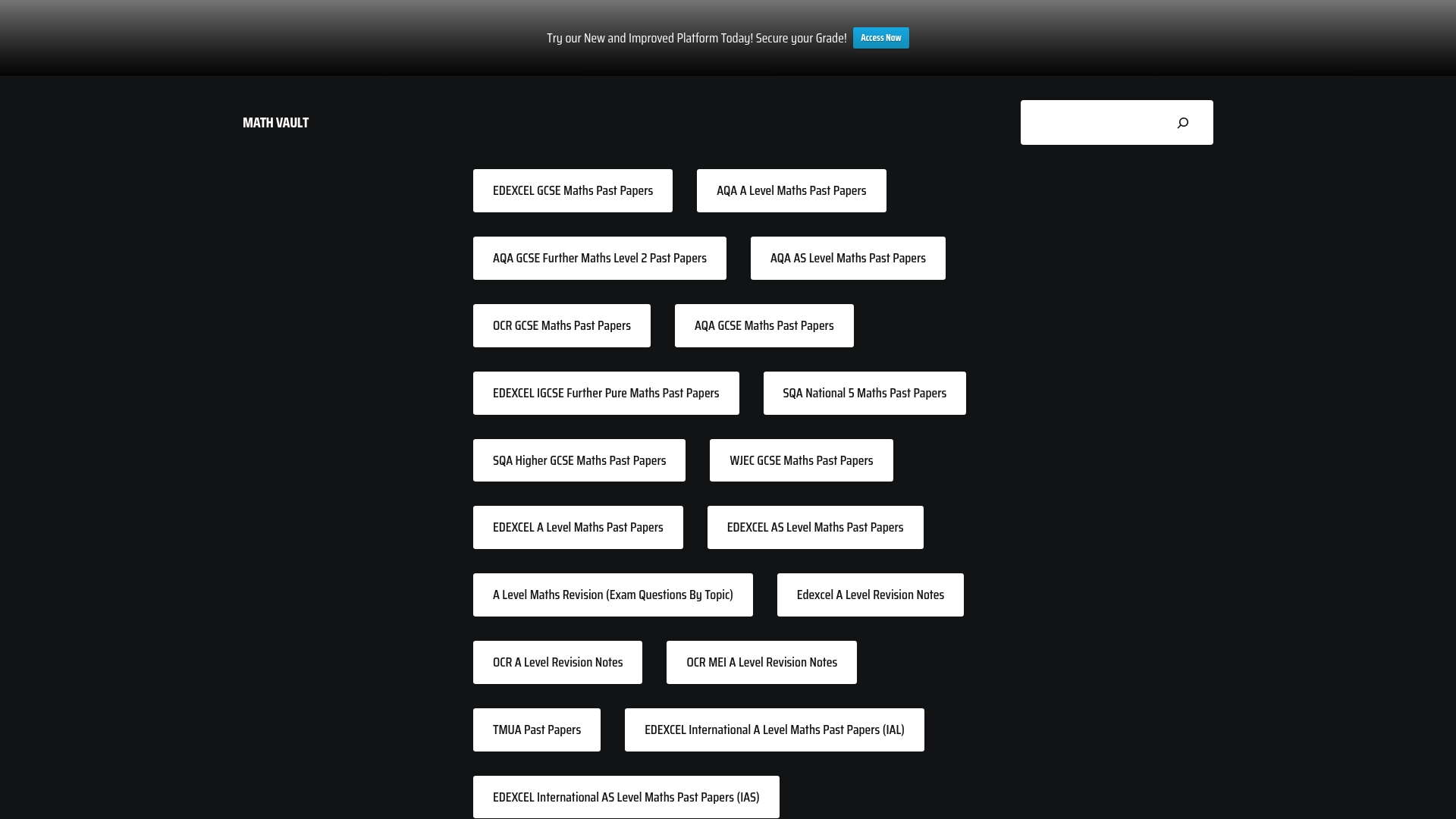
The GCSE revision guides on Mathvault are organised by topic and exam board, so you can pull a focused question set for the exact topic on your spacing schedule. Work through it timed and unaided, then open the fully worked step-by-step solution to mark your attempt line by line. Video walkthroughs cover the questions where a written solution alone does not make the method clear. Live weekly Q&A sessions mean that when you hit a genuine block, you can bring the question to a session rather than staying stuck.
For A-level students, AQA A-level resources and Edexcel A-level past paper questions by topic follow the same structure: organised by topic, with worked solutions ready for the correction step. Visit Mathvault to find your exam board and start your first session today.
Sources
- Spaced retrieval practice and retrieval practice in mathematics learning (University of York author deposit)
- Retrieval practice—A tool to narrow the achievement gap in learning higher mathematics (International Journal of Science and Mathematics Education)
- Active recall – study & revision: a Practical Guide (University of York subject guides)
- Retrieval Practice: 3 Exercises to Improve K-12 Math Achievement (Carnegie Learning)
- What is active recall? The best study method explained (Birmingham City University exam & revision guide)
Leave a Reply