
If you are stuck on a GCSE or A-Level maths question and want an answer from a real person, you have three realistic routes: a live Q&A session, a free community forum, or a paid one-to-one tutor. Each suits a different kind of question. This guide explains which to pick, how to word a question so you get a useful reply, and how to turn every answer into marks. We run weekly live Q&A sessions at Mathvault, free of charge, so we have seen what separates a question that gets solved from one that gets a vague reply.
TL;DR
- Use a live Q&A session for method questions on a specific past-paper question, a forum for unusual or university-style puzzles, and a tutor when you need a regular plan.
- Always include the question, your working so far and the exact line where you got stuck. That one habit gets better answers than any other.
- Ask for the method, not just the answer. Examiners report that marks are often lost on reading, copying and presentation rather than missing knowledge.
- If a live session involves a child and a private tutor, parents should be present or check in regularly and ask about safeguarding.
- Mathvault’s live Q&A and past-paper solutions are free, so you can try them alongside anything else you use.
Table of Contents
- Three ways to ask a maths question live
- How to word a question so you get a useful answer
- Get the most from a live answer
- Why marks disappear, and what to ask about
- Practise with the real thing: past papers plus live help
- Our perspective: what makes live maths help work
- Staying safe when live help involves a child
- Where Mathvault fits in
- FAQ
- Sources
Three ways to ask a maths question live
When people search for ways to ask maths questions live, they usually mean one of three things. They are not interchangeable.
| Route | Best for | Watch out for |
|---|---|---|
| Scheduled live Q&A with a maths team | Stuck on a specific GCSE or A-Level past-paper question; understanding a mark scheme | You need to arrive on time with your question ready |
| Open online forum or community | Unusual problems, curiosity, a second opinion on a method | Replies vary in quality and speed, and answers may not match exam-board expectations |
| Private online tutor | Regular, personalised teaching over weeks or months | Cost, and the need for safeguarding checks |
There is also a fourth option that many students overlook: your own teacher. Bringing a written question to a lesson or a drop-in often gets a quick, board-specific answer, and it tells your teacher where the class needs more work.
Scheduled live Q&A
A live session works like a drop-in clinic. You bring a question, someone works through it in real time, and you can ask a follow-up straight away. The advantage over a forum is that the explanation is shaped by your reaction. If the first explanation does not click, the second one can come at it from a different angle.
At Mathvault we run weekly live Q&A sessions for GCSE and A-Level students, and they are free. Because our past papers and solutions are organised by exam board, most questions people bring are already tied to a specific paper, which means the person answering can see the mark scheme you are working against.
Forums and communities
Community forums are good at breadth. Someone, somewhere, has usually seen your type of problem. The trade-off is that a reply may use methods beyond your specification, skip steps an examiner would want to see, or take hours or days to arrive. They work best when you are curious or want to compare approaches, less well the night before a paper.
Paid one-to-one tutoring
A tutor makes sense when the problem is not one question but a pattern: you keep losing marks on algebra, or you are aiming for the top A-Level grades and need structure. It is a commitment of money and time, so it is worth trying free live help first to find out which topics are actually causing trouble.
How to word a question so you get a useful answer
Most live sessions go wrong in the first thirty seconds, when the question is too vague to answer quickly. “I don’t get circle theorems” is a topic. “In question 17 of this paper I know the angle at the centre is double the angle at the circumference, but I can’t see which angle is at the centre” is a question someone can solve in two minutes.
Use this checklist before you post or speak:
- Name the source. Exam board, level, year, paper number and question number. For example, AQA GCSE Paper 2, June 2025, Q14.
- Paste or photograph the question exactly. Miscopied numbers are a classic source of confusion for everyone involved.
- Show your working so far. Even if it is wrong. A helper can then correct the one faulty step instead of restarting from scratch.
- Say where you got stuck. “I got to 3x + 5 = 2x – 7 and then wasn’t sure whether to subtract 2x or 5 first” is perfect.
- Say what you want back. A hint, the full method, or a check on your answer. Hints build more independence, and it helps the person answering to know.
A worked example
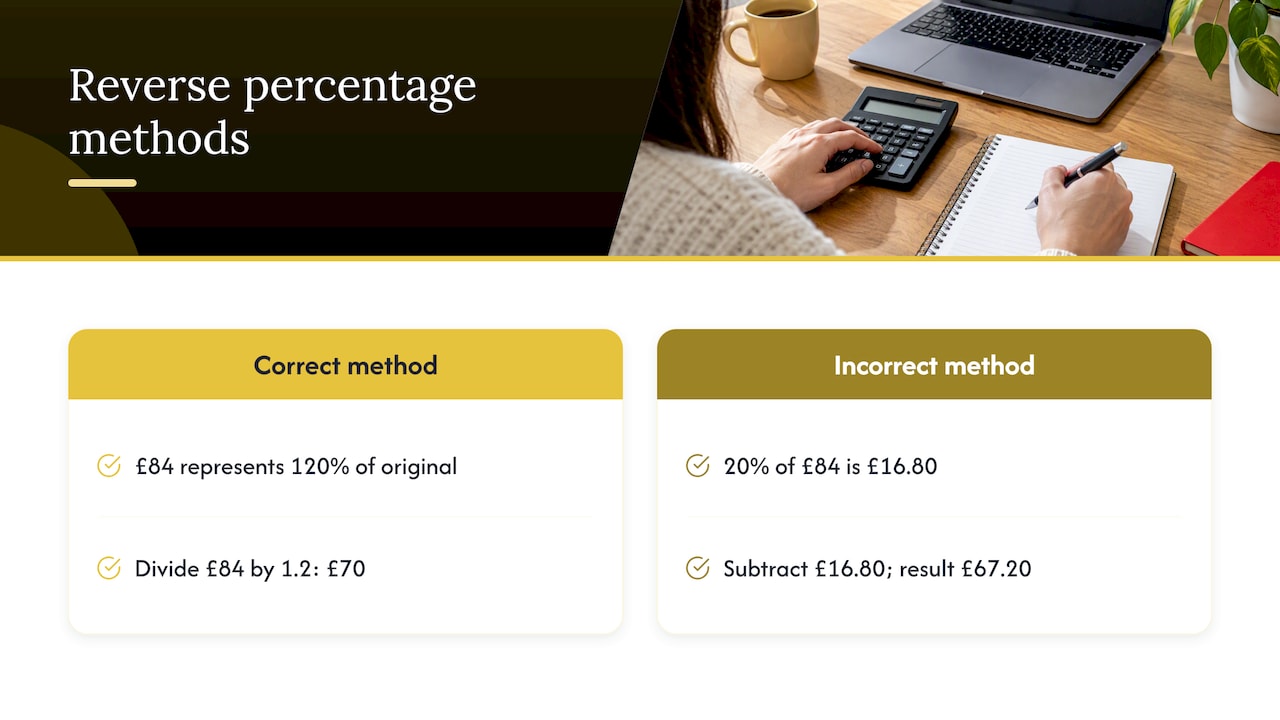
Suppose a Higher GCSE question says a price increased by 20% to £84 and asks for the original price. A weak question: “how do I do reverse percentages?” A strong one: “The price after a 20% increase is £84. I did 20% of 84 = 16.80 and subtracted it to get £67.20, but the mark scheme says £70. Why is my method wrong?”
The second version shows the helper the exact misconception. The 20% applies to the original amount, not to £84, so £84 represents 120% of the original. Dividing by 1.2 gives £70. Reverse percentages are one of the areas examiner reports flag as a recurring difficulty, so a question like this will earn you marks on future papers too.
Get the most from a live answer
A correct answer on screen does not mean you have learned anything yet. The Education Endowment Foundation’s guidance on improving maths puts weight on metacognitive strategies: teaching pupils to plan, monitor and reflect on how they tackle a problem, rather than only chasing the right result. You can build that into every live session.
- Before the answer: say out loud, or type, what you think the first step is. If you are wrong, the correction is far more memorable.
- During the answer: pause the helper at any step you could not have chosen yourself, and ask “what told you to do that?”
- After the answer: close the explanation and redo the question from a blank page. If you cannot, you have borrowed the solution rather than learned it.
- Within 48 hours: try a similar question on the same topic and note whether you got it right unaided.
If your questions are word problems, where the difficulty is turning a sentence into an equation, this guide to helping students tackle maths word problems is a useful companion. It supports the same habit: slow down, identify what is being asked, and build your own plan before asking for one.
Why marks disappear, and what to ask about
Live help is most valuable when it targets the ways marks are actually lost. Principal examiners’ feedback for the 2023 Edexcel GCSE Higher paper noted that the paper proved accessible, with most students attempting most questions, which is encouraging. The same reports are also a catalogue of avoidable slips.
The patterns that recur across recent reports include:
- arithmetic errors in division and decimals, even among strong candidates;
- reverse percentages and percentage change;
- set notation and rearranging complex formulae;
- choosing the correct circle theorem;
- answers in the wrong format, such as a missing inequality sign or the wrong degree of accuracy.
These make good live questions. Instead of asking for yet another run through of a topic you have already studied, ask: “Where would I lose marks on this question?” and “What would the method mark be if my final answer were wrong?” Clear, complete working often secures method marks even when the last line is incorrect, and a helper who knows mark schemes can show you exactly how much is available.
Method marks versus accuracy marks
In most exam-board mark schemes, method marks reward a valid approach and accuracy marks reward the correct result that follows from it. Ask a live helper to point at the mark scheme line by line. Once you can see where each mark sits, you start to write answers for the examiner, not just for yourself.
Practise with the real thing: past papers plus live help
Live help works best when you have a real paper in front of you. Official board materials, such as AQA’s maths support hub, are the authoritative source for specifications, mark schemes and examiner reports. Note that grade boundaries belong to a specific exam series, so a practice paper you mark yourself gives you a rough guide and not an official grade.
Here is a simple weekly routine that pairs a past paper with live questions:
- Monday to Thursday: work on topic questions. Mark them yourself, and list every question you could not finish or got wrong.
- Friday: pick the three most useful questions from your list and write each up as a proper question using the checklist above.
- The live session: bring those three. Ask for method, then redo them from scratch.
- Weekend: sit a timed section of a full paper. Explain your reasoning at each step, as examiners recommend.
Our guide to self-marking GCSE past papers with board-aligned solutions and live Q&A walks through this process in more detail, and it is the quickest way to find out which of your wrong answers are knowledge gaps and which are slips.
For specific papers, you can browse our AQA GCSE Maths 2025 past papers and mark schemes, the AQA A-Level Maths archive for 2018 to 2025, or the AQA GCSE Further Maths papers. Students in Wales can use our WJEC collections, such as WJEC 2024 and WJEC 2022.
Our perspective: what makes live maths help work
We have built Mathvault around one belief: students improve fastest when they can see a complete, fully worked solution and then talk to someone about the step that confuses them. That is why the archive, the video walkthroughs and the live Q&A sit together on one site, organised by exam board.
Three things we have learned shape how we run sessions.
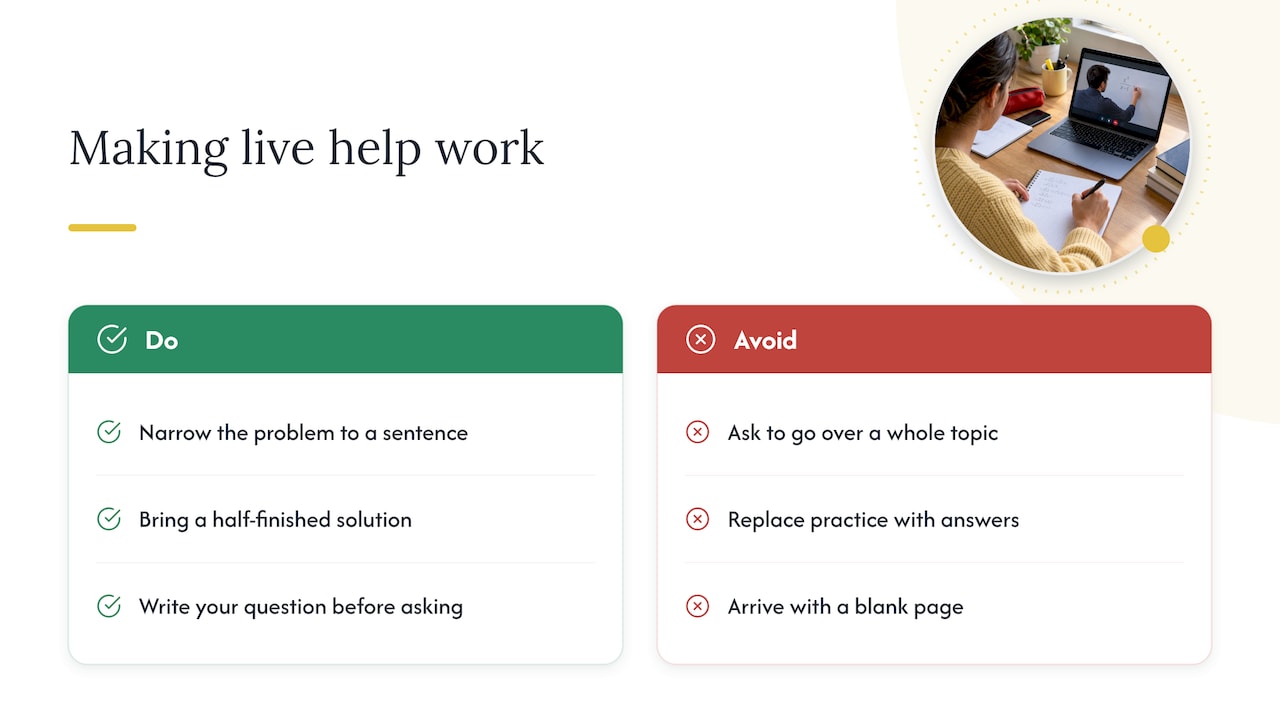
The best questions are small. A question about one line of working, one command word or one mark is nearly always more productive than a request to “go over” a whole topic. If you can narrow your problem to a sentence, you are most of the way to solving it.
Answers should never replace attempts. A live session is not a shortcut around practice. We would rather you arrive with a half-finished solution and a clear sticking point than with a blank page.
Free access matters. Exam stress is hard enough without a paywall in front of help. Our revision guides, solutions and weekly sessions are free. A small number of people choose to buy full downloadable packs for offline use or to make a donation, which keeps the site going, but nobody needs to pay to ask a question.
If you take one habit from this article, make it this: write your question down before you ask it. Half the time the act of writing it shows you the answer.
— Oloru
Staying safe when live help involves a child
Free group sessions and open communities are different from a one-to-one video call between an adult and a child, and parents should treat them differently. If your child is under 18 and you are arranging a private tutor, safeguarding comes first.
The Tutors’ Association’s Code of Practice sets out that reputable tutors should provide clear documentation, be open about background checks, and teach in professional settings. A local safeguarding partnership’s guidance on engaging a private tutor adds practical points: do not allow sessions to be recorded without your approval, and be present for online sessions or check in regularly.
A few sensible habits for any live help:
- Keep your child in a shared space at home, not a bedroom, for video calls.
- Do not share home addresses, phone numbers or school details in a public chat.
- Ask any one-to-one tutor what checks they hold and how to contact them outside lessons. A professional will welcome the question.
- If something feels wrong, end the session and speak to your child’s school safeguarding lead.
If you are a parent supporting a sixth-former, our 12-week A-Level Maths plan for parents explains how to help without trying to teach the content yourself.
Where Mathvault fits in
If you want to ask maths questions live and then practise on real exam material, start with our free resources. You can join the weekly live Q&A, work through fully worked solutions and video walkthroughs, and revise by topic.
For GCSE, our OCR GCSE Maths revision topics cover Number, Graphs and Functions, Sequences and Vectors with past questions. For A-Level, our Edexcel A-Level Maths revision topics include Calculus and Sequences and Series. Applying for a maths-heavy university course? Our TMUA past-paper questions are there too.
Start from the Mathvault home page, choose your exam board and bring your first question to the next session.
FAQ
Is there a free way to ask maths questions live in the UK?
Yes. Mathvault runs free weekly live Q&A sessions for GCSE and A-Level students, and open forums let you post questions at no cost. Live sessions give you an immediate follow-up, while forums are slower but broad. Many students use both.
What should I include when I ask a maths question?
Give the exam board, year and question number, the exact wording, your working so far and the line where you stopped. State whether you want a hint or a full method. A precise question gets a precise answer.
Can live help replace a tutor?
For targeted questions, often yes. For a long-term plan with regular feedback on your weak areas, a tutor may be a better fit. If you do hire one, ask about safeguarding and background checks, and stay involved if the student is under 18.
Will asking for answers hurt my learning?
Only if you stop at the answer. Ask for the method, say your next step before it is revealed, and redo the question from a blank page afterwards. The Education Endowment Foundation highlights reflecting on your own problem solving as a key strategy.
Sources
- Examiners’ Report, Principal Examiner Feedback Summer 2023 (Pearson Edexcel GCSE Maths)
- Improving Mathematics in Key Stages 2 and 3 (Education Endowment Foundation)
- Maths You Can Count On (AQA)
- Code of Practice, July 2025 (The Tutors’ Association)
- Guidance for engaging with a private tutor, carer or similar (CHSCP)
Leave a Reply