
A good A Level maths walkthrough shows you more than the answer. It shows the decision at each step, the method mark you would earn, and the point where a tempting approach goes wrong. Used well, a walkthrough turns a past paper from a score into a lesson. Used badly, it becomes a way of feeling you understand something you could not yet do alone.
This guide explains what to look for in a walkthrough, how to study one so the method sticks, how it links to the way A Level papers are marked, and where to find free worked solutions by exam board.
TL;DR
- A strong walkthrough gives the full method, explains why each step is chosen, and flags common examiner traps. A bare final answer does not count as one.
- Attempt the question first, then watch or read the solution. Compare your method with the model, not just your answer.
- Method marks mean a sound line of working can earn credit even when the final answer is wrong, so write every step down.
- MathVault offers free worked solutions and video walkthroughs for A Level past papers, organised by exam board.
Table of Contents
- What a good A Level maths walkthrough contains
- Why walkthroughs work: what the research says
- How to study a walkthrough, step by step
- Learning from incorrect and incomplete solutions
- Method marks: what walkthroughs should teach you about the mark scheme
- Where to find A Level maths walkthroughs
- Free walkthroughs by exam board at MathVault
- Our perspective: a walkthrough is only as good as what you do next
- Making walkthroughs work when maths feels hard
- A weekly plan using walkthroughs
- Start with the right paper
- FAQ
- Sources
What a good A Level maths walkthrough contains
Search for walkthroughs and you will find everything from a one-line answer key to a forty-minute video of a whole paper. They are not equally useful. Before you spend time on one, check it against this list.
- Every step of the working. No jumps from line three to line seven. If a step is skipped, you cannot see where marks would be awarded.
- The reason for the choice. “Use the chain rule here because the function is a composite” teaches you something. “Differentiate” does not.
- The mark scheme language. Method marks (M), accuracy marks (A) and follow-through marks are the currency of the exam. A walkthrough that points them out helps you write answers examiners can reward.
- Common errors. Sign slips, lost brackets, rounding too early, answers left unsimplified. A walkthrough that names these saves you from repeating them.
- A link to the topic. Knowing a question is really a “proof by contradiction” question or a “differentiation from first principles” question helps you spot the same structure next time.
- Alternative methods where they exist. Seeing a second route to the same answer is one of the quickest ways to build flexibility.
If a walkthrough meets most of these, it is worth your time. If it only confirms that the answer is 7.2, you can get the same from a mark scheme.
Why walkthroughs work: what the research says
Worked examples are not a shortcut. The Education Endowment Foundation explains that studying a pre-solved problem reduces cognitive load, which frees you to concentrate on the reasoning, the strategy and the “why” behind each step rather than on arithmetic and bookkeeping.
That has a practical consequence. When you read a walkthrough, you are not copying a procedure. You are unpicking how an expert thinks. The EEF’s guidance on improving mathematics (written for Key Stages 2 and 3, but the principle carries straight into A Level) says teachers and pupils should model the planning, monitoring and evaluating stages of solving a problem. Three questions capture it:
- What is this question asking?
- Is my current approach working?
- What could I try if it is not?
Pause a video at the start of each question and answer those three yourself. Then press play and see how the model does it.
The same guidance points out that real problem-solving means tasks where you do not have a ready-made algorithm. That matters at A Level, where some questions deliberately sit away from the routine. When you watch a walkthrough of a hard question, look for the moment the solution bridges the gap between the wording and the mathematics. That bridging move is the skill, and the algebra after it is usually the easy part.
How to study a walkthrough, step by step
Here is a routine that works for most students, whether you are on a single question or a full paper.
1. Attempt the question cold
Give it a fair try with a timer. For a paper, that means the real time allowance. For a single question, give it roughly a minute per mark as a guide, which is a common rule of thumb rather than an official figure. If you get stuck, write down exactly where, in one sentence. That sentence is the most valuable thing you will take from the session.
2. Mark yourself against the scheme before the walkthrough
Use the official mark scheme first, and note which M and A marks you would have earned. Then open the walkthrough. This order stops you from judging your work in the glow of an explanation you have just seen.
3. Watch with a pen in hand
Stop the video wherever the working surprises you. Ask whether it surprised you because you did not know the technique, or because you knew it and did not think to use it. Those are two different problems. The first needs revision. The second needs more varied practice.
4. Cover and recreate
Close the solution and rewrite it from memory. If you cannot, you followed it rather than understood it. Go back, find the step that broke, and try again.
5. Log it
Keep a short error log: topic, mistake, fix. Review it before each new paper. Patterns appear quickly, and they are usually small: dropped negatives, forgotten constants of integration, calculators left in degrees.
6. Return a week later
Retry the same question without help. If it comes out cleanly, move on. If not, it goes back on the list.
Learning from incorrect and incomplete solutions
One of the most useful habits is to study solutions that are wrong. The EEF guidance suggests seeking out or creating incomplete or incorrect worked examples, because identifying why a method fails forces critical analysis that a perfect solution does not.
You can do this yourself. After you finish a question, rewrite it with one deliberate mistake, such as a sign error in the second line, and swap with a friend to find it. Or look at your own wrong answers in your error log and write one line beside each: this fails because… A walkthrough that names the pitfall explicitly is doing this work for you.
The same source also encourages looking for deeper similarities in mathematical structure rather than surface context. A projectile question and a rate-of-change question may look nothing alike, yet both may reduce to the same differentiation. Group your walkthroughs by method, not by the story in the question.
Method marks: what walkthroughs should teach you about the mark scheme
The single biggest reason to use a good walkthrough is that it teaches you how marks are earned. In AQA’s published commentary on its specimen papers, the board explains that mark schemes place heavy weight on method, so you can often earn marks for logical steps even when the final answer is wrong, and that follow-through marks generally mean you are not penalised more than once for the same error.
This changes how you should write answers:
- Show every line. A correct answer with no working may earn little more than a wrong answer with good working.
- Do not cross out a method unless you replace it. A half-finished sound method can still earn a mark.
- Carry errors forward cleanly. If you made a slip in part (a), use your own value in part (b) and write it clearly.
- Say what you are doing in proofs and “show that” questions. The marks are in the reasoning, because the answer is already given.
Our guide on how to stop losing method marks on non-calculator papers goes through this with examples, and the habit carries over to every paper you sit.
How the three assessment objectives shape the questions
A Level maths papers are built against three assessment objectives set nationally. According to the GOV.UK assessment objectives for GCSE, AS and A level, AO1, using and applying standard techniques, carries 50% of the marks. AO2, reasoning, interpreting and communicating mathematically, and AO3, solving problems within mathematics and in other contexts, are 25% each.
| Objective | What it tests | Share of A Level marks |
|---|---|---|
| AO1 | Use and apply standard techniques | 50% |
| AO2 | Reason, interpret and communicate mathematically | 25% |
| AO3 | Solve problems within mathematics and in other contexts | 25% |
What this means for walkthroughs: half the marks reward routine technique you can drill, but the other half reward explanation and problem-solving. When you review a solution, ask which objective each part was testing. If you keep losing AO2 and AO3 marks, more routine practice will not fix it. You need walkthroughs that show how to set up and justify an argument.
Where to find A Level maths walkthroughs
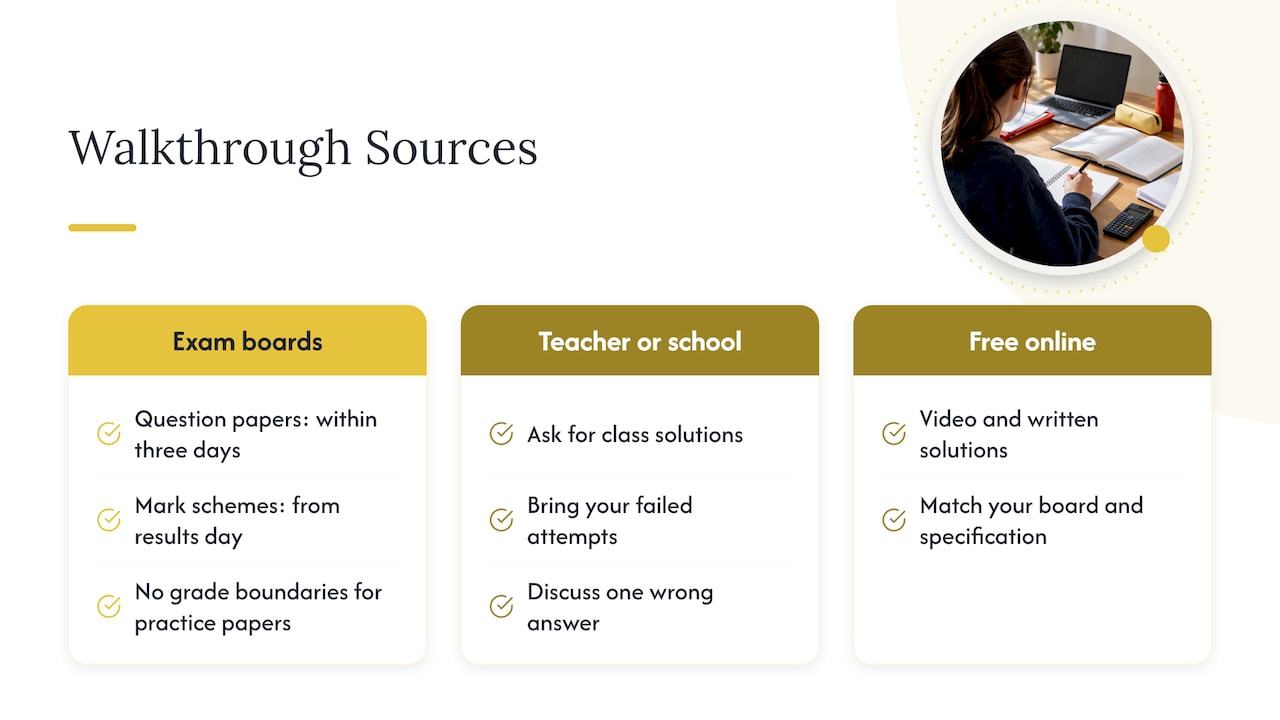
There are three kinds of source, and a good revision plan uses all of them.
1. The exam boards. Boards publish specimen papers and past papers with official mark schemes. AQA says that question papers are usually uploaded within three days of the exam being sat, with mark schemes generally available from results day. Board-written practice papers reflect the expected standard but carry no grade boundaries, because boundaries are only set after a live exam. Mark schemes tell you what earns credit. They rarely tell you how to think.
2. Your teacher or school. Ask for the solutions your teacher uses in class, and bring your own failed attempts. A short conversation about one wrong answer is often worth more than ten polished solutions.
3. Free online walkthroughs. This is where video explanations and written step-by-step solutions fill the gap between a mark scheme and understanding. Check that any resource you use matches your exam board and specification, because question styles and formula booklets differ between boards.
Free walkthroughs by exam board at MathVault
At MathVault we organise A Level resources by exam board and year, so you can find the paper you actually sat or plan to sit. Each paper comes with its mark scheme, fully worked answers and video solutions.
- Edexcel: Edexcel A Level Maths has year-by-year resources with mark schemes, video solutions and worked answers.
- AQA: AQA A Level Maths covers past papers with mark schemes, video solutions and worked answers across the years listed on the page.
- Question practice by topic: our A Level past-paper questions let you drill one area, such as integration or trigonometry, rather than a whole paper.
- University admissions maths: if you are preparing for the TMUA, there are TMUA past-paper questions too.
The core revision materials are free, and so are our live weekly Q&A sessions. A smaller number of recent or advanced resources and the full downloadable packs are paid, and donations are welcome but never expected.
Our perspective: a walkthrough is only as good as what you do next
We have built MathVault around one belief: a solution should teach, not just confirm. Seeing the correct answer is the easy part. The learning happens in the gap between your attempt and the model, and a good walkthrough makes that gap visible.
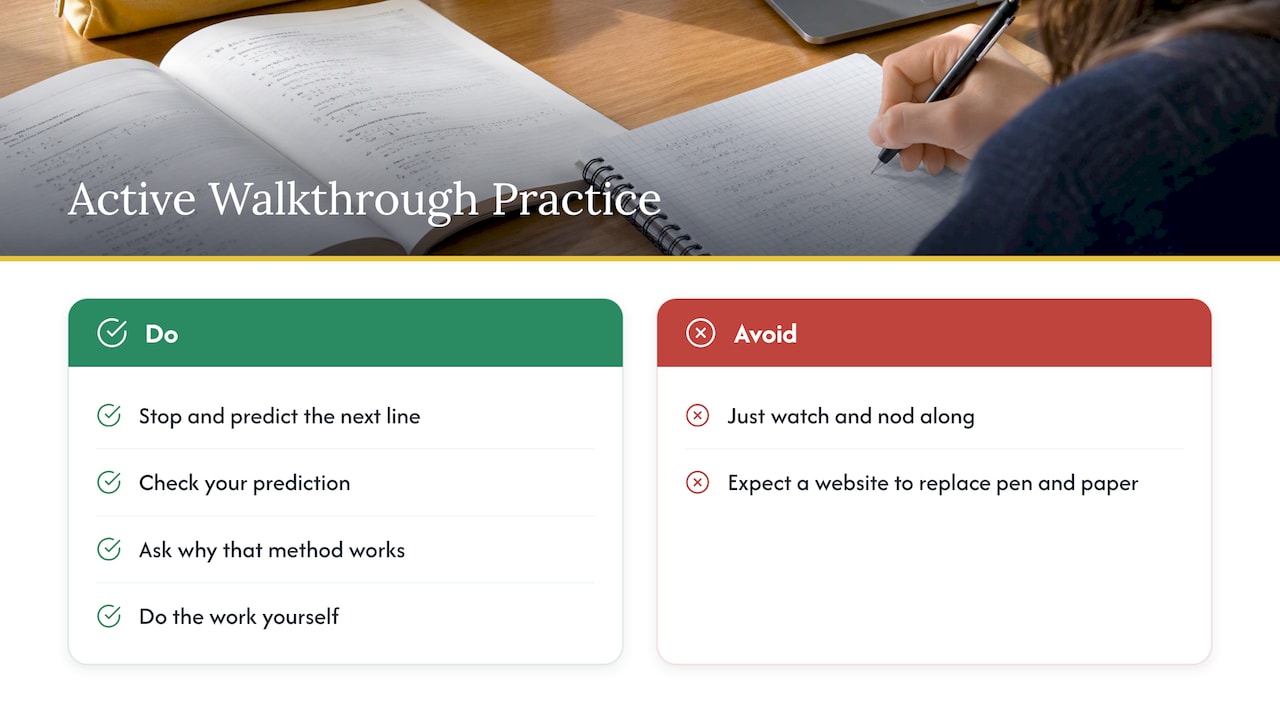
That is why we pair past papers with worked answers, video explanations and live Q&A. A student who watches a solution and nods along has learned very little. A student who stops, predicts the next line, checks it, and then asks “why that method?” is learning quickly. The live sessions exist for the questions a recording cannot answer, such as “I did it differently and got the same result: was that fine?”
We would also say, plainly, that no website replaces your own pen on paper. Use us to see how experienced examiners and teachers set out their thinking, then do the work yourself. Confidence in maths comes from having solved enough problems that unfamiliar ones stop looking frightening.
— Oloru
Making walkthroughs work when maths feels hard
Many students reach Year 12 worried that they are not a “maths person”. Walkthroughs help most when you read them as evidence that everyone’s first attempt is untidy. The model solution has been edited. Your first draft, and the first draft of every strong mathematician, usually has crossings-out.
It also helps to remember why the effort is worth it. Maths opens doors in places you might not expect. If you are curious how much of it a practical career needs, a guide on learning to fly without strong maths looks at how aspiring pilots approach the numbers. Whatever your destination, the habits you build now, checking each step, estimating answers and reading carefully, will carry with you.
For day-to-day practice, short sessions beat marathon ones. Our guide to 20 to 30 minutes of daily non-calculator practice shows how to build a routine that fits around school.
A weekly plan using walkthroughs
If you are not sure how to fit this in, try a simple week:
| Day | Task | Time |
|---|---|---|
| Monday | Choose one topic and attempt 4 to 6 questions cold | 40 minutes |
| Tuesday | Mark against the scheme, then watch walkthroughs for the questions you lost marks on | 40 minutes |
| Wednesday | Cover and recreate the two hardest solutions | 30 minutes |
| Thursday | Mixed-topic questions, with no help | 40 minutes |
| Friday | Update your error log and write three “this fails because…” notes | 20 minutes |
| Weekend | One timed section of a past paper | 60 minutes |
Adjust the times to suit you. The structure matters more than the exact minutes: attempt first, review second, recreate third.
Start with the right paper
Pick the board you are sitting, then the most recent paper you have not seen. Attempt it under timed conditions, mark yourself, and then use the worked solutions and video walkthroughs on the questions where marks slipped away. Our A Level past-paper questions hub is a good place to begin, and the board pages above take you straight to your specification. If you are still working towards GCSE, our GCSE maths revision guides are the place to start.
FAQ
Are A Level maths walkthroughs enough to pass on their own?
No. They show you how a solution is built, but you only learn the method by producing it yourself. Use them after you have attempted a question, then recreate the solution without looking. Combine them with timed past papers and your teacher’s feedback.
Should I watch a walkthrough before or after attempting the question?
After. Attempting first exposes exactly what you do not know, which makes the walkthrough far more useful. If you are completely stuck on a new topic, read your notes or a short worked example first, then attempt a different question on the same topic.
Do I get marks for working if my final answer is wrong?
Often, yes. AQA’s commentary on its specimen papers says that method marks can be earned for logical steps even where the final answer is incorrect, and follow-through marks mean an error is generally not penalised twice. That is why you should always write out your method rather than relying on a calculator.
Where can I find official mark schemes?
Your exam board publishes them. For AQA, the A-level maths hub lists specimen papers and mark schemes, and the other boards run similar pages. Make sure you use the specification code that matches your course.
Sources
- Ways into maths: Making the most of worked examples, EEF
- Improving Mathematics in Key Stages 2 and 3, EEF (2022 update)
- GCSE, AS and A level assessment objectives, GOV.UK
- Commentary on specimen papers, AQA A-level Mathematics 7357
- AQA All About Maths: A-level Maths
Leave a Reply