
Marking a maths past paper well means sitting it under exam conditions, then using the official mark scheme line by line to award method, accuracy and follow-through marks. Do this honestly and the paper becomes a list of exactly which skills to fix next. Do it loosely and a past paper tells you almost nothing. This guide shows you how to mark GCSE and A-Level maths papers the way examiners expect, what to do when your answer does not match the scheme, and how to use the result.
TL;DR
- Sit the paper timed and unaided first. Mark it afterwards, in a different colour of pen, using the official mark scheme for the same board, tier and series.
- Learn the mark codes. M marks reward a valid method, A marks follow from a correct method, and follow-through marks credit sensible working after an earlier slip.
- If your answer differs from the scheme, check whether it is equivalent or uses a different valid route before you take the mark off.
- The score is the start, not the point. Log every lost mark by cause, then target those topics in the next week of revision.
- Parents, tutors and teachers can mark a paper in about the time it takes to read it, once they know the codes below.
Table of Contents
- How examiners actually mark GCSE and A-Level maths
- Before you mark: set the paper up properly
- Reading a maths mark scheme: the codes that matter
- Step-by-step: marking a paper, question by question
- When your answer differs from the mark scheme
- Turning a score into a revision plan
- How parents, tutors and teachers can help
- Where to find the right papers and schemes
- Our perspective: marking is a skill you can practise
- Free marking support on MathVault
- FAQ
- Sources
How examiners actually mark GCSE and A-Level maths
Before you mark your own work, it helps to know who marks the real thing. Exam boards are responsible for marking GCSE and A-level exams, and the process is overseen by Ofqual, which exists to keep marking accurate and consistent. The government’s guide to how GCSE and A Level marking works explains that boards recruit and pay examiners, most of whom are current or former teachers, and that most boards use seeding to monitor marking quality.
Two things follow for you as a self-marker.
- The mark scheme is the examiner’s rulebook. Examiners do not mark by impression. They apply the scheme mark by mark, so you should too.
- The scheme is written to be as fair as possible. According to Tes reporting on how exams are marked, schemes are finalised after students have sat the paper, which lets boards include expected and unexpected student responses. That is why a scheme often has more detail than you would guess from the question alone.
The practical lesson: your job is not to decide whether your answer “feels right”. It is to find the line in the scheme that rewards what you actually wrote.
Before you mark: set the paper up properly
Marking accurately starts before you pick up the pen.
Sit the paper under exam conditions
OCR advises sitting a paper under exam conditions and then using the mark scheme to mark your own work, in its guidance on getting more from past papers. That means a timer, no notes, a calculator only where the paper allows one, and no peeking at solutions halfway through. A paper completed with the mark scheme open is practice, not assessment, and the score it gives will flatter you.
Write down what a full-mark answer needs
OCR also suggests a neat trick: before you check, write a short summary of what you think a full-mark answer to a tricky question requires. It is a two-minute habit that exposes whether you understood the question or only recognised the topic. When the scheme disagrees with your summary, you have found something worth learning.
Match the paper to the right scheme
A mark scheme is only valid for its own paper. Check the board, qualification, subject, paper number, tier (Foundation or Higher at GCSE) and exam series. The most common slip is marking a Higher paper against a Foundation scheme, or a 2023 paper against a 2022 scheme. Go to your exam board’s own past papers page, or to a resource organised by board such as our AQA GCSE maths past papers collection, where each paper sits beside its scheme.
Use a different colour
Mark in green or red pen, never the pen you wrote with. You want to see afterwards what you originally produced, what you corrected, and what you only understood once you read the scheme.
Reading a maths mark scheme: the codes that matter
Maths mark schemes look cryptic at first, but the logic is simple. Marks are awarded for stages of working, not just final answers. AQA’s marking guidance for GCSE Mathematics sets out the main principles, and the same ideas, with small differences in labelling, appear across boards.
| Code | What it rewards | What to look for in your work |
|---|---|---|
| M (method) | A correct method, or correct calculations or values seen, that could lead to a valid solution, even if the final result is wrong | A visible, sensible process: a correct substitution, a correct rearrangement, a correct first step |
| A (accuracy) | A correct answer that follows a correct method, where the method may be implied | The right value, usually only after an M mark has been earned |
| B (independent) | A mark for a correct statement or value that does not depend on a method | A correct fact, reading or result, written down |
| ft (follow through) | Credit for correct working after an earlier mistake | Later steps that are right for the wrong value you carried forward |
| oe (or equivalent) | Any answer equivalent to the one printed | A different but equal fraction, form or rearrangement |
The two ideas to hold on to are these. M marks are awarded for correct calculations or values seen, even when the final result is incorrect, provided the method could lead to a valid solution. And A marks follow a correct method, which can be implied. That second point matters: if your answer is right and your working clearly leads to it, you do not lose the accuracy mark because a step was done in your head.
A worked example
Suppose a question asks you to solve 3x + 7 = 25 and the scheme gives 2 marks: M1 for subtracting 7 from both sides (or equivalent), A1 for x = 6.
- You write 3x = 18, then x = 6. You earn M1 and A1: 2 out of 2.
- You write 3x = 32, then x = 32/3. You subtracted incorrectly, so there is no M1 for that step, but the scheme may still give credit for a valid method used afterwards, so read the notes column carefully before you write 0.
- You write only x = 6 with no working. The answer is correct, so check the guidance: on many one- and two-mark questions a correct answer alone earns full marks, but on questions that say “show that” or “you must show your working”, it will not.
That last case is why showing working is worth real marks, not just good habits. Our guide to banking the AO3 marks for showing working in GCSE maths explains how many marks sit in reasoning and communication across the paper.
Follow-through marks in practice
Follow-through is the mark scheme being kind in a specific way. If you misread a value in part (a) and then did parts (b) and © correctly using your wrong value, the scheme will often award follow-through marks for (b) and ©. Look for “ft” in the scheme. When it is absent, the later parts usually need the correct earlier answer, so a slip early on can cost more than it first seems.
Step-by-step: marking a paper, question by question
- Print or open the scheme beside your script. Work one question at a time, not the whole paper at once.
- Read the question again, then the scheme’s answer column. Check the final answer first.
- Look at the marks available. A 3-mark question is telling you there are three things to show.
- Tick each mark you can point to. Write M1, A1 and so on in the margin, next to the line of working that earned it. If you cannot point to a line, do not award it.
- Read the notes or guidance column. This is where the scheme lists alternative routes, accepted forms and common errors that still earn a mark.
- Record the total at the end of each question. Add up at the end, then re-add. Arithmetic slips in the marking itself are surprisingly common.
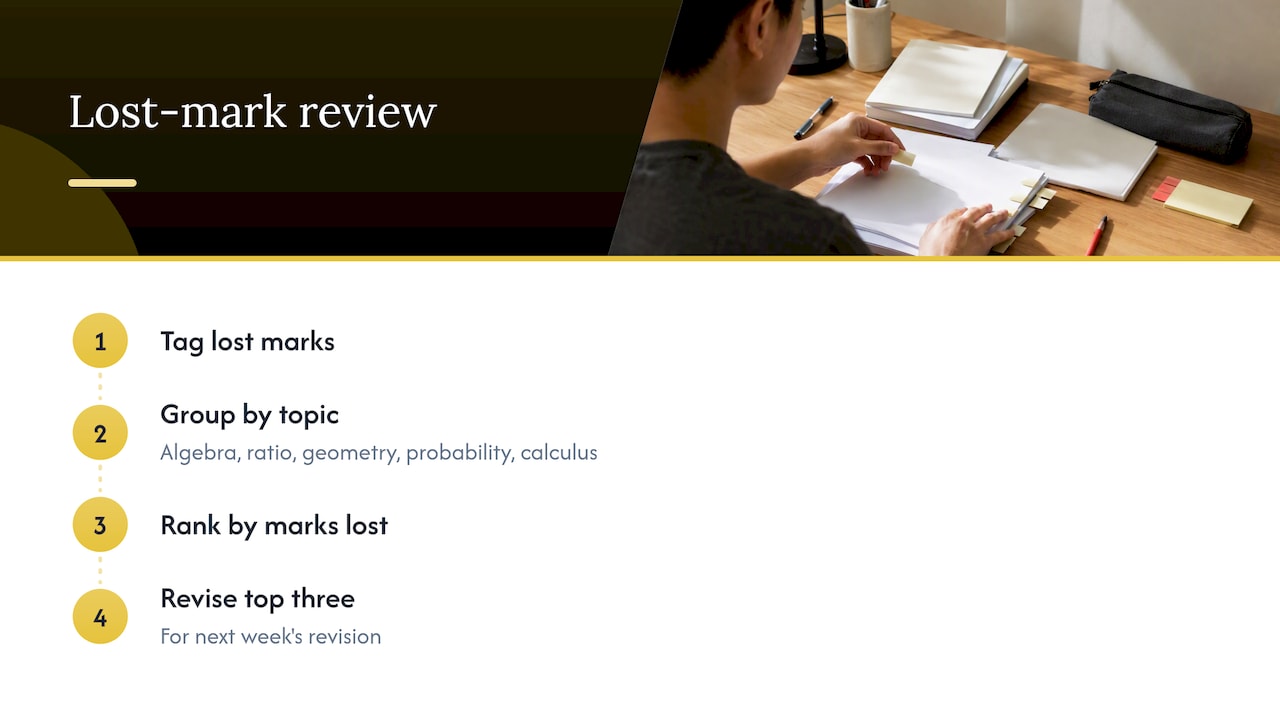
- Tag every lost mark. Use a short code: K for a knowledge gap, C for a calculation slip, R for misreading the question, W for missing working, T for running out of time.
The tagging is the step most students skip, and it is the one that turns marking into revision. Twelve lost marks tagged C is a different problem from twelve lost marks tagged K.
When your answer differs from the mark scheme
This is where self-marking most often goes wrong, in both directions: students awarding themselves marks they have not earned, and students refusing marks they have.
OCR’s guidance is that if your answer differs, you should check whether it uses an equivalent idea, method or evidence that the scheme rewards. Mark schemes cover the commonly seen solution routes, and assessors use professional judgement, or refer unusual approaches to a team leader or principal examiner. AQA states a similar core principle on its mathematics assessment page: any valid method is rewarded, even if it is not the most efficient, provided it could lead to a solution.
In practice, ask yourself these questions in order:
- Is my answer equivalent? 0.25, 1/4 and 25% may all be accepted, but only if the question does not specify a form. Check the “oe” notation and the question wording.
- Is my method a different but valid route? Using trial and improvement, a different substitution or a graph where the scheme uses algebra can still earn method marks if it could genuinely lead to the answer.
- Did I do something the question did not ask for? An extra rounding step, a missing unit or an answer left in the wrong form can cost the accuracy mark.
- Am I being honest? If you are tempted to give yourself a mark because “I basically meant that”, ask whether an examiner could point to it on the page. If not, leave it.
If you are still unsure, flag the question and ask someone. A teacher, tutor or an online Q&A is the right place for an unusual method. On our free self-mark past papers page, board-aligned solutions come with live Q&A so you can check a borderline answer rather than guess.
A note on older papers
OCR points out that teachers using past papers for formative assessment two or more years after the original exam may need to adapt mark schemes, making them more or less lenient depending on the academic cycle. For a self-marking student the takeaway is simple: do not treat a score on a five-year-old paper as a precise forecast. Content also changes between specifications, so check that a question is still on your course before you stress about losing marks on it.
Turning a score into a revision plan
A raw percentage tells you where you are. It does not tell you what to do on Monday.
Find the pattern in your lost marks
After tagging, group the lost marks by topic: algebra, ratio, geometry, probability, calculus for A-Level, and so on. Rank the topics by marks lost. Your top three are next week’s revision.
OCR recommends using mark schemes and examiner reports to identify areas of weakness and skills to work on. Examiner reports are written by principal examiners and reflect on common student errors and performance across the whole cohort. They tell you not just that a question was hard, but how typical candidates went wrong, which is exactly the information a self-marker lacks.
Use grade boundaries with care
Grade boundaries are published by each board after each series and shift from year to year. Use them to place your score roughly, not to predict a grade. A paper that is harder than usual has lower boundaries, so the same percentage can mean different grades in different years. Look at several papers before drawing conclusions, and treat one paper as one data point.
Build a weekly loop
A simple cycle works for most students:
- Sit one full paper or a half paper under timed conditions.
- Mark it the same day while the questions are fresh.
- Tag the lost marks and pick the top three topics.
- Revise those topics with targeted questions and worked solutions over the next few days.
- Re-test with fresh questions on the same topics before moving on to the next paper.
If you are short on time, our last-minute GCSE maths revision plan shows how to compress this loop. For a longer runway, the A-Level maths 12-week plan and our guide to effective GCSE maths revision strategies fit the same marking habit into a wider schedule.
Try first, then check
When you hit a question you cannot do, resist the urge to jump straight to the answer. Attempt it, write what you can, then compare. Whether you then read a written solution or watch a video depends on the gap: a written solution is quick for checking a step, while a video is better when you do not know where to start. We compare the two in written vs video solutions for maths.
How parents, tutors and teachers can help
You do not need to be a maths specialist to support a student’s marking. You need the scheme and a consistent routine.
- Parents: let your child mark first, then look through the tagged errors together. Ask “which mark was this?” rather than “why did you get this wrong?” The conversation stays on method, not on blame.
- Tutors: use the mark scheme to build a glossary of terms and command words the student keeps missing, and rank topics by the student’s confidence to set a study order, as OCR suggests. Summarise what examiner reports say about stronger and weaker responses for the same question.
- Teachers: set marking as a class activity. Pairs swap scripts and mark against the scheme, which builds familiarity with how marks are awarded. If you use older papers for formative assessment, adjust your expectations of leniency to the cohort.
A note for homeschooling families: because you may not have access to a school’s mock papers, a structured set of papers by board and year, with solutions that explain each mark, is especially useful.
Where to find the right papers and schemes
Always begin with your own exam board’s official page for past papers, mark schemes and examiner reports, and check subject, qualification, paper, tier and series. If you want everything for one board gathered in one place, these pages help:
- AQA GCSE maths past papers, 2017 to 2025
- A-Level maths past-paper questions
- IGCSE maths past-paper questions
- AQA A-Level 2025 papers and mark schemes
- OCR GCSE maths revision topics
For GCSE Further Maths, you can see how a scheme reads on a real paper, for example the AQA GCSE Further Maths 2025 Paper 1 mark scheme alongside its question paper.
Our perspective: marking is a skill you can practise
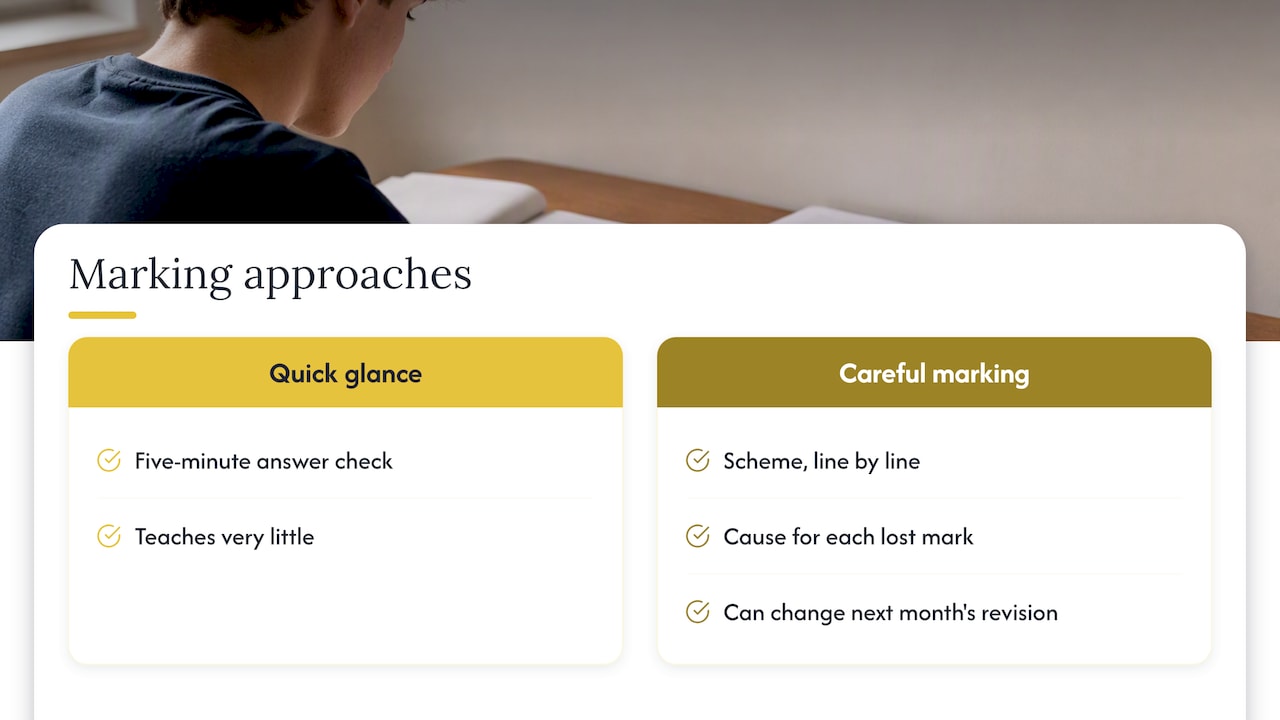
We built MathVault around a simple observation: students who improve fastest are rarely the ones who do the most papers. They are the ones who mark most carefully. A paper marked in five minutes with a quick glance at the answers teaches very little. A paper marked against the scheme, line by line, with each lost mark given a cause, can change a student’s next month of revision.
That is why our papers come with fully worked solutions organised by exam board, and why we run live Q&A sessions: the hard part of self-marking is rarely the arithmetic, it is judging a borderline answer with confidence. Method marks are the clearest example. Students often feel they “got it wrong” and score zero in their heads, when the scheme would have given them one or two marks for sound working. Seeing those marks, again and again, changes how a student feels about maths. It shows that partial understanding is already worth something, and that is encouraging in a way a bare percentage never is.
Our advice is to mark honestly, mark promptly and mark for information rather than for comfort. A lower score that points to three fixable topics is worth more than a high score you do not trust.
— Oloru
Free marking support on MathVault
If you want a ready-made way to do all of this, start with our self-mark past papers page. It brings together past papers with board-aligned solutions and live Q&A, so you can mark your work, check the odd answer and move on to the next topic. The revision materials are free to use; some recent or advanced resources and full downloadable packs are available as one-off purchases for those who want offline access, and donations are welcome but never required. Browse the main site to pick your board and year range.
FAQ
Can I earn money by marking exam papers?
Yes, exam boards recruit and pay examiners to mark written exams, and most are current or former teachers, according to the government’s marking guide. Each board sets its own recruitment requirements, so check the examiner recruitment page of the board you are interested in.
How do examiners mark GCSE papers?
They apply the board’s mark scheme question by question, awarding marks for method, accuracy and other specified points. Boards use seeding, where pre-marked responses are mixed in, to monitor whether examiners are marking to the standard, and Ofqual oversees the system.
What should I do if my answer is correct but my method is not in the mark scheme?
Check whether your method is a valid route that could lead to the answer. AQA’s principle is to reward any valid method, even an inefficient one, and OCR notes that assessors use professional judgement for unusual approaches. If you are unsure, ask a teacher or tutor rather than awarding yourself the marks.
Should I mark my own past papers or ask someone else?
Both work. Marking your own paper teaches you how marks are awarded and shows exactly where you slipped. Having a teacher or tutor check a few questions, especially extended or unusual ones, guards against being too generous or too harsh with yourself.
How often should I mark a full past paper?
A full paper once a week is plenty for most students, with shorter topic questions on the other days. What matters more than frequency is that every paper you sit is marked properly and its lost marks turned into specific revision tasks.
Sources
- How GCSE and A Level marking works, GOV.UK
- How are GCSEs and A-level exams marked? Tes
- Getting more from past papers, OCR
- Notes and guidance: marking guidance, AQA GCSE Mathematics
- Mathematics, AQA Inside Assessment
Leave a Reply