
Pick one past paper or a single topic section, set a clear purpose (diagnosis, timed training, or full rehearsal), attempt it honestly, mark it immediately using the official mark scheme, code every mistake by type, fix the single biggest gap, then re-test that same question after a short gap. That cycle, repeated consistently, is what past papers as a feedback system actually means.
Three modes suit different stages of revision:
- Diagnosis (open book): attempt topic questions while your notes are open to identify gaps without time pressure.
- Training (timed sections): close your notes, set a timer per section, and practise pacing and command-word responses.
- Rehearsal (full timed paper): replicate exam conditions exactly, including the clock, permitted materials, and no interruptions.
Pro Tip: Reserve at least three to four unseen full papers for the final fortnight before your exam to support your preparation with effective exam simulation. Using every paper too early leaves you with nothing to verify genuine improvement against, and it creates false confidence from material you half-remember.*
Table of Contents
- Why do past papers actually improve your results?
- When should you start using past papers?
- How to run an effective past-paper practice session
- How to mark strictly and build a feedback loop
- What do command words mean, and where do students lose marks?
- A sample revision plan you can copy
- Key takeaways
- The difference between training and learning
- Mathvault: past papers, mark schemes, and worked solutions in one place
- Useful sources
Why do past papers actually improve your results?
Past papers train exam skills, not just content recall. Sitting a paper forces you to manage time, interpret command words, select which questions to attempt first, and sustain concentration across a full session. Those are skills that topic notes alone cannot build.
Specific skills you develop through regular past-paper practice include:
- Timing: learning how long each mark genuinely takes you, not how long you think it takes.
- Exam phrasing: recognising the vocabulary examiners use and matching your answers to it.
- Stamina: sustaining focus across a two-hour paper, which is a physical and mental habit.
- Planning extended answers: structuring multi-mark responses under pressure.
- Synoptic thinking: connecting topics across a specification, which higher-grade questions demand.
Cambridge Assessment’s Neil Wade draws a useful distinction: past papers are powerful for training exam performance, but they should not replace teaching the core thinking skills that underpin deep understanding. The two must work together.
The practical implication is that a student who completes ten papers without reviewing them carefully will improve less than one who completes four papers with rigorous error analysis after each.
When should you start using past papers?
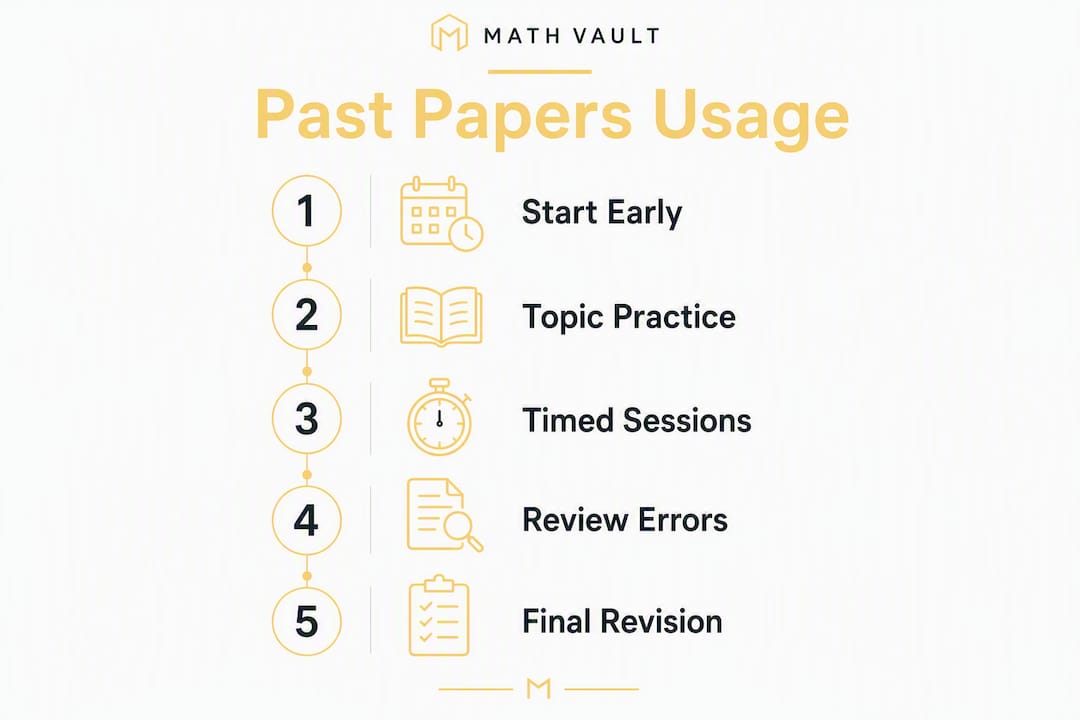
The answer depends on how much of the course you have covered, not on how close the exam is. Starting full timed papers before you know the content wastes your best verification resources.
A phased approach works best:
- Early stage (content still being taught): use topic-specific questions from past papers, open book, to check understanding as you go.
- Mid stage (most content covered): move to timed sections and mixed-topic question sets to build pacing and test retention.
- Late stage (full syllabus covered): attempt full timed papers under exam conditions, then review rigorously.
A sample eight-week timeline:
| Week | Focus | Paper type |
|---|---|---|
| 1–2 | Topic consolidation | Open-book topic questions |
| 3–4 | Mixed-topic practice | Timed sections |
| 5–6 | First full papers | Timed full papers, strict marking |
| — | Error remediation | Targeted topic questions on coded gaps |
| — | Final rehearsal | Reserved unseen full papers only |
Quality of review matters more than volume. If you are repeating the same mistakes across consecutive papers, that is a clear signal to pause papers and return to the underlying topic before attempting another full paper.
How to run an effective past-paper practice session
A consistent routine turns every attempt into learning, not just a score.
- Set your purpose before you start. Decide whether this session is diagnostic, timed training, or full rehearsal. That decision determines whether your notes are open, whether you time yourself, and which paper you select.
- Choose the right paper for your exam board. For GCSE maths, confirm whether you are sitting AQA, Edexcel, OCR, or WJEC. For Scottish qualifications, use SQA papers. Attempting the wrong board’s paper wastes time and may confuse you on question style. Mathvault organises papers by board and level, so you can find the right one quickly.
- Prepare your environment. Remove your phone, close revision notes (unless this is a diagnostic session), gather permitted materials only (calculator, ruler, formulae sheet if allowed), and sit at a clear desk.
- Build timing progressively. Do not attempt a full timed paper until you have practised at section level.
| Stage | Session type | Suggested time |
|---|---|---|
| 1 | Single question (5–— marks) | 6 minutes |
| 2 | Topic section | 30 minutes |
| 3 | Half paper | — |
| 4 | Full timed paper | Exact exam duration |
- Mark immediately after the attempt. Do not leave marking until the next day. The reasoning behind each answer is still fresh, which makes error analysis far more accurate.
Pro Tip: Learn the marks-per-minute rate for your paper. Most GCSE and A-level maths papers allocate roughly one mark per minute. If a six-mark question is taking you twelve minutes, you need to practise that question type specifically, not just do more full papers.
How to mark strictly and build a feedback loop

This is the step most students skip or rush, and it is where the real improvement happens. Marking must be done using the official mark scheme, not your own judgement of whether your answer was “close enough.”
Follow this sequence after every attempt:
- Mark honestly with the official mark scheme. Award method marks (M marks) and accuracy marks (A marks) exactly as the scheme states. Do not give yourself a mark because you “knew what you meant.”
- Code each mistake. Assign every lost mark one of five categories: C (content gap), M (misread question), T (timing, ran out of time), S (structure, poor answer organisation), or K (careless slip). This taxonomy, recommended by experienced tutors, turns vague errors into targeted actions.
- Record in your error log. Use the table below as a template.
- Rewrite one weak answer. Choose the question where you lost the most marks and write a corrected response from scratch.
- Set a next action and a retry date. Schedule when you will reattempt the same or a similar question.
Error log template:
| Question | Topic | Error code | Marks lost | Reason | Next action | Retry date |
|---|---|---|---|---|---|---|
| Q5b | Quadratics | C | 3 | Forgot completing the square method | Revise completing the square | +5 days |
| Q | Probability | M | 2 | Misread “without replacement” | Practise conditional probability Qs | +3 days |
Pro Tip: Use a different coloured pen for your corrections so you can see at a glance, weeks later, which questions were originally wrong. Red for errors, green for corrections is a widely used convention.
Marking can take as long as the paper itself. If you sit a two-hour paper, budget two hours for review. Rushing the marking phase is the single most common reason students do the same number of papers but make the same mistakes throughout.
Examiner reports go further than mark schemes. They show you the specific phrasings that examiners accepted, the common errors that cost students marks across the cohort, and the command-word expectations that mark schemes alone do not spell out. Reading the examiner report for a paper after you have marked it takes fifteen minutes and is one of the highest-return revision activities available.
What do command words mean, and where do students lose marks?
Misinterpreting a command word can cost you the majority of marks on a question even when you know the underlying content. Each word signals a specific type of response.
- Describe: state what you observe. No reasons required. A weak answer adds explanation the question did not ask for and wastes time.
- Explain: give reasons or mechanisms. “Because” is usually the hinge word. A weak answer describes without explaining why.
- Calculate: show every step of working. A correct final answer with no working shown can score zero on method marks.
- Evaluate: weigh evidence on both sides and reach a supported conclusion. A weak answer lists points without judging their relative weight.
- Justify: give a reason that directly supports a decision or claim. A weak answer restates the claim rather than defending it.
- Assess: consider the significance or validity of something, then make a reasoned judgement.
Beyond command words, the most common non-content mistakes are:
- Not showing working in maths, even when the answer is correct.
- Misreading the question (check units, check whether the question asks for an exact value or a decimal).
- Poor time allocation, spending eight minutes on a two-mark question.
- Omitting key vocabulary that the mark scheme specifically requires (for example, “directly proportional” rather than “goes up”).
A sample revision plan you can copy
Eight-week block

| Week | Daily focus | Past-paper activity |
|---|---|---|
| 1–2 | Topic study and notes | Open-book topic questions from past papers |
| 3–4 | Mixed-topic flashcards | Timed topic sections, marked same day |
| 5 | First full paper attempt | Full timed paper, strict marking, error log |
| 6 | Error remediation | Targeted questions on coded gaps only |
| — | Second full paper | Full timed paper, compare error log with week 5 |
| — | Final rehearsal | Reserved unseen papers, no open-book work |
Final two-week crash plan
| Day | Activity |
|---|---|
| 1–3 | One timed section per day, mark and log errors immediately |
| 4–5 | First reserved full paper under exam conditions, full review |
| 6 | Remediation: rewrite three weak answers from error log |
| — | Rest or light topic review only |
| —–9 | Second reserved full paper, compare error codes to day 4–5 |
| — | Final targeted questions on remaining coded gaps |
| — | Third reserved paper, timed, no review until after exam |
Pro Tip: In the final two weeks, prioritise the quality of your review over the number of papers you attempt. One paper reviewed for two hours produces more improvement than three papers reviewed for twenty minutes each.
Key takeaways
Past papers improve exam performance only when each attempt is followed by strict marking, coded error analysis, targeted remediation, and spaced re-testing.
| Point | Details |
|---|---|
| Use papers as a feedback system | Treat every attempt as a diagnostic tool, not a score to chase. |
| Mark with the official mark scheme | Award marks exactly as stated; generous self-marking hides real gaps. |
| Code every mistake | Assign each error a category (C, M, T, S, K) to create a targeted next action. |
| Reserve unseen papers | Keep three to four full papers unseen until the final fortnight for genuine rehearsal. |
| Mathvault organises papers by board | Find GCSE and A-level papers, mark schemes, and worked solutions sorted by exam board at Mathvault, free to access. |
The difference between training and learning
There is a version of past-paper revision that feels productive but produces little improvement: sitting paper after paper, glancing at the mark scheme, circling the wrong answers, and moving on. The score might creep up slightly because you are seeing similar questions repeatedly. But that is familiarity, not learning.
The feedback loop described in this article works differently. Coding a mistake as a content gap rather than a careless slip forces you to decide whether you actually understand completing the square or whether you have been pattern-matching from memory. That distinction matters because the exam will test the concept in a form you have not seen before.
The practical test of whether your approach is working is simple: pull out your error log from three weeks ago and reattempt those specific questions cold. If you are scoring them correctly now, the cycle is working. If the same error codes keep appearing, the issue is not the number of papers you are doing. It is that the remediation step is being skipped.
Past papers are one of the most powerful revision tools available to GCSE and A-level students. They are also easy to misuse. The students who improve most are not the ones who do the most papers. They are the ones who treat each paper as the beginning of a learning cycle, not the end of a revision session.
Mathvault: past papers, mark schemes, and worked solutions in one place
Every step in this guide requires the right paper for your exam board, an official mark scheme, and ideally a worked solution to check your method, not just your final answer. Mathvault provides all three, free, organised by board and level so you are not hunting across multiple sites.
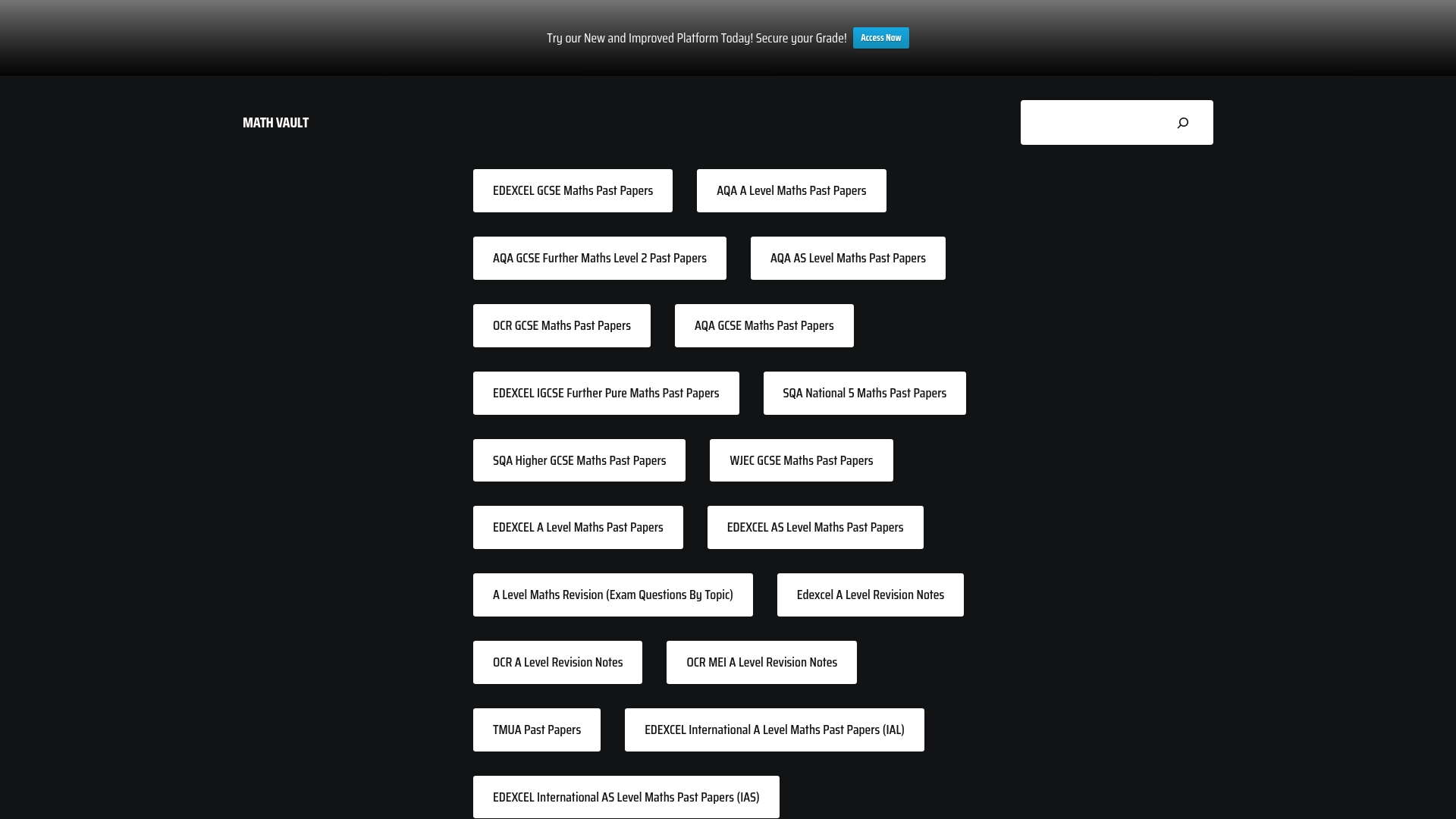
For GCSE students, the GCSE maths revision guides page is the clearest starting point, with resources grouped by board. If you are on Edexcel, the topic-organised past paper questions let you practise by topic before stepping up to full papers, which maps directly to the phased approach in this guide. A-level students can find board-specific papers and step-by-step solutions at the Edexcel A-level page, and Scottish students sitting Higher or National 5 will find SQA papers with worked solutions on the site as well. AQA, OCR, and WJEC resources are all covered. Downloadable revision packs are available for students who want offline access, and live weekly Q&A sessions mean you can get a specific question explained if the worked solution alone is not enough. Visit Mathvault to find your board, download your papers, and start the feedback loop today.
Useful sources
Official exam board sites are the only reliable source for past papers, mark schemes, and examiner reports. Download directly from these:
- AQA GCSE Mathematics (8300) assessment resources: past papers, mark schemes, and examiner reports for AQA GCSE maths.
- Edexcel (Pearson): past papers and mark schemes are available via the Pearson qualifications website, organised by qualification and series.
- OCR: past papers and examiner reports are listed on the OCR website under each qualification’s assessment page.
- WJEC: past papers and mark schemes for Wales are available on the WJEC website, including both English-medium and Welsh-medium versions.
- SQA: past papers and marking instructions for National 5, Higher, and Advanced Higher are available on the SQA website, free to download.
- BBC Bitesize: how to use past exam papers: practical guidance on marking, command words, and timing from BBC’s revision resource.
- Cambridge Assessment: are past paper questions always useful?: Neil Wade’s analysis of the training versus education distinction, useful for understanding the limits of past-paper practice.
- Cambridge International AS & A Level Mathematics (9709): past papers, examiner reports, and specimen papers for Cambridge International A-level maths.
Leave a Reply