
A method (M) mark rewards a valid mathematical procedure shown on your script, and you can often earn it even when your final answer is wrong. Mark schemes separate the process from the result precisely so that a slip in arithmetic doesn’t wipe out everything you understood. The practical takeaway is simple: show every step of your working, and check how your specific exam board applies its codes.
TL;DR:
- Method marks reward correct process application, even if the final answer is wrong, emphasizing the importance of showing step-by-step working.
- Mark schemes use shorthand codes like dep, cao, ft, and isw; understanding these helps prevent losing marks due to misreading or misplaced assumptions.
- Error carried forward allows examiners to credit work based on flawed initial steps if subsequent work applies correct methods, supporting partial credit.
- Accurate presentation, such as clear labeling and full precision, is crucial for securing method and accuracy marks; vague or incomplete working often results in lost points.
- Using worked, labeled solutions and practicing with official revision resources enhances understanding of how marks are awarded and reduces errors during exams.
Table of Contents
- Method marks explained: M, A and B marks and how they differ
- Decoding mark-scheme codes: dep, cao, ft, isw, oe, nfww, soi, eeo
- How examiners apply method marks: ECF, follow-through and standardisation
- Show your working: a checklist for students and teachers
- Worked examples: M, A and B marks with error carried forward
- What worked solutions teach you that a final answer never can
- Practise method marks with Mathvault’s revision packs
- Where to check the official mark-scheme wording
- Sources
Method marks explained: M, A and B marks and how they differ
Every GCSE and A-Level maths mark scheme runs on three mark types, and knowing them changes how you approach every question in the exam.
An M mark rewards method. It’s awarded when you’ve applied a correct process, formula, or approach to a problem, regardless of whether your final number is right. If a question asks you to solve a quadratic and you correctly set up and apply the quadratic formula, but then make an arithmetic slip on the final line, the M mark for using the formula still stands.

An A mark rewards accuracy. It only becomes available once the relevant method mark has been earned, and it’s given for a correct answer (or correct intermediate value) that follows from that method. This is why A marks are almost always “dependent” in practice: you can’t collect one without first showing the working that justifies it.
A B mark stands apart from both. It’s an independent mark, awarded for a correct statement, fact, or result that doesn’t depend on a preceding method step. A B mark might reward simply writing down the correct formula, stating a known geometric fact, or reaching a correct value by any legitimate route.
Exam boards split marks this way for two reasons. First, fairness: a student who understands the mathematics but makes a careless slip shouldn’t score the same as one who has no idea how to approach the problem. Second, diagnosis: separating method from accuracy lets teachers and examiners see exactly where understanding breaks down, which matters both for grading and for classroom feedback.
A typical multi-mark GCSE question illustrates the split clearly:
- A 4-mark algebra question might award 2 M marks (for rearranging the equation and substituting correctly) and 2 A marks (for the correct intermediate and final values).
- A 3-mark trigonometry question could give 1 M mark for selecting the right rule, 1 M mark for correct substitution, and 1 A mark for the final answer.
- A 2-mark “state the value” question is often pure B marks, since there’s no process to reward, only a correct fact.
This structure is documented across exam board specifications. AQA’s assessment resources show exactly how method, accuracy and communication marks are allocated question by question, and comparing mark schemes across topics is one of the fastest ways to internalise the pattern.
Decoding mark-scheme codes: dep, cao, ft, isw, oe, nfww, soi, eeo
Mark schemes are written in shorthand, and misreading a code costs marks that students have genuinely earned. These abbreviations appear across AQA, Edexcel, OCR and Cambridge International schemes, with only minor variations in exact wording.
- dep (dependent): a mark that can only be awarded if a specific earlier mark has already been given. If M2 is “dep on M1”, you can’t collect it without the first method step being correct.
- cao (correct answer only): no partial credit exists. The mark is only awarded for the exact correct final value, method notwithstanding.
- ft (follow through): a mark awarded for correct working based on an earlier, incorrect answer. This is where error carried forward comes into play.
- isw (ignore subsequent working): once a correct answer has been reached, extra working afterwards that muddies or contradicts it doesn’t cost the mark already secured.
- oe (or equivalent): any mathematically equivalent form of an answer or expression is acceptable, not just the version printed in the scheme.
- nfww (no further work wrong): similar to isw, this confirms that later steps mustn’t undo a correct result but allows the examiner to check nothing wrong follows.
- soi (seen or implied): the mark can be awarded even if the value wasn’t explicitly written down, provided it’s clearly implied by subsequent working.
- eeo (each error or omission): used in scoring where a running total loses one mark per mistake, rather than one blanket mark for the whole calculation.
Cambridge International’s own FAQ page lists these shorthand codes directly, confirming that ‘dep’, ‘cao’, ‘oe’ and ‘isw’ are standard across its IGCSE mathematics mark schemes. That consistency across boards is worth knowing: a code you learn from an AQA past paper will usually mean the same thing on an OCR or Edexcel script.
dep and cao cause the most lost marks in practice. Students often assume partial credit is always available, then lose an entire mark on a cao question because their final answer was one decimal place out. Watch for isw and ft working in your favour too. If you’ve made an early slip but carried it through correctly afterwards, follow-through marking means you haven’t necessarily lost as much as you think.
How examiners apply method marks: ECF, follow-through and standardisation
Error carried forward (ECF) is the mechanism that lets a single early mistake avoid destroying an entire question’s marks. Once an examiner spots an error, they mentally recalculate what the correct next values would have been using the student’s flawed figure, then check whether the student’s subsequent working is consistent with that flawed figure. If it is, follow-through (ft) marks are awarded even though the final answer is wrong.
Here’s the logic flow examiners follow on a typical multi-part question:
- Identify the first point where an error occurs.
- Confirm the method mark for that step still stands, if the approach itself was valid.
- Recalculate the “expected” figures that would follow from the student’s incorrect value.
- Award ft marks for any later step that correctly applies method to that incorrect figure.
- Withhold marks only where the working genuinely breaks down or contradicts itself.
Standardisation is what keeps this consistent across thousands of scripts and dozens of examiners. Before live marking begins, exam boards run standardisation meetings where senior examiners agree on how borderline cases should be treated, then circulate example scripts so every marker applies the same logic. Ofqual’s guidance stresses that fairness in national exams depends on this kind of consistent application of mark schemes across examiners, not just a well-written scheme on paper.
Multiple valid methods are handled the same way. If a student solves simultaneous equations by substitution instead of elimination, and both routes are mathematically sound, the mark scheme’s principles apply equally, even if the printed scheme only shows one method explicitly.
Common examiner rulings you’ll see in moderation reports include:
- A misread number (copying 15 as 51) generally doesn’t cost the method mark, provided the working is otherwise consistent and correct.
- Contradictory working (two different final answers, with no clear final choice) usually loses the accuracy mark, since the examiner can’t determine which the student intended.
- Ambiguous or unlabelled steps that could support more than one interpretation are marked in the student’s favour only when the intended method is genuinely clear.
Pro Tip: If your mock exam mark scheme feels ambiguous on a borderline case, check the scheme’s own general marking instructions first. Most boards’ cover pages explain how misreads, alternative methods, and omitted units should be treated before you even reach the question-specific marks.
Show your working: a checklist for students and teachers
Losing method marks is rarely about not knowing the maths. It’s almost always about presentation. Examiners can only reward what’s visible on the page, and a correct calculation done in your head earns nothing if it isn’t written down.
Run through this checklist before every exam and every mock:
- Write the formula first. If a question involves the quadratic formula, the sine rule, or a statistical formula, write it out symbolically before substituting numbers. This alone often secures an M mark independent of what follows.
- Substitute values clearly. Show the numbers going into the formula, not just the result. An examiner needs to see how you got from formula to answer.
- Label diagrams and working. In geometry and mechanics, label angles, lengths, and forces directly on the diagram. Unlabelled sketches force examiners to guess your intended method.
- Keep full precision until the final line. Rounding too early is one of the most common ways students lose accuracy marks on multi-step questions, since a rounded intermediate value throws off everything that follows.
- Don’t cross out working unless you’re replacing it with something better. A crossed-out method that was actually correct can still be marked, but only if it’s legible.
Different question types reward slightly different habits; practising with IB maths AA mock exams can help develop consistent method-marking skills. In algebra, showing each rearrangement step separately protects method marks even if you slip on the final simplification. In geometry, stating the theorem or rule you’re using (angle sum, similar triangles, Pythagoras) before applying it often earns a mark on its own. In probability, writing out the sample space or tree diagram values explicitly means examiners can follow-through your logic even if a final multiplication is wrong. In statistics, showing the formula for mean, variance, or a test statistic before you calculate protects your method mark even when a calculator slip changes the final figure.
For teachers marking mock papers, research on classroom feedback supports what most maths departments already do instinctively: specific, timely feedback tied to exactly where a student lost marks improves outcomes far more than a bare total score.
A practical marking routine helps here. Mark one question across the whole class set before moving to the next, rather than marking each script cover to cover. This keeps the mark scheme fresh in your mind for that specific question and reduces what practitioners call “mark drift”, where marking standards subtly shift over a long stack of scripts. Guidance on training a maths department to mark this way recommends annotating a short rationale next to every method mark you award, such as “valid substitution” or “ECF from part (a)”. It takes seconds and makes moderation and student feedback far quicker later.
Pro Tip: Keep a shadow calculation running when marking ECF questions. Work out what the student’s carried-forward answer should produce at each stage, then compare it directly against their script rather than recalculating from scratch every time.
Worked examples: M, A and B marks with error carried forward
Seeing the logic applied to real questions makes the mark types far less abstract. Here are two worked examples in the style you’ll meet in GCSE and A-Level papers.
Example 1: Multi-step algebra (GCSE Higher, 4 marks)
- 6x − 8 = 5x + 7 — M1 for correctly expanding the bracket.
- 6x − 5x = 7 + 8 — M1 for correctly collecting terms onto the appropriate sides (dependent on M1 above).
- x = 15 — A1 for the correct final value, dependent on both method marks.
The first M mark is lost, because the expansion itself was wrong. But the second M mark is still awarded via ft, because the student correctly applied the collecting-terms method to their own (incorrect) equation. The final A mark is lost, since the answer doesn’t match the correct value, but the student still salvages 1 of the 3 available marks rather than 0.
Example 2: Geometry with a cao trap (GCSE Higher, 3 marks)
Question: Find the size of angle x in a triangle where two other angles are given as 52° and 67°.
- x = 180 − 52 − 67 — M1 for using the angle sum of a triangle.
- x = 61 — A1, dependent on the method mark, for the correct calculation.
If the scheme marks the final line as cao, a student who writes x = 61.0° is generally fine, since it’s mathematically equivalent, but a student who writes 61 without any indication of units where units were explicitly requested elsewhere in the question may lose the mark, depending on the board’s own convention. This is exactly the kind of edge case standardisation meetings exist to settle before marking begins.
Guidance used in mock exam mark schemes states this principle directly:
M marks are awarded for a correct method and can be given even when the final answer is incorrect. Follow-through marks and ‘ignore subsequent working’ exist specifically to protect valid intermediate reasoning from being penalised by a later, unrelated slip.
That single sentence explains most of what confuses students about method marks. The mark scheme isn’t trying to catch you out. It’s built to protect the maths you got right.
What worked solutions teach you that a final answer never can
Most students treat a mark scheme as a scoreboard. Read closely, it’s closer to a map of how mathematicians actually think through a problem, which is why Mathvault builds every solution around the full method rather than just the answer line.
A worked solution that shows M1, M1, A1 labelled against each step teaches you to see your own working the way an examiner does. That’s a durable skill. It carries into A-Level, into any numerate degree, and into any job where you need to show your reasoning, not just state a conclusion.
Teachers marking mock papers can borrow that same structure directly: use labelled worked solutions as the reference standard when training less experienced markers to award M, A and B marks consistently. It saves time, and it stops good working going unrewarded.
— Oloru
Practise method marks with Mathvault’s revision packs
Understanding how M, A and B marks work is only half the job. The other half is drilling questions until labelling your own working becomes automatic, and that’s exactly what Mathvault’s free resources are built for.
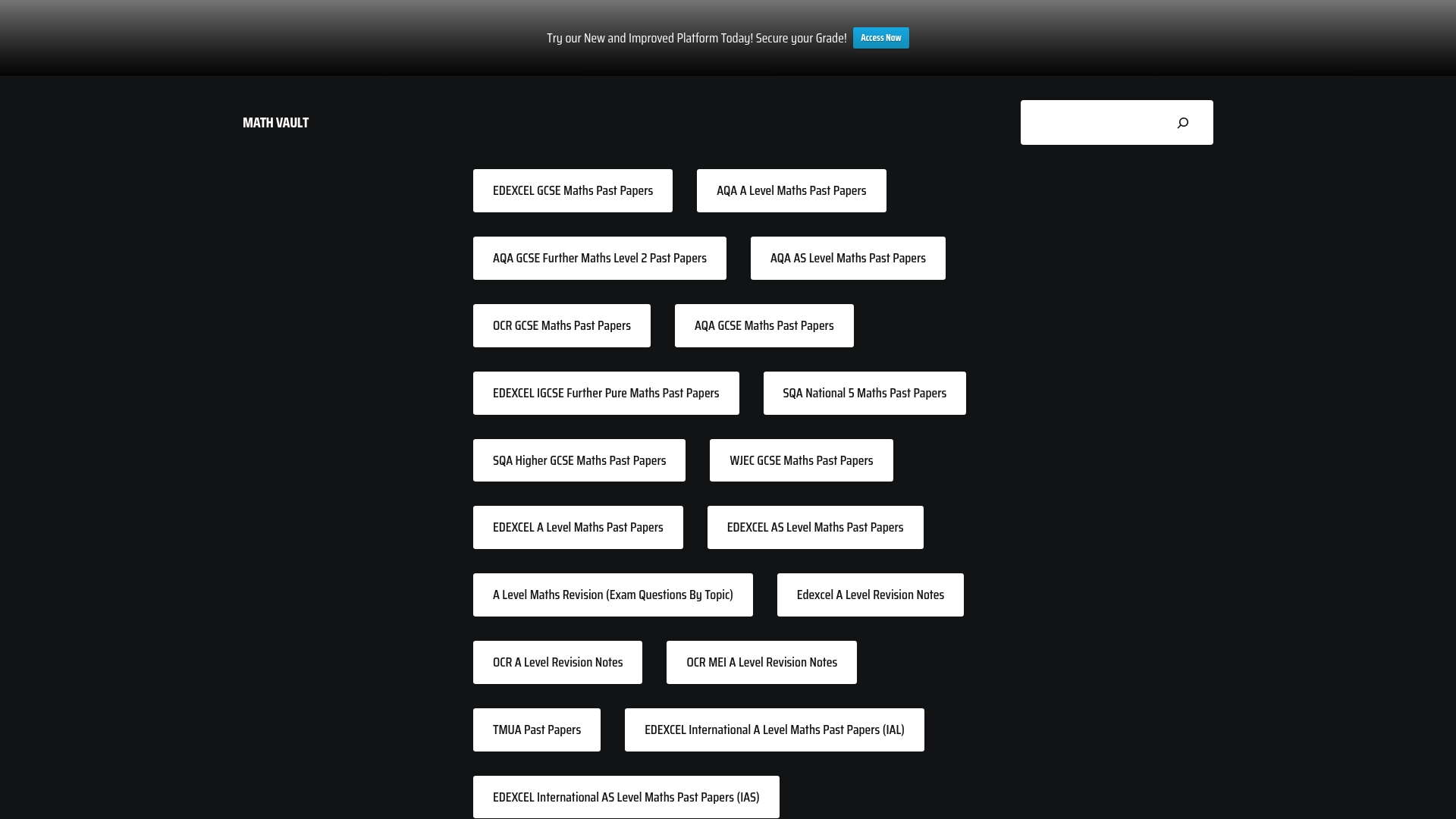
If you’re sitting GCSE this year, the GCSE maths revision guides are the natural starting point, with fully worked solutions that show every M and A mark exactly as an examiner would award it. Edexcel students preparing topic by topic should head straight to the Edexcel GCSE past papers by topic, while AQA candidates working towards Further Maths can use the AQA GCSE Further Maths resources to see method marking at a higher level of difficulty. A-Level students moving into statistics-heavy papers will find the A-Level statistics revision guide useful for practising dependent accuracy marks in context.
Every solution on Mathvault is free, and our weekly live Q&A sessions let you ask directly why a particular step earned or lost a mark. Start with one topic pack this week and mark your own attempt against the worked solution before moving on.
Where to check the official mark-scheme wording
For anything borderline, always defer to your own exam board’s published mark scheme rather than a summary.
- AQA’s assessment resources publish full mark schemes alongside past papers for every GCSE and A-Level maths specification.
- Ofqual sets the regulatory standards that govern how exam boards must apply marking consistently across England.
- Cambridge International’s FAQ page clarifies shorthand codes used specifically in IGCSE mathematics schemes.
- Edexcel (Pearson) and OCR both publish equivalent mark-scheme documentation directly through their own qualification pages, worth checking whenever a code’s exact meaning is unclear for your specific paper.
Sources
- Ofqual
- AQA – assessment resources for mathematics
- Guidance on the use of codes within this mark scheme
- GCSE maths marking decoded: how to train your department
Leave a Reply