
The algebra errors that cost GCSE students the most marks fall into a handful of predictable categories: sign slips and poor term collection, bracket expansion, index laws, fraction handling, and confusing equations with identities. The single habit that fixes most of them is writing systematic, line-by-line working and checking every sign and operation before moving on. The sections below walk through each mistake with worked corrections and short practice routines.
TL;DR:
- For algebraic fractions, invert only the divisor and cancel complete factors; terms within a sum cannot cancel, as in (x + 4)/x.
- Negative indices mean reciprocals, and powers with matching bases require adding exponents; bracket negative values before applying powers.
- Circle command words before solving: identities must be proved rather than solved, while multiplying or dividing an inequality by a negative reverses its sign.
- Spend 20 to 30 minutes on one error type, solve six to eight questions, then compare each step with a model solution.
- Clear, line by line working can earn method marks despite a final arithmetic slip; substitute answers back into original equations to catch errors.
Table of Contents
- Collecting like terms and sign errors
- Expanding and factorising brackets
- Index laws and negative indices
- Fractions and algebraic fractions
- Equations, identities and inequalities: read the command and answer accordingly
- Exam technique: structure your working to keep method marks
- Worked examples and practice routines using MathVault resources
- Common mistakes with substitution and evaluating expressions
- Errors in handling algebraic fractions, including cancelling terms incorrectly
- Misapplication of the distributive law
- Mistakes in solving quadratic equations
- Confusion between variables and constants
- Errors with rearranging formulas and isolating variables
- What examiners prioritise in higher-tier algebra
- Practical next steps with MathVault: past papers, worked answers and short practice plans
- FAQ
- Sources
Collecting like terms and sign errors
Sign errors happen when students treat a coefficient as a standalone number rather than keeping it attached to its sign. This is one of the most frequently recorded issues in examiner commentary, which notes that expressions such as 6x + 9 are sometimes wrongly simplified to 15x, and 10x − 5 is collapsed into 5x, because the operation between terms gets lost rather than carried through the calculation, as recorded in examiner reports on common errors.
Another correction: 10x − 5 similarly cannot be reduced to 5x, since 10x and 5 are unlike terms.
- Underline like terms before combining them.
- Box each coefficient so its sign travels with it through every line.
- Read the signs aloud as you write each step, rather than skimming them.
Expanding and factorising brackets
Bracket questions trip up higher-tier students in a specific way: many expand (x + y)² by squaring each term separately, giving x² + y² instead of the correct x² + 2xy + y², and some even collect x² and x² incorrectly into x⁴ when brackets are multiplied out. Examiner commentary from OCR flags these as recurring misconceptions and recommends a visual scaffold such as an area model or grid method to make every term pairing explicit.
A partner resource with visual proofs for algebraic identities offers another way to see why every term must pair with every other term.
Try this now: draw a 2×2 grid for (x + 4)(x − 2) and fill each cell before collecting terms.
Index laws and negative indices
A negative index means reciprocal, not a negative value, so x⁻² equals 1/x² rather than a negative number. AQA examiner reports record that candidates frequently misread negative indices this way and also multiply bases together instead of adding indices when multiplying powers, a pattern confirmed in the AQA examiner report on higher-tier papers.
Worked example one: x³ × x⁴ equals x⁷, because the indices add when the bases match, never x¹².
Worked example two: 2x⁻³ simplifies to 2/x³, not −2x³.
- State the index rule you are using before applying it, out loud or in the margin.
- After simplifying, substitute a small value for x to check the original and simplified expressions match.
Fractions and algebraic fractions
Dividing by a fraction is where many students lose marks, often by inverting both fractions instead of only the second, or by hunting for a common denominator when it is not needed. This pattern appears consistently in AQA’s examiner commentary on fraction operations.
Numeric example: 3/4 ÷ 1/2 means keeping the first fraction, flipping the second, then multiplying: 3/4 × 2/1 = 3/2, not 3/8.
Algebraic example: (x + 2)/3 ÷ (x + 2)/6 becomes (x + 2)/3 × 6/(x + 2), and the (x + 2) terms cancel as whole factors, leaving 2, never a partial cancellation of just part of the bracket.
Write every intermediate step rather than jumping from the question to an answer; hiding the “flip and multiply” step is where most of these errors creep in unnoticed.
Equations, identities and inequalities: read the command and answer accordingly
An expression has no equals sign, an equation is true for specific values, an identity holds for all values, and an inequality compares rather than equates. A common error is treating an identity as something to “solve”, when the task is really to show that both sides are logically equivalent through stepwise manipulation, as OCR’s guidance on misconceptions in algebraic reasoning describes.
With inequalities, dividing or multiplying both sides by a negative number must reverse the inequality sign, and many students forget to revert it once the arithmetic is done.
Dividing both sides by −2 gives x < −3, with the sign flipped, never x > −3.
- Circle the command word (solve, show, simplify, prove) before starting.
- Present inequality answers with the correct direction and, where asked, on a number line.
- Double check the final inequality sign matches the number of sign changes made.
Exam technique: structure your working to keep method marks
Examiner guidance is consistent on this point: candidates who lay out their working clearly can secure method marks even when their final answer contains an arithmetic slip, according to AQA’s sample mark scheme guidance. A disorganised page of numbers, by contrast, gives an examiner nothing to credit.
A dependable layout starts with the original equation, puts each transformation on its own line, and boxes the final answer. Annotating key steps, such as noting “divide both sides by 3”, helps both you and the examiner follow the logic. A guide on showing working in GCSE maths sets out this layout in more detail.
Pro Tip: Once you reach an answer, substitute it back into the original equation. If both sides do not match, you have caught your own error before the examiner does.
Worked examples and practice routines using MathVault resources
Each mistake type above maps to ways of practising it, so revision stays targeted rather than general.
- For sign and term-collection slips, work through topic-based past papers filtered to algebraic manipulation, then check each line against worked solutions.
- For bracket expansion and factorising, watch a short video walkthrough first to see the grid method applied, then attempt a matching past-paper question cold.
- For index laws, use a short daily practice plan: five questions on power rules, checked immediately against model answers.
- For fractions, equations, identities and method-mark recovery, a guide to method marks pairs with worked solutions so it is possible to see exactly where marks are awarded.
A simple 20 to 30 minute daily routine works well: pick one error type per day, attempt six to eight questions on it, then mark your own working against a model solution rather than just the final answer. A useful micro-session template is to spot the error in a pre-worked incorrect solution, rewrite the line correctly, then compare your rewrite with a worked version. Reviewing examiner reports and mark schemes alongside this routine helps learners see not just what the correct answer is, but which steps actually earn marks, which is important until errors cause lost marks.
Common mistakes with substitution and evaluating expressions
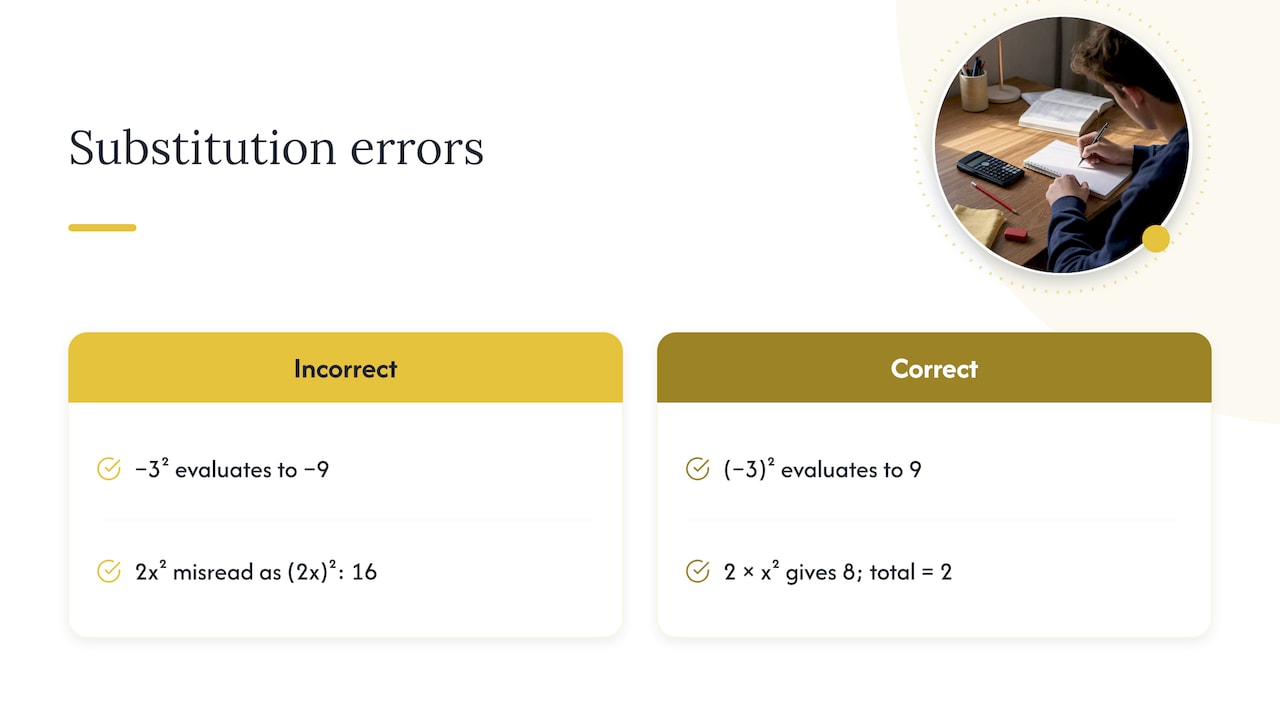
Substitution looks simple but catches out higher-tier students in consistent ways, usually around negative numbers and order of operations. A frequent error is substituting a negative value into an expression like x² without bracketing it first, so −3² is calculated as −9 instead of correctly bracketing (−3)² to get 9.
Students sometimes calculate 2x² as (2x)² rather than 2 × (x²), giving 16 instead of the correct 2 × 4 = 8, before adding 3 × (−2) = −6, for a correct total of 2.
A third pattern appears when substituting fractions or decimals into formulas, where students forget to apply the full expression to the substituted value, perhaps multiplying only part of a bracketed term. The fix in every case is the same: write the expression with the substituted value in brackets before doing any arithmetic, so (−2)² is clearly distinct from −2². This single habit, pausing to bracket the substituted value before calculating, removes most substitution errors because it forces the correct order of operations rather than relying on memory under exam pressure. Checking your substituted expression against the original formula, term by term, before simplifying also catches cases where a term has been dropped or miscopied during the substitution step itself.
Errors in handling algebraic fractions, including cancelling terms incorrectly
Algebraic fractions produce a specific and persistent error: cancelling terms that are added or subtracted rather than multiplied. Cancellation is only valid for common factors of the entire numerator and entire denominator, never for a term that happens to appear on both the top and bottom of a fraction when other terms are present, as examiner commentary on common errors in algebraic manipulation makes clear.
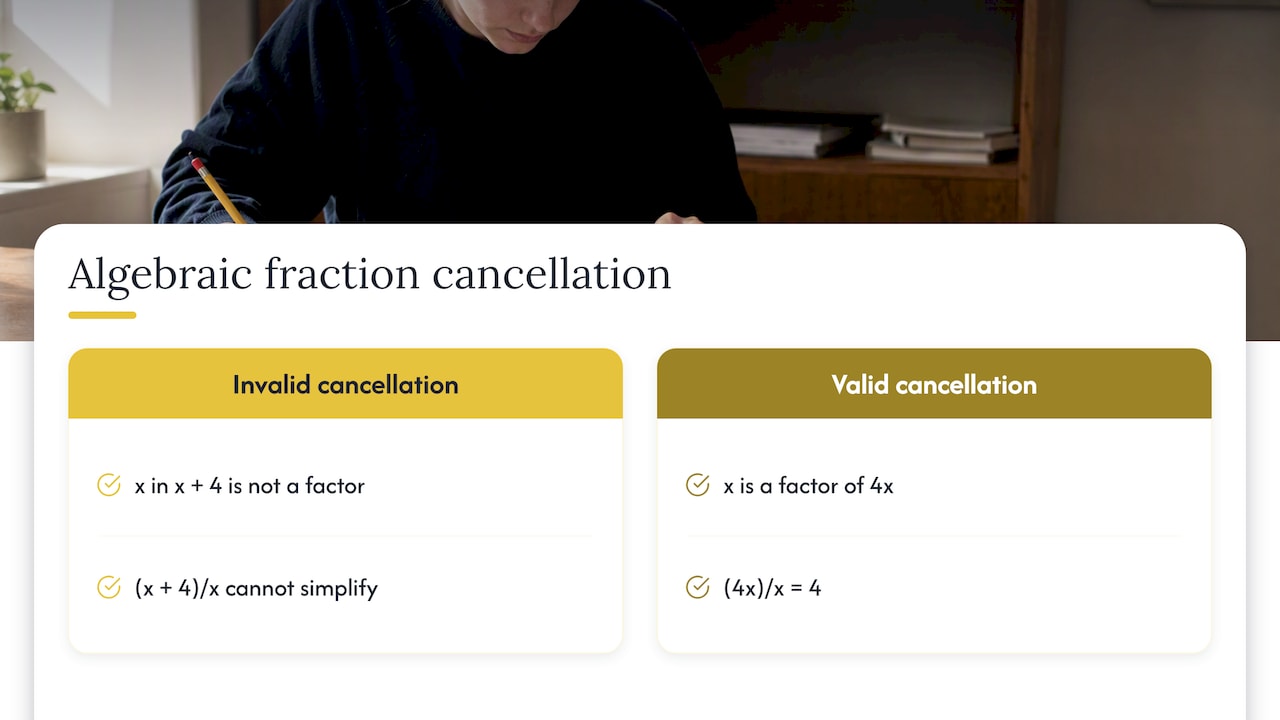
For example, in the fraction (x + 4)/x, students sometimes cancel the x terms to leave just 4, which is incorrect because x is not a factor of the entire numerator, only part of a sum. The fraction cannot be simplified further in this form.
Contrast this with (4x)/x, where x genuinely is a factor of the numerator, so it cancels correctly to leave 4.
The reliable habit is to factorise the numerator and denominator fully before attempting any cancellation, and to cancel only complete factors, never individual terms within a sum. Writing out the factorisation step explicitly, rather than cancelling by eye, is what separates correct simplification from the partial cancellation error examiners see repeatedly in weaker scripts.
Misapplication of the distributive law
The distributive law states that a(b + c) equals ab + ac, and the most common error is multiplying only the first term inside the bracket while leaving the second term untouched.
This error becomes more serious with negative numbers outside the bracket.
The distributive law also applies when expanding two brackets together, where every term in the first bracket must multiply every term in the second.
The dependable fix is to draw arrows from the term outside the bracket to every term inside it, or use a grid, before writing anything down. This turns an easy-to-miss mental step into a visible one, which matters most under exam time pressure when working from memory alone becomes unreliable.
Mistakes in solving quadratic equations
Quadratic equations bring together several of the errors already covered, and factoring mistakes are especially common.
The quadratic formula brings its own pitfalls. For ax² + bx + c = 0, the formula is x = (−b ± √(b² − 4ac)) / 2a, and a frequent error is forgetting the negative sign on b when b itself is negative, or dividing only part of the numerator by 2a rather than the whole expression. Another common slip is calculating b² − 4ac incorrectly when b is negative, since (−5)² must be calculated as 25, not −25.
Worked example: for x² − 5x + 6 = 0, factorising gives (x − 2)(x − 3) = 0, so x = 2 or x = 3, both solutions needed, not just one.
Writing the quadratic formula out in full before substituting any values, and bracketing negative values of b before squaring them, prevents most of these errors. Checking a factorised answer by expanding it back out is a reliable final step that catches mistakes before they reach the final answer line.
Confusion between variables and constants
A variable can take different values within a problem, while a constant stays fixed, and confusing the two leads to errors in both algebraic manipulation and real-world problem questions. In an equation like y = mx + c, students sometimes treat m and c as if they could be solved for alongside x and y, when in a given context they are fixed values describing a specific line.
This confusion also appears when simplifying expressions with multiple letters. In 3a + 2b − a, some students add all the terms together regardless of letter, producing an incorrect single term, rather than recognising that a and b represent different quantities that cannot be combined. The correct simplification collects only the like terms: 3a − a + 2b gives 2a + 2b.
Formula questions make this error more visible. In the formula for the area of a trapezium, A = ½(a + b)h, the letters a and b represent the parallel side lengths and h the height, all of which vary between problems, while the ½ is a fixed constant. Mixing these up, for instance by treating ½ as a variable to solve for, misses what the formula is actually describing. Reading the problem context carefully before manipulating any formula, and noting which letters are given values and which are not, prevents this kind of structural misunderstanding from affecting the algebra that follows.
Errors with rearranging formulas and isolating variables
Rearranging a formula to make a different letter the subject is a higher-tier staple, and the most common error is performing an operation to only one term on one side rather than to the entire side. For the formula v = u + at, rearranging to make t the subject requires subtracting u from both complete sides first, giving v − u = at, then dividing the entire right side by a, giving t = (v − u)/a, never t = v/a − u.
A second frequent error appears when the subject variable appears more than once in the formula, or when it sits inside a squared term. For the formula A = πr², making r the subject requires dividing both sides by π first, then taking the square root of the entire result: r = √(A/π), not √A/π, since only dividing by π before the square root, rather than after, changes the answer.
A third pattern shows up with fractions in the formula itself. For 1/f = 1/u + 1/v, students sometimes try to isolate v by directly subtracting 1/u from both sides without first combining the fractions on a common denominator, leading to incorrect intermediate expressions.
The reliable approach is to treat each side of the formula as a single, complete quantity at every step, applying the same operation to all of it rather than to an individual term, and to undo operations in reverse order to how they were applied. Writing out each rearrangement step on its own line, exactly as recommended for exam technique generally, makes it far easier to spot where an operation has been applied unevenly.
What examiners prioritise in higher-tier algebra
Precision with indices and careful reading of “show that” questions separate strong higher-tier scripts from weaker ones far more often than raw ability does. A short “spot the error” exercise, built from real past-paper scripts, trains the eye to catch the same slips examiners report every series. Comparing your own method against a worked solution, rather than just checking your final answer, is the habit that actually moves a grade.
— Oloru
Practical next steps with MathVault: past papers, worked answers and short practice plans
Fixing these mistakes takes repetition against real exam questions, not just reading about them, and resources exist that support this approach. Every topic covered above has matching sets of free past papers, fully worked solutions and short video walkthroughs organised by exam board to practise relevant question types.

A good next step is to pick one mistake type from this article, attempt a related past-paper question, and compare your working line by line with our model solution to see exactly where marks would have been gained or lost.
- Browse topic-aligned GCSE revision guides to find subtopics to practise.
- Work through IGCSE past-paper questions with fully worked solutions attached.
- Use our method marks explained guide to understand exactly how examiners award partial credit.
Start with a single past paper this week and build your daily practice routine from there.
FAQ
What are the most challenging topics in GCSE maths?
Higher-tier students most often struggle with algebraic fractions, quadratic equations, index laws and formula rearrangement, since each combines several earlier skills at once. These topics also appear repeatedly in examiner commentary as areas where candidates lose otherwise accessible marks, as noted in examiner reports on common errors.
What are the basic rules of algebra you should never break?
The core rules are: only combine like terms, apply the distributive law to every term inside a bracket, keep operations balanced on both sides of an equation, apply index laws correctly when multiplying or dividing powers, and treat a negative index as a reciprocal rather than a negative value. Keeping these in mind while writing each line of working prevents most of the errors covered in this article.
How can you avoid careless algebra mistakes under exam pressure?
Writing full, line-by-line working rather than skipping steps is the single most effective habit, since examiner guidance confirms that structured working secures method marks even when a final answer contains a slip, as set out in AQA’s sample mark scheme guidance. Substituting your final answer back into the original equation is a quick way to catch errors before submitting.
Why do students misread algebra questions in exams?
Many candidates follow a familiar method without first checking it matches what the question actually asks, particularly with command words like “show that”, which requires a logical derivation rather than a numerical answer. Examiner guidance on common misunderstandings in GCSE maths gives several examples of marks lost this way, so circling the command word before starting is a simple preventative habit.
Sources
- Common errors in mathematics (Cambridge Assessment)
- AQA examiner report (Higher) – November 2022
- GCSE maths: common misconceptions highlighted by examiners (OCR)
- AQA examiner guidance and sample mark scheme (AQA)
Leave a Reply