
Always show every step of your method in the order you did it, because examiners award marks for correct method even when your final answer is wrong. A simple template works for almost any question: define your variables, set up the equation or calculation, show each step of the working, then check your answer. Master this and you can bank method marks even on questions you don’t fully solve.
TL;DR:
- Showing every step of your method allows examiners to award marks for correct processes, even if your final answer is wrong.
- Labeling unknowns, aligning equations, and annotating non-obvious steps improve your chances of earning method and follow-through marks.
- Practicing with past papers by deliberately including and comparing your working to model solutions helps ingrain markable presentation habits.
- Writing the equation or formula before manipulating it, especially in calculator exams, is the most critical habit to avoid losing method marks.
- Time management should prioritize completing and checking work for AO3 questions, as they account for a significant portion of your total marks.
Table of Contents
- Why does showing your working matter in GCSE maths?
- What presentation rules make your working easy to mark?
- What do full-mark worked examples actually look like?
- How should you practise showing working with past papers?
- What should your exam-day routine be for showing working?
- How Mathvault’s resources support these habits
- Ready to put this into practice?
- What examiners actually notice when marking your working
- Sources
- FAQ
Why does showing your working matter in GCSE maths?
Marks in GCSE maths are not all pinned to the final answer. Every exam board splits marks between the process you use and the number you land on, and that split is written into the mark scheme before a single paper is sat.
Mark schemes use four main categories, and learning to recognise them changes how you write an answer:
- M marks (Method) — awarded for a correct method, even if the arithmetic that follows is wrong.
- A marks (Accuracy) — awarded for a correct final answer, usually dependent on the method mark already being earned.
- B marks (Independent) — a standalone mark for a correct answer or statement that doesn’t rely on a preceding method mark.
- ft marks (Follow-through) — awarded when you correctly work through the consequences of an earlier mistake.
This last one is the mark students throw away most often. Say a question asks you to solve a pair of simultaneous equations and use the result in a second calculation. If you make a slip in the first equation but correctly apply your (wrong) answer to the second part, the ft mark still lands. Skip the working, and there’s nothing for the examiner to follow through on.
This isn’t a minor allowance buried in the small print. OCR’s own guidance on problem solving confirms that Assessment Objective 3 (AO3), which covers problem solving and reasoning, accounts for 30% of marks at Higher tier and 25% at Foundation tier. That’s not a handful of marks tucked away at the end of the paper. It’s roughly a third of the entire Higher paper riding on how clearly you translate a worded problem into mathematical steps and reasoning, not just whether you reach the right number.
Here’s a scenario that plays out in exam halls every year. A student is asked to solve [3x](https://www.quora.com/How-do-you-solve-for-x-in-3x-7-22) + 7 = 22. They write:
3x + 7 = 22
3x = 15
x = 4
The correct answer is 5, not 4. It’s an arithmetic slip. But look at what’s visible. The method line (3x = 15) is completely correct. That’s a method mark secured before the mistake even happens. Compare that to a student who writes only “x = 4” with no working shown. Same wrong answer, but zero marks recovered, because there’s nothing on the page to reward.
Reading a mark scheme properly means treating it as the examiner’s own instructions for what they’re hunting for on your page. Every M, A, B, and ft code corresponds to a specific line of working they expect to see. If your working doesn’t produce that line, in some recognisable form, that mark is gone regardless of what your final answer says.
What presentation rules make your working easy to mark?
Correct maths poorly presented still loses marks, because an examiner marking hundreds of scripts under time pressure will only credit what they can clearly follow. The fix is a set of habits you can apply automatically, without slowing down your actual problem solving.
- One operation per line. Never combine two steps into one. If you’re solving
2x + 5 = 17, write2x = 12on its own line, thenx = 6on the next. Combining them into a single scribbled line makes it impossible for an examiner to isolate the method mark from the accuracy mark. - Align your equals signs. Stack each line so the
=signs sit roughly underneath each other. This isn’t about neatness for its own sake; it lets an examiner scan down the page and instantly see the chain of logic rather than hunting across a messy block of numbers. - Label every unknown in words. Before any algebra, write a short line like “let x = number of apples Sam buys.” This single habit protects your B marks even when the rest of your working goes wrong, because it shows you understood what the question was asking.
- Annotate non-obvious steps. A brief note beside a line, such as “divide both sides by 2” or “multiply out the bracket”, tells the examiner exactly what you did and why. It costs you five seconds and can be the difference between a method mark being credited or queried.
- Include units at every stage, not just the end. If a question is in centimetres, keep writing cm through your working, not just in the final line. Dropping units partway through is one of the most common ways students lose an accuracy mark on an otherwise correct answer.
- Show substitution back into the original equation where a question allows it. This acts as your own check and, on many mark schemes, some of the working that supports it is itself creditable.
Calculator papers need their own version of this discipline. Papers 2 and 3 allow a calculator, but the distinction between GCSE maths papers doesn’t mean you can skip method lines just because the arithmetic happens off the page. Write the formula you’re using before you type anything into the calculator, and if you round an intermediate value, show it clearly, ideally in brackets or with an arrow, so the examiner can see you rounded deliberately rather than by accident. Paper 1, the non-calculator paper, rewards this even more directly: your handwritten arithmetic is the only evidence of method the examiner has, so every carried digit and intermediate total needs to be visible on the page.
Pro Tip: Write the equation or formula you’re about to use as its own line before you touch a calculator. It takes two seconds and it’s often the single line that separates a method mark from a blank space on the mark scheme.
None of these habits require extra maths knowledge. They’re purely about translating what’s already in your head onto the page in a form an examiner can mark quickly and generously.
What do full-mark worked examples actually look like?
Seeing the level of detail examiners expect makes the presentation rules click far faster than reading them as abstract advice. Here are four worked examples across the main GCSE question types, each annotated to show exactly where the marks sit.
Algebra: solving a linear equation
x = 7                    ← A1: correct final answer
Check: 5(7 − 3) = 5(4) = 20; 2(7) + 6 = 20 ✓
The expansion line earns a method mark on its own, independent of whether the rest of the algebra is correct. The line collecting terms onto one side is a second method mark. Only the final line, x = 7, earns the accuracy mark, and it’s dependent on the method marks already being visible. The check at the end isn’t required by most mark schemes, but it costs seconds and confirms you haven’t made a silent error.
Percentages and ratio: a compound problem
Find the final price.
Discount amount: 80 × 0.15 = £12          ← M1: correct percentage method
Discounted price: 80 − 12 = £68           ← M1: correct subtraction step
VAT amount: 68 × 0.20 = £13.60            ← M1: correct method on new base
Final price: 68 + 13.60 = £81.60          ← A1: correct final answer
This question is a favourite because students often apply both percentages to the original £80, which throws away marks on the second calculation even if the first is right. Writing “discounted price” and “VAT amount” as labels, rather than leaving bare numbers, shows the examiner exactly which base each percentage is working from, protecting the method marks even if the final arithmetic slips.
Geometry and trigonometry: finding a missing length
Question: A right-angled triangle has a hypotenuse of 12cm and one angle of 35°. Find the length of the side opposite that angle.
Label diagram: opposite = ?, hypotenuse = 12cm, angle = 35°
sin(35°) = opposite / hypotenuse           ← M1: correct trig ratio chosen
opposite = 12 × sin(35°)                   ← M1: correct rearrangement
opposite = 12 × 0.5736
opposite = 6.88cm (3 s.f.)                 ← A1: correct final answer with units
Labelling the diagram, even mentally, before writing any trigonometry is what earns the first method mark: it shows you identified which sides and angle you’re working with. Writing the ratio as a formula before substituting numbers is the second method line, and it’s the one students skip most often when they’re confident with a calculator. Rounding to three significant figures and keeping the unit (cm) attached protects the accuracy mark.
AO3 problem solving: a worded multi-step question
Question: A shop sells notebooks in packs of 5 for £3.50 and packs of 8 for £5.20. Priya needs exactly 40 notebooks and wants to spend as little as possible. Show your working to find the cheapest combination and its total cost.
Let a = number of packs of 5, b = number of packs of 8   ← B1: variables defined
5a + 8b = 40
Try b = 5: 5a = 40 − 40 = 0, a = 0        ← M1: valid combination tested
Cost: 5(0) + 5.20(5) = £26.00
Try b = 0: 5a = 40, a = 8                  ← M1: second valid combination tested
Cost: 3.50(8) + 5.20(0) = £28.00
Cheapest combination: 5 packs of 8, no packs of 5, total = £26.00   ← A1
AO3 questions like this reward students who write down the equation linking the variables even before they know how to solve it neatly. Third Space Learning’s problem-solving question sets consistently show that translating the words into an equation, however you then choose to test it, is where most of the AO3 credit sits. Testing combinations systematically and stating each cost as you go, rather than jumping straight to the answer, gives the examiner a visible trail even if you don’t spot the absolute cheapest option on your first attempt.
How should you practise showing working with past papers?
Reading about presentation rules is one thing. Building them into muscle memory under exam pressure is another, and that only happens through a specific kind of repeated practice.
- Attempt a full question under normal conditions, without looking at the mark scheme, exactly as you would in the exam.
- Mark your own answer against the official mark scheme, line by line, checking not just whether your final answer matches but whether each of your working lines corresponds to an M, A, B, or ft code.
- Rewrite the question from scratch as a model answer, this time deliberately including every line the mark scheme rewards, even ones you skipped the first time.
- Repeat with a different question of the same type a day or two later, without referring back to your model answer, to test whether the habit has actually stuck.
This loop works because it forces you to see the gap between what you wrote and what the mark scheme was actually looking for, which is usually a smaller gap than students expect. Deliberate, curriculum-aligned problem-solving practice of this kind builds the pattern recognition you need to write markable lines automatically, rather than reconstructing them from memory in the exam hall.
Timed blocks matter too, but split your practice into two distinct types. Full timed papers, done under real exam conditions, tell you whether your pacing allows time for proper working on every question. Shorter method-only drills, where you only write the setup and method lines for ten different questions in fifteen minutes without solving them fully, build speed at the specific skill of translating a problem into a correctly labelled first line. Both matter and neither substitutes for the other.
Board-specific resources help here because mark schemes vary slightly in phrasing and expectation between boards. Mathvault’s Edexcel GCSE past papers organised by topic let you drill a single question type, like simultaneous equations or compound percentages, repeatedly against worked solutions until the presentation becomes automatic. Comparing your own working line-by-line against a model solution is usually the fastest way to spot the exact steps you’re leaving out without realising it.
What should your exam-day routine be for showing working?
Time pressure is the single biggest reason students abandon good presentation habits mid-exam, so it helps to have a routine decided in advance rather than improvised under stress.
- Do a first pass for easy marks. Answer every question you can solve confidently before returning to longer AO3 problems, so a tricky question doesn’t eat into time you needed elsewhere.
- Budget roughly a minute per mark as a rough guide, adjusting for questions that are clearly working-heavy rather than a single calculation.
- Leave real time for AO3 questions. These carry a large share of marks and need full working, not a rushed final line, so don’t leave them for the last two minutes of the paper.
- If you spot an early slip, don’t erase everything. Cross out the wrong line neatly with a single strike, write the correction beside it, and keep working through consistently from that point, since ft marks reward a correct method applied to your own (wrong) earlier answer.
- Add a quick check where time allows, such as substituting your answer back into the original equation, especially on questions worth three marks or more.
Pro Tip: If you realise partway through a question that an earlier line was wrong, don’t panic and restart from scratch. Cross out the error, write “error, continuing with above” if there’s room, and carry on. Examiners are specifically trained to award follow-through marks for exactly this situation.
How Mathvault’s resources support these habits
I’ve worked with GCSE and A-Level students across several exam boards, helping them close the gap between understanding a topic and actually earning full marks for it on paper, and the pattern is always the same: the maths knowledge is usually there before the presentation habit is.
Resources with past papers organised by topic can help students practise showing working properly by drilling one question type repeatedly, such as simultaneous equations or trigonometry, until the working pattern becomes automatic rather than something you have to think about mid-exam. Fully worked step-by-step solutions can show the exact line-by-line detail examiners expect, so students can compare their own attempt against a model answer and spot precisely which lines they’re missing. Video walkthroughs may talk through the reasoning behind each method line, which helps when a written solution alone doesn’t make clear why a particular step was necessary. Live weekly Q&A sessions can give a direct route to ask why a specific line in your working did or didn’t earn a mark, rather than guessing from a mark scheme alone.
One pattern shows up repeatedly with students who use worked solutions as a genuine comparison tool rather than just an answer check: their scores on method-heavy questions improve noticeably faster than their scores on pure recall questions, because presentation is a skill you can drill directly, unlike raw topic knowledge.

Ready to put this into practice?
Reading about method marks and actually watching yourself earn them are two different experiences, and the second one only happens through repeated, marked practice against real exam material. There are free resources providing full past papers organised by board and topic, fully worked step-by-step solutions that show exactly which lines an examiner is looking for, and live weekly Q&A sessions where students can ask why a specific line in their own working did or didn’t score.
Start with the self-mark past papers with board-aligned solutions, attempt a paper under timed conditions, then mark it line by line against the worked solution rather than just checking your final answers. If you want to target a specific weak area first, Mathvault’s past papers organised by topic let you drill algebra, percentages, or trigonometry in isolation until the presentation habit sticks. Most students find the gap between their working and a full-mark answer is smaller than they feared, and it closes fast once you can see it clearly.
What examiners actually notice when marking your working
The most common mistake I see isn’t a maths error at all. It’s a student who knows the method perfectly well but skips the line that shows it, usually because they’re rushing and doing the step “in their head” to save time. The irony is that this almost never saves meaningful time. Losing the method mark because that line doesn’t exist costs a mark that no amount of correct final-answer arithmetic can recover.
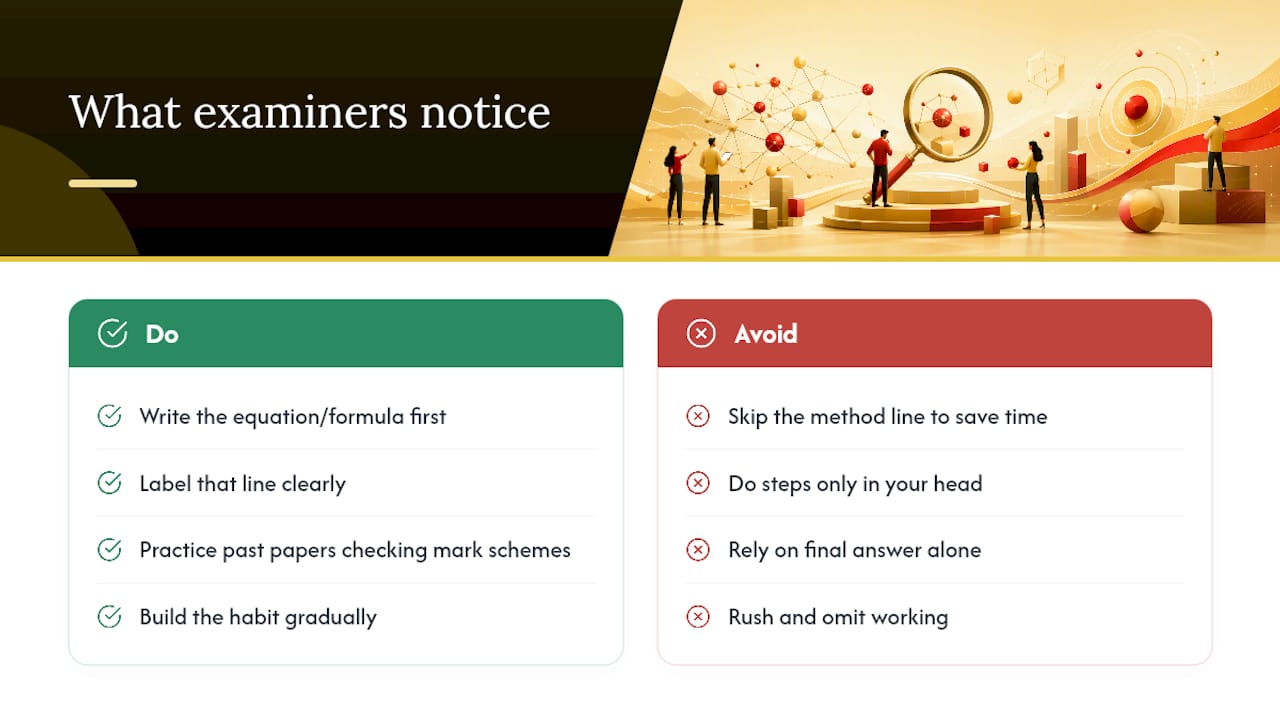
The single habit worth building before anything else is this: always write the equation or formula line before you touch any manipulation of it, whether that’s algebra, a percentage calculation, or a trigonometric ratio. That one line, written first and labelled clearly, is disproportionately likely to be the exact line a mark scheme is looking for.
This isn’t a habit you install overnight. Build it gradually through past-paper practice where you deliberately check your working against the mark scheme rather than just your final answer, and it becomes second nature well before exam day arrives.
— Oloru
Sources
- Problem solving in GCSE (9-1) Maths: examples of good practice — OCR
- How to read a GCSE maths mark scheme? — Greenhill Academics
- 30 problem solving maths questions and answers for GCSE — Third Space Learning
FAQ
Does the UK use BODMAS or PEMDAS?
The UK uses BODMAS (Brackets, Orders, Division/Multiplication, Addition/Subtraction), which describes the same order of operations as the American PEMDAS; the acronyms differ but the underlying rule is identical.
What is GCSE in the UK equivalent to in the USA?
GCSEs broadly correspond to the US high school diploma level, though the two systems assess and structure subjects differently, so a direct grade-for-grade comparison isn’t exact.
What are the top three hardest GCSEs?
Students and teachers most commonly cite further maths, physics, and modern foreign languages as among the most demanding GCSEs, largely due to their heavy reliance on multi-step problem solving and precise technical language, though difficulty is genuinely subjective and varies by student strength.
How many marks can you lose for not showing working in GCSE maths?
You can lose every method, accuracy, and follow-through mark tied to a question if no working is visible, since AO3 alone accounts for 30% of Higher tier marks and 25% of Foundation tier marks, and those marks depend on a visible method.
Leave a Reply