
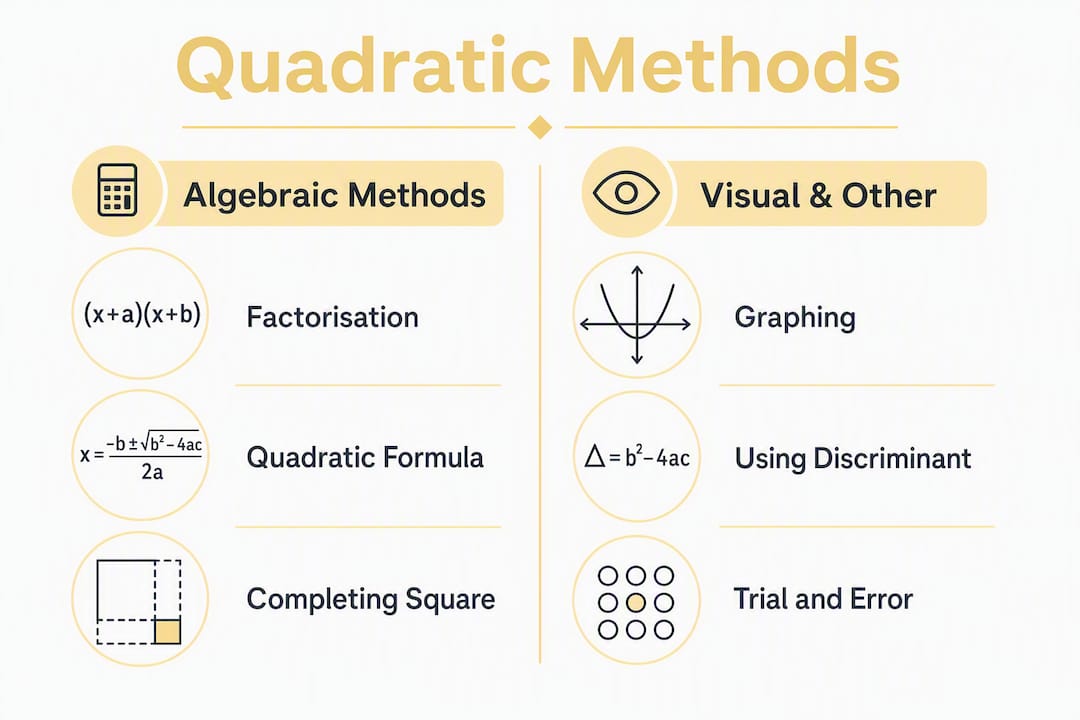
A quadratic equation is any equation where the highest power of the unknown is 2, written in standard form as ax² + bx + c = 0 (where a ≠ 0). For most GCSE questions, your fastest route to the answer is to try factorisation first; if the quadratic does not factorise neatly, reach for the quadratic formula without hesitation.
- Always rearrange to ax² + bx + c = 0 before you do anything else.
- Try factorisation when the numbers look manageable.
- Use the quadratic formula when factorisation stalls or coefficients are awkward.
- Use completing the square when the question asks for the vertex, minimum, or an exact surd answer.
- Use a graph when the question asks you to sketch or estimate roots.
The quadratic formula appears on the GCSE maths formula sheet for many recent sittings, though provision varies by exam board and year. Check your specific board’s guidance. AQA, Edexcel, OCR, and WJEC all follow the same core methods, so the approach below applies across boards.
Pro Tip: Before choosing a method, always move every term to one side so the equation reads ax² + bx + c = 0. A sign error at this stage costs marks on every step that follows.

Table of Contents
- What does a quadratic equation look like?
- How do you solve a quadratic by factorisation?
- How do you use the quadratic formula?
- How does completing the square work?
- How do graphs help you solve quadratic equations?
- Which method should you use in an exam?
- Exam-style practice questions with worked solutions
- Common GCSE mistakes with quadratics and quick fixes
- Where to practise more: Mathvault’s GCSE resources
- Key takeaways
- The method matters more than the formula
- Mathvault’s GCSE quadratics pack: free and exam-board aligned
- Further reading and sources
What does a quadratic equation look like?
A quadratic equation is any algebraic equation whose highest exponent is 2. The standard form is:
ax² + bx + c = 0, where a ≠ 0
The condition a ≠ 0 is what makes it quadratic rather than linear. The values b and c can be zero, but a cannot.
Key principle: Rearrange first, solve second. Every solving method assumes the equation is already in standard form. Skipping this step is the single most common source of sign errors in GCSE quadratic questions.
Reading off a, b and c
Once the equation is in standard form, identifying a, b, and c is straightforward.

Example 1: 3x² − 5x + 2 = 0 → a = 3, b = −5, c = 2
Example 2: x² = 4x − 3 → rearrange to x² − 4x + 3 = 0 → a = 1, b = −4, c = 3
Example 3: 2x(x + 1) = 6 → expand to 2x² + 2x = 6 → 2x² + 2x − 6 = 0 → divide by 2 → x² + x − 3 = 0
Notice that in Example 2, moving 4x − 3 to the left changes the signs. Writing out this step explicitly on your paper prevents the most common rearrangement errors.
How do you solve a quadratic by factorisation?
Factorisation is the quickest method when it works, and it is the one examiners expect you to try first for integer-coefficient questions.
When a = 1: simple factorisation
- Write the equation in standard form: x² + bx + c = 0.
- Find two numbers that multiply to c and add to b.
- Write the factorised form: (x + p)(x + q) = 0.
- Apply the zero-product principle: x = −p or x = −q.
Worked example: Solve x² + 5x + 6 = 0.
- Need two numbers that multiply to 6 and add to 5: those are 2 and 3.
- Factorised form: (x + 2)(x + 3) = 0.
- Solutions: x = −2 or x = −3.
When a ≠ 1: splitting the middle term
- Write in standard form: ax² + bx + c = 0.
- Calculate the product a × c.
- Find two numbers that multiply to a·c and add to b.
- Split the middle term using those two numbers.
- Factorise by grouping, then apply the zero-product principle.
Worked example: Solve 2x² + 7x + 3 = 0.
- a × c = 2 × 3 = 6.
- Two numbers that multiply to 6 and add to 7: 1 and 6.
- Rewrite: 2x² + x + 6x + 3 = 0.
- Group: x(2x + 1) + 3(2x + 1) = 0.
- Factorise: (x + 3)(2x + 1) = 0.
- Solutions: x = −3 or x = −½.
Many GCSE marks come from showing the split-middle-term working clearly rather than simply stating the factor pair. Write every step.
How do you use the quadratic formula?
When factorisation is not obvious, the quadratic formula always works. State it, substitute carefully, and evaluate the discriminant before computing the square root.
The formula is:
x = (−b ± √(b² − 4ac)) / (2a)
Worked example: Solve 2x² − 4x − 3 = 0.
Identify: a = 2, b = −4, c = −3.
Discriminant: b² − 4ac = (−4)² − 4(2)(−3) = 16 + 24 = 40
Since 40 > 0, there are two distinct real roots.
x = (4 ± √40) / 4 = (4 ± 2√10) / 4 = (2 ± √10) / 2
x = (2 + √10) / 2 or x = (2 − √10) / 2
If a decimal is required, show the exact surd first, then the approximation: x ≈ 2.58 or x ≈ −0.58.
Exam technique: Write the discriminant calculation on its own line before you attempt the square root. A negative discriminant tells you immediately that there are no real roots — catching this early saves unnecessary working and prevents arithmetic errors.
The discriminant: how many roots?
The expression b² − 4ac is called the discriminant. Its sign tells you the nature of the roots before you solve.
| Discriminant value | Number and type of roots | GCSE phrasing to use |
|---|---|---|
| b² − 4ac > 0 | Two distinct real roots | “The equation has two real solutions.” |
| b² − 4ac = 0 | One repeated real root | “The equation has one repeated root.” |
| b² − 4ac < 0 | No real roots (two complex roots) | “The equation has no real solutions.” |
The discriminant test earns both method marks and interpretation marks in GCSE answers, so always state the conclusion in words.
How does completing the square work?
Completing the square converts ax² + bx + c = 0 into the form (x + p)² = q, which you can solve by taking a square root. It also gives you the vertex of the parabola directly.
Method for a = 1
- Start with x² + bx + c = 0.
- Move c to the right: x² + bx = −c.
- Add (b/2)² to both sides: x² + bx + (b/2)² = (b/2)² − c.
- Write the left side as a perfect square: (x + b/2)² = (b/2)² − c.
- Take the square root of both sides (include ±).
- Solve for x.
Worked example: Solve x² + 6x + 7 = 0.
- x² + 6x = −7
- Add (3)² = 9 to both sides: x² + 6x + 9 = 2
- (x + 3)² = 2
- x + 3 = ±√2
- x = −3 + √2 or x = −3 − √2
These are exact surd answers. If the question says “leave in surd form,” do not convert to decimals.
Method for a ≠ 1
- Divide every term by a first: x² + (b/a)x + (c/a) = 0.
- Follow the same steps as above.
Worked example: Solve 2x² + 8x + 3 = 0 by completing the square.
- Divide by 2: x² + 4x + 3/2 = 0
- x² + 4x = −3/2
- Add (2)² = 4: x² + 4x + 4 = 4 − 3/2 = 5/2
- (x + 2)² = 5/2
- x + 2 = ±√(5/2) = ±(√10)/2
- x = −2 + (√10)/2 or x = −2 − (√10)/2
When a question asks you to “express in the form (x + p)² + q”, stop at step 4 and rearrange: (x + 2)² − 5/2 = 0 gives the vertex form (x + 2)² − 5/2, so the vertex is at (−2, −5/2).
How do graphs help you solve quadratic equations?
The graph of y = ax² + bx + c is a parabola. The solutions to ax² + bx + c = 0 are the x-coordinates where the parabola crosses the x-axis, known as the x-intercepts or roots.
- If the parabola crosses the x-axis at two points, the equation has two distinct real roots.
- If it touches the x-axis at exactly one point, there is one repeated root.
- If it does not reach the x-axis, there are no real roots.
Graph insight: The axis of symmetry always passes through x = −b/(2a). This is also the x-coordinate of the vertex. Knowing this lets you sketch the parabola quickly and check whether your algebraic roots are symmetrically placed around it.
Reading roots from a sketch
If a sketch shows y = x² − 5x + 4 crossing the x-axis at x = 1 and x = 4, you can confirm algebraically: (x − 1)(x − 4) = 0 gives exactly those roots. The factorised form and the x-intercepts are two ways of expressing the same information.
For exam questions that ask you to “use the graph to estimate the roots,” read the x-intercepts to one decimal place and state them clearly. If the question then asks for exact roots, switch to an algebraic method.
Which method should you use in an exam?
Choosing the right method quickly is half the battle under exam conditions. Use this table as your decision guide.
| Method | When to use it | Speed | Typical marks available |
|---|---|---|---|
| Factorisation | Integer coefficients, factors look obvious | Fast | 3–4 marks |
| Quadratic formula | Factorisation fails, decimal or surd answers expected | Medium | 3–4 marks |
| Completing the square | Vertex/minimum asked for, exact surd form required | Slower | 4–5 marks |
| Graph | Sketch requested, estimation acceptable | Varies | 2–4 marks |
Pro Tip: To spot a factorable quadratic quickly, check whether any factor pair of a·c sums to b. If no pair works within 30 seconds, move straight to the quadratic formula. Do not waste exam time forcing factorisation on a non-integer quadratic.
Exam-style practice questions with worked solutions
Work through these progressively. Write full method steps as an examiner would expect.
-
Solve x² + 7x + 12 = 0 by factorisation.
Factors of 12 that add to 7: 3 and 4. → (x + 3)(x + 4) = 0. x = −3 or x = −4. -
Solve x² − 5x − 14 = 0 by factorisation.
Factors of −14 that add to −5: −7 and 2. → (x − 7)(x + 2) = 0. x = 7 or x = −2. -
Solve 3x² + 10x + 3 = 0 by factorisation.
a·c = 9. Factors of 9 that add to 10: 1 and 9. Split: 3x² + x + 9x + 3 = 0. Group: x(3x + 1) + 3(3x + 1) = 0. → (x + 3)(3x + 1) = 0. x = −3 or x = −⅓. -
Solve x² + 4x − 1 = 0, leaving your answer in surd form.
a = 1, b = 4, c = −1. Discriminant: 16 + 4 = 20. x = (−4 ± √20) / 2 = (−4 ± 2√5) / 2 = −2 ± √5. -
Solve 2x² − 3x − 2 = 0 using the quadratic formula.
a = 2, b = −3, c = −2. Discriminant: 9 + 16 = 25. x = (3 ± 5) / 4. x = 2 or x = −½. -
Solve x² + 6x + 11 = 0 and comment on the nature of the roots.
Discriminant: 36 − 44 = −8. Since b² − 4ac < 0, the equation has no real solutions. -
Complete the square to solve x² − 4x − 3 = 0.
(x − 2)² − 4 − 3 = 0 → (x − 2)² = 7 → x − 2 = ±√7. x = 2 + √7 or x = 2 − √7. -
A parabola y = x² − 3x − 10 is sketched. State the roots and write the factorised form.
Factors of −10 that add to −3: −5 and 2. Roots: x = 5 or x = −2. Factorised form: (x − 5)(x + 2) = 0.
For exam-style past-paper questions by topic, Mathvault’s Edexcel resource bank organises questions exactly this way, with fully worked solutions alongside.
Common GCSE mistakes with quadratics and quick fixes
These are the errors that cost marks most often. Recognise them before your exam.
- Not rearranging first. Attempting to factorise x² = 5x − 6 without rearranging leads to sign errors. Always write x² − 5x + 6 = 0 before proceeding. Failing to rearrange is the most frequently cited source of lost marks in GCSE quadratic questions.
- Forgetting the ± in the quadratic formula. Writing x = (−b + √(b² − 4ac)) / (2a) only gives one root. Both signs must appear, and both solutions must be stated.
- Dividing only part of the equation by 2a. After computing −b ± √(b² − 4ac), the entire numerator divides by 2a, not just the ±√ part.
- Leaving surd answers as decimals when exact form is required. If the question says “leave in surd form” or “give an exact answer,” a decimal loses the accuracy mark. Show the surd, then add the decimal only if the question also asks for it.
- Misreading the discriminant sign. A negative discriminant means no real roots. State this conclusion explicitly rather than attempting to square-root a negative number.
Where to practise more: Mathvault’s GCSE resources
Mathvault is built specifically for GCSE and A-Level students in England, Wales, and Scotland. Every resource is free to use, organised by exam board, and aligned to current syllabuses.
For quadratics specifically, the most useful pages are:
- Formula sheet guide: Mathvault’s GCSE formula sheet page explains exactly which formulae are provided in each board’s exam and which you need to memorise.
- Topic past papers: The Edexcel past-paper questions by topic page pulls together every quadratic question from past Edexcel papers with fully worked solutions. AQA students can use the AQA GCSE maths page for the equivalent.
- Video walkthroughs: Each major method has a video walkthrough that shows the exact algebraic steps an examiner expects.
- Live weekly Q&A: If a particular question type is not clicking, Mathvault’s live sessions let you ask in real time.
How to use past papers for deliberate practice: Time yourself on a set of quadratic questions, write full method steps, then compare your working line-by-line against the worked solution. Note the specific step where your method diverges. That step is your revision target, not the topic as a whole. Tiered practice from straightforward to exam-standard questions builds both confidence and technique.
Key takeaways
Factorisation is the fastest method for GCSE quadratics, but the quadratic formula is your reliable fallback when factorisation is not obvious, and the discriminant tells you exactly what kind of answer to expect before you solve.
| Point | Details |
|---|---|
| Rearrange first | Always write ax² + bx + c = 0 and identify a, b, c before choosing a method. |
| Method selection | Try factorisation for integer coefficients; use the quadratic formula when it does not work. |
| Discriminant | Calculate b² − 4ac first; state the nature of the roots in words for full marks. |
| Exact surd answers | Leave answers in surd form unless a decimal is explicitly requested. |
| Mathvault resources | Mathvault’s free topic past papers and worked solutions are the recommended next step for structured practice. |
The method matters more than the formula
There is a tendency among students to treat the quadratic formula as the safe default, something to reach for whenever a question looks difficult. That instinct is understandable, but it misses a subtler point. The formula will always produce an answer, yet it will not tell you whether that answer is reasonable, or whether you have set the equation up correctly in the first place.
The students who perform most consistently on quadratic questions are not those who have memorised the formula most reliably. They are the ones who have drilled rearrangement until it is automatic, who check the discriminant before computing anything, and who can recognise a factorable quadratic within a few seconds of reading the question. That pattern recognition comes from working through a large volume of varied questions, not from reading about methods.
Completing the square tends to be undervalued for exactly this reason. Students avoid it because it looks laborious, but it is the method that builds the deepest understanding of why the formula works and what the graph is doing. A student who can complete the square fluently will also find the vertex form, the axis of symmetry, and the minimum value of a quadratic expression without needing separate formulae for each.
The practical recommendation is straightforward: use Mathvault’s topic past papers to practise each method in isolation first, then mix question types so you are forced to make the method decision under time pressure. That decision speed is what separates a grade 6 from a grade 8 on quadratic questions.
Mathvault’s GCSE quadratics pack: free and exam-board aligned
Every method covered in this article has a corresponding set of past-paper questions, fully worked solutions, and video walkthroughs on Mathvault, organised by exam board and topic so you can practise exactly what your syllabus requires.

Mathvault’s GCSE revision guides bring together quadratic equations questions from AQA, Edexcel, OCR, and WJEC papers, with step-by-step solutions that mirror the mark scheme. Everything is free. If you want offline access to a complete organised pack, downloadable versions are available for a small one-off cost. Start with the topic past papers, work through the worked solutions, and use the live Q&A if a specific question type is not clicking. Visit Mathvault to find your exam board and get started today.
Further reading and sources
- BBC Bitesize: Quadratic equations (AQA) — best for quick revision of standard form and factorisation; clear, concise explanations aligned to AQA.
- BBC Bitesize: Quadratic equations (Edexcel) — Edexcel-specific phrasing and mark-scheme guidance; useful for checking board-specific expectations.
- Third Space Learning: Quadratic equation guide — detailed worked examples covering all four methods and the discriminant; good for deeper reading on each technique.
- Third Space Learning: Surds worksheet — free worksheet for practising surd simplification, which you will need when quadratic formula answers involve surds.
- Mathvault: GCSE formula sheet guide — confirms which formulae are provided in your exam and which require memorisation.
- Mathvault: Edexcel past-paper questions by topic — the most direct route to timed quadratic practice with worked solutions for Edexcel students.
- Cognito: GCSE maths formulas 2026 — useful reference for confirming formula sheet provision across exam boards for current sittings.
Leave a Reply