
The best way to revise maths is to do maths: attempt questions from memory, check your working against a mark scheme, then return to the topics that went wrong at spaced intervals. Re-reading notes feels productive but rarely tests whether you can actually solve a problem. The techniques below show you how to start, what to do in each session and how to space your practice up to the exam.
TL;DR
- Work actively: retrieve methods from memory, explain them aloud and attempt questions before looking at solutions.
- Revise in short, regular sessions. BBC Bitesize suggests 15 to 20 minutes every day beats two hours once a week.
- Use past papers under exam conditions, then mark them against the mark scheme to see where method and accuracy marks went.
- Space your reviews with a method such as 2-3-5-7, and keep returning to weak topics until the exam.
- Keep a running list of weak topics after every paper and let that list decide what you revise next.
Table of Contents
- Why active revision beats re-reading
- How to start: find out where you stand
- Techniques to use inside a revision session
- Using past papers and mark schemes properly
- Spacing your revision: the 2-3-5-7 method
- Building a weekly plan you can stick to
- Revising at A-Level
- Using live help when you are stuck
- Perspective: why we built MathVault around practice
- Start practising with MathVault
- Common mistakes to avoid
- FAQ
- Sources
Why active revision beats re-reading
Maths is a practical subject. You are not storing facts so much as building the ability to choose and carry out a method. That is why passive revision, such as highlighting or copying notes, tends to disappoint.
Mathematics Hub, an Australian education resource, explains that the more effective strategies demand more mental effort. They ask you to retrieve, connect or construct knowledge, and combining approaches is often the most effective way to get results. In practice, that means three habits:
- Retrieve. Close the book and write down the method for a topic, such as completing the square or integration by parts, before you check it.
- Connect. Link a new idea to something you already know. Ask where a technique appears elsewhere in the course.
- Construct. Build your own worked example, your own flashcard or your own explanation, instead of copying someone else’s.
Research summarised by the Centre for Independent Studies points the same way. Seeing a method demonstrated step by step before you try it independently helps, and so does frequent review with retrieval practice. Immediate feedback matters too, because it corrects misunderstandings before they become habits.
If you want a short, practical guide to the first of those habits, we have written an active recall quick-start for maths.
How to start: find out where you stand
The hardest part of revision is often the first session. A vague aim like “revise algebra” is hard to begin and hard to finish. Start with a diagnosis instead.
Step 1: Sit one paper cold
Choose a past paper for your exam board and attempt it without notes. Do it in one sitting if you can. Your score matters less than what the paper tells you about where the marks went.
Step 2: List the topics that cost you marks
BBC Bitesize recommends writing down the topics you struggled with after a past paper, then revising, practising or asking for help on those, rather than going over what you already know. It is tempting to revise the topics you enjoy. Resist that.
A simple three-column list works well:
| Topic | Where I lost marks | What I will do |
|---|---|---|
| Simultaneous equations | Sign errors when subtracting | Ten practice questions, then a mixed set |
| Circle theorems | Could not recall the rules | Flashcards, then three exam questions |
| Quadratic inequalities | Did not sketch the graph | Worked example, then retry from scratch |
Step 3: Turn the list into a plan
Give each weak topic a slot in your week. Put the weakest first, since they need the most repeat visits. Keep a short slot at the end of each week for mixed questions, so that you practise choosing a method rather than being told which one to use.
Techniques to use inside a revision session
Learn why the method works
BBC Bitesize advises understanding why a formula works rather than memorising it. Its example is that remembering a triangle’s area is half that of a rectangle can be easier than memorising the formula, and understanding sticks longer than a long list of facts. The same applies at A-Level. If you know where the quadratic formula comes from, or why the product rule has two terms, you can rebuild it under pressure.
Use flashcards for command words and key facts
Bitesize also suggests flashcards with command words such as simplify, solve, expand and factorise on the front, and the explanation on the back. This is retrieval practice in a small, portable form. Good flashcards for maths hold one idea each:
- A command word and a short example on the front, the worked method on the back.
- A formula you are given on the paper versus one you must remember. Know which is which for your board.
- A common error, such as forgetting to square a negative, with the corrected version.
Explain it aloud and sketch it
Explaining a method to a friend, a parent or an empty room exposes gaps quickly. If you cannot say why you did a step, you probably will not reproduce it reliably. Sketching a graph, a diagram or a quick tree diagram works in the same way, because it forces you to organise what you know.
Try first, then look
The single most useful rule for worked solutions is to attempt the question before reading the answer. Reading a solution makes every step look obvious, which gives a false sense of mastery. Once you have tried, compare your attempt line by line. Our guide to written versus video solutions explains when to check a written answer and when a video walkthrough is the better next step.
Keep sessions short and focused
Bitesize recommends chunks of 15 to 20 minutes each day over a single long weekly session. Many students find a simple pattern useful: a focused block, a short break, then another block on a different topic. Quality matters more than the hours you log. Two hours of unfocused re-reading does less than forty minutes of questions you have to think about.
Using past papers and mark schemes properly
Past papers are the closest thing to a rehearsal you will get. How you use them matters.
AQA says working through past papers gives you an idea of the kind of questions to expect, and recommends answering them as if under exam conditions to develop your exam writing skills. It also advises checking your paper against the mark scheme to see what examiners look for and how they award marks.
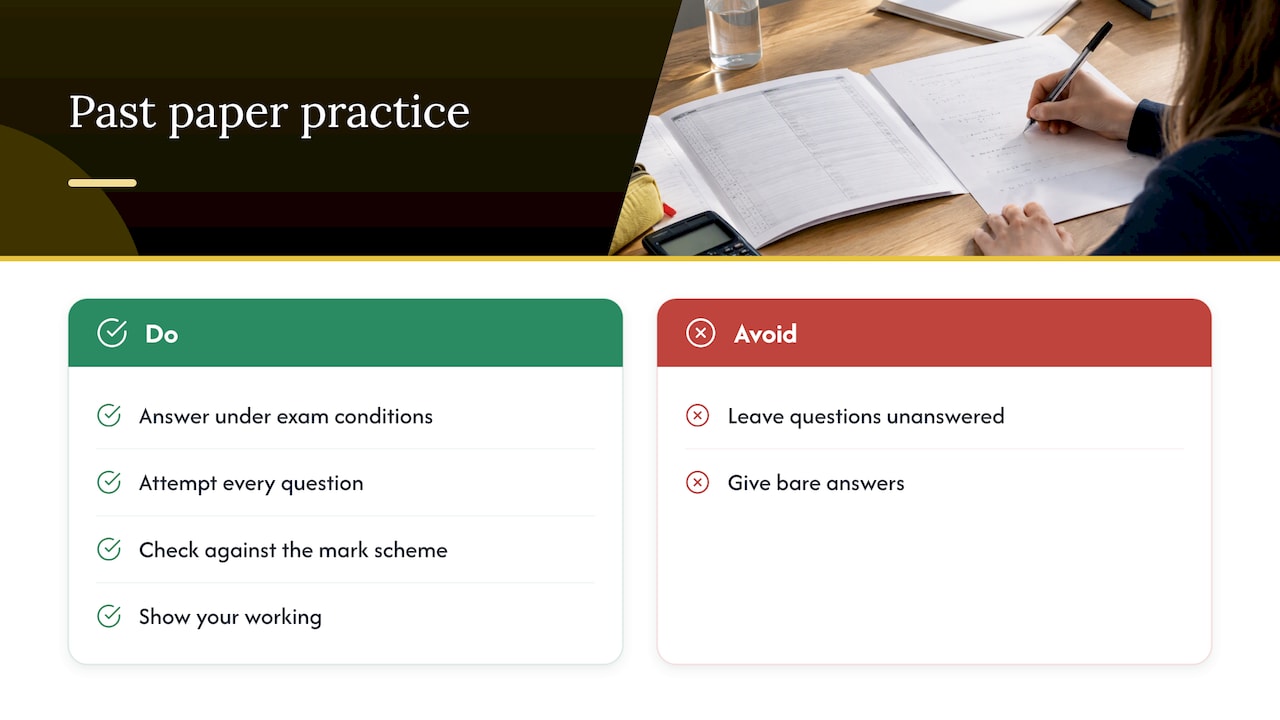
OCR gives similar advice: sit full papers under exam conditions and attempt every question. It explains that M marks are for method working and A marks are for correct answers, and that an A mark generally cannot be awarded without an M mark unless the guidance allows the method to be implied. That is why a bare answer is risky, and why showing your working earns marks even when the final number is wrong.
A routine for each paper
- Prepare. Choose a paper, set a timer to match the real exam and put your phone away.
- Sit it. Attempt every question, including the ones you think you cannot do. A partial method can still earn marks.
- Mark it. Use a different coloured pen. Note method marks, accuracy marks and any marks lost for unclear working.
- Log errors. Write each lost mark against a topic or a habit, such as misreading the question or arithmetic slips.
- Redo. A few days later, retry the questions you got wrong without looking at the solution.
OCR also points out that a mark scheme is not a model answer, and that seeing it removes the problem-solving element of a question. So mark after you have finished, never while you are stuck. If you are unsure how to mark your own work fairly, our guide to marking past papers walks through it, and our page on how to self-mark GCSE papers with board-aligned solutions shows how that works alongside live Q&A.
Spacing your revision: the 2-3-5-7 method
Cramming a topic once and moving on means it fades. Spaced repetition fixes this by returning to a topic at gradually longer gaps. Birmingham City University describes it as a method that involves reviewing at closer intervals, and recommends using it straight after studying something new.
How the method works
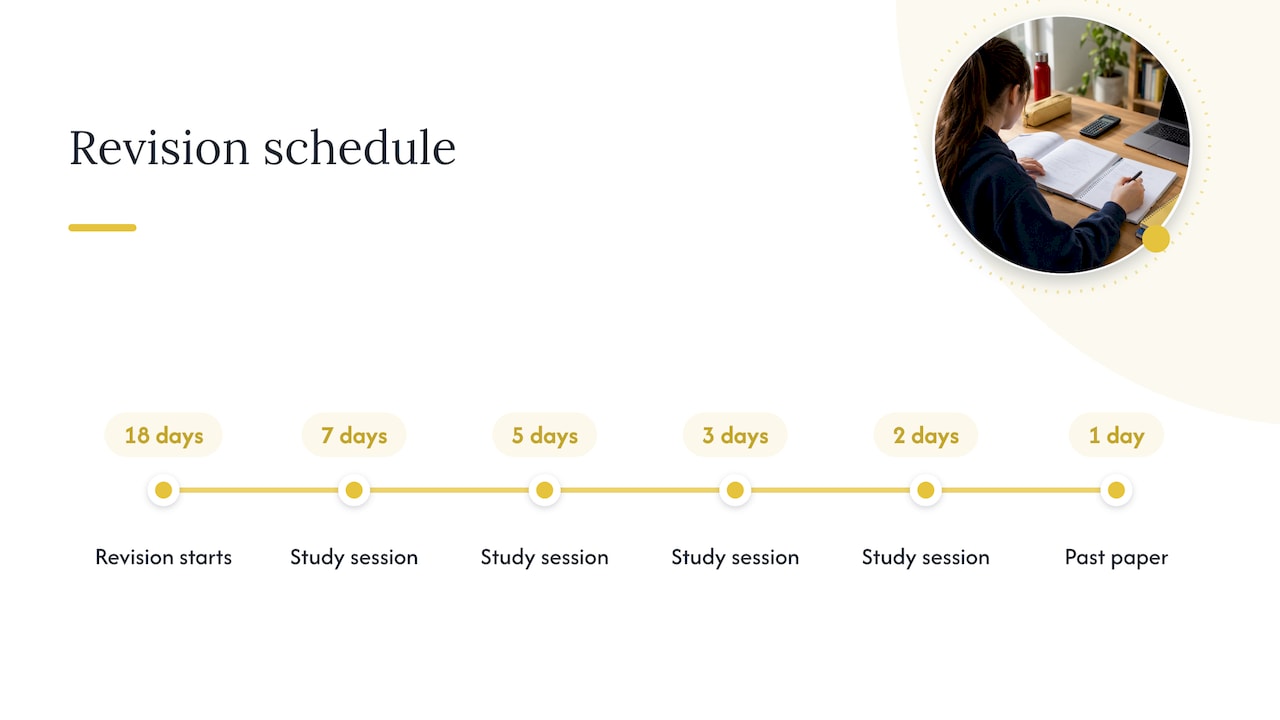
The 2-3-5-7 method plans backwards from the exam. According to the Complete University Guide, you fill your exam dates into a calendar, plan a past paper for the day before each exam, then count back 2, 3, 5 and 7 days to place study sessions for that subject. Revision starts 18 days before the exam. It also uses a mix-and-match approach, switching between subjects to keep your mind fresh.
A worked example for a maths paper
Suppose your paper falls on day 0. Counting back gives these sessions:
| Days before exam | Session |
|---|---|
| 18 | First pass: learn or relearn the topic and note examples |
| 11 | Retrieve from memory, then fix gaps |
| 6 | Mixed questions on the topic with other topics |
| 3 | Timed questions or part of a paper |
| 1 | Full past paper, marked afterwards |
The gaps are 7, 5, 3 and 2 days, with the final session on the day before. Spread across several topics, this gives each weak area repeated, shrinking-gap practice.
Keep going if the exam is further away
The method is a study-skills rule of thumb, not the result of a single experiment. A Paced Study article makes this point, and notes that if your exam is more than about two weeks away, you should keep reviewing gaps after day 7, with spacing that grows as the test gets closer. With GCSE and A-Level exams in the summer, you will usually start well before the 18-day window, so treat it as the final stage of your plan rather than the whole plan.
We look at the evidence in more depth in does spaced repetition actually work for maths.
Building a weekly plan you can stick to
A plan fails when it is too ambitious. Aim for something you can do on a bad week.
- Pick three or four weak topics per week. Rotate through your list so that none disappears for long.
- Schedule short sessions. Four or five slots of 20 to 40 minutes beat one marathon.
- End each session with retrieval. Close your notes and write down what you can recall before you stop.
- Keep one weekly mixed session. Mixed questions train you to recognise which method a question needs.
- Do one paper regularly. Mark it, log the errors and feed them into next week’s list.
If you are revising over a six-week run, our 4 to 6 week plan using exam-aligned video walkthroughs shows how to sequence topics and papers together.
For parents and tutors
If you are supporting a student, you do not need to teach the maths. Ask them to explain a method to you, help them keep the weak-topic list up to date and make sure papers are sat under timed conditions. Praise the habit of marking honestly, since that is what drives improvement.
Revising at A-Level
A-Level asks for longer chains of reasoning, so the same principles apply with a few adjustments.
- Rebuild proofs and derivations from memory. Break a long proof into stages and retrieve each stage separately.
- Practise choosing methods. Mixed sets matter even more when topics across pure, statistics and mechanics can overlap.
- Study the language of the mark scheme. Method marks reward correct setups, so clear, ordered working is vital.
- Use walkthroughs after trying. Our guide to A-Level maths walkthroughs explains how to use them to gain marks rather than to copy answers.
An A-Level maths question bank gives you topic-focused practice once you have identified your weak areas.
Using live help when you are stuck
A stuck student who stays stuck wastes revision time. When a worked solution does not clear things up, ask a person. Our live Q&A sessions are designed for that. They let you bring specific questions, and the guide to getting the most from A-Level live Q&A shows how to prepare a question so you get a useful answer.
Perspective: why we built MathVault around practice
We built MathVault on a simple belief: students improve when they attempt real exam questions, mark them honestly and see how a full solution is built. That is why our archive is organised by exam board and year, and why the solutions are fully worked rather than just final answers.
In our experience, the students who gain the most are those who treat a past paper as a diagnostic tool. They sit it, mark it against the scheme, note which method and accuracy marks they missed, then return to those topics a few days later. Our video walkthroughs and live Q&A sessions are there for the moment after you have tried and got stuck, because that is when explanation is most useful.
We keep the revision materials free because confidence should not depend on what a family can pay. Our paid packs exist for those who want offline, organised sets, and for those who wish to support the site.
Oloru
Start practising with MathVault
If you are ready to put these techniques into action, you can work through AQA GCSE maths past papers from 2017 to 2025 with board-aligned solutions, or explore the rest of our free revision resources from the MathVault home page. Pick one paper, sit it under timed conditions and mark it using the routine above.
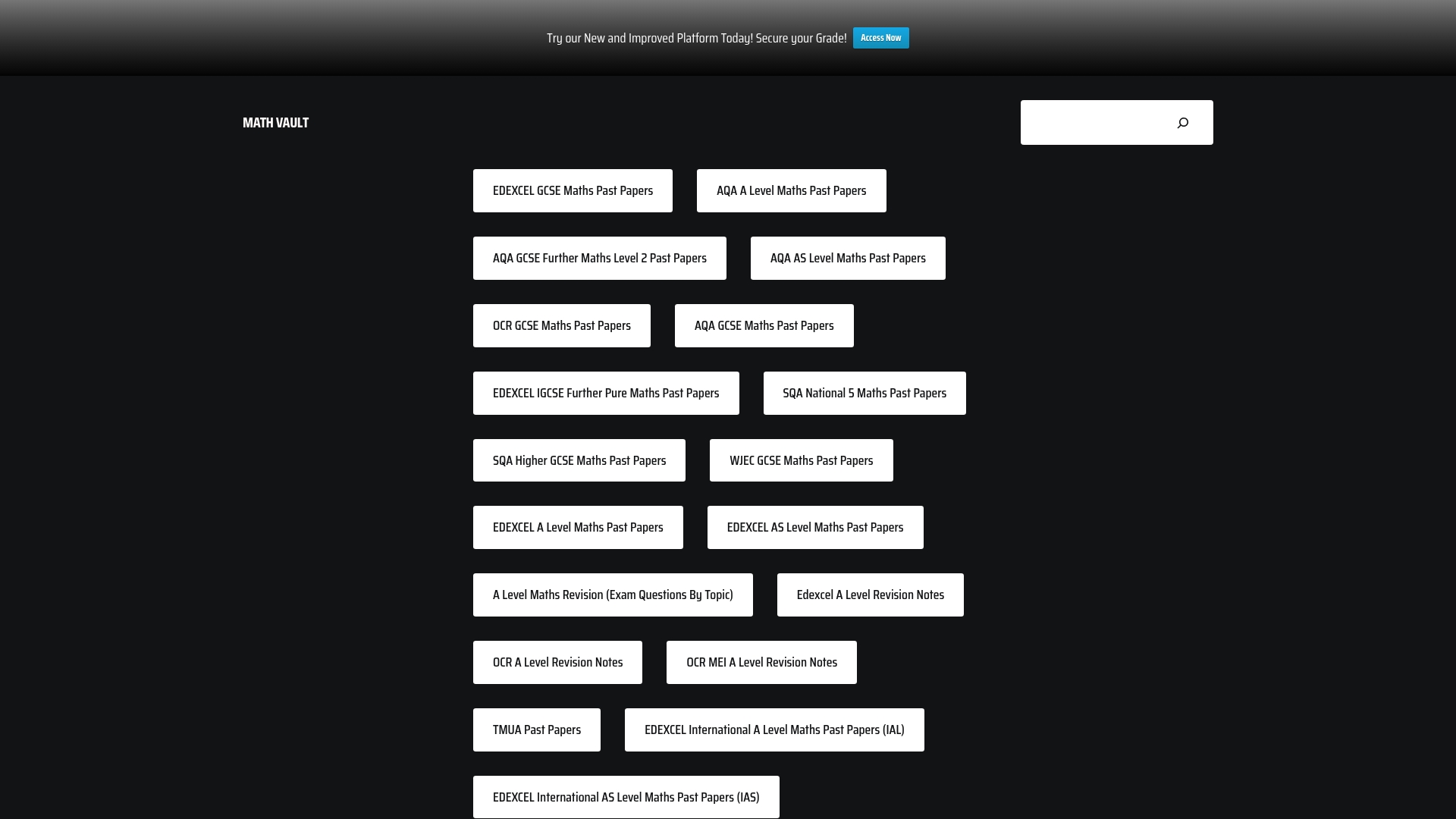
We offer past papers, fully worked step-by-step solutions, video walkthroughs, topic-based revision guides, downloadable revision notes and weekly live Q&A sessions. Most of the revision material is free, and some recent or advanced resources and full downloadable packs are available separately.
Common mistakes to avoid
- Revising only what you already know. It feels good, but the marks are in the weak topics.
- Reading the solution too soon. Try first, even for ten minutes, then compare.
- Skipping the marking. An unmarked paper teaches very little. The learning is in the error log.
- Leaving out working. Without method marks, a small slip can cost the whole question.
- Revising one topic until it is perfect. Return to it later at spaced intervals instead of mastering it in a single sitting.
- Marathon sessions. Short, regular practice tends to hold up better than occasional long ones.
FAQ
How do I revise maths effectively?
Start by sitting a past paper and listing the topics that cost you marks. Then practise those topics with questions rather than notes, mark your work against the mark scheme and revisit weak areas at spaced intervals. Short, frequent sessions work better than occasional long ones.
What is the 2-3-5-7 method of revision?
It is a spaced-repetition timetable that works backwards from your exam. You plan a past paper for the day before, then count back 2, 3, 5 and 7 days to schedule study sessions, which means starting 18 days before. If your exam is further away, keep reviewing weak topics with growing gaps beforehand.
Is two hours of revision a day enough for GCSE maths?
There is no single right number, because what you do in the time matters more than the length. Bitesize suggests regular 15 to 20 minute chunks are better than one long weekly session. Focus on questions, marking and weak topics, and add time if your list of weak topics is long.
Should I revise from notes or from past papers?
Use both, in that order of importance. Notes help you refresh a method, but past papers show whether you can apply it under exam conditions. Mark each paper against the scheme, because that tells you where method and accuracy marks are being lost.
Sources
- BBC Bitesize: Five tips and tricks to help with GCSE Maths revision
- Mathematics Hub: Effective learning and review strategies for students
- Centre for Independent Studies: Maths Practices You Can Count On
- AQA: Revision resources
- OCR: Getting more from past papers
- Birmingham City University: Spaced repetition and the 2357 method
- The Complete University Guide: Creating a revision timetable
- Paced Study: The 2-3-5-7 revision method
Leave a Reply