
An A level maths live Q&A is a scheduled online session where you put your questions to a maths specialist in real time and get the method explained step by step, with the chance to follow up on the spot. Used well, one session can unblock a topic you have been stuck on for weeks. Used badly, it is an hour of watching someone else do maths. This guide explains what happens in a session, how to prepare, how to ask questions that get useful answers, and how to link the live hour to past papers and written solutions.
TL;DR
- A live Q&A works best as a follow-up to your own practice: attempt questions first, then bring the ones that defeated you.
- Send questions in advance or through the chat, and name the topic, the question source and the exact line where you got stuck.
- Recordings matter. Choose sessions you can rewatch if you cannot attend, and pair them with fully worked written solutions.
- Our weekly live Q&A sessions are free, organised by exam board and designed to sit alongside our past papers and video walkthroughs.
- Judge any live resource on four things: who answers, how you ask, whether it is recorded, and whether it matches your exam board.
Table of Contents
- What happens in a live A level maths Q&A
- Which topics come up most
- How to prepare so the session is worth your time
- Using live Q&A alongside past papers and written solutions
- Recordings, captions and missing a session
- Perspective: why we think live support belongs in free revision
- What we offer: free live Q&A and the resources around it
- How to choose a live A level maths Q&A
- Advice for teachers, tutors and parents
- Common mistakes in live Q&A
- FAQ
- Sources
What happens in a live A level maths Q&A
Formats differ, but most sessions follow the same rhythm. A host opens the session and sets the scope: a topic (say, integration or proof), a paper, or an open floor. Students then send questions through a chat or question box. The host picks questions, often grouping similar ones, and works through each on screen, talking through the reasoning as well as the answer. Good hosts stop to ask what you would try next, rather than racing to the result.
The interaction itself is usually simple. For example, Oxford’s mathematics department runs admissions-test livestreams where students submit questions through the live chat and Q&A feature on Slido during the stream. That model, a shared screen plus a moderated question queue, is common across live maths help generally.
A typical session has four parts:
- Scope and ground rules. What the session covers and how to submit questions.
- Worked examples. Sometimes the host starts with one or two exam-style questions to set the tone.
- Student questions. The main body: your questions, explained on screen.
- Wrap-up. Common errors, a pointer to further practice, and often the date of the next session.
What a live session is not: a lecture covering the whole syllabus, or a replacement for practising. It is a targeted tool for the specific points where reading a mark scheme has not been enough.
Which topics come up most
Questions follow the specification you are studying. The Pearson Edexcel A level Maths specification is built around Pure Mathematics, Statistics and Mechanics, and live questions tend to cluster in the same places across boards. From our experience of what students ask, the recurring pressure points are:
- Calculus: differentiation from first principles, integration by substitution and parts, and setting up differential equations from a context.
- Algebra and functions: partial fractions, composite and inverse functions, transformations of graphs.
- Trigonometry: identities, solving equations in a given range, and the small-angle approximations.
- Proof: knowing how to start, and which method (deduction, contradiction, counter-example) fits.
- Sequences and series: binomial expansion with fractional powers, and convergence.
- Mechanics: modelling assumptions, resolving forces, and variable acceleration with calculus.
- Statistics: hypothesis tests, conditional probability, and interpreting the large data set.
If you want the full topic map before choosing what to bring, our guide to the Edexcel A level maths topics sets out each area, and the section on how the three exam papers are structured helps you see where each topic is tested.
How to prepare so the session is worth your time
The students who gain most arrive with work already done. Some live events say so explicitly: the Oxford livestreams encourage students to look at the worksheets or practice problems in advance, so the live time goes on discussion rather than first contact with the questions. The same principle applies to A level revision.
Before the session
- Pick the topic. Check the session’s scope and choose one or two areas that match it.
- Attempt questions cold. Use topic-based past-paper questions, such as those in our Edexcel A level revision topics, and give each a fair try under light time pressure.
- Mark honestly. Use the mark scheme to separate method marks from accuracy marks. Note where you lost each.
- Shortlist two or three questions. Choose the ones where you cannot see why the mark scheme works, not the ones where you made an arithmetic slip.
- Write down where you stopped. The exact line or decision point is what a host needs.
Make your questions easy to answer
Compare two ways of asking:
- Weak: “Can you explain integration?”
- Strong: “Edexcel Paper 2, integration by parts. I chose u as the exponential and the integral got more complicated. How do I decide which part to differentiate?”
The second tells the host the board, the topic, what you tried and the decision you are unsure about. It also gets a reply that will help the next student with the same confusion.
If you want a system for retaining what you learn between sessions, a tool that builds spaced repetition review plans from your own notes can turn each answer into a flashcard you revisit before the next sitting, so the explanation does not fade after a week.
Using live Q&A alongside past papers and written solutions
Live sessions are one part of a revision loop, not the loop itself. A workable weekly pattern looks like this:
| Day | Activity | Purpose |
|---|---|---|
| Early week | Topic questions from past papers | Find the gaps |
| Midweek | Check against mark scheme and written solution | Separate method errors from slips |
| Live Q&A | Bring two or three stuck questions | Get the reasoning explained |
| After | Redo the same questions from a blank page | Prove you can now do it alone |
| Weekend | One full timed paper section | Test under exam conditions |
The step people skip is redoing the question afterwards. Understanding an explanation while it is on screen is not the same as being able to reproduce it. Come back 48 hours later with a blank sheet.
There is also a sensible order for checking answers. Try first, then look at a written solution for the specific step you were stuck on, and only then watch a video if the written version did not land. We explain the trade-offs in written versus video solutions. If you would like a structured run, our 4 to 6 week plan using video walkthroughs shows how to schedule the viewing around your own practice.
Recordings, captions and missing a session
You will not make every session, so check whether the live hour is recorded. Many are: the Oxford livestreams, for instance, are recorded so students can watch later if they cannot join live. Treat a recording as a proper study resource rather than a consolation prize:
- Watch with a pen and pause before the host reveals each step.
- Note timestamps for the questions relevant to your topic so you can return to them.
- Turn captions on if you follow technical language better when you can read it. Our note on checking captions before live events covers what to look for.
If you are mid-problem and cannot wait for a scheduled session, our guide to asking maths questions live lists where to get help straight away.
Perspective: why we think live support belongs in free revision
We built MathVault around a simple observation: the hardest moment in revision is not starting, it is being stuck at 9pm with a mark scheme that shows what the answer is but not why. A past paper tells you that you lost marks. A fully worked solution shows you the route. A live session lets you ask the follow-up question that neither can answer: “But why did you choose that method?”
That is why we offer all three, and why we keep them free. Students in England, Wales and Scotland face the same pressure points, and access to someone who can explain a method should not depend on whether a family can afford a tutor. Our view is that the best live sessions are small in ambition: one topic, a handful of questions, and every explanation tied to how marks are awarded. Method marks, accuracy marks and the examiner traps that catch even strong students are where a live hour pays off most.
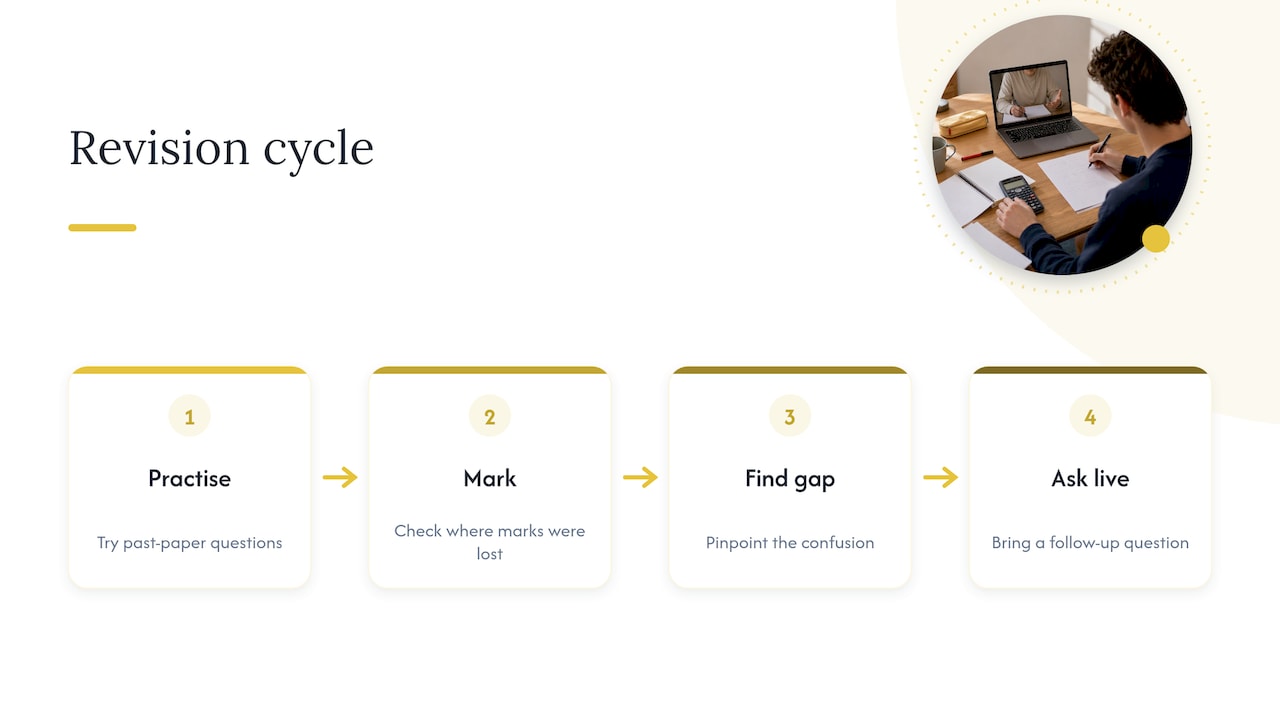
We also think live Q&A should be the end of a good revision cycle rather than the start. Practise, mark, find the exact point of confusion, then ask. Arrive that way and an hour can be worth weeks of unfocused rereading.
— Oloru
What we offer: free live Q&A and the resources around it
Our weekly live Q&A sessions are free, and sit alongside topic-based revision guides, past papers organised by exam board, fully worked step-by-step solutions and video walkthroughs. Most revision materials and most papers cost nothing. Some recent or advanced resources and complete downloadable packs are paid, and some people support the site through small donations. If you are an A level student, start with our A level past-paper questions, pick a topic, and bring your hardest question to the next session. Further maths students can also use our A level further maths revision guide.
How to choose a live A level maths Q&A
Whether you are a student, a parent or a teacher recommending resources, run any option through the same checklist.
Check these before you commit
- Exam board match. Edexcel, AQA, OCR and MEI differ in structure and emphasis. Our page on how Edexcel differs from other A level maths boards is a useful reference for what to ask.
- Who answers. A specialist maths teacher or experienced examiner-level tutor, not a generic chat service.
- How you ask. Live chat, a question form, or voice? Can you send questions in advance?
- Recording. Can you rewatch, and are captions available?
- Written follow-up. Are there worked solutions you can read, not only a video?
- Scope. Does the session cover the topic and level you need, including further maths if relevant?
- Cost and transparency. Is it free, a one-off purchase or a subscription, and is that clear before you sign up?
Types of resource and what each is good for
| Type | Best for | Watch out for |
|---|---|---|
| Free live Q&A from a revision platform | Specific stuck questions, regular routine | Check the schedule and board coverage |
| University outreach livestreams | Stretch material, admissions-style problems | Often aimed at admissions tests, not A level exam technique |
| Paid small-group classes | Structured coverage and accountability | Cost, fixed timetable |
| One-to-one tutoring | Personalised diagnosis | Cost, depends heavily on the tutor |
| Recorded video libraries | Revisiting on demand | No chance to ask follow-ups |
Stretch sessions are worth knowing about: the Oxford worksheets, for example, include extension ideas to investigate after finishing the questions. They suit students aiming for competitive courses, but if your target is the A level exam itself, prioritise sessions that practise exam-style questions and mark scheme language.
Advice for teachers, tutors and parents
Teachers and tutors: use a live session as homework follow-up. Ask students to bring one question each and to state the board, paper and the line where they stopped. It turns a passive viewing task into a diagnostic exercise, and the questions students choose tell you where the class is weakest.
Parents: you do not need to understand integration to help. Ask your child what they are taking to the next session, whether they attempted it first, and whether they redid it afterwards. Those three questions support the habit without requiring subject knowledge.
Homeschooling families: a weekly live session gives a fixed point in the week and a way to check understanding when there is no classroom teacher. Combine it with a structured topic sequence from the Edexcel topic guide so the questions you bring follow a plan.
Common mistakes in live Q&A
- Arriving with nothing attempted. The explanation will not stick without struggle first.
- Asking for a full topic lecture. Questions this broad cannot be answered in a session. Narrow down.
- Copying the solution and moving on. Always redo it from a blank page later.
- Not recording your own notes. Write the reasoning, not just the final answer.
- Waiting until the weeks before the exams. Regular sessions through the year beat a panic in May. For the pressure points students struggle with, see our section on common challenges and how to overcome them.
FAQ
Are live A level maths Q&A sessions free?
It depends on the provider. Our weekly live Q&A sessions are free, as are most of our revision materials. Some other services charge for classes or one-to-one tutoring, so check the cost before you sign up.
Can I watch a session later if I miss it?
Often you can. Some live events are recorded for later viewing, and recordings are worth using as a proper study resource: pause before each step and attempt it yourself. Check the provider’s page for how long recordings stay available.
How do I ask a question during a live session?
Most sessions use a chat or question box, and some let you send questions beforehand. Give the exam board, the topic, what you tried and where you got stuck, so the host can answer precisely.
What should I do before joining?
Attempt past-paper questions on the topic first, mark them with the mark scheme, and pick two or three that you still cannot explain. Redo them from a blank page after the session to check the explanation has stuck.
Sources
- Oxford Maths Admissions Test Livestream, Mathematical Institute, University of Oxford
- Edexcel A Level Maths Specification (Pearson)
Leave a Reply