
What are the Edexcel A level maths topics?
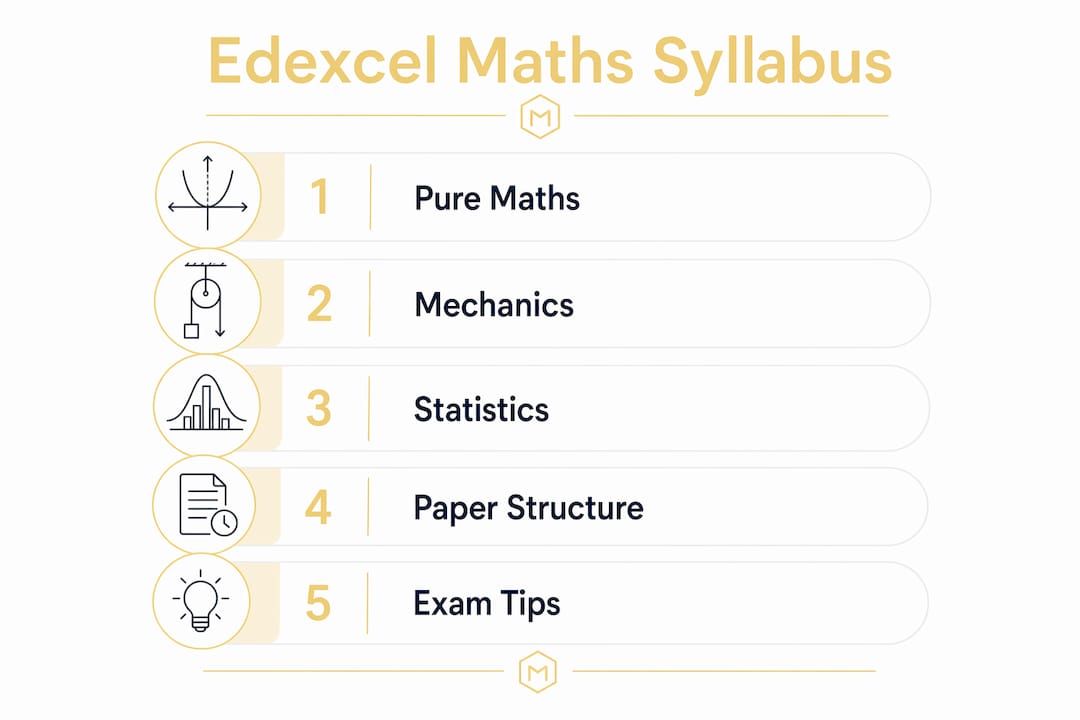
The Edexcel A level maths syllabus (specification code 9MA0) divides into three core branches: Pure Mathematics, Mechanics, and Statistics. Together, these form a fully linear course, meaning all assessments take place at the end of the two-year programme rather than being staggered across years. Here is a quick orientation:
- Pure Mathematics forms the largest portion of the course and underpins every other area.
- Mechanics applies mathematical reasoning to physical situations, from motion to forces.
- Statistics develops your ability to analyse data, calculate probabilities, and test hypotheses.
- The course demands confident recall of key formulae beyond what the exam booklet provides.
- All three branches are assessed across three papers sat in May or June of Year 13.
Table of Contents
- Pure mathematics topics you need to master
- Mechanics topics covered in Paper 3
- Statistics topics covered in Paper 3
- How the three exam papers are structured
- Where to find the best revision resources
- How Edexcel differs from other A level maths boards
- Learning objectives for each topic area
- Common challenges and how to overcome them
- A suggested learning path through the syllabus
- What has changed in the current Edexcel syllabus?
- Key takeaways
- Free Edexcel revision resources from Mathvault
Pure mathematics topics you need to master
The pure mathematics content spans Papers 1 and 2, with no strict topic-to-paper allocation. Any pure topic can appear on either paper, so you must prepare all areas thoroughly.
- Proof — constructing rigorous arguments, including proof by contradiction and exhaustion.
- Algebra and functions — manipulating expressions, solving equations, working with composite and inverse functions, and understanding the modulus function.
- Coordinate geometry — straight lines, circles, and parametric equations in the (x, y) plane.
- Sequences and series — arithmetic and geometric progressions, sigma notation, and the binomial expansion.
- Trigonometry — radians, exact values, identities (including double angle formulae), and solving trigonometric equations.
- Exponentials and logarithms — laws of logarithms, natural logarithms, and modelling with exponential functions.
- Differentiation — first principles, the chain rule, product rule, quotient rule, and applications including optimisation.
- Integration — definite and indefinite integrals, integration by parts, by substitution, and finding areas under curves.
- Numerical methods — iteration, the Newton-Raphson method, and the trapezium rule.
- Vectors — working in two and three dimensions, finding magnitudes, and using position vectors.
Pro Tip: Examiners expect recall of certain identities not supplied in the Mathematical Formulae and Statistical Tables booklet. Build a personal formula sheet early and test yourself on it weekly.
Mechanics topics covered in Paper 3
Mechanics sits in the first section of Paper 3 alongside Statistics. The content applies Newtonian principles to real-world physical problems.
- Quantities and units in mechanics — SI units, scalars versus vectors, and dimensional consistency.
- Kinematics — motion in a straight line with constant or variable acceleration, using the SUVAT equations and calculus-based approaches.
- Forces and Newton’s laws — resolving forces, applying Newton’s three laws, connected particles, and friction.
- Moments — calculating the turning effect of forces, equilibrium of rigid bodies, and centre of mass problems.
Mechanics questions often combine two or more of these areas in a single problem, so understanding how the topics connect is just as important as knowing each one individually.
Statistics topics covered in Paper 3
Statistics shares Paper 3 with Mechanics. The statistics content requires both conceptual understanding and confident use of the statistical tables provided in the exam.
- Statistical sampling — sampling techniques, advantages and limitations of each method, and understanding bias.
- Data presentation and interpretation — histograms, box plots, cumulative frequency, measures of central tendency and spread, including outliers.
- Probability — Venn diagrams, conditional probability, and the addition and multiplication rules.
- Statistical distributions — the binomial distribution and the normal distribution, including using the normal as an approximation to the binomial.
- Statistical hypothesis testing — setting up null and alternative hypotheses, critical regions, and interpreting p-values in context.
How the three exam papers are structured
The Edexcel 9MA0 assessment is fully linear: all three papers are sat at the end of the two-year course, with no opportunity to bank results from earlier sittings.
- Paper 1: Pure Mathematics — a timed exam covering any pure topic from the specification.
- Paper 2: Pure Mathematics — a timed exam with the same broad scope as Paper 1 with no topic ring-fenced to one paper only.
- Paper 3: Statistics and Mechanics — a timed exam split into a Statistics section and a Mechanics section.
- Calculators are permitted in all three papers.
- The Mathematical Formulae and Statistical Tables booklet is provided in every paper, though recall of additional formulae is expected.
Where to find the best revision resources
Effective revision combines official materials with structured practice. The resources below cover every stage of preparation.
- Edexcel past paper questions by topic — Mathvault organises past exam questions by topic with fully worked step-by-step solutions and video tutorials, making targeted revision straightforward.
- Official Edexcel past papers — available via the Pearson qualifications website, these are the most authentic practice material available.
- Mathematical Formulae and Statistical Tables booklet — download and use this from day one so the layout becomes second nature before the exam.
- Video walkthroughs — Mathvault’s video solutions demonstrate worked methods clearly, particularly useful for integration and hypothesis testing where method marks matter.
- Revision notes by topic — concise notes help consolidate understanding after completing practice questions.
- Live Q&A sessions — Mathvault’s free weekly sessions allow you to ask questions in real time, which is particularly valuable when a topic is not clicking from written resources alone.
How Edexcel differs from other A level maths boards
All A level maths specifications in England must meet the same Department for Education subject content criteria, so the core pure mathematics content is broadly consistent across Edexcel, AQA, and OCR. The differences lie in the applied content choices and exam style. Edexcel specifies both Mechanics and Statistics for all students, whereas some boards allow centres to choose their applied content. Edexcel questions also tend to be more structured and formula-driven, which rewards students who practise past papers from the correct board rather than mixing papers from different specifications.

Learning objectives for each topic area
Understanding what examiners actually test within each topic saves revision time. Below are the key learning objectives by area.
- Proof — construct proofs by deduction, exhaustion, and contradiction; identify flaws in given arguments.
- Algebra and functions — solve simultaneous equations, work with partial fractions, and sketch transformations of graphs.
- Trigonometry — prove identities, solve equations in given intervals, and apply the sine and cosine rules.
- Differentiation — find stationary points, determine their nature, and apply differentiation to rates of change.
- Integration — evaluate definite integrals, find areas between curves, and solve differential equations by separation of variables.
- Normal distribution — standardise values, use the inverse normal, and apply the distribution in hypothesis testing.
- Kinematics — derive equations of motion using calculus and interpret velocity-time graphs.
Common challenges and how to overcome them
Certain topics catch students out repeatedly, often because the underlying concept is sound but the exam technique is not.

Integration is the most frequently cited difficulty. The fix is systematic: identify the method first (substitution, by parts, or standard result), then execute. Practising the decision-making step separately from the calculation itself builds speed and accuracy.
Hypothesis testing trips students up on language. Examiners award marks for precise conclusions stated in context, not just a correct p-value. Write your conclusion as a full sentence every time you practise, referencing the original claim.
Proof questions reward students who write every step explicitly. Skipping lines costs method marks even when the final result is correct.
Pro Tip: After each practice paper, categorise every lost mark by topic. Three sessions of targeted work on your two weakest areas will outperform six sessions of general revision.
A suggested learning path through the syllabus
Sequencing your study sensibly reduces the time spent revisiting earlier material.
- Algebra and functions first, as this underpins almost every other topic.
- Coordinate geometry and trigonometry next, building on algebraic manipulation.
- Differentiation, then Integration, in that order, since integration techniques build on differentiation concepts.
- Exponentials and logarithms alongside integration, as the two topics overlap in exam questions.
- Sequences and series, then Numerical methods and Vectors to complete the pure content.
- Statistics topics as a block, starting with probability before moving to distributions and hypothesis testing.
- Mechanics topics last, applying the calculus skills developed in the pure strand to kinematics problems.
What has changed in the current Edexcel syllabus?
The current specification (Issue 4) has been in place since first teaching in September 2017. The substantive content has remained stable, but Pearson has issued minor clarifications across several sections, including updated guidance on proof by exhaustion, clearer wording around completing the square, and a correction to the exact values required for tan. No topics have been added or removed in recent issues. Students should always download the latest version of the specification directly from the Pearson qualifications website to confirm they are working from the current issue, particularly if using older revision materials.
Key takeaways
The Edexcel A level maths syllabus covers Pure Mathematics, Mechanics, and Statistics across three linear papers, all sat at the end of Year 13.
| Point | Details |
|---|---|
| Three core branches | Pure Mathematics, Mechanics, and Statistics form the complete A level maths syllabus. |
| Linear assessment | All three papers are sat at the end of the two-year course; no results can be banked early. |
| Pure topics on both papers | Any pure topic can appear on either Paper 1 or Paper 2, so full preparation across all areas is required. |
| Formula recall matters | The exam booklet does not supply every formula; memorising additional identities is part of exam readiness. |
| Mathvault for free revision | Mathvault provides topic-organised past paper questions, worked solutions, and live Q&A sessions at no cost. |
Free Edexcel revision resources from Mathvault
Knowing the syllabus is half the battle. Putting that knowledge into practice with the right materials is what moves the grade.
Mathvault gives you free access to Edexcel A level past paper questions organised by topic, each accompanied by fully worked step-by-step solutions and video walkthroughs. When a method is not clicking from written notes alone, the video explanations show exactly how an examiner expects the working to be laid out. Live weekly Q&A sessions mean you can get a direct answer to a specific question rather than spending an hour searching through textbooks. Every resource on Mathvault is free to use, covering all major UK exam boards including Edexcel. Head to Mathvault now and work through the topics where you know you are losing marks.
Leave a Reply