
Start with topic-by-topic past questions and Mathvault’s fully worked solutions — that combination gives you the fastest, most structured route into A level further maths revision. In the next 24 hours, pick one topic where you feel least confident, download a worked solution pack, and attempt three timed questions before checking your method against the mark scheme.
- Fastest wins: topic-sorted exam questions with worked solutions, followed by a timed past paper under exam conditions
- First action: log every error from those three questions — method slip, algebraic error, or misread — and that list becomes your first revision priority
Pro Tip: Before you open a revision guide, write down the three topics you find hardest. Every resource you use in the first week should address at least one of them.
Table of Contents
- Where do you find topic-by-topic exam questions for further maths?
- Which revision notes actually work, and when should you use them?
- How should you use past papers and timed mocks?
- How do short video lessons fit into your revision routine?
- How do you match resources to your exam board?
- What does an evidence-backed study plan look like for further maths?
- Where can you download full revision packs and worked solutions?
- Key takeaways
- Four weeks is enough — if you use them correctly
- Mathvault gives you organised packs and live support, all free
- Useful sources and official links
Where do you find topic-by-topic exam questions for further maths?
Topic-sorted question sets are the most efficient way to build fluency in Further Maths. Rather than working through a full paper and encountering every topic at once, drilling one topic at a time lets you spot repeated structures, practise method variations, and build speed before mixing topics under timed conditions.
Mathvault’s Edexcel topic question pages organise past paper questions by topic with board-aligned worked walkthroughs — useful for method learning and for checking whether your approach matches what the examiner expects. AlevelMathsRevision provides categorised Further Maths exam questions drawn from past papers, making it straightforward to isolate a single topic for a short drill. MyExamRevision’s AQA Further Maths pages organise topics into Core Pure, Mechanics, Statistics, and Discrete, which helps you map the specification before you begin. For Edexcel students, MyExamRevision’s Edexcel pages break the syllabus into 51 topics mapped to papers and options — a practical cross-check for coverage gaps.

Structure your topic drills in short, focused bursts of 20–30 minutes. Attempt a set of questions, mark them immediately, and log every error by type: wrong method, algebraic slip, or misread question. That error log is more valuable than the questions themselves.
Pro Tip: Attempt the same question three different ways and compare speed and reliability. This trains you to identify the most efficient method under pressure — a habit that pays off significantly in long Paper 3 questions.
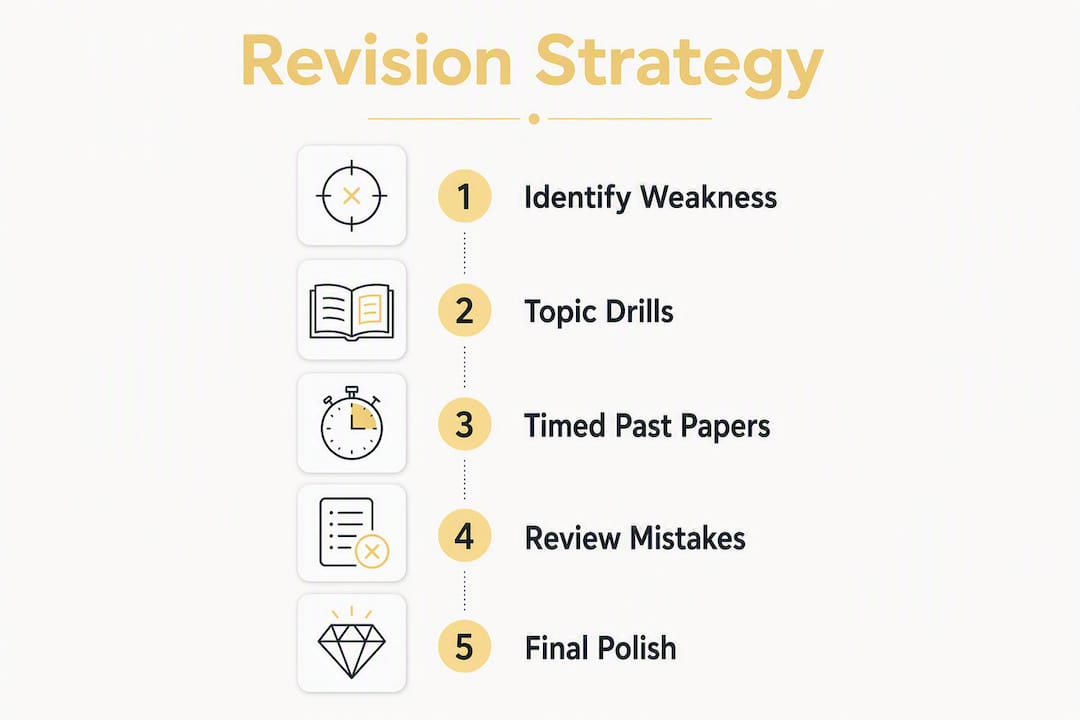
Which revision notes actually work, and when should you use them?
The type of notes you need changes as your revision progresses. Early in the cycle, one-page concept sheets help you consolidate understanding of a topic before you attempt questions. Closer to mocks, worked example sheets let you check your method against a model answer. In the final days, formula crib sheets and brief recall prompts are all you need.
A good 10-minute topic summary contains four things: the key formulae (in exact form), the two or three most common question types for that topic, one fully worked exemplar showing every line of working, and a short note on the most frequent examiner trap. Nothing more. If your summary runs to three pages, it is a set of notes, not a revision tool.
Integral Maths provides structured resources aligned to A level specifications, including topic notes and practice questions — worth using for initial consolidation on topics such as complex numbers or matrices. The Mathvault differentiation guide and the A level formula booklet are both useful for building crib sheets quickly.
- One-page concept sheets: best for initial consolidation; write them yourself from a worked example, not from a textbook
- Worked example sheets: use pre-exam, to check method against board expectations
- Formula crib sheets: final-week recall tools; keep exact forms throughout
Pro Tip: Condense each topic onto one index card, then cover it and recite the key formulae and question types aloud. If you cannot recall a formula without looking, it is not yet revision — it is still learning.
Avoid passive highlighting and overlong notes. Algebraic manipulation fluency — completing the square, partial fractions, factor theorem, surd manipulation — is the core skill that separates A from A* in Further Maths. Your notes should reinforce method, not replace practice.
How should you use past papers and timed mocks?
Past papers are the single most useful resource for A level Further Maths revision. Working through every available paper from your board, marked strictly against the scheme, identifies method and timing weaknesses faster than any other approach. Once you have exhausted your board’s papers, equivalent papers from other boards provide additional practice — provided you check the specification first (see Section 6).
Mathvault’s further maths past papers hub is a practical starting point for accessing board-organised papers and downloadable packs. Official board websites hold the most recent papers and mark schemes.
Timed mock checklist:
Before:
- Check which calculator is permitted for that paper.
- Set a timer based on the paper’s total marks — allow roughly 1.5 minutes per mark as a working rule.
- Remove all notes and work in silence.
During:
- Write full structured working for every question, even when the answer seems obvious.
- Keep exact form (surds, fractions, exact trigonometric values) until the final line.
- If a question takes significantly longer than 1.5 minutes per mark, flag it and move on.
After:
- Mark against the scheme immediately — do not wait until the next day.
- Categorise every lost mark: method error, accuracy error, or misread question.
- Redraft every flagged question within 48 hours, without looking at the solution first.
Pro Tip: Double-mark your mock: once for the answer, once for the working. Mark schemes award method marks when working is clear and exact form is preserved — a wrong final answer with correct method still scores. Treat the scheme as a scoring system, not just an answer key.
How do short video lessons fit into your revision routine?
Short, focused videos — ideally 5–10 minutes per topic — serve a specific purpose in Further Maths revision: they clarify a concept or worked method quickly, without replacing active practice. The AMSP (Advanced Mathematics Support Programme) provides resources specifically designed for A level Further Maths students, including topic-focused materials in the FMSP tradition. Save My Exams offers short video walkthroughs alongside revision notes and topic questions, organised by board.
Watch each video three times with a clear purpose:
- First watch: follow the structure and note the method steps without writing anything.
- Second watch: pause after each step and reproduce the working yourself before the video continues.
- Third watch: close the video after the question is set, attempt the full solution independently, then compare.
Build a playlist by weakness, not by topic order. Start with your two or three weakest Core Pure topics — complex numbers, matrices, or series, depending on your board — then move to your chosen options (Further Mechanics, Further Statistics, or Decision). Keep each session to two or three videos maximum; more than that and active engagement drops.
Pro Tip: Active watching means predicting the next line before the video shows it. If you cannot predict it, that is the exact point where your understanding needs work — pause, attempt the step, then continue.
How do you match resources to your exam board?
Using a paper from the wrong board or the wrong specification year is a common and costly mistake. Before attempting any past paper, check three things: the specification code (e.g. 9FM0 for Edexcel), the paper variant (Paper 1, Paper 2, or an options paper), and the year the paper was sat.
| Exam board | Specification name | Core papers | Options available |
|---|---|---|---|
| Edexcel | A Level Further Mathematics (9FM0) | Core Pure 1 & 2 | Further Mechanics, Further Statistics, Decision |
| AQA | A Level Further Mathematics | Paper 1 & 2 (Core Pure) | Mechanics, Statistics, Discrete |
| OCR/MEI | A Level Further Mathematics B (MEI) | Core Pure, Pure Major | Mechanics, Statistics, Modelling with Algorithms |
| CCEA | A Level Further Mathematics | Pure, Applied | Mechanics, Statistics |
| Cambridge (Pre-U) | Further Mathematics | Paper 1 & 2 | Further Applications |
MyExamRevision’s AQA Further Maths board pages and Edexcel pages both provide topic breakdowns that map directly to specification sections — useful for confirming you are practising the right content. Mathvault’s board-organised pages follow the same structure.
Cross-board papers are worth using for extra practice once you have exhausted your own board’s materials, but always note which topics differ. Edexcel’s Decision Mathematics option, for example, covers algorithms and graph theory that AQA’s Discrete option approaches differently. Practising the method is transferable; the exact notation and question style may not be.
- Check before you attempt: specification code, paper variant, and year
- Cross-board practice: use for method exposure, not specification coverage
- Board-specific topic lists: use MyExamRevision or Mathvault board pages to cross-check your coverage
What does an evidence-backed study plan look like for further maths?
A six-week block works well for most students, with each week combining topic drills, a timed mock, and a structured error review.
Six-week plan:
- Week 1: Core Pure fluency — algebra drills (completing the square, partial fractions, factor theorem), complex numbers, matrices. No full mocks yet; topic questions only.
- Week 2: Further Pure consolidation — series, proof by induction, differential equations. Begin timed topic sets (30 minutes per topic).
- Week 3: Options topics — work through your chosen options (Mechanics, Statistics, or Decision) using topic question sets. One timed half-paper at the end of the week.
- Week 4: Mixed topic practice — attempt questions that combine two or more topics. One full timed mock with strict marking.
- Week 5: Past papers — one full paper per session, marked immediately. Error log reviewed and redrafted within 48 hours.
- Week 6: Polish and consolidation — target remaining weak spots from error logs, review examiner reports, final formula sheet check.
48/24/8 last-minute checklist:
- 48 hours before: complete one final timed mock, mark it, and review your error log. No new topics.
- 24 hours before: review your formula crib sheets and worked exemplars for your three weakest topics. Sleep at a normal time.
- 8 hours before: read through your one-page concept sheets once. Check your calculator, stationery, and exam timetable. Nothing new.
Pro Tip: Use spaced retrieval for algebraic fluency: write out a manipulation drill (e.g. five partial fractions questions) at the start of every revision session, before you open any notes. Two minutes of cold recall at the start of each session builds automaticity faster than blocked practice.
The 1.5 minutes per mark rule is a practical pacing guide for timed practice. If a question consistently takes longer, the issue is usually method inefficiency or algebraic fluency, not knowledge — and that tells you exactly where to focus.
Where can you download full revision packs and worked solutions?
Organised downloads save time and make offline revision significantly more practical. Mathvault offers downloadable revision packs and fully worked solutions organised by board, alongside topic-organised question lists — a practical first stop for building an offline revision library.
Download priority order:
- First: worked solutions by paper for your exam board (these anchor your marking routine)
- Second: topic question packs for your three weakest areas
- Third: the official formula booklet for your board — keep it open during every timed session
- Fourth: timed mock bundles for the final two weeks
A good worked solution pack contains step-by-step working with every line shown, notes on where method marks are awarded, alternative methods where they exist, and brief examiner commentary on common errors. Packs that only show the final answer are not worth your time.
Organise your downloads by board, then by paper type (topic pack, full paper, worked solutions), then by year. A simple folder structure — Board > Paper Type > Year — prevents the common problem of attempting a paper you have already marked.
Pro Tip: Convert worked solutions into active revision tasks: read the solution once, close it, and reproduce the full working from memory. Then compare line by line. Any line you cannot reproduce is a gap — not in knowledge, but in method fluency.
Key takeaways
Structured A level further maths revision built around topic questions, timed past papers, and fully worked solutions gives you the clearest path to consistent marks across all papers.
| Point | Details |
|---|---|
| Start with topic questions | Drill one topic at a time using board-aligned question sets before attempting full papers. |
| Use the 1.5-minute rule | Allow roughly 1.5 minutes per mark in timed practice; consistent overruns signal a method or fluency gap. |
| Mark schemes reward method | Write full structured working and keep exact form throughout — method marks are awarded even when the final answer is wrong. |
| Build a 6-week plan | Rotate topics weekly, run one timed mock per week from Week 4, and review your error log within 48 hours. |
| Mathvault for downloads | Mathvault provides board-organised worked solution packs and topic question sets as a primary download resource. |
Four weeks is enough — if you use them correctly
The most common mistake in Further Maths revision is spending too long reading and not long enough doing. Students who score at the top of the grade boundary are not necessarily those who know the most content — they are the ones who have practised retrieving and applying it under timed conditions, repeatedly, until the method is automatic.
If I had four weeks, this is how I would structure them:
Week 1 — Core Pure fluency. Every session starts with a five-minute algebra drill: partial fractions, completing the square, factor theorem. No exceptions. The rest of the session is topic questions on complex numbers and matrices, marked immediately. Algebra is the substrate of everything else in Further Maths; weaknesses here cascade through every long question.
Week 2 — Further Pure and consolidation. Series, proof by induction, differential equations. I would use short AMSP-style videos to clarify any concept I could not reproduce from memory, then practise the same question three ways to find the fastest reliable method. One timed half-paper at the end of the week, marked strictly.
Week 3 — Options and mixed practice. Work through the chosen options topics using topic question sets, then begin mixing topics within a single session. This is where the three-way method test pays off: you start to see which approach is fastest under pressure, not just which is correct.
Week 4 — Timed papers and polish. One full timed paper every other day, marked immediately, with every error redrafted within 24 hours. On non-paper days: formula sheet review, examiner report reading, and cue-card recall. The night before the exam, nothing new — just a single read-through of your one-page concept sheets.
Keep your algebra neat throughout. Underline key phrases in each question before you write a single symbol. Hold exact form until the very last line. These habits do not just look good — they protect your method marks when the final answer goes wrong.
Mathvault gives you organised packs and live support, all free
Mathvault is the direct route to everything this plan requires: board-organised past paper questions, fully worked step-by-step solutions, short video walkthroughs, and live weekly Q&A sessions — all free. Where other platforms scatter resources across multiple pages or charge for worked solutions, Mathvault organises everything by exam board and topic so you can move from download to timed practice without hunting around.
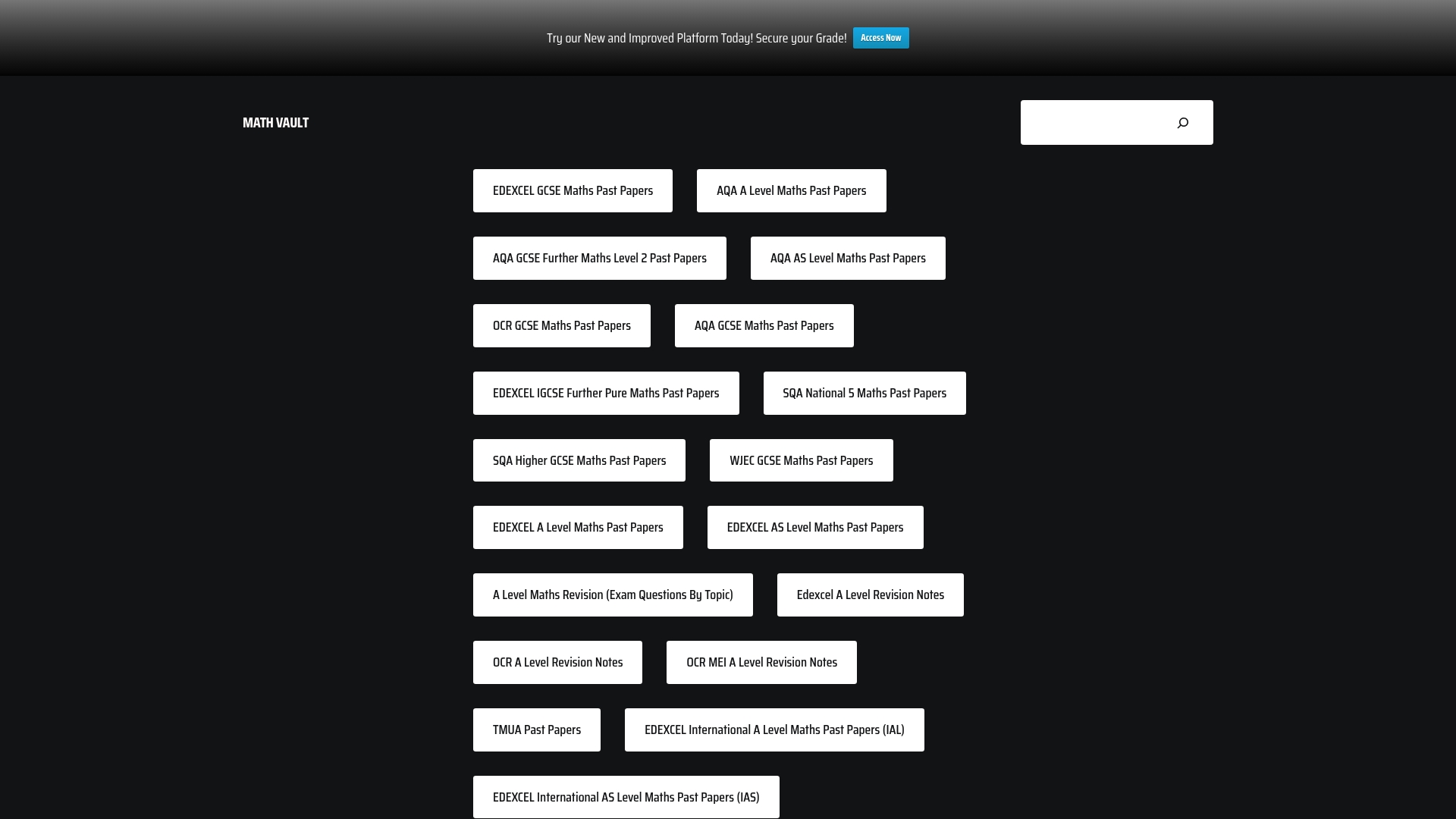
The Edexcel A level topic question packs are a strong starting point for Edexcel students, with worked walkthroughs that align directly to board expectations. The live Q&A sessions let you bring specific questions from your error log and get them answered in real time — a practical complement to solo timed practice. For students who want a complete offline library, downloadable revision packs are available to support every stage of the six-week plan above.
Visit Mathvault to download your first topic pack or check the schedule for the next live Q&A session.
Useful sources and official links
Verifying a paper’s year and specification before you attempt it takes under a minute and prevents wasted practice. Check the specification code printed on the front of the paper, confirm the paper variant (e.g. Core Pure 1 vs an options paper), and cross-reference the year against your board’s current specification — papers from before a specification change may test content or notation that no longer appears.
- Mathvault further maths past papers hub: board-organised past papers with worked solutions and downloadable packs; use as your primary download source
- MyExamRevision AQA Further Maths: topic breakdowns for AQA, including Core Pure, Mechanics, Statistics, and Discrete
- MyExamRevision Edexcel Further Maths: 51-topic breakdown mapped to papers and options; useful for coverage checks
- AlevelMathsRevision categorised questions: categorised Further Maths exam questions by topic for targeted drills
- AMSP student resources: topic-focused materials and support specifically for A level Further Maths students
- Save My Exams Further Maths: board-organised revision notes, topic questions, and video walkthroughs
- Integral Maths: structured topic notes and practice questions aligned to A level specifications
- NRICH Further Maths resources: challenge problems and enrichment material for students aiming at the top grades
Examiner reports are among the most underused resources available. Every board publishes them after each series, and they explain precisely where candidates lost marks, what the top answers did differently, and which topics caused the most widespread difficulty. Reading the examiner report for your most recent past paper attempt takes 15 minutes and often reveals a pattern in your error log that question practice alone would not surface.
A note on this guide: the information here is general revision guidance and does not constitute professional academic advice. Always verify current specification details and paper availability directly with your exam board.
Leave a Reply