
Sign errors, misapplied differentiation or integration rules and calculator misuse cost the most marks in A Level calculus, usually alongside a failure to show working. The single most effective fix is to write the rule you are using before you touch the algebra, and to annotate every substitution, limit and calculator mode as you go. Examiner reports from AQA, Pearson and OCR back this advice directly, and we unpack their evidence below.
TL;DR:
- Applying the correct calculus rule and annotating every step, including substitutions and signs, greatly reduces common errors in differentiation and integration.
- Remember to change limits in definite integrals and re-substitute in the original variable to avoid slips when using substitution methods.
- Always confirm calculator mode, round only at the last step, and support numerical answers with clear working to prevent calculator-related mark losses.
- Rewriting algebraic and trigonometric expressions into standard forms before differentiation prevents many sign and simplification errors.
- Carefully reading and responding to command words like “show that” ensures detailed reasoning, which helps secure method marks even if the final answer is slightly off.
Table of Contents
- 1. Common errors in differentiation and how to avoid them
- 2. Common integration errors and exam-safe ways to show working
- 3. Calculator and numerical errors: mode, rounding and when a calculator hurts your mark
- 4. Algebra and trigonometry slips that masquerade as calculus errors
- 5. Exam technique: command words, showing working and rescuing method marks
- 6. A concise exam checklist and revision routine to stop losing marks in calculus
- 7. How MathVault resources and examiner reports support avoiding A Level calculus mistakes
- Small, realistic changes that improve marks
- How we can help you stop losing marks in calculus
- FAQ
- Sources
1. Common errors in differentiation and how to avoid them
Differentiation mistakes rarely come from not knowing the rules. They come from applying the right rule to the wrong structure, or rushing the bookkeeping that holds a multistep answer together. Before multiplying anything out, decide which rule the expression actually calls for.
- Product rule: write u, v, u’ and v’ separately before combining them; never multiply terms out first and differentiate the mess that results.
- Quotient rule: keep the denominator squared and double-check the order of subtraction in the numerator, since reversing it is the single most common slip.
- Chain rule: differentiate the outer function first, then multiply by the derivative of the inner function, and write that inner derivative on paper even when it looks obvious.
- Sign tracking: annotate every sign change explicitly rather than carrying it in your head across several lines.
Implicit differentiation brings its own trap: students differentiate terms in y as though they were terms in x, forgetting the dy/dx that must appear from the chain rule each time. Parametric differentiation causes a related slip, where students divide dy/dt by dx/dt the wrong way round, or forget to convert a final answer back in terms of x when the question asks for it. Our implicit differentiation guide walks through both of this step by step with worked exam-style questions.
Here is a typical misstep. The corrected working reads: let u =
² + 1, so y = u⁴, du/dx = 6x, and dy/dx = 4u³ × 6x = 24x(3x² + 1)³. An examiner marking this would award the method mark for recognising the chain rule structure even before seeing the final line, provided the intermediate step linking u and its derivative is visible.
That point matters more than it sounds. Pearson’s own examiner feedback notes that a correct method can still earn the method mark even when the final numerical answer is slightly off, which means a slip in late-stage algebra does not have to cost you everything, as long as the structure of your working is clear Pearson’s January 2025 examiner report. If you spot an algebra slip after the fact, do not cross out the whole answer. Leave the correct method visible and fix only the line where the error occurred, since examiners mark the method trail, not just the final box.
Pro Tip: If you realise an error only on your final line, write “check” beside the earlier correct step rather than scrubbing it out entirely; a visible, intact method often still earns the marks it deserves.
Our differentiation rules revision guide covers each rule with the kind of worked examples that make these habits automatic well before exam day.
2. Common integration errors and exam-safe ways to show working
Integration punishes carelessness in a way differentiation often forgives, mostly because the constant of integration, the limits and the direction of a substitution all have to survive several lines of algebra intact.
For indefinite integrals, forgetting +C is the most basic error, and examiners expect to see it whenever no limits are given. For definite integrals, +C cancels out, but students sometimes include it anyway out of habit, or worse, drop a limit altogether partway through a long calculation. A quick sanity check: if your answer to a definite integral representing an area comes out negative when the curve sits above the x-axis across that interval, you have almost certainly swapped the limits or mishandled a sign.
Substitution causes two recurring problems. The first is forgetting to change the limits when you substitute in a definite integral; the second is forgetting to substitute back to the original variable when you do not change the limits. Both are avoidable with one habit: decide at the start of the question which workflow you are using.
- Change the limits: when you substitute u = f(x), convert both limits into u-values immediately and write “limits changed: x = a → u = …” on your script.
- Back-substitute: if you prefer to integrate entirely in u and convert at the end, write the final answer back in terms of x before applying the original limits, never after.
Integration by parts adds a third failure point: choosing u and dv the wrong way round so the integral gets harder rather than easier. A reliable rule of thumb is to let u be the term that simplifies when differentiated (such as x or ln x) and dv be the term that is straightforward to integrate (such as eˣ or cos x). A common sign mistake follows from the formula itself: students forget the minus sign in ∫u dv = uv − ∫v du, and that single dropped sign can undo an otherwise correct method.
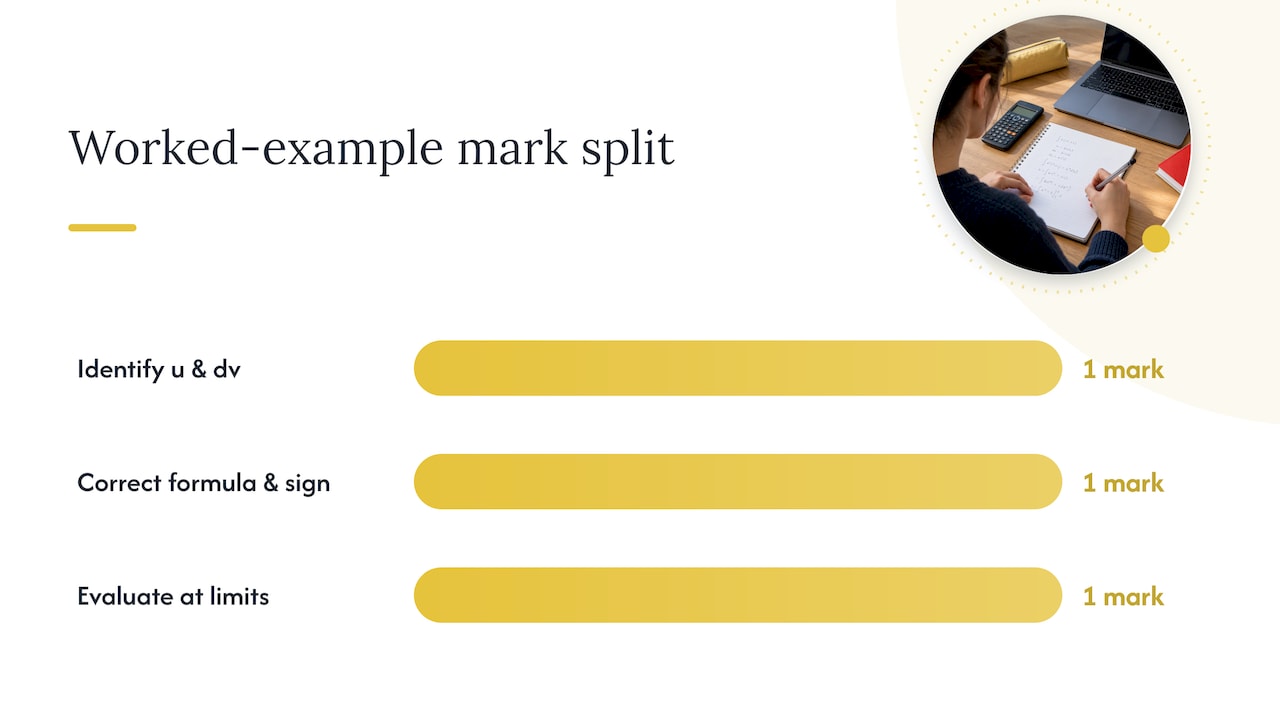
Here is a short worked example an examiner would recognise. Find ∫₀^π/2 x sin x dx. Let u = x, dv = sin x dx, so du = dx and v = −cos x. The formula gives [−x cos x]₀^π/2 + ∫₀^π/2 cos x dx. Evaluating the bracket gives 0 − 0 = 0, and the remaining integral gives [sin x]₀^π/2 = 1. The final answer is 1. The examiner mark scheme would typically award one mark for correctly identifying u and dv, one for the correct by-parts formula with the right sign, and one for correct evaluation at the limits, so losing the final arithmetic step still leaves two marks recoverable.
Pro Tip: Annotate every substitution with the exact limit change on paper, since this single line is often what separates a method mark awarded from a method mark withheld.
3. Calculator and numerical errors: mode, rounding and when a calculator hurts your mark
A calculator should support your working, not replace it. Examiner reports consistently describe the same handful of numerical slips appearing year after year, and nearly all of them are avoidable with a five-second check.
- Using degree mode instead of radian mode (or vice versa) when the question involves calculus with trigonometric functions.
- Over-rounding or truncating intermediate values, which then compounds into a visibly wrong final answer.
- Reading a value straight off a graphical calculator display and writing it down with no supporting algebra.
- Quoting a final answer to the wrong number of significant figures relative to what the question specifies.
Pearson’s own examiner feedback documents exactly this pattern: degree and radian mode confusion and over-rounding are repeatedly cited as avoidable causes of lost accuracy marks, and answers built entirely from a graphical output with no shown method frequently cannot score the method marks at all, even when the number itself is correct Pearson examiner report. AQA’s reporting echoes the same concern from a different angle, warning that calculator solutions offered without supporting working often fail to receive credit wherever a question explicitly calls for justification AQA Paper 2 examiner report.
AQA’s examiner report states that calculator-derived answers submitted without supporting working often fail to earn marks where a question demands justification, which means the habit of writing out your method is not optional polish, it is the difference between full and zero credit on certain question types.
Before you write a final answer down, run this four-step check: confirm the calculator is in the correct mode for the question, glance at the display to confirm it matches what you expect in scale and sign, round only at the very last step and to the precision asked for, and do one quick manual check (such as estimating the answer by substituting a rounder number) to catch anything wildly off. Use the calculator freely for arithmetic, but perform the differentiation, integration or substitution step by hand on paper, since that is the part examiners are actually marking.
4. Algebra and trigonometry slips that masquerade as calculus errors
A surprising share of what looks like a calculus mistake is really an algebra or trigonometry mistake wearing a calculus disguise. A student who correctly applies the quotient rule but then simplifies the resulting fraction incorrectly will still lose the accuracy mark, even though the calculus itself was flawless.
Common culprits include incorrectly combining fractions over a common denominator after differentiating a quotient, misapplying trig identities such as confusing sin²x + cos²x = 1 with a double-angle formula, and mishandling negative indices or fractional powers when rewriting an expression before differentiating it. A question involving √x, for instance, is far easier to differentiate once rewritten as x^(1/2), and students who skip that rewriting step often apply the power rule incorrectly to the root form instead.
- Factorisation: practise spotting common factors quickly, since a factorised derivative is usually what a “show that” question expects as its final line.
- Fraction rearrangement: drill combining and simplifying algebraic fractions, the step where quotient rule answers most often go wrong.
- Trig identities: keep the core identities (double angle, Pythagorean) fluent enough to recall instantly mid-calculation.
- Indices and surds: convert roots and reciprocals into index form automatically before differentiating or integrating.
Before starting a calculus practice session, spend a few minutes on a short warm-up: simplify two or three algebraic fractions, rewrite two expressions involving surds in index form, and recall one trig identity from memory without checking a formula sheet. If any of these feel slow, that is the actual gap to close, not the calculus rule sitting on top of it. A useful habit here is to rewrite any expression into a standard form, fully factorised, with a common denominator or in simplified trig form, before you differentiate or integrate it, since this single step prevents a large share of the sign and distribution errors that follow.
5. Exam technique: command words, showing working and rescuing method marks
Command words are instructions, not decoration, and misreading one is a quiet but frequent source of lost marks. “Show that” demands a full, convincing chain of algebra leading to a given result, with no steps skipped, because the examiner already knows the answer and is marking the journey. “Determine” and “find” generally expect a clear method and a final answer, but allow slightly more flexibility in how you present intermediate steps. “Hence” means you must use a previous result or method, not start again from scratch with a different approach.
OCR’s examiner report for its Pure Mathematics paper found that many candidates did not provide sufficiently detailed reasoning for command-worded questions, and lost marks as a direct result, even when their final answer was correct OCR examiner report. The same report notes that concise, correctly structured working is consistently preferred over long, unfocused text, so the goal is not to write more, it is to write the right steps in the right order.
- Read the command word first and decide how much justification it demands before writing anything.
- For “show that” questions, write every algebraic line, including ones that feel obvious, since the examiner is checking the chain, not just the destination.
- Structure your working top to bottom in the order you performed it; working scattered across the margin or out of sequence is harder to credit.
- If you run out of time, write down the rule and the first line of substitution even for an unfinished question, since a correct method opening can still earn a mark.
Pacing matters here too. Fatigue late in a paper is when sign errors and copying mistakes spike, so build in thirty seconds at the end of each question to glance back over your signs and check that you copied the original expression correctly before moving on. Our method marks guide sets out exactly how examiners award partial credit and how to structure an answer to claim every mark available, even when the final line is wrong.
Pro Tip: Treat “show that” as an instruction to over-explain, not under-explain; examiners mark the steps you include, not the ones you assumed were obvious.
6. A concise exam checklist and revision routine to stop losing marks in calculus
A short, repeatable routine does more for your mark than hours of unfocused practice. Use the sequence below both as a pre-exam warm-up and as an in-exam habit.
- Spend 10 to 15 minutes before a calculus paper on targeted algebra and sign drills: a few fraction simplifications, a couple of trig identities, one or two index rewrites.
- In the exam, read the command word first and decide how much working it requires before writing a single line.
- Write the rule you are about to apply (chain, product, quotient, by parts, substitution) before you manipulate any algebra.
- Annotate every substitution and every changed limit directly on your script as you make it.
- Confirm your calculator mode and significant figures before committing to a final numerical answer.
- Box your final answer and run a ten-second sanity check, such as confirming a definite integral representing an area is not negative.
Outside the exam itself, a weekly routine of practising past papers organised by topic, rather than by paper number, exposes recurring weaknesses faster than working through papers in order. Keep a short error log, a single page listing the exact algebraic slips you made and the correct fix for each one, since this accelerates improvement far more than unfocused repetition. Our topic-based past papers are organised precisely to support this kind of targeted practice.
| Action | Why it matters |
|---|---|
| Write the rule before manipulating algebra | Prevents misapplied chain, product or quotient rules |
| Annotate substitutions and changed limits | Secures method marks even with a later slip |
| Check calculator mode before the final answer | Avoids degree/radian errors examiners flag repeatedly |
| Read the command word first | Matches the level of working to what is actually required |
| Keep a one-page error log | Targets revision at your actual recurring mistakes |
| Run a ten-second sanity check on the final answer | Catches sign and orientation errors before you move on |
7. How MathVault resources and examiner reports support avoiding A Level calculus mistakes
Reading an examiner report is useful, but pairing it with a worked solution in the same topic area is what actually changes how you answer questions. Our topic-based past papers let you isolate differentiation or integration questions specifically, so you can practise the exact error types covered here rather than working through a mixed paper and hoping the relevant questions come up. Each paper sits alongside fully worked solutions and video walkthroughs that show the method line by line, illustrating the kind of structured working examiner reports say candidates too often omit.
AQA, Pearson and OCR examiner reports consistently return to the same three themes: insufficient shown working, calculator misuse through wrong mode or over-reliance on a graphical output, and a lack of detailed reasoning for command-worded questions. Our guide to using mark schemes sets out how to read a mark scheme alongside the original examiner report so you understand not just what the correct answer was, but why a particular method earned the marks it did.
A practical sequence for targeted practice: pick a topic, attempt the relevant past paper questions without a calculator first, mark your own working against the official scheme, then compare your approach to one of our worked solutions where your method differed from the expected one. Live Q&A sessions are available for moments when a written solution does not fully resolve confusion, giving students a route to ask about a specific step in real time.
Small, realistic changes that improve marks
The habits that genuinely move a grade are smaller than most students expect. Writing the rule before touching the algebra, annotating a sign change, running a ten-second sanity check on a final answer: none of these take long, but together they close the gap between knowing calculus and reliably scoring on it under exam pressure.
Progress from habits like these is incremental, not instant. A student who starts annotating substitutions this week will not see every method mark land immediately, but the pattern compounds across a term of practice papers, because each habit removes one specific, repeatable way of losing marks. Rather than trying to fix everything at once, pick a single habit, perhaps writing the rule before every differentiation question, and practise it deliberately for a week before adding the next one.
— Oloru
How we can help you stop losing marks in calculus
The topic-based past papers and fully worked solutions are designed to help target the exact error types covered above rather than guessing which past paper covers differentiation or integration. Every solution is written step by step in the style examiners actually mark, to show where a method mark is earned and where an accuracy mark depends on a specific line of working.
If you want a steadier structure than working through papers on your own, our 12-week A* programme is designed for students who want guided, sequenced preparation in the run-up to exams, and our live Q&A sessions are there for the specific steps a written solution does not fully untangle.
- Free topic-based past papers for AQA A Level Maths with fully worked solutions attached.
- Video walkthroughs that show the exact method examiners expect, not just the final answer.
- Live weekly Q&A sessions for the moments a written solution raises a follow-up question.
Visit MathVault to start working through differentiation and integration questions by topic today.
FAQ
What are some common mistakes made in calculus?
The most frequent errors are misapplying the chain, product or quotient rules, dropping or mishandling the constant of integration, sign mistakes during substitution, and relying on a calculator without showing supporting working. Examiner reports from AQA and Pearson both confirm that unsupported calculator answers and insufficient working are recurring causes of lost marks.
What grade is 67% in A Level maths?
Grade boundaries shift slightly from one exam series to the next, so 67% does not map to a single fixed grade across all years and boards. The safest approach is to check the specific grade boundary document for your exam board and series rather than relying on a fixed percentage.
What are the top three hardest A Levels?
There is no single official ranking of A Level difficulty, since perceived difficulty depends heavily on a student’s own strengths and prior preparation. Maths and Further Maths are commonly discussed as demanding subjects because of their cumulative content, which is part of why consistent topic-based practice matters so much for calculus specifically.
Can you still do A Levels if you fail maths at GCSE?
Entry requirements for A Level Maths vary by school and sixth form, and most require a strong GCSE maths grade, typically a 6 or above, before accepting a student onto the course. If you have not met your centre’s requirement, it is worth speaking to your school directly about resit options or alternative routes, since policies differ between institutions.
How do examiners award method marks in calculus questions?
Method marks are awarded for demonstrating the correct approach, such as correctly identifying and setting up a differentiation or integration rule, even if a later arithmetic or algebraic slip affects the final numerical answer. Examiner reports note that a clearly shown correct method can still earn the method mark despite a small accuracy error later in the working.
Sources
The advice in this article draws directly on official examiner reports rather than general study guides, since these documents describe exactly where real candidates lose marks each series. They are worth reading alongside the relevant mark scheme and a topic-matched past paper, so you can see the error described, the correct method expected and a fully worked version of that method side by side.
- Examiner report: Paper 2 – June 2025 (AQA)
- Examiners’ Report Principal Examiner Feedback January 2025 (Pearson)
- A Level Mathematics A – H240/02 – Summer 2022 (OCR)
Leave a Reply