
Every differentiation rule you need for A Level Maths sits in one place here. The Edexcel specification requires you to master the power rule, chain rule, product rule, quotient rule, and derivatives of exponential, logarithmic, and trigonometric functions. These are not optional extras; they are the core calculus content tested across Papers 1 and 2.

Here is a quick-reference summary of the essential formulas:
Basic rules
- Power rule: d/dx (xⁿ) = nxⁿ⁻¹
- Exponential: d/dx (eˣ) = eˣ and d/dx (eᵏˣ) = keᵏˣ
- Natural log: d/dx (ln x) = 1/x
- General exponential: d/dx (aˣ) = aˣ ln(a)
Trigonometric derivatives
- d/dx (sin x) = cos x
- d/dx (cos x) = −sin x
- d/dx (tan x) = sec²x
The three core rules
| Rule | Formula |
|---|---|
| Chain rule | dy/dx = dy/du × du/dx |
| Product rule | dy/dx = f′(x)g(x) + f(x)g′(x) |
| Quotient rule | dy/dx = [f′(x)g(x) − g′(x)f(x)] / [g(x)]² |

The Edexcel specification explicitly lists all of these as mandatory calculus content. Higher-order derivatives (finding d²y/dx²) and implicit differentiation extend these foundations and appear in multi-step exam questions.
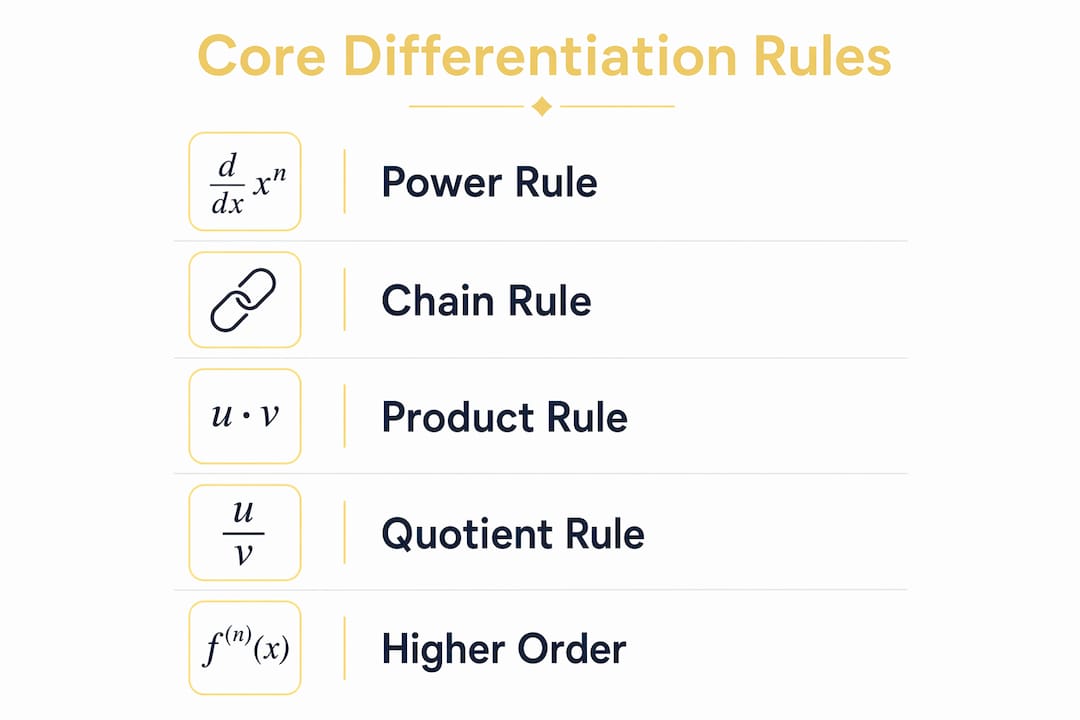
Table of Contents
- How to apply the chain rule, product rule, and quotient rule
- How to find stationary points and sketch curves using derivatives
- Exam tips and common mistakes in A Level differentiation
- Moving from memorising rules to solving unseen problems
- Key takeaways
- Practise with Mathvault
How to apply the chain rule, product rule, and quotient rule
Edexcel past papers consistently feature composite functions that require you to combine two or more differentiation techniques. Knowing the formula is half the battle; knowing when to reach for each rule is what separates a confident answer from a muddled one.
The chain rule
Use the chain rule whenever a function is composed of two or more nested functions, for example y = sin(3x²) or y = (2x + 1)⁵.
How it works:
- Identify the outer function f and the inner function u = g(x).
- Differentiate the outer function with respect to u: find f′(u).
- Differentiate the inner function with respect to x: find du/dx.
- Multiply: dy/dx = f′(u) × du/dx.
Worked example: Differentiate y = (3x + 2)⁴.
Let u = 3x + 2, so y = u⁴.
- dy/du = 4u³
- du/dx = 3
- dy/dx = 4(3x + 2)³ × 3 = 12(3x + 2)³
The chain rule is widely identified as the most challenging rule for students to internalise, because the idea of differentiating a function of a function feels abstract at first. Focused practice with varied composite functions resolves this.
The product rule
Apply the product rule when y is the product of two distinct functions, such as y = x² sin x or y = eˣ ln x.
How it works:
- Label the two factors: f(x) and g(x).
- Differentiate each separately to get f′(x) and g′(x).
- Apply: dy/dx = f′(x)g(x) + f(x)g′(x).
Worked example: Differentiate y = x³ eˣ.
- f(x) = x³, so f′(x) = 3x²
- g(x) = eˣ, so g′(x) = eˣ
- dy/dx = 3x²eˣ + x³eˣ = eˣ(3x² + x³)
A common pitfall is forgetting to add both terms, or differentiating only one factor and leaving the other unchanged.
The quotient rule
Use the quotient rule when y = f(x)/g(x), for example y = sin x / x² or y = (x + 1)/(2x − 3).
Worked example: Differentiate y = (x² + 1)/(x − 2).
- f(x) = x² + 1, f′(x) = 2x
- g(x) = x − 2, g′(x) = 1
- dy/dx = [2x(x − 2) − 1(x² + 1)] / (x − 2)²
- = [2x² − 4x − x² − 1] / (x − 2)²
- = (x² − 4x − 1) / (x − 2)²
Pro Tip: Many students lose marks by writing the quotient rule as [g′f − f′g] / g² instead of [f′g − g′f] / g². Write the formula at the top of your working before substituting, every time.
The table below summarises when to use each rule.
| Situation | Rule to use |
|---|---|
| Function inside a function | Chain rule |
| Two functions multiplied together | Product rule |
| One function divided by another | Quotient rule |
| Combination of the above | Apply rules in sequence |
Mixing rules is common in harder questions. For y = x² sin(3x), you need the product rule for the overall structure and the chain rule for sin(3x). Practise spotting this layering before you write a single line of working.
How to find stationary points and sketch curves using derivatives
Stationary points and curve sketching are frequently tested in Edexcel A Level papers, and they require you to synthesise several derivative skills in one question.
Finding stationary points: step by step
- Differentiate y to find dy/dx.
- Set dy/dx = 0 and solve for x.
- Substitute each x value back into the original equation to find the corresponding y coordinates.
- Find d²y/dx² (the second derivative).
- Evaluate d²y/dx² at each stationary point:
- If d²y/dx² > 0, the point is a minimum.
- If d²y/dx² < 0, the point is a maximum.
- If d²y/dx² = 0, the test is inconclusive; use the first derivative test instead.
Worked example: Find and classify the stationary points of y = x³ − 3x + 2.
- dy/dx = 3x² − 3; setting this to zero gives x² = 1, so x = 1 or x = −1.
- d²y/dx² = 6x.
- At x = 1: d²y/dx² = 6 > 0, so (1, 0) is a minimum.
- At x = −1: d²y/dx² = −6 < 0, so (−1, 4) is a maximum.
Using derivatives for curve sketching
| Derivative condition | What it tells you |
|---|---|
| dy/dx > 0 | Curve is increasing |
| dy/dx < 0 | Curve is decreasing |
| d²y/dx² > 0 | Curve is concave upward |
| d²y/dx² < 0 | Curve is concave downward |
| dy/dx = 0 and d²y/dx² changes sign | Point of inflection |
Tangents and normals
To find the equation of a tangent at a point (a, b):
- Calculate dy/dx at x = a to get the gradient m.
- Use y − b = m(x − a).
The normal at the same point has gradient −1/m, so its equation is y − b = (−1/m)(x − a). Examiners often ask for both in the same question, so practise writing them out in full rather than stopping at the gradient.
Exam tips and common mistakes in A Level differentiation
Examiners’ reports identify a consistent set of errors that cost students marks in differentiation questions. Knowing these pitfalls in advance is one of the most practical things you can do before sitting the paper.
Most frequent errors to avoid:
- Misapplying the chain rule by forgetting to multiply by the derivative of the inner function. For example, writing d/dx (sin(3x)) = cos(3x) instead of 3cos(3x).
- Sign errors in the quotient rule, particularly writing g′f − f′g instead of f′g − g′f in the numerator.
- Omitting constants when differentiating terms like 5eˣ, writing eˣ instead of 5eˣ.
- Not simplifying the derivative before substituting values, which leads to algebraic errors in later parts of the question.
- Confusing the product and chain rules when a question involves something like y = (x + 1)² sin x. The outer structure is a product; the (x + 1)² term also needs the chain rule.
- Skipping the second derivative test when classifying stationary points, and simply assuming the first stationary point found is a maximum.
Exam technique advice:
- Write the relevant rule formula at the top of your working before substituting. This earns method marks even if your algebra goes wrong later.
- For multi-step questions, label each stage clearly. Examiners award method and accuracy marks at each step, so clear working protects your marks.
- Check your derivative by substituting a simple value and verifying the gradient makes sense geometrically.
- Revisit basic power rule fluency before tackling chain rule questions. A slip on a straightforward term like d/dx (x⁻²) = −2x⁻³ can unravel an otherwise correct solution.
- Use Mathvault’s past paper questions by topic to practise differentiation questions grouped by technique, so you build targeted confidence in each rule before mixing them.
Pro Tip: Build an error log specifically for differentiation. Each time you drop a mark, record the rule you misapplied and the correct method. Reviewing it weekly before your exam is more effective than redoing questions you already find straightforward.
Moving from memorising rules to solving unseen problems
Memorising differentiation rules alone does not secure top A Level grades. Expert analyses identify the transition from procedural recall to autonomous rule selection as the main challenge in achieving A* results. The real difficulty in A Level differentiation is not the formula itself; it is recognising which rule to apply when the question gives you no indication.
The assessment taxonomy used in mathematics education sorts questions into groups. Group A covers factual recall and standard procedures. Group C covers genuine problem-solving, where you must synthesise ideas across topics without being told which method to use. A Level Maths sits between these, and the hardest differentiation questions sit firmly in Group C territory.
Students who focus on understanding the reasoning behind each rule, rather than rote memorisation, show improved ability to tackle unseen, multi-stage exam questions. If you understand why the product rule works, you are far less likely to misapply it under pressure.
How to build flexible problem-solving skills:
- Practise mixed problem sets that require you to decide between the chain, product, and quotient rules without any prompt. Isolated drills build recall; mixed sets build judgement.
- Work through “hence” and “show that” questions, which force you to use a previous result rather than starting fresh. These are the questions that distinguish A from A*.
- After completing a question, ask yourself: could this have been approached differently? Seeing multiple routes through the same problem deepens understanding.
- Use Mathvault’s video walkthroughs to watch how an experienced teacher selects and applies rules in real exam questions. Observing the decision-making process is as valuable as the algebra itself.
Mathvault’s topic-organised resources and step-by-step worked solutions are built precisely for this kind of targeted, reflective practice. The platform’s free access to past Edexcel papers, grouped by differentiation topic, means you can move from isolated rule practice to full exam-style questions at your own pace.
Key takeaways
Mastering A Level differentiation requires knowing every core formula, applying the chain, product, and quotient rules accurately, and practising mixed problem sets that build autonomous rule selection.
| Point | Details |
|---|---|
| Core formulas are mandatory | The Edexcel specification requires fluency in power, exponential, logarithmic, and trigonometric derivatives. |
| Rule selection is the real challenge | Examiners do not tell you which rule to use; recognising the structure of a function is the skill that earns top marks. |
| Second derivative classifies stationary points | Use d²y/dx² to confirm whether a stationary point is a maximum, minimum, or inconclusive. |
| Common errors are predictable | Sign errors in the quotient rule and missing chain rule multipliers are among the most frequent mark-losing mistakes. |
| Mixed practice beats isolated drills | Practising questions that combine chain, product, and quotient rules builds the flexible judgement needed for A* performance. |
Practise with Mathvault
Mathvault offers free access to Edexcel A Level past paper questions organised by topic, including every differentiation technique covered in this guide. Fully worked step-by-step solutions, video walkthroughs, and live Q&A sessions mean you can check your understanding at every stage, not just at the end. Whether you are consolidating the basics or pushing for an A*, Mathvault’s free resources give you the structured practice and expert guidance you need to walk into your exam with confidence.
Leave a Reply