
Using mark schemes properly means treating them as an active checklist, not a set of answers to read after the fact. Pick one past-paper question and its official mark scheme right now, attempt it under timed conditions, then mark your own work line by line against the scheme’s language before rewriting your answer.
That single loop, done consistently, does more for your grade than another hour of passive revision. Boards like AQA, OCR, and Edexcel publish examiner reports alongside their schemes precisely because they want you to see why marks are lost, not just where. MathVault’s worked solutions exist to show you what a scheme-matching answer actually looks like on the page.
- Grab one past-paper question and its mark scheme.
- Attempt it under exam timing, no notes.
- Mark it yourself, then rewrite the answer using the scheme’s own wording.
Key Takeaways
Using mark schemes as an active checklist, then rewriting and retesting your answers against them, converts revision time directly into higher, more consistent exam marks.
| Point | Details |
|---|---|
| Treat the scheme as a checklist | Tick each point against your own answer rather than reading the scheme passively. |
| Rewrite, don’t copy | Restate scheme points in your own words to prove genuine understanding, not recall. |
| Space your retests | Retest the same question type within a few days to check the improvement actually stuck. |
| Pair schemes with examiner reports | Use reports to find the recurring misconceptions behind your logged errors. |
| Use Mathvault for board-aligned practice | Mathvault’s free past papers and worked solutions show scheme-matching answers by board. |
Where to find official mark schemes and worked support
- AQA past papers and mark schemes for GCSE and A-Level subjects.
- CCEA GCSE past papers and mark schemes for Northern Ireland qualifications.
- Edexcel/Pearson and SQA publish equivalent past-paper and scheme pages on their own official sites.
- Mathvault’s GCSE maths revision guides for board-aligned worked solutions and revision notes.
Table of Contents
- Using mark schemes as a checklist: the routine to memorise
- What the parts of a mark scheme actually mean
- The attempt, mark, rewrite, log, retest loop in practice
- Reading examiner reports alongside grade boundaries
- Where mark-scheme practice goes wrong
- Building templates and a scheme-aware error log
- Practise smarter with board-aligned resources from Mathvault
- Sources
Using mark schemes as a checklist: the routine to memorise
Every practice session should follow the same shape. Do it enough times and it becomes automatic, which is exactly the point.
- Simulate real conditions. Time yourself and remove notes before you attempt the question.
- Mark immediately using the official scheme, ticking off each point as you find it in your own answer.
- Circle every miss and copy the exact scheme phrase next to it, word for word.
- Rewrite the improved answer so it would now earn full marks.
- Log the error by paper code and topic.
- Retest the same question type within 48 to 72 hours.
Pro Tip: Mark in a different coloured pen each time you revisit a question. After three rounds you can see your own progress at a glance, which is far more motivating than a single tick or cross.
What the parts of a mark scheme actually mean
Mark schemes are not fixed answer keys. AQA is explicit that indicative content acts as a guide rather than an exhaustive list, and that schemes are written with cognitive demand in mind, meaning valid alternative reasoning outside the printed list should still be credited. If your answer reaches the same conclusion by a different, sound route, it can still score.
OCR confirms this from the other side of the marking desk: schemes are finalised after the exam through a standardisation process that reviews real candidate scripts and often adds valid approaches examiners hadn’t anticipated. That’s why photocopying scheme wording verbatim misses the point. You need the reasoning behind the phrase, not just the phrase.
Three structures show up repeatedly:
- Points-based schemes award a fixed mark per correct fact, step, or calculation, common in shorter maths and science questions.
- Levels-based schemes use descriptors, rewarding the overall quality and coherence of a response rather than ticking isolated points, typical in extended writing and evaluation questions.
- Method marks in maths reward correct working even when the final answer is wrong. Label intermediate steps clearly so an examiner can find and credit them, a point Edexcel’s own GCSE guidance stresses for multi-step algebra and mechanics problems.
The attempt, mark, rewrite, log, retest loop in practice
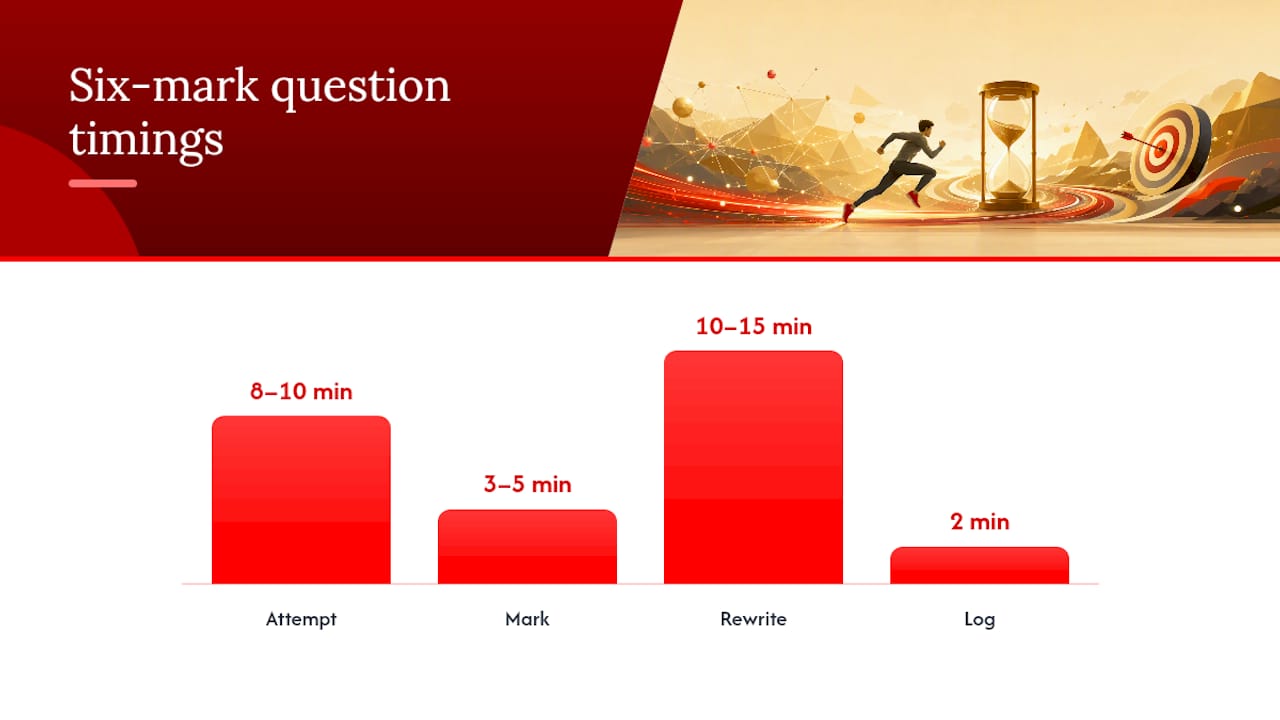
Here’s how the timings work for a single six-mark maths question, from first attempt to confirmed improvement.
| Stage | Timing | What you actually do |
|---|---|---|
| Attempt | 8–10 minutes | Answer under exam pressure, no scheme visible |
| Mark | 3–5 minutes | Tick scheme points against your working, mark by mark |
| Rewrite | 10–15 minutes | Redraft the answer so it hits every scheme point |
| Log | 2 minutes | Record the paper code, topic, and specific reason marks were lost |
| Retest | Within 2–3 days | Attempt a similar question cold, no scheme in sight |
Say the question asks you to solve a quadratic by completing the square, worth six marks. You attempt it, get the right numerical answer, but the scheme requires showing the halfway step explicitly to earn the method marks. Your rewrite adds that line. Your log entry reads: “Paper 2, June 2023, Q14: lost 2 method marks for skipping the intermediate squared-term step. Fix: always write the halfway line even when confident of the final answer.”
Space your retests over several days rather than doing them all at once. A seven-step practice loop like this one works because the gap between rewrite and retest forces genuine recall rather than short-term pattern matching. Mixing exam boards is fine once you’re confident with your own board’s phrasing, but do it deliberately. CCEA and SQA schemes, for instance, sometimes use different command-word conventions from AQA or OCR, so treat cross-board practice as a deliberate stretch exercise, not your default diet.
Reading examiner reports alongside grade boundaries
Examiner reports tell you why marks disappear, which the scheme alone can’t. They flag recurring misconceptions, wording that consistently confuses candidates, and command words students misread under pressure.
- Search the report for your exact topic before your next retest, not the whole document cover to cover.
- Cross-reference flagged misconceptions against your own error log; a pattern appearing in both places is your top revision priority.
- Use published grade boundaries to translate a raw mark into a realistic target, then track whether your rewritten answers are closing that gap over successive attempts.
Reports and schemes work as a pair: the scheme shows how marks are awarded, the report explains the mistakes that stopped candidates reaching them.
Where mark-scheme practice goes wrong
A few habits quietly cancel out all the benefit of this method.
- Reading the scheme before attempting the question. This creates a false sense of mastery. You’re recognising the answer, not producing it.
- Copying scheme phrases without understanding them. Rewrite the point in your own words that still satisfies the same criterion, rather than parroting text you might misapply in a different question.
- Skipping the retest. Rewriting once feels like progress but doesn’t confirm you can reproduce it cold days later, which is the actual skill being tested.
Pro Tip: If you can recite a scheme point but can’t apply it to a slightly reworded question, you’ve hit the “illusion of competence.” The fix is always the same: retest with a variation, not a repeat.
Building templates and a scheme-aware error log
Command words repeat across papers and years, so build short templates once and reuse them. An “evaluate” template might run: state the factor, explain its effect, weigh it against a counter-factor, conclude with a judgement. A “compare” template needs a similarity, a difference, and evidence for each.
Annotating exemplar answers against level descriptors shows you precisely what separates a Level 2 response from a Level 3 one, often a single missing justification or unlinked point, a technique AQA’s own anatomy-of-a-mark-scheme guidance recommends for exactly this purpose.
- Choose a command word template that matches the question type.
- Draft your answer against it before checking the scheme.
- Log any gap in a simple table.
| Paper code | Scheme reason for lost marks | Fix applied |
|---|---|---|
| AQA Paper 1, 2023 | Missing method mark for intermediate step | Always write the halfway calculation |
| OCR Paper 3, 2022 | Answer lacked linked justification for Level 3 | Add explicit “this means…” link between points |
Why this approach earns real confidence, not just marks
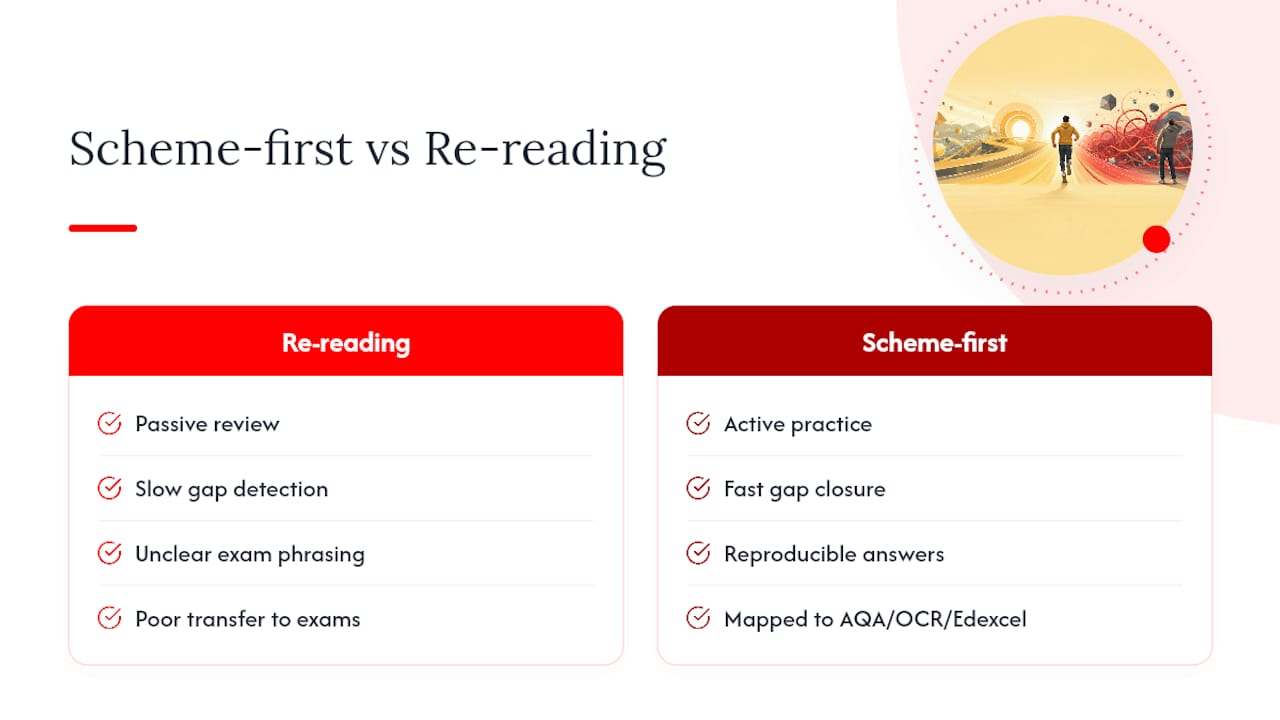
Students who switch from re-reading notes to scheme-first practice tend to notice something concrete within a few sessions: the gap between what they thought they knew and what they can actually reproduce closes fast. That gap, not raw content knowledge, is usually what separates a good mock result from a good real one. MathVault builds its worked solutions and revision guides around exactly this principle, mapping content to AQA, OCR, and Edexcel specifications so students can move between attempt and exemplar without hunting for board-specific phrasing.
— Oloru
Practise smarter with board-aligned resources from Mathvault
Mathvault gives you the one thing a scheme alone can’t: a ready supply of past papers and fully worked solutions that show exactly what a mark-scheme-matching answer looks like on the page, for free. Rather than hunting across several exam board sites for the right paper and then guessing whether your rewrite would actually score, you get the question, the official scheme, and a worked walkthrough in one place, organised by board.
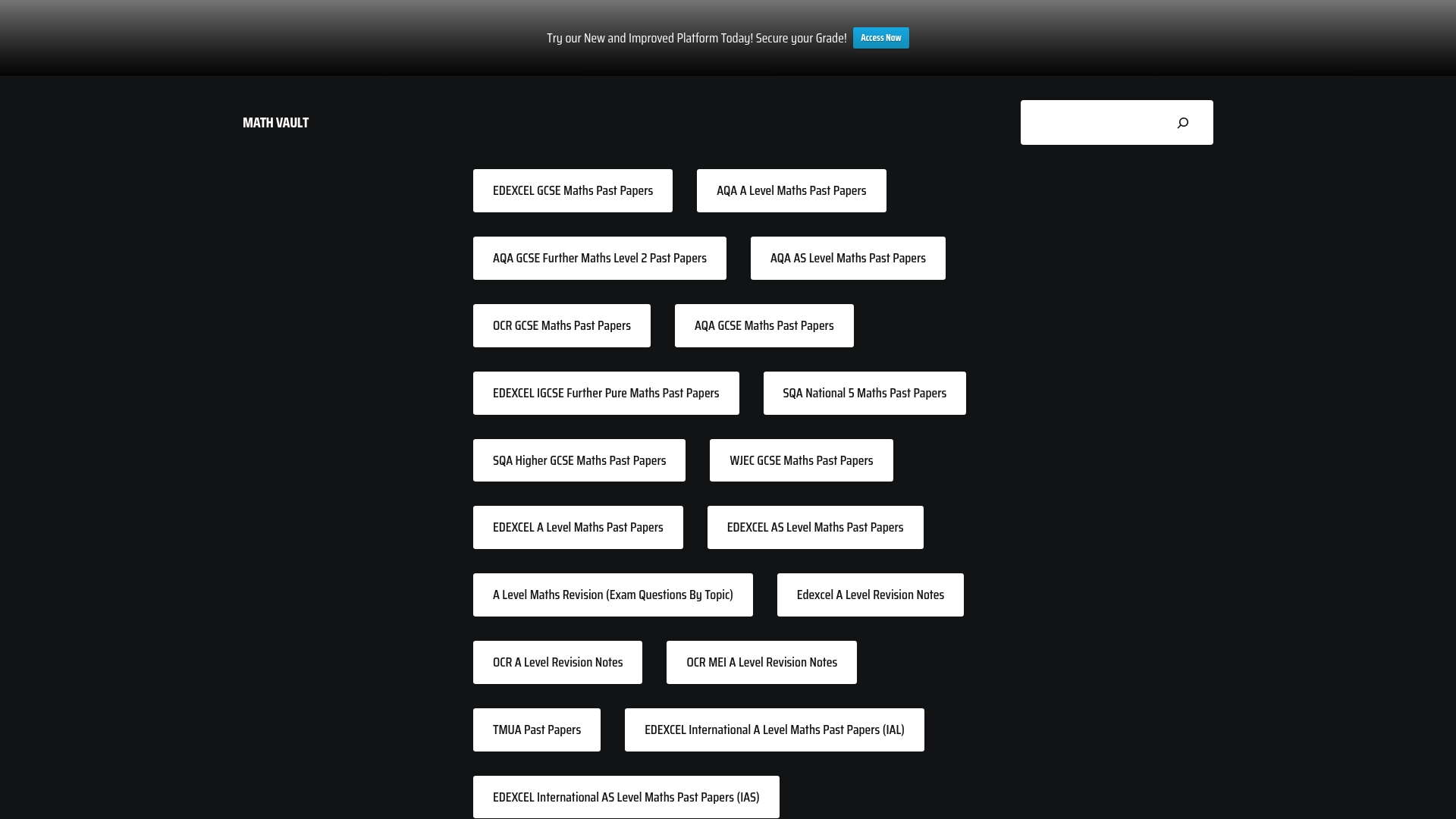
Start with the GCSE maths revision guides if you’re working towards GCSEs, or head to the AQA GCSE maths and OCR GCSE maths pages if you already know your board. If you’re not sure how to structure a session around past papers and schemes, the how to use past papers guide walks through the timing and marking process step by step. Pick one topic tonight, open the matching revision guide, and run the attempt, mark, rewrite loop on a single question before you close the laptop.
Sources
- Understanding mark schemes: how they’re created and used (OCR blog)
- AQA | Mark schemes (Inside assessment)
- Inside Exams: The anatomy of a mark scheme (AQA PDF)
- AQA | Past papers & mark schemes
Leave a Reply