
The most effective approach combines board-aligned revision notes with structured past-paper practice under timed conditions. Notes give you the framework; past papers teach you how examiners actually award marks. Mathvault’s A‑Level maths resources offer worked solutions, past papers by topic, and downloadable topic packs built for AQA and Edexcel specifications. The sections below show you exactly where to find subject-specific materials and how to turn them into exam marks.
TL;DR:
- Using board-specific revision notes paired with past papers and mark schemes ensures focused practice and reduces time wasted on irrelevant content.
- Active recall methods like self-explanation, timed questions, and revising stripped-down solutions significantly improve long-term memory and exam performance.
- Confirm your exam board and specification code before choosing resources, and prioritize official past papers and solutions to match your syllabus exactly.
- Practising full timed papers under exam conditions, especially in the final weeks, builds stamina and helps identify persistent mistake patterns for targeted revision.
- Digitally organized notes and resources support efficient revision, but should complement hands-on practice and active recall rather than replace them.
Table of Contents
- What makes A level revision notes actually useful
- How to use revision notes effectively: active recall beats re-reading
- Finding subject- and board-specific notes and past papers
- Subject-focused priorities: what actually earns marks
- Building a past-paper-led revision plan that actually works
- MathVault.io: board-aligned support built for UK students
- Turning long notes into something you’ll actually revisit
- Digital notes versus handwritten notes: what actually helps
- Mind maps and visual aids: where they genuinely help
- Apps and tools worth using to organise your notes
- Group revision: how to make it actually productive
- Staying motivated when exam season drags on
- Why board-aligned notes matter more than students assume
- Get board-aligned notes and past papers without the search
- Where to check your specification and verify your revision materials
- Sources
What makes A level revision notes actually useful
Not all revision notes earn their place in your folder. Some resource types genuinely move your grade; others just make you feel productive while you highlight the same paragraph for the third time.
Structured notes give you the skeleton of a topic: definitions, formulae, key relationships between concepts. They matter because A‑Level exams reward students who can see how topics connect, not just recall isolated facts. A biology student who understands how enzyme kinetics links to the wider unit on cellular respiration will answer a synoptic question far more confidently than one who memorised each topic in isolation.
Worked examples show you the method, not just the answer. This distinction decides whether you pick up partial credit on a question you can’t fully solve. Maths and physics papers in particular award “method marks” for correct working even when your final answer is wrong, so studying how a solution is built, step by step, is often more valuable than checking whether your answer matches the back of the book.
Past papers are the closest thing to a dress rehearsal you’ll get before the real exam. They expose exactly how a specification gets tested, which topics recur, and how command words like “evaluate” or “justify” translate into what an examiner wants on the page.
Mark schemes matter more than most students realise. Reading a mark scheme after attempting a question often reveals that you lost marks not because your maths was wrong, but because you skipped a stated step the examiner needed to see.
Flashcards work best for discrete, testable facts: dates, definitions, named reactions, quotations. They’re weak for anything requiring multi-step reasoning, which is why they should sit alongside past-paper practice rather than replace it.
Board alignment changes everything about which resources are worth your time. AQA, Edexcel, and OCR each structure their A‑Level specifications differently, with different topic orders, different formula sheets provided in the exam, and sometimes entirely different content within the same subject title. Revising from an Edexcel-focused resource for an AQA exam risks studying topics you’ll never be asked about while missing ones you will.
Before committing time to any resource, run this quick check:
- Does it name the specific exam board and specification code (e.g. AQA 7407, Edexcel 9MA0)?
- Is the material dated, and does it reflect the current specification rather than a superseded one?
- Does it include worked solutions, not just final answers?
- Are past papers paired with the official mark scheme?
- Can you trace who wrote it, a named teacher, subject specialist, or established platform?
How to use revision notes effectively: active recall beats re-reading
Here’s the uncomfortable truth about most revision sessions: re-reading notes feels productive but barely improves recall. Active recall, the practice of retrieving information from memory rather than passively reviewing it, produces measurably better long-term retention, according to guidance from Birmingham City University’s exam preparation resources. The mechanism is simple: forcing your brain to reconstruct an idea strengthens the memory pathway far more than looking at the answer again.
Three exercises put this into practice immediately:
- Self-explain out loud. Close your notes and explain the topic as if teaching a friend who knows nothing about it. Gaps in your explanation reveal gaps in your understanding, usually faster than any quiz would.
- Closed-book past-paper questions. Attempt a question with no notes visible, then check your working against the mark scheme. The struggle to recall the method is where the learning happens, not the moment you see the correct answer.
- Flashcard retrieval with a twist. Instead of flipping a card to check the answer, write your answer down first, then compare. The act of committing to an answer before checking it forces genuine retrieval rather than false confidence.
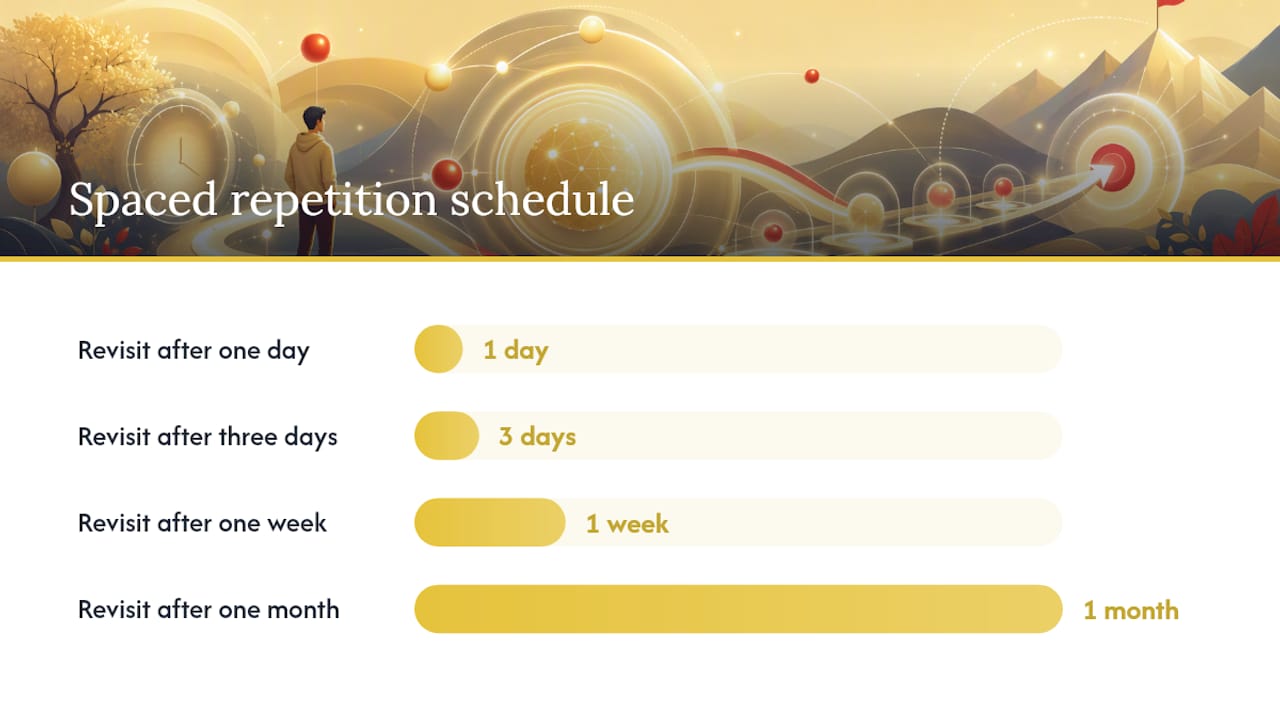
Spaced repetition complements active recall by controlling when you revisit a topic. Cramming a topic once and never returning to it guarantees you’ll forget most of it within weeks. A practical schedule looks like this: revisit a topic after one day, then after three days, then after a week, then after a month. Each revisit should take less time than the last, because the memory is stronger.
Interleaving, mixing questions from different topics within a single revision session rather than blocking all your practice by topic, trains you for what the real exam actually demands. A‑Level papers rarely present questions in the neat, single-topic order your textbook uses. Practising mixed past papers closer to the exam date forces your brain to first identify which topic a question belongs to before applying the method, which is exactly the skill a real exam tests.
Some long-standing revision habits do more harm than good. Highlighting text creates a false sense of familiarity without testing recall. Re-reading notes multiple times feels thorough but rarely improves your ability to reproduce the material under exam pressure. Copying out notes verbatim, without reformulating them in your own words, is closer to transcription than learning.
Pro Tip: Take any worked solution and strip out the final two or three steps before revising it. Attempt to complete the solution yourself, then compare your working against the original. This turns a passive resource into an active recall exercise in under a minute.
Apps offering flashcards and quizzes can support this approach when used for genuine retrieval practice rather than passive scrolling, but they work best as a supplement to full past-paper practice, not a replacement for it.
Finding subject- and board-specific notes and past papers
Getting the wrong specification’s notes wastes hours you don’t have in the run-up to exams. A structured search process avoids that entirely.
Step 1: confirm your exam board and specification code. Check your exam timetable, your school’s exam entry letter, or ask your teacher directly. AQA’s A‑Level maths specification code is 7407; Edexcel’s is 9MA0. Getting this wrong before you start means every subsequent resource choice risks being irrelevant.
Step 2: prioritise resources explicitly labelled with board and year. A generic “A‑Level Biology notes” document with no board mentioned is a warning sign, not a convenience. Resources that name the board and specification, and that pair notes with worked solutions and past papers, tend to track much more closely with what you’ll actually be examined on. Mathvault’s past papers by topic are organised precisely this way, letting you drill a single weak topic across several years of papers rather than hunting through full papers for relevant questions.
Step 3: use official exam-board pages as your source of truth for past papers and mark schemes, then cross-check any third-party notes against the specification document itself. Exam boards publish their full specifications online, along with sample assessment materials and grade boundaries from previous years. Third-party subject sites can be genuinely useful for topic summaries and worked video explanations, but treat them as a supplement, always verify the content against your actual specification rather than assuming it matches.
A short verification checklist before you rely on any resource:
- Author credentials: is the material written by a named teacher, subject specialist, or an established educational platform, rather than an anonymous upload?
- Date: does it reflect the current specification, or a version from before the last major syllabus change?
- Board code stated clearly: AQA, Edexcel, or OCR, with the specification number where relevant.
- Mark schemes included: past papers without mark schemes leave you unable to self-assess accurately.
- Worked solutions provided: not just final answers, but the method that earns the marks.
Board-specific notes reduce wasted revision time in a very direct way: confirming the specification code before you invest an evening in a resource means you never discover halfway through exam season that you’ve been studying the wrong syllabus. It’s a five-minute check that prevents a genuinely costly mistake.
Subject-focused priorities: what actually earns marks
Generic revision advice only goes so far. Each A‑Level subject rewards a slightly different approach, and knowing where to focus your limited revision time makes a measurable difference to your final grade.
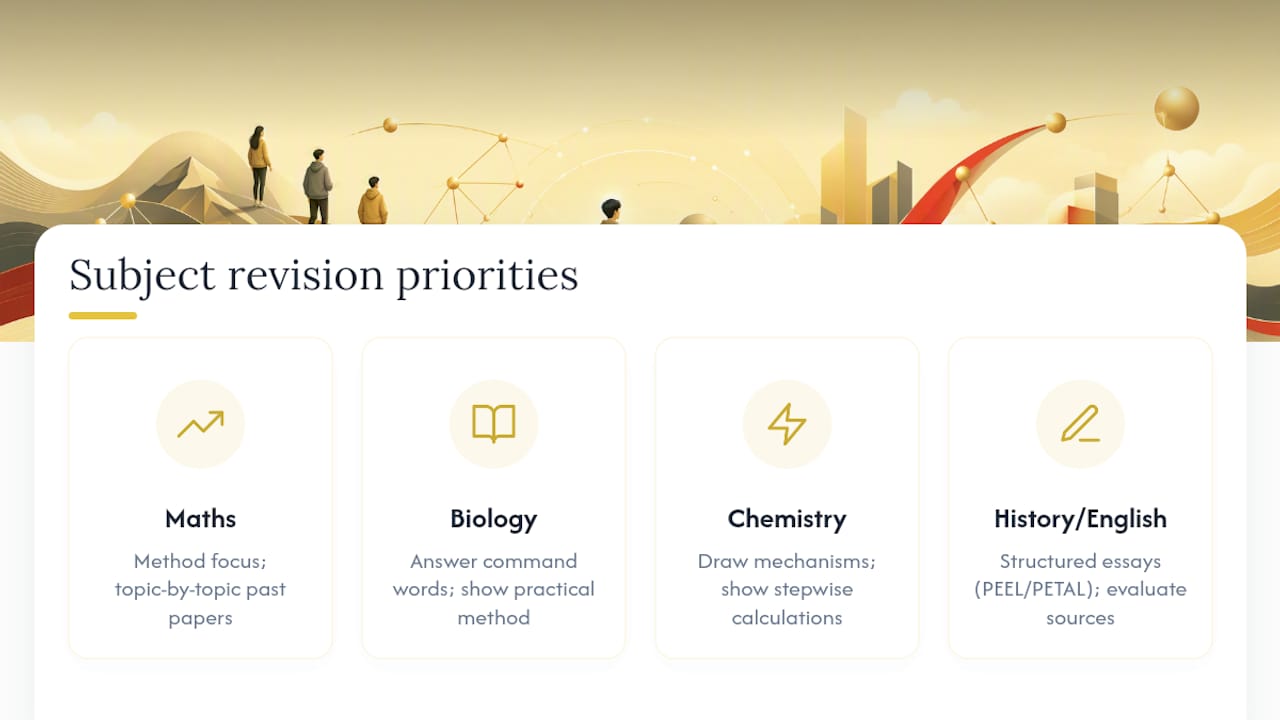
Maths rewards method over memorisation. Pure maths foundations, algebra manipulation, calculus fundamentals, trigonometric identities, underpin almost every other topic on the paper, so weaknesses here compound across the whole exam. Practise past papers topic by topic rather than working through full papers from the start; this lets you isolate exactly where your method breaks down. Mechanics and statistics topics tend to carry their own vocabulary and modelling assumptions, so treat them as distinct revision blocks rather than an extension of pure maths. Learning the specific method steps that earn marks, showing units, stating assumptions, writing intermediate working, matters as much as getting the final number right.
Biology exams penalise students who know the content but don’t understand command words. “Explain” demands a causal chain; “describe” wants observation without reasoning; “evaluate” requires weighing evidence on both sides. In practical-based questions, showing your method, how you controlled variables, why you chose a particular technique, earns marks independently of your final result. Data interpretation questions, reading graphs, calculating standard deviation, spotting anomalies, appear on every paper and are highly practisable using past papers alone.
Chemistry blends calculation with mechanism. Organic mechanism questions reward students who can draw curly arrows accurately and explain electron movement, not just name the reaction. Calculation questions, particularly around moles, titrations, and equilibrium, need clearly shown working because examiners award marks at each stage of the calculation, not just for the final figure.
Physics demands formula recall alongside the ability to derive relationships rather than just quote them. Quantitative past-paper questions, ones requiring multi-step calculations with units carried through correctly, make up a large share of the marks available, so full timed practice under exam conditions matters more here than in most subjects.
History and English Literature reward structured argument over raw content recall. Model essays show you how to build a paragraph that states a point, evidences it, and links back to the question, the classic PEEL or PETAL structure most English departments teach. In History, source-based questions test your ability to evaluate provenance and reliability, a skill that improves dramatically with repeated practice against real past-paper sources rather than abstract revision of dates.
Economics and Psychology both lean heavily on data-response questions. Practising how to interpret a given dataset or research study, and how to structure an evaluative response using named methodology or economic models, matters more than memorising theory in isolation. Both subjects also reward students who can name specific studies or real-world examples rather than writing in generalities, examiners consistently reward specificity over vague assertion.
Building a past-paper-led revision plan that actually works
Notes without deliberate practice rarely translate into exam performance. The most reliable structure moves from topic-focused study towards full timed papers as the exam approaches.
A practical progression, drawn from common exam-preparation guidance, looks like this:
- 12 weeks out: spend most sessions on topic notes and worked examples, identifying weak areas subject by subject. Use topic-specific past-paper questions to test each area as you cover it.
- 8 weeks out: shift towards topic-clustered past papers, several years’ worth of questions on a single weak topic, rather than full mixed papers. This accelerates improvement on the areas costing you the most marks.
- 4 weeks out: move to full past papers under strict timed conditions, replicating the actual exam environment as closely as possible, including no notes and a countdown timer.
- Final two weeks: prioritise examiner-marked or self-marked full papers, using official mark schemes to identify recurring error patterns rather than attempting new topics.
Simulating exam conditions matters more than students expect. Sitting a paper at a desk, with a clock running and no phone nearby, trains the stamina and pacing that reading notes never will. After each timed paper, mark it strictly against the mark scheme, and keep a running log of why marks were lost, not just how many. A pattern of losing marks on the same command word or calculation step tells you exactly where to focus the next week’s revision.
| Weeks before exam | Primary focus | Format |
|---|---|---|
| 12 | Topic notes and worked examples | Untimed, topic by topic |
| 8 | Topic-clustered past papers | Semi-timed, weak topics only |
| 4 | Full past papers | Fully timed, exam conditions |
| 2 and under | Marked full papers, error review | Fully timed plus review session |
Topic packs suit the early weeks, when you’re still building foundational understanding. Mixed-paper practice suits the final stretch, when the goal shifts to simulating the real exam’s unpredictability. If a particular topic keeps resisting progress despite repeated practice, that’s the moment to seek live support rather than repeating the same self-study approach that isn’t working.
MathVault.io: board-aligned support built for UK students
Mathvault exists to remove the guesswork from finding the right resource for your exact specification. The platform hosts board-aligned past papers organised by topic, fully worked step-by-step solutions, downloadable revision packs, and topic-specific study guides covering GCSE and A‑Level maths across England, Wales, and Scotland.
What sets the approach apart is the pairing of every past paper with a complete worked solution, so you’re never left staring at a wrong answer with no way to diagnose the mistake. Subject pages are organised by exam board, with dedicated resources for Edexcel and AQA specifications, which matters given how differently the two boards structure their maths papers.
Beyond static resources, Mathvault runs live weekly Q&A sessions where students can ask about a specific method or past-paper question in real time, useful when a worked solution alone doesn’t clarify why a particular step was taken. Most materials, including past papers, worked solutions, and topic guides, remain free to access, with downloadable revision bundles available for students who want an offline, organised pack to work through away from a screen.
Turning long notes into something you’ll actually revisit
Long notes rarely get reopened. Condensing them into a usable format is what makes revision efficient rather than just thorough.
Start by rewriting notes in your own words rather than copying textbook phrasing. The act of rephrasing forces you to process the material rather than transcribe it, and it immediately reveals which sections you don’t fully understand yet, because you’ll struggle to find the words.
Aim for a single side of A4 per major topic. This constraint forces prioritisation: only the formulae, definitions, and key relationships that genuinely matter make the cut. Anything that needs a full paragraph to explain probably belongs in a separate, more detailed note rather than your summary sheet.
Use a consistent shorthand system, arrows for cause and effect, boxes for key definitions, underlining for command words, so your eye can scan a page and immediately locate the type of information it needs. Colour-coding by theme (all organic chemistry reactions in one colour, all inorganic in another) speeds up retrieval during timed revision sessions.
Revisit your condensed notes only after you’ve tested yourself with active recall first. Condensing before testing tends to produce notes that feel complete but haven’t actually been checked against what you can reproduce from memory.
Digital notes versus handwritten notes: what actually helps
Neither format wins outright. Each suits a different stage of revision, and most students end up using both.
Handwritten notes force slower, more deliberate processing. The physical act of writing tends to encourage summarising rather than copying verbatim, which supports the same self-testing benefit as active recall. Handwritten notes are also faster to annotate during a lesson and easier to sketch diagrams or graphs onto without fiddling with software.
Digital notes win on searchability and organisation. Finding every mention of “enzyme inhibition” across a term’s worth of biology notes takes seconds in a searchable document, versus flicking through several exercise books. Digital notes are also easier to share for group revision, back up so nothing is lost before exams, and update quickly if you spot an error.
The practical answer: use handwritten notes for first-pass learning and for anything visual, diagrams, graphs, mechanism arrows, and digital notes for condensed summary sheets you’ll want to search, share, or print multiple copies of. Converting a handwritten topic summary into a typed one-page digital sheet closer to the exam also doubles as a useful active recall exercise in itself.
Mind maps and visual aids: where they genuinely help
Mind maps earn their place for one specific job: showing how topics connect, not for storing detail. A biology mind map linking respiration, photosynthesis, and the carbon cycle helps you see the synoptic relationships examiners increasingly test in the final papers of most specifications.
They’re less useful as a primary revision tool for anything requiring precise recall, exact definitions, named reactions, formula derivations, because the format encourages breadth over depth. Use a mind map to plan an essay structure in History or English, mapping themes to evidence, or to visualise how a maths topic like differentiation links to real-world applications and other calculus topics, rather than as a substitute for detailed notes.
Diagrams and flowcharts work well for process-based topics: the stages of mitosis, the steps in a chemical extraction, the decision tree for choosing a statistical test. Redrawing a diagram from memory, rather than tracing or copying it, converts a passive visual aid into an active recall exercise.
Apps and tools worth using to organise your notes
A handful of digital tools genuinely earn a place in a revision routine, provided they support active recall rather than becoming another passive scrolling habit.
Note organisation apps like Notion or OneNote let you build a searchable, tagged library of notes across every subject, useful when you’re managing five or more A‑Level subjects simultaneously and need to find a specific topic quickly. Flashcard and quiz apps, including dedicated revision apps available on the App Store, support spaced repetition scheduling automatically, prompting you to revisit a card exactly when you’re likely to forget it. Cloud storage through Google Drive or similar keeps notes backed up and accessible from any device, which matters if you’re revising across a school laptop, a home computer, and a phone.
The common thread across useful tools: they should make retrieval practice easier, not replace it. An app that only lets you re-read notes offers no advantage over a paper folder.
Group revision: how to make it actually productive
Group revision sessions fail more often than they succeed, usually because they drift into socialising or one person explaining while everyone else half-listens. Structure prevents that drift.
Assign each person a topic to teach the group before the session. Having to explain a concept to peers is one of the most effective active recall exercises available, because you can’t fake understanding when someone asks a follow-up question. Rotate this role so everyone gets the teaching benefit, not just the listening one.
Bring a shared past paper and attempt it individually under quiet, timed conditions first, then compare answers and mark schemes together afterwards. This gives you the benefit of collaborative discussion on the marking without sacrificing the individual retrieval practice that makes past-paper work effective in the first place.
Keep group sessions to a fixed length, sixty to ninety minutes tends to work well, and end with each person naming one thing they’re taking away to revise individually. Open-ended group sessions without a clear structure or end point rarely produce as much learning as the same time spent revising alone.
Staying motivated when exam season drags on
Motivation dips are predictable, especially in the middle stretch of exam season when the finish line still feels distant. A few practical habits keep momentum going better than willpower alone.
Track topics completed rather than hours spent. Hours are a poor measure of progress; a checklist of topics revised, tested, and re-tested gives you visible evidence that you’re moving forward, which matters more for motivation than raw time logged.
Break revision into sessions no longer than 45 to 50 minutes, with a genuine break in between, away from your phone and your desk. Sustained focus degrades sharply beyond this window for most students, and pushing through tired concentration produces low-quality revision that needs repeating later anyway.
Alternate difficult and easier subjects across a single day rather than grinding through the subject you find hardest for hours at a stretch. A run of small wins in a subject you enjoy resets your motivation before you tackle the one that drains it.
Finally, treat consistency as more valuable than intensity. A student who revises for an hour most days will typically outperform one who does nothing for a week and then attempts an eight-hour session, because spaced repetition depends on regular, repeated exposure rather than a single long push.
Why board-aligned notes matter more than students assume
Most students underestimate how much time gets wasted on resources that don’t match their actual specification. It’s the single most avoidable mistake in A‑Level revision, and it’s entirely preventable with a five-minute check of your specification code before you open a single revision guide.
The conventional advice, “just find good notes”, misses the point. Good notes for the wrong board are worse than average notes for the right one, because they build false confidence in content that will never appear on your paper. Teacher-written, board-aligned material paired with genuine past-paper mastery consistently outperforms generic revision guides, not because the writing is better, but because every hour spent studying maps directly onto marks available in the real exam.
If you’re in your final week, resist the urge to start new topics. Spend that time on timed past papers targeting your weakest areas, and use worked solutions to correct method errors rather than just checking final answers. Mathvault’s subject filters and downloadable packs exist precisely to make that final-week focus faster to organise.
— Oloru
Get board-aligned notes and past papers without the search
There’s no shortage of A‑Level resources scattered across forums, tutor blogs, and subject websites, but hunting through them to check board alignment costs time you don’t have in exam season. Mathvault does that verification for you: every resource is organised by exam board and specification, paired with a fully worked solution, so you spend your time practising rather than checking whether a note even applies to your syllabus.
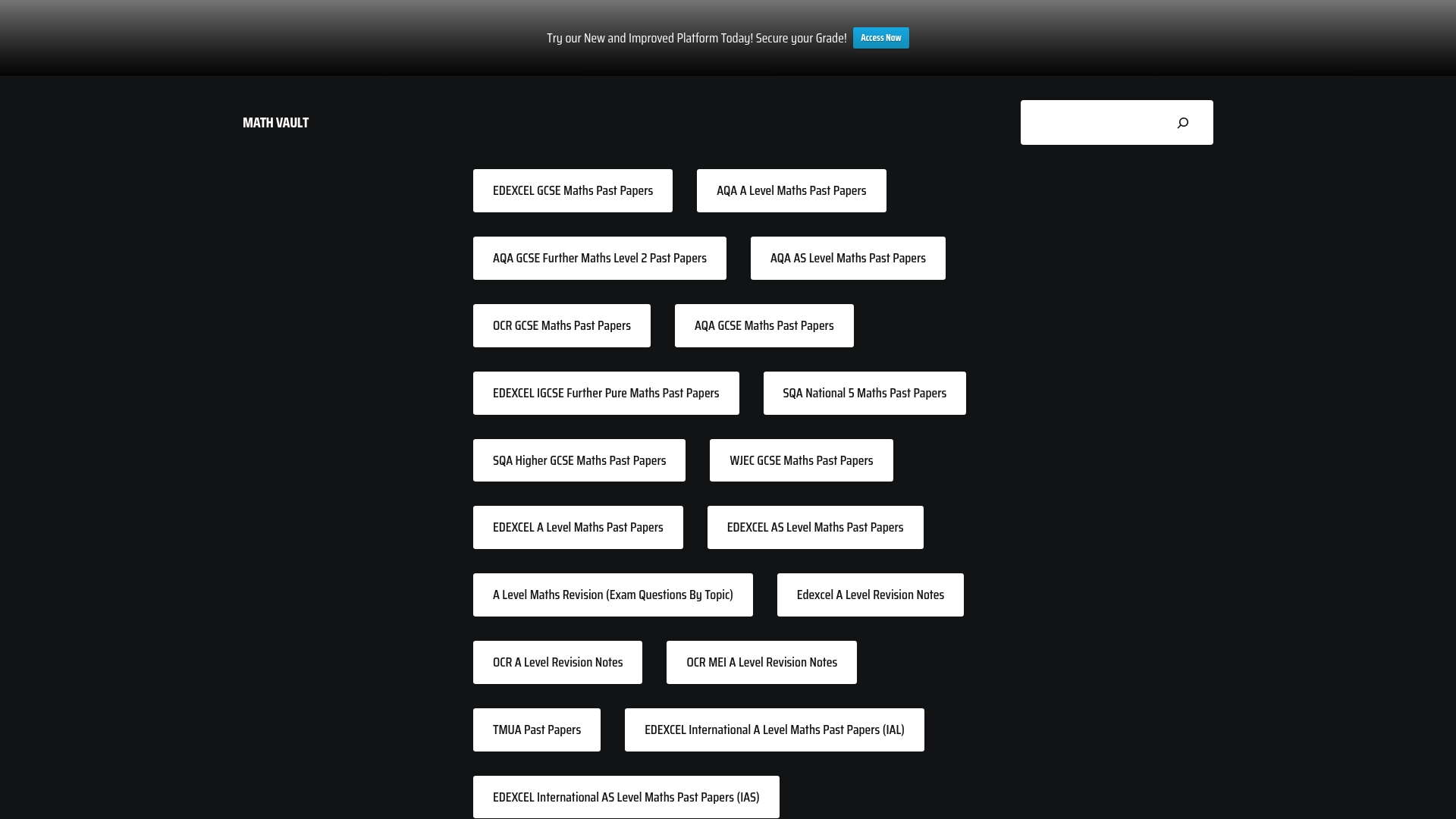
If you’re studying towards AQA, start with the AQA A‑Level maths hub for topic notes and worked solutions matched to specification 7407. Edexcel students can head straight to past papers organised by topic to drill weak areas across multiple years of papers rather than working through full papers from scratch. Every download comes with the matching mark scheme, so self-marking is accurate rather than guesswork. If a method still doesn’t click after working through a worked solution, join one of Mathvault’s live weekly Q&A sessions and ask directly.
Where to check your specification and verify your revision materials
Confirming your exact specification before committing hours to any resource remains the single most useful five-minute task in your entire revision schedule.
- Exam board specification pages (AQA, Edexcel, OCR): the definitive source for your syllabus content, formula sheets, and official past papers with mark schemes.
- Active recall guidance from Birmingham City University: a clear, evidence-based explanation of why retrieval practice outperforms passive re-reading, useful if you want the reasoning behind the technique rather than just the instruction to use it.
- Study-guide scheduling advice: practical timetable structures for building a 12, 8, or 4-week revision plan around past-paper frequency.
- Tutor scheduling guidance from Tiber Tutor: an external perspective on pacing study schedules across science subjects, useful for cross-checking your own timetable structure.
Sources
- Best ways to revise: active recall (Birmingham City University)
- A-LEVEL Study Guide 2026 — Exam Format, Topics & Practice Questions – Practicetestgeeks
Leave a Reply