
For GCSE and A-Level maths, the quickest route to topic-sorted past exam questions is Mathvault’s topic pages, which map directly to AQA, Edexcel, OCR, and WJEC specifications and include fully worked step-by-step solutions. Open that first, then cross-reference with your exam board’s official past papers search for the full archive.
If you need backup options or cover subjects beyond maths, here are the most reliable starting points:
- Official exam board sites (Pearson Edexcel, AQA, OCR, WJEC): free public access to older papers, mark schemes, and examiner reports, though recent sessions are restricted to registered centres
- Topical aggregators such as PapersByTopic, which compile every past question on a single topic into one document, and TopicWisePapers, which organises questions by topic to simplify targeted practice
- Your school’s exams officer: the only route to centre-only papers from the most recent series
- Mathvault topic pages: syllabus-aligned topic indexes with worked solutions and video walkthroughs, free for GCSE and A-Level maths
Key takeaways
Topic-first revision with syllabus-aligned past papers and worked solutions is the most efficient way to close specific knowledge gaps before GCSE and A-Level exams.
| Point | Details |
|---|---|
| Start with your specification | Download your board’s specification first to map topics before searching for past questions. |
| Use topic packs for weak areas | Drill every past question on one topic before moving on, rather than sitting full papers at random. |
| Mark schemes and worked solutions serve different purposes | Use mark schemes for self-marking; use worked solutions to understand method and presentation. |
| Recent papers may be centre-only | Papers from roughly the last 9–12 months are restricted; ask your exams officer for access. |
| Mathvault for maths topic practice | Free syllabus-aligned topic pages, worked solutions, and video walkthroughs for AQA, Edexcel, WJEC, and SQA. |
Table of Contents
- Subject index: which subjects have ready topic packs?
- How to find the exact paper that matches your specification
- How to use topic-sorted past papers effectively in revision
- Worked solutions, mark schemes, and examiner reports: what to use when
- Downloading and organising your topic packs
- Why Mathvault is a strong starting point for maths topic packs
- The case for topic-first revision, not paper-first
- Mathvault’s topic pages: free resources, ready to use
- Sources
Subject index: which subjects have ready topic packs?
Topic-based past exams are most developed for maths and sciences, where syllabuses are highly structured. The table below shows what you can typically expect by subject.
Exam board coverage to check per subject:
- Maths: AQA, Edexcel, OCR, WJEC, CAIE, SQA Higher — topic packs exist for all major boards; Mathvault covers AQA and Edexcel in depth
- Sciences: AQA, Edexcel, OCR (A and B) — topic packs are common but quality varies
- English, History, Geography: AQA, Edexcel, OCR, WJEC — topic-level packs are less standardised; skill-based question banks are more practical
- Computer Science: CAIE is particularly well served by topical aggregators like PapersByTopic
For maths specifically, Mathvault’s Edexcel GCSE topic pages and AQA A-Level resources provide downloadable PDF packs alongside worked solutions. For sciences and humanities, the official board sites remain the most complete archive, though you will need to compile topic sets yourself from full papers.
How to find the exact paper that matches your specification
The most common mistake students make is downloading a paper before confirming it matches their exact specification. Follow this retrieval flow every time.
- Confirm your qualification and board. Check your timetable or ask your teacher: are you sitting AQA, Edexcel, OCR, or WJEC? GCSE or A-Level? Foundation or Higher tier?
- Download your specification. Every board publishes a free PDF. The specification lists every topic and sub-topic you can be examined on — this is your master checklist.
- Map the topic you want to practise. Find the topic in the specification (e.g. “Algebra: surds and indices” in Edexcel GCSE maths) and note the exact wording the board uses.
- Search the board’s past papers page or a topic aggregator. On the official board site, filter by qualification, subject, and series. On Mathvault or a topical aggregator, navigate directly to the topic page.
- Filter by year, tier, and series. For GCSE maths, confirm Foundation or Higher. For A-Level, confirm Paper 1, 2, or 3. Note the series (e.g. June 2023, November 2022).
- Download the question paper and mark scheme together. Never practise without the mark scheme ready — you need it for immediate self-assessment.
Worked example: You are revising Edexcel GCSE maths and want to practise surds. Open the Edexcel GCSE maths specification, locate “surds” under Number. Then visit Mathvault’s Edexcel GCSE topic pages and navigate to the surds section. You will find past questions pulled from multiple series, with worked solutions alongside. Cross-check with the Pearson past papers search for any series not yet on the topic page.
Pro Tip: Recent papers from roughly the last 9–12 months are restricted to registered centres by boards such as Pearson Edexcel. If you need those, ask your exams officer directly — they can share centre-only materials with you. Slightly older series (two or more years back) are publicly available and cover the same syllabus content, so they are just as useful for topic practice.
How to use topic-sorted past papers effectively in revision
Organising past exam questions by topic helps you focus revision and target weak areas far more efficiently than working through full papers at random. The most effective routine is short and repeatable.
The core cycle:
- Select one topic you find difficult.
- Set a timer and attempt five to ten past questions on that topic under exam conditions.
- Mark your answers immediately against the official mark scheme.
- For every question you dropped marks on, read the examiner report to understand the common errors, then study the worked solution to see the expected method.
- Revisit your textbook for the underlying concept if the error was conceptual rather than a slip.
- Repeat the cycle on the same topic two days later with a fresh set of questions.
Sample weekly plan:
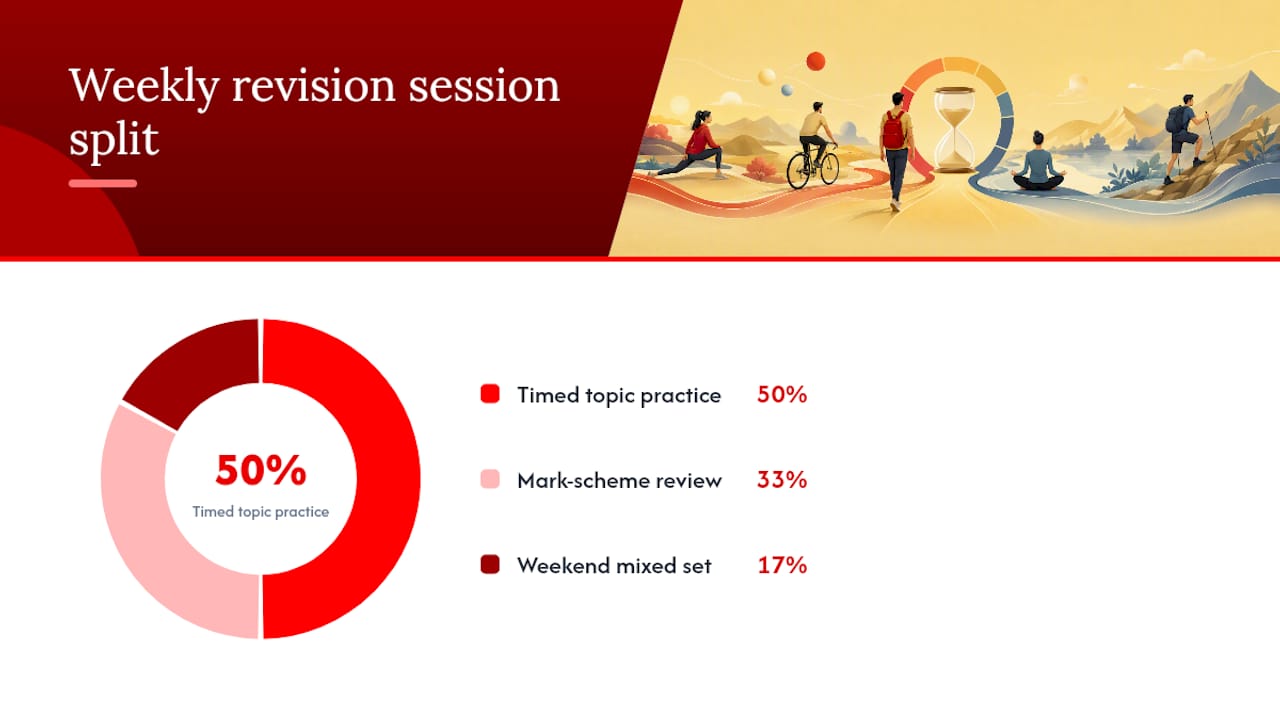
- Monday/Wednesday/Friday: timed topic practice (20–30 minutes per session, one topic per session)
- Tuesday/Thursday: mark-scheme review and error analysis; note recurring mistakes
- Weekend: one short mixed topic set to consolidate, then review any flagged topics
Keep sessions short and focused. A 25-minute block on quadratic equations is more productive than a two-hour session covering everything at once.
Adapting for different competency levels:
- Foundation tier students: start with questions worth one or two marks on a topic before attempting multi-step problems. Some topic repositories label questions by difficulty or grade, which makes this easier.
- Higher tier and A-Level students: prioritise multi-part questions and proof-style problems. Work through the mark scheme line by line, paying attention to method marks versus accuracy marks.
- Students building pre-GCSE foundations: Year 9 maths curriculum resources can help consolidate the underlying skills before you move to past paper practice.
Worked solutions, mark schemes, and examiner reports: what to use when
These three resources serve different purposes. Using the wrong one at the wrong moment wastes revision time.
- Official mark scheme: use this immediately after timed practice. It shows the accepted methods and the marks allocated to each step. It is concise by design, not explanatory.
- Examiner report: read this after you have marked your work. Examiner reports describe the most common errors students made nationally on each question. If you dropped marks, the report often tells you exactly why most students did too — which reveals the pitfall rather than just the answer.
- Worked solution: study this when the mark scheme alone does not explain why a method works. A good worked solution shows every step with reasoning, not just the final answer. Prefer solutions that are syllabus-aligned and teacher-reviewed; quality varies significantly across free resources online.
The practical difference matters. A mark scheme might state “M1 for correct use of the quadratic formula; A1 for both correct roots.” A worked solution will show the substitution written out, the simplification, and the final values with units. Cross-checking both gives you the full picture: what earns marks and how to present it.
For WJEC students, Mathvault’s WJEC 2022 worked solutions demonstrate this approach in practice, with step-by-step methods aligned to the mark scheme.
Downloading and organising your topic packs
Most topic packs download as PDFs. Some platforms bundle multiple topics into a single zip file. The action is straightforward: click the download link on the topic page, save the file, and rename it before it lands in your downloads folder.
Suggested file-naming convention:
Subject_Board_Topic_Year_Tier
For example: Maths_Edexcel_Surds_2022_Higher.pdf or Biology_AQA_CellBiology_2021_GCSE.pdf
Folder structure that works:
- Top-level folder:
Revision - Sub-folders by subject:
Maths,Biology,Chemistry - Within each subject: sub-folders by board, then by topic
This structure means you can locate any question set in under ten seconds, which matters when you are mid-revision and do not want to break focus.
A note on cost: most topic pages on reputable platforms are free. Some platforms, including Mathvault, offer complete downloadable packs for recent series or full board archives as optional paid downloads or via a small donation. Check the page before attempting a bulk download — free individual topic PDFs and paid full-series bundles often sit on the same page. Platforms such as Studyclix demonstrate the range of formats you will typically encounter: individual topic PDFs, full paper archives, and worked example sets.
Why Mathvault is a strong starting point for maths topic packs
Mathvault provides syllabus-aligned topic pages and fully worked solutions for GCSE and A-Level maths, covering AQA, Edexcel, OCR, WJEC, and SQA. Three features make it particularly useful for topic-based revision:
- Topic indexes mapped to exam boards: each board has its own section, and within that, topics follow the specification order. You do not need to hunt through full papers to find questions on a specific area.
- Step-by-step worked solutions: every solution shows the method, not just the answer. This is especially useful for multi-step problems where the mark scheme alone is ambiguous.
- Video walkthroughs and live Q&A: for topics where written solutions are not enough, video explanations walk through the reasoning in real time. Weekly live Q&A sessions let you ask about specific questions directly.
The Edexcel A-Level topic pages and AQA AS-Level resources are good starting points for A-Level students. GCSE students should begin at the GCSE maths revision guides page, which links to all board-specific topic indexes. The majority of resources are free; full downloadable packs for specific series are available as optional purchases.
The case for topic-first revision, not paper-first
Most students default to sitting full past papers from start to finish. It feels productive — you cover everything, you get a score, you move on. The problem is that a full paper mixes every topic at once, which means you never spend enough time on the areas where you actually lose marks.
Topic-first revision flips that. You identify a weak area, drill it with every past question the board has ever asked on it, and only move on when you can answer those questions reliably. Topical aggregators exist precisely because this method works: pulling every question on a single topic into one document removes the friction of hunting through individual papers.
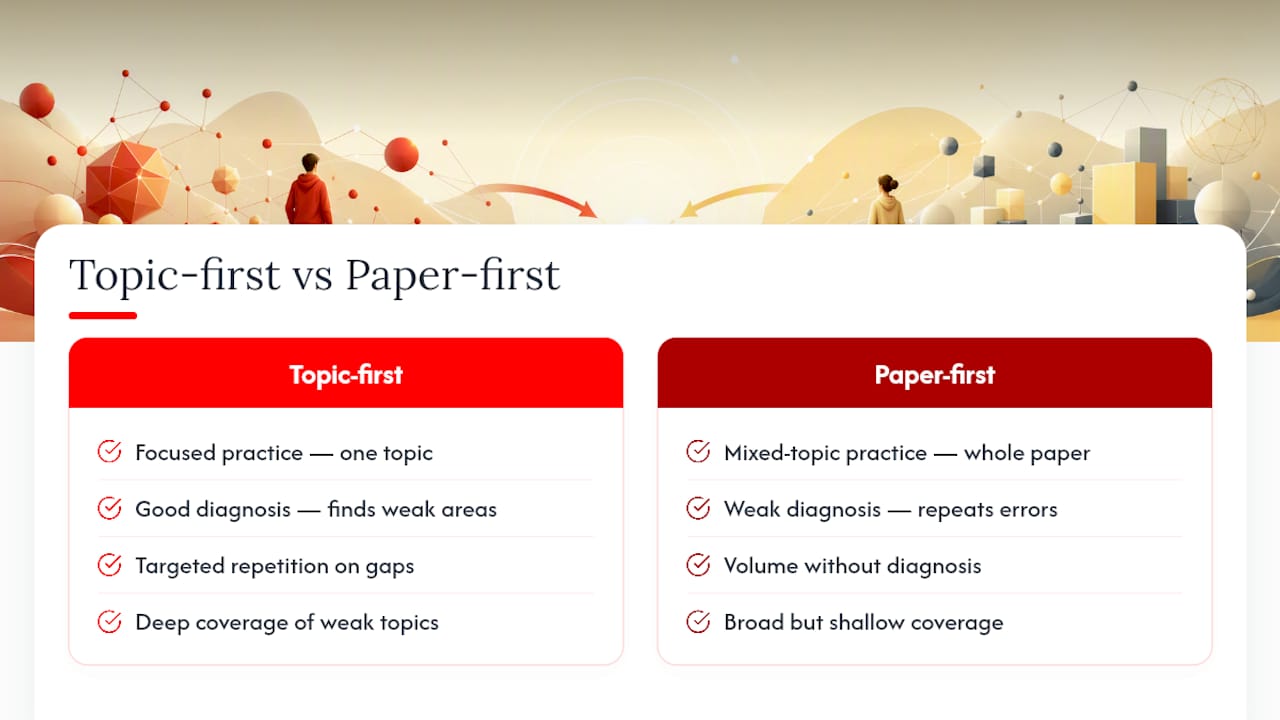
The conventional advice to “do as many past papers as possible” is not wrong, but it is incomplete. Volume without diagnosis is just repetition. The students who improve fastest are the ones who combine topic packs with mark-scheme analysis and short, targeted textbook review rather than accumulating question counts. Full papers still have a role — they are essential for practising timing and paper management in the final weeks before an exam. But for the bulk of the revision period, topic-sorted practice is the more efficient route.
Mathvault’s topic pages: free resources, ready to use
Mathvault’s Edexcel GCSE past paper questions by topic page gives you immediate access to syllabus-mapped topic packs, worked solutions, and video walkthroughs at no cost. Select your board, navigate to your topic, and start practising today.
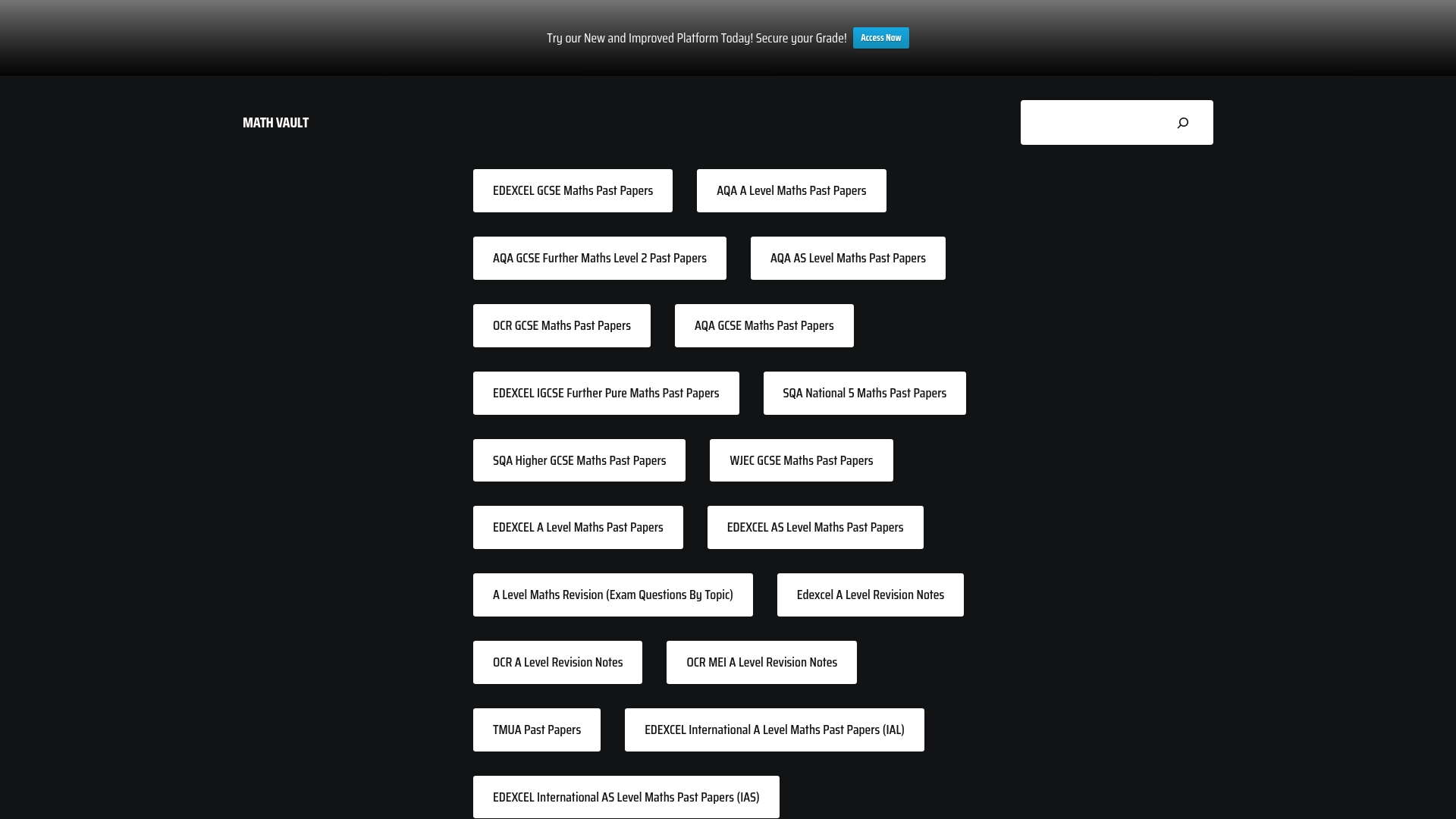
Every topic page is free. Full downloadable packs for complete series are available as optional purchases, giving you offline access to organised revision materials whenever you need them.
Sources
- Past papers | Past exam papers | Pearson qualifications
- Topical Past Papers CIE – PapersByTopic – Complete CIE Syllabus (9608)
- Topic Wise Questions from Past Papers Online | topic wise questions
- Papers | Studyclix
On centre-only papers: if the board’s public archive does not include the most recent series, contact your school’s exams officer. They have access to centre-restricted materials and can share them with you directly.
Leave a Reply