
Start with a syllabus-aligned topic checklist, then move straight into timed past-paper practice, and finish each session by reviewing fully worked solutions. That sequence covers the three things that move marks most reliably in A-Level statistics revision.
Quick-start checklist (30–120 minutes right now):
- Review the formula sheet for your board and tick off every formula you can recall without looking.
- Complete one timed past-paper question on a topic you find difficult (set a timer, no notes).
- Check your answer against a fully worked solution and note any step where your method diverged.
Why this order? Reviewing formulae first aligns your knowledge to what the examiner actually tests. Attempting a question immediately after locks in application before the theory fades. Checking the worked solution then corrects method errors at the point when they are freshest in your mind.
Key takeaways
Effective A-Level statistics revision combines a syllabus-aligned topic checklist, timed past-paper practice, and examiner-phrased conclusions — in that order, every session.
| Point | Details |
|---|---|
| Start with the topic checklist | Tick off each syllabus topic only once you can complete the practice target without notes. |
| Use the six-step past-paper routine | Simulate conditions, time by marks, mark immediately, log method vs arithmetic errors, build a weak-topic set, and retest after 48–72 hours. |
| Memorise two conclusion phrasings | “Sufficient evidence to reject H₀” and “insufficient evidence to reject H₀” cover every hypothesis-test conclusion mark. |
| Build calculator fluency daily | Practise distribution and inverse-normal functions until the key-press sequence is automatic; always enter σ, not σ². |
| Use Mathvault for board-aligned practice | Free topic-organised past papers, worked solutions, and video walkthroughs are available by exam board at Mathvault. |
Table of Contents
- What does A-level statistics revision actually cover?
- How do Edexcel, AQA and OCR differ for statistics?
- Which revision resources actually move your marks?
- How to use past papers and mark schemes effectively
- What do examiners actually expect in statistics answers?
- A compact 4-week revision plan for A-level statistics
- Which calculator should you use for A-level statistics?
- Managing exam stress and time during the paper
- Mathvault gives you everything you need for statistics revision
- A note from Mathvault
- Sources
What does A-level statistics revision actually cover?
Every UK exam board covers the same core topics, though the weighting and exact content vary slightly. Use the table below as a pre-practice checklist: tick each topic once you can complete the practice target without notes.
| Topic | Why it matters for the exam | Practice target |
|---|---|---|
| Data presentation & interpretation | Interpreting diagrams and summary statistics appears in almost every paper | 6–8 mixed questions |
| Sampling methods | Definitions and limitations are common short-answer marks | 4–6 questions |
| Averages & spread | Mean, variance, and standard deviation underpin distributions | 6–8 questions |
| Correlation & regression | Interpreting r and the regression line in context is a frequent examiner trap | 4–6 questions |
| Probability rules | Addition and multiplication rules feed directly into distributions | 6–8 questions |
| Binomial distribution | Cumulative probabilities and parameter identification are tested every year | 8–10 questions |
| Normal distribution | Standardising, inverse normal, and variance vs standard deviation errors cost marks | 8–10 questions |
| Normal approximation to binomial | Continuity correction is a common omission; applying Z = (X − μ)/σ correctly is tested | 4–6 questions |
| Hypothesis testing (binomial, mean, sign test) | Conclusion phrasing alone can be worth 1–2 marks per question | 8–10 questions |
| Large data set | Board-specific; Edexcel tests familiarity with the data set directly | 4–6 questions |
| Calculator usage | Distribution and inverse functions must be fluent under timed conditions | Practise every session |

For the normal distribution a level, pay particular attention to whether a question gives variance or standard deviation: most calculators require σ (standard deviation), not σ², so entering the wrong value is a silent error that costs the accuracy mark.
How do Edexcel, AQA and OCR differ for statistics?
All three boards share the core content above, but there are meaningful differences in emphasis and assessment style.
Edexcel includes a compulsory large data set element. Questions may ask you to interpret pre-released data directly, so familiarity with the data set’s structure is part of your revision, not a bonus. Edexcel also tests the normal approximation to the binomial with continuity correction. Mathvault’s Edexcel A-Level topic-organised past papers are arranged by syllabus topic. This makes targeted practice straightforward. The Edexcel A-Level subject hub gives you the full paper collection alongside worked solutions.
AQA covers hypothesis testing for the binomial distribution and the normal distribution, and places strong emphasis on interpreting statistical results in real-world contexts. The AQA A-Level hub on Mathvault organises papers and solutions by specification.
OCR and OCR MEI both include the sign test and place notable weight on hypothesis-testing methodology. OCR MEI goes further with a data analysis component. For any OCR student, the OCR examiner guidance on hypothesis-test conclusions is required reading.
Actionable next step: download the specification for your board from the exam board’s website, print the statistics section, and cross-reference it against the topic checklist above. Mark any topic listed in the spec but not in your notes as a priority gap.
Which revision resources actually move your marks?
Work through resources in this order of priority:
- Formula sheet + one-page topic summaries — know what you are given and what you must recall.
- Fully worked solutions — compare your method step by step, not just your final answer.
- Short video walkthroughs — use these for topics where your written notes are not clicking (hypothesis testing and normal approximation are the two most common).
- Targeted question banks — once you understand the method, volume of practice builds speed.
When you review a worked solution, do not simply check whether your answer matches. Identify the precise step where your method diverged, write it in an error log, and practise a similar question within 48–72 hours. That short retest cycle is what converts a one-off correction into a reliable method.
Pro Tip: Before exam day, practise your calculator’s distribution and inverse-normal functions until you can complete them without consulting the manual. Casio Education’s statistics revision guide specifically recommends building fluency with cumulative distribution and inverse functions under timed conditions — this alone can save several minutes per paper.
How to use past papers and mark schemes effectively
A past paper only improves your marks if you use it correctly. Follow this routine for every session:
- Simulate exam conditions. Remove notes, set a timer, and work through the paper or a timed section without stopping.
- Allocate time by marks. Roughly one minute per mark is a reliable guide; flag any question that is taking significantly longer and move on.
- Mark against the mark scheme immediately after. Do not wait until the next day — the reasoning is still fresh.
- Separate method errors from arithmetic slips. A method error means you misunderstood the technique; an arithmetic slip is recoverable with practice. Log each type separately.
- Build a weak-topic set. After three papers, list every topic where you dropped marks. Pull two or three questions on each topic from earlier papers and complete them as a focused mini-test.
- Retest after 48–72 hours. Return to the weak-topic set without looking at your previous attempt. Improvement here is the clearest signal that the method has stuck.
Casio Education’s guidance on timed practice and mark-scheme review supports this approach directly. Mathvault’s Edexcel topic-organised papers make step 5 particularly efficient because questions are already grouped by syllabus topic.
What do examiners actually expect in statistics answers?
The single most costly mistake in hypothesis testing is over-assertive language. Examiners do not want you to claim that H₀ is true or that H₁ is proved. OCR’s examiner guidance states this explicitly and provides a structured approach to hypothesis-test answers.
Common mistakes that cost marks:
- Choosing the wrong tail (one-tailed vs two-tailed) because the question wording was not read carefully.
- Omitting the continuity correction when approximating a binomial with a normal distribution. The CIMT chapter on distributions and hypothesis testing contains worked examples that show exactly when and how to apply it.
- Confusing variance (σ²) with standard deviation (σ) when entering values into calculator functions.
- Failing to interpret the conclusion in context — stating “reject H₀” without linking back to the scenario in the question.
- Misidentifying the parameter: always state clearly whether you are testing a proportion p, a mean μ, or a median.
Two phrasings to memorise for your conclusion marks:
- “There is sufficient evidence at the [X]% level to reject H₀ in favour of H₁.”
- “There is insufficient evidence at the [X]% level to reject H₀; we cannot conclude that [parameter] has changed.”
A compact 4-week revision plan for A-level statistics
Week 1 — Foundations. Cover data presentation, sampling, averages, spread, probability rules, and correlation. Complete 6–8 questions per topic. Identify any formula you cannot recall without the sheet.
Week 2 — Distributions and hypothesis testing. Work through binomial distribution, normal distribution, normal approximation, and hypothesis testing (binomial, mean, sign test). Use video walkthroughs for any topic where your method is uncertain. Practise the CIMT hypothesis-testing method structure: state H₀ and H₁, identify the parameter, calculate the test statistic, compare with the critical value, and write a contextual conclusion.
Week 3 — Timed past papers. Complete two or three full papers under timed conditions. Use the six-step routine from the past-papers section above. Build your weak-topic list by the end of the week.
Week 4 — Targeted rework and consolidation. Return to every weak topic with fresh questions. Consolidate your formula sheet. Practise calculator functions daily until they are automatic.
Daily session template (60–90 minutes):
- Warm-up: one short question on a topic you already know well (5–10 minutes).
- Focused practice: 2–3 questions on a target topic, timed (30–40 minutes).
- One past-paper question under exam conditions (15–20 minutes).
- Worked-solution review and error log update (10–15 minutes).
Reassign hours based on your diagnostic results. If hypothesis testing is your weakest area after Week 2, give it an extra session in Week 3 rather than spending equal time on topics you have already mastered.
Which calculator should you use for A-level statistics?
The Casio fx-991EX Classwiz and the Casio fx-991CW are the most widely used calculators for A-Level statistics in the UK, and both are permitted across Edexcel, AQA, and OCR. The fx-991EX Classwiz offers distribution functions (binomial cumulative probability, normal CDF and inverse normal) that are directly applicable to exam questions.
Key calculator habits to build before exam day:
- Practise entering normal distribution parameters as σ (standard deviation), not σ². Entering variance by mistake is one of the most common silent errors on the paper.
- Use the inverse-normal function to find critical values directly rather than reading from tables — it is faster and less prone to interpolation errors.
- For binomial cumulative probabilities, double-check whether the question asks for P(X ≤ k) or P(X < k), since the boundary condition changes the answer.
- Run through at least five distribution questions per revision session using only your calculator, no written tables, so the key-press sequence becomes automatic.
Casio Education’s A-Level statistics guide recommends building this kind of calculator fluency as a core part of exam preparation, not an afterthought.
Managing exam stress and time during the paper
Stress in a statistics exam usually comes from two sources: a question that looks unfamiliar, and running out of time. Both are manageable with a clear strategy.

Before the exam: practise under timed conditions regularly enough that the time pressure feels familiar rather than alarming. Students who have completed several timed papers rarely panic at the clock.
During the exam: read each question twice before writing anything. Missing that instruction costs marks before you have written a single line.
Allocate roughly one minute per mark and move on from any question that is taking significantly longer. A partially correct answer on a later question is worth more than a perfect answer on one you are stuck on. Return to flagged questions only after you have attempted everything else.
If a question looks unfamiliar, write down what you know: state H₀ and H₁, identify the distribution, write the formula. Examiners award method marks for correct structure even when the final answer is wrong.
Mathvault gives you everything you need for statistics revision
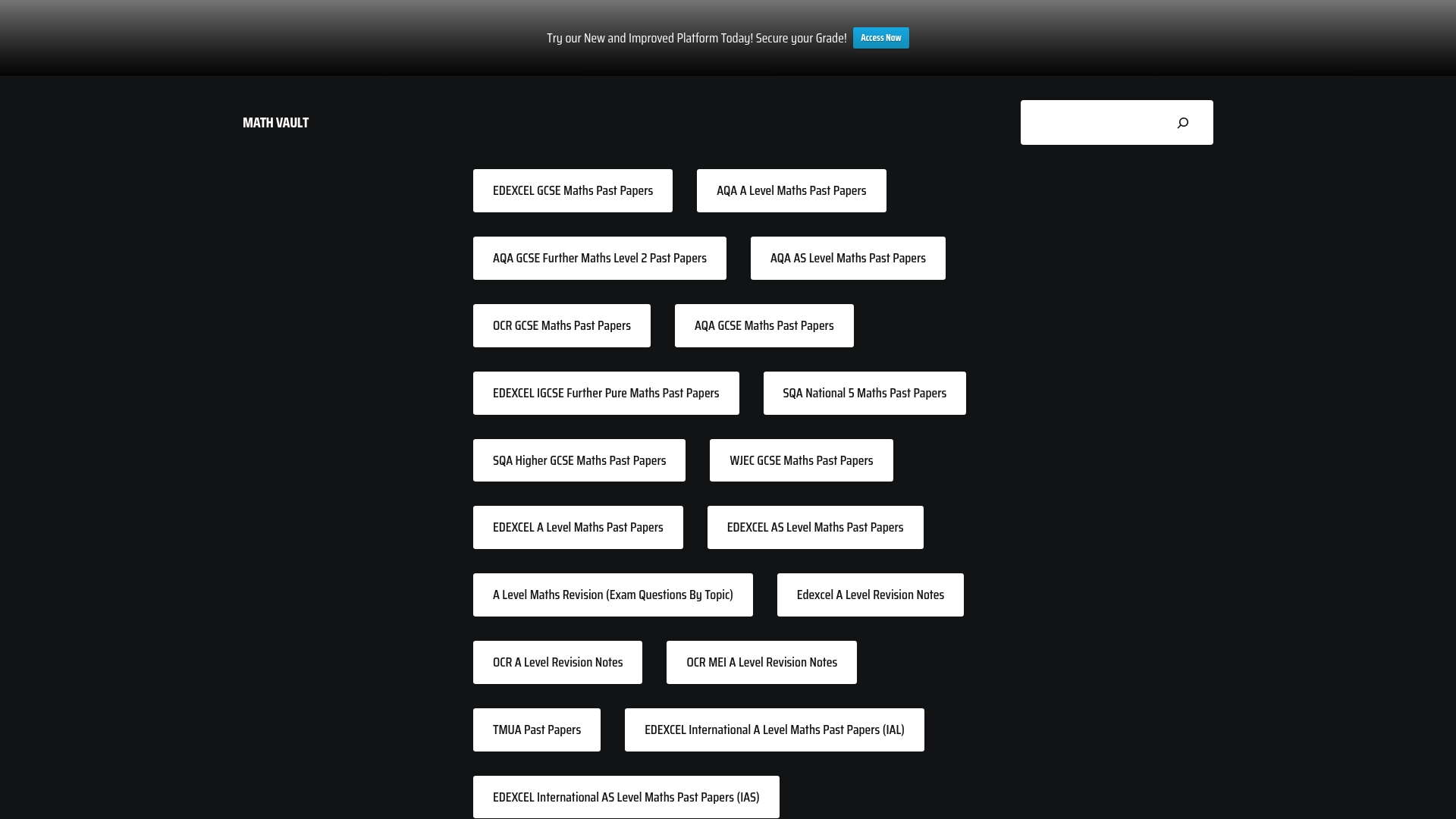
Mathvault brings together every resource type this guide recommends, organised by exam board and available free of charge. For A-Level statistics specifically, you get syllabus-mapped past papers, fully worked step-by-step solutions, downloadable PDF revision packs, video walkthroughs for tricky topics, and live weekly Q&A sessions where you can ask about specific questions.
The Edexcel A-Level topic-organised paper collection is particularly useful for the weak-topic practice sets described above: questions are grouped by syllabus topic, so you can pull a set of hypothesis-testing questions without searching through full papers. AQA students can access the same structure via the AQA A-Level hub.
All core resources are free. Downloadable offline packs and direct support are available via a small one-off purchase or donation, making it straightforward to build a complete revision library without a subscription.
Start by downloading the past-paper set for your board and completing your first timed session this week.
A note from Mathvault
Statistics rewards students who practise with purpose rather than volume. The students who improve most sharply are those who identify exactly where their method breaks down, correct it with a worked solution, and retest within a day or two. That cycle, repeated consistently across the four weeks before your exam, is what the platform is built around. Mathvault’s free resources, live Q&A sessions, and board-organised paper collections are here to support every stage of that process. If you have a question about a specific topic or a paper you are stuck on, bring it to a live session and we will work through it together.
Sources
- A Level Maths – hypothesis tests and the art of being non-assertive
- A-level statistics: a quick revision guide – Casio Education
- A‑level statistics: chapter 10 (CIMT)
Avoid relying on a single resource. The strongest revision combines exam-board specification pages (for scope), worked solutions (for method), and timed past papers (for application). Each source fills a gap the others leave.
Leave a Reply