The best Year 10 maths revision is short, regular and built around questions rather than rereading: about three focused sessions a week, topic by topic, with every mistake logged and revisited. Year 10 is the year to secure the foundations that the GCSE papers in Year 11 depend on, so you have time to fix gaps calmly instead of in a panic. Below you will find what to revise, how to organise your weeks, how to use practice questions and past papers, and where to find free worked solutions.
TL;DR
- Revise little and often: three or four sessions of 30 to 45 minutes a week beats one long weekend session.
- Follow what your school is teaching, then add a weekly “older topics” session so earlier work does not fade.
- Practise with exam-style questions by topic first, then move to full past papers in the summer term.
- Check every answer against a fully worked solution and keep an error log of the marks you lost and why.
- Use the free GCSE maths revision guides and board-specific topic pages on MathVault to match your exam board.
Table of Contents
- What Year 10 maths revision is actually for
- Which topics to revise in Year 10
- Building a revision timetable you can keep
- How to use practice questions well
- Using past papers in Year 10
- Finding and fixing the skills you keep getting wrong
- Where live help fits in
- Our perspective: why we built MathVault for pupils like you
- Free practice, solutions and live sessions in one place
- A sample four-week Year 10 revision cycle
- Tips for parents, tutors and teachers
- FAQ
- Sources
What Year 10 maths revision is actually for
In Year 10 you are not yet sitting your final exams, but you are learning most of the content that will be examined. Revision now has two jobs. The first is consolidation: making sure that what you were taught in September is still secure in March. The second is diagnosis: finding the topics that cost you marks while there is plenty of time to improve them.
That is a different mindset from Year 11 revision, where the priority is speed, exam technique and the final push. In Year 10 you can afford to go slowly, understand why a method works and build fluency. A pupil who does this has far less to repair later.
It also helps to know that GCSE maths is split into Foundation and Higher tiers, and that your school may change a tier decision during the course. Revising the Higher or Foundation content properly, rather than dabbling in both, keeps your effort focused. Ask your teacher which tier you are currently working towards.
Which topics to revise in Year 10
There is no single national Year 10 timetable. Schools sequence the GCSE specification differently, and the content itself differs slightly between exam boards and across the UK nations. England uses GCSE boards such as AQA, Edexcel and OCR, Wales uses WJEC, and Scotland uses SQA National 5 qualifications. Your first job is to find out which course you are on.
To see what this looks like in practice, one English academy’s Year 10 revision evening materials list equations and inequalities, simultaneous equations, number, indices and roots, ratios, percentages, circles and compound measures among the topics pupils meet that year. Your own school’s list will differ, but it will almost certainly draw on the same five strands of the GCSE specification.
The five strands to keep in view
| Strand | Typical Year 10 content | What examiners reward |
|---|---|---|
| Number | Fractions, percentages, indices, surds, standard form, bounds | Accurate arithmetic and clear method |
| Algebra | Expanding and factorising, quadratics, simultaneous equations, inequalities, sequences | Correct manipulation and showing each step |
| Ratio and proportion | Sharing in a ratio, direct and inverse proportion, compound measures | Setting up the relationship before calculating |
| Geometry and measures | Circles, Pythagoras, trigonometry, volume, vectors, transformations | Diagrams, correct formulae and units |
| Statistics and probability | Averages, charts, tree diagrams, conditional probability | Reading the question carefully and organising data |
When you plan revision, tick off topics against your own school’s scheme of work or your board’s specification, not against a generic list. If your teacher has given you a topic checklist, that is your master document.
Using board-specific topic pages
Because content is organised by exam board, it saves time to revise from pages that match yours. On MathVault you can browse the AQA GCSE maths revision topics or the OCR GCSE maths revision topics, each broken down by strand with past questions attached. If you want to go deeper on one strand, there are dedicated pages such as AQA Number, AQA Graphs and Functions, OCR Ratio and Proportion and Edexcel Sequences.
Building a revision timetable you can keep
A timetable only works if you will follow it in week six, not just week one. Start small, then add.
A simple weekly pattern
- Session 1, new material (30 to 45 minutes). Revise the topic you covered in class this week while it is fresh. Redo two or three class examples without looking at your notes.
- Session 2, practice (30 to 45 minutes). Work through exam-style questions on that topic. Mark them using a worked solution.
- Session 3, older topics (30 to 45 minutes). Pick a topic from a few weeks or months ago. Try five mixed questions cold. This is where forgetting shows up.
- Optional session 4, error log (20 minutes). Review the mistakes you logged and redo the questions you got wrong.
That is roughly two to three hours a week. It is realistic alongside homework and other subjects, and it builds a habit that carries into Year 11.
How long should a session last?
For most pupils, 30 to 45 minutes of focused work is plenty. Maths revision is active: if you have been working for an hour and your answers are getting careless, stop and return another day. Put your phone in another room, have a pen, paper and a calculator ready, and decide the topic before you sit down so no time is lost choosing.
Adjusting around school life
- Half terms: use one of the breaks for a slightly longer session on your weakest topic.
- Assessment weeks: swap the older-topics session for the specific units being tested.
- Busy weeks: drop to two sessions rather than none. Consistency matters more than volume.
How to use practice questions well
Reading a revision guide feels productive, but it is passive. Real revision means answering questions and finding out what you cannot yet do. A good order is:
- Read the short explanation or your class notes for the topic.
- Attempt a handful of questions without help, on paper, in the style the exam uses.
- Check each one against a full worked solution, line by line.
- Redo any question you got wrong, a day or two later, from a blank page.
Step four is the one most pupils skip, and it is the one that turns a mistake into a secure skill.
Show your working every time
GCSE mark schemes award method marks as well as accuracy marks. A wrong final answer can still earn most of the marks if the method is visible and correct, while a bare correct answer to a multi-mark question can be risky. Practise writing each step, even when you could do it in your head. Our guide to using worked solutions to revise explains how to compare your working with a mark scheme step by step.
Try first, then check
It is tempting to read the solution straight away. Resist that. Give every question a genuine attempt, then look. If you are stuck, the choice between a written solution and a video is worth thinking about: our piece on written versus video solutions sets out when each helps most. For a whole paper, the 2023 AQA GCSE video walkthroughs let you watch the reasoning behind each question unfold.
Using past papers in Year 10
Year 10 pupils often ask whether they are “allowed” to use past papers yet. They are, with some care. Full papers cover the entire course, so before you have finished the content they will contain questions you have not been taught. That is not a problem if you use them selectively.
- Autumn and spring terms: pull out individual questions on topics you have covered. Treat the paper as a question bank.
- Summer term: attempt whole papers, or large sections, under timed conditions once most of the course has been taught.
- After each attempt: mark honestly, then sort lost marks into categories (see the next section).
Past papers are available for each board. For example, you can work from the AQA GCSE maths 2018 past papers and mark schemes. If you are in Wales or Scotland, there are WJEC 2016 and SQA National 5 papers for 2019, 2022 and 2023.
If you are sitting IGCSE instead, the IGCSE past-paper questions are organised in the same way.
Calculator and non-calculator practice
GCSE maths includes a non-calculator paper, so you need to practise both. Every week, include some questions where you work without a calculator: fractions, percentages, surds, expanding brackets and estimation are the usual candidates. Check your own board’s specification for the exact paper structure and timings.
Finding and fixing the skills you keep getting wrong
The most powerful tool in Year 10 revision is an error log. It takes five minutes after each practice session and tells you where your marks are going.
Build an error log
Create a simple table in a notebook or spreadsheet:
| Date | Topic | Question | What went wrong | Fix |
|---|---|---|---|---|
| 12 Jan | Quadratics | Factorise x² + 5x + 6 | Used wrong pair of factors | Check by expanding |
| 19 Jan | Ratio | Share £60 in 3:2 | Divided by 3 instead of 5 | Add the parts first |
Each error usually falls into one of four types:
- Knowledge gap: you did not know the method or formula.
- Method slip: you knew it but applied a step wrongly.
- Arithmetic error: the method was right, the calculation was not.
- Misread question: you answered something different from what was asked.
Knowledge gaps need re-learning. Method slips need more practice. Arithmetic errors and misreads need a different habit, such as checking your answer or underlining key words, not more content revision.
Spot specification gaps early
Sometimes the issue is not a single mistake but a whole area you have never properly covered. Our guide to finding specification gaps in GCSE revision notes shows how to compare your notes against the board’s topic list so nothing is missed.
Textbooks and notes
In Year 10 there is time to learn from a textbook in depth. As exams approach, concise notes become more useful for quick recall. We cover the switch in when to move from textbooks to notes.
Where live help fits in
Even with great resources, you will sometimes be stuck on a question that no solution seems to explain in the way you need. That is where live help is valuable. Writing down your question in advance, and what you have already tried, makes the session far more productive. Our guide to getting the most from live Q&A explains how to turn one hour into weeks of progress, and where to ask maths questions live points you to the next session.
Our perspective: why we built MathVault for pupils like you
We built MathVault because we saw how often a pupil’s revision stalls at the same point: they have questions but no way to know whether their answers are right, or why. A past paper with no worked solution is only half a resource.
That is why everything we publish is built around fully worked, step-by-step solutions, organised by exam board, with video walkthroughs and live weekly Q&A alongside. We want you to see not just the final answer but the method and accuracy marks that sit behind it, because that is how examiners think.
Our position is simple: Year 10 is the best moment to start. A pupil who spends the year practising by topic, checking against full solutions and learning from errors arrives in Year 11 with confidence, not catch-up. We offer our revision materials and live sessions free so that every student in England, Wales and Scotland can do exactly that.
Oloru
Free practice, solutions and live sessions in one place
If you want a ready structure for your Year 10 revision, MathVault gives you free past exam papers, fully worked solutions, video walkthroughs, topic-based revision guides and downloadable notes, sorted by exam board. Live Q&A sessions run weekly for students who want to ask questions in real time. Some recent or advanced resources and full downloadable packs are available through one-off purchases or small donations, which help us keep the rest free.
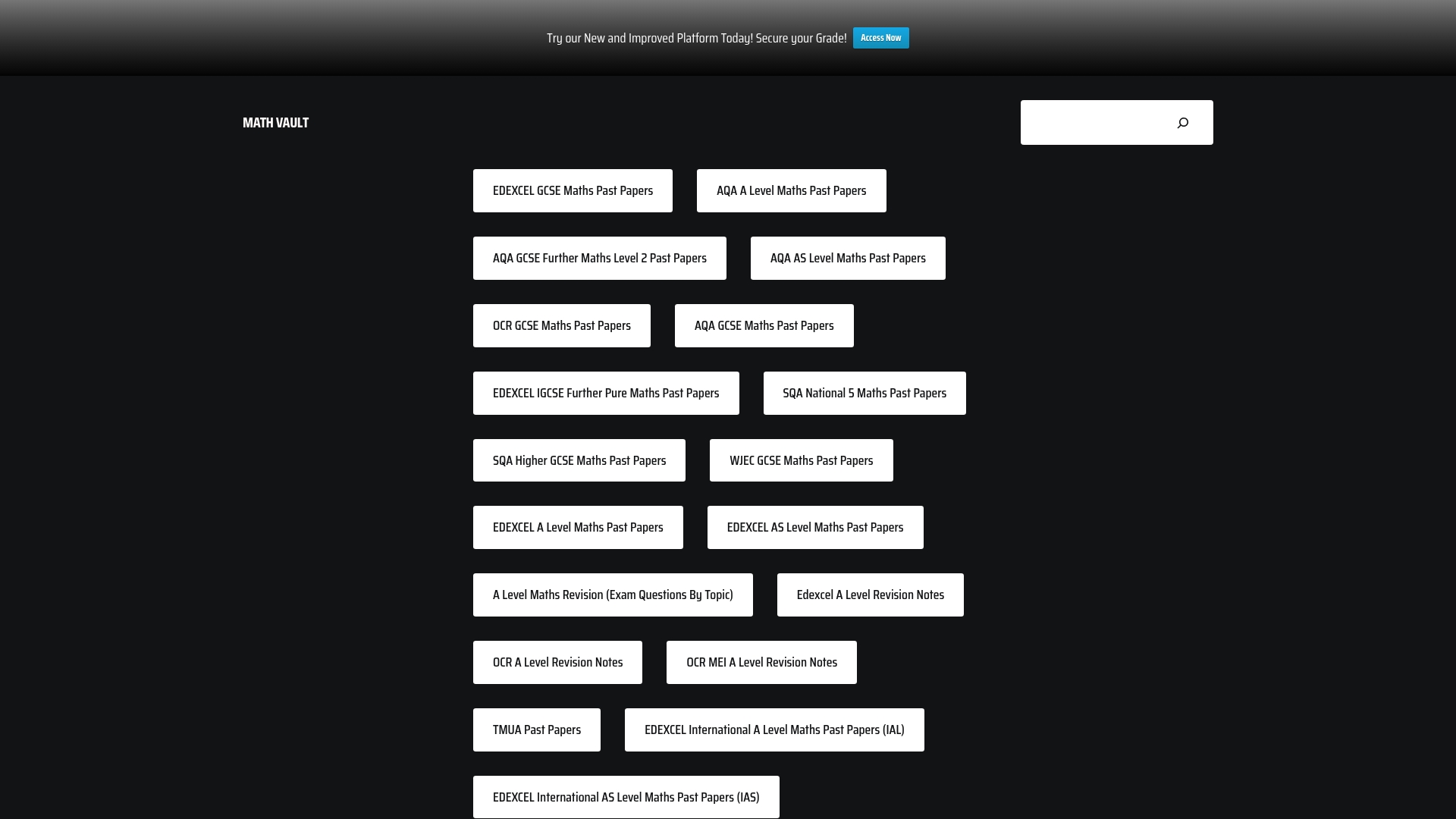
Start with the MathVault homepage to pick your exam board, or follow our 4 to 6 week video walkthrough plan if you want a ready-made routine. Looking ahead, the A-Level maths past-paper questions will be there when you reach sixth form.
A sample four-week Year 10 revision cycle
If you are unsure how to begin, try this cycle on one strand, then repeat it with another.
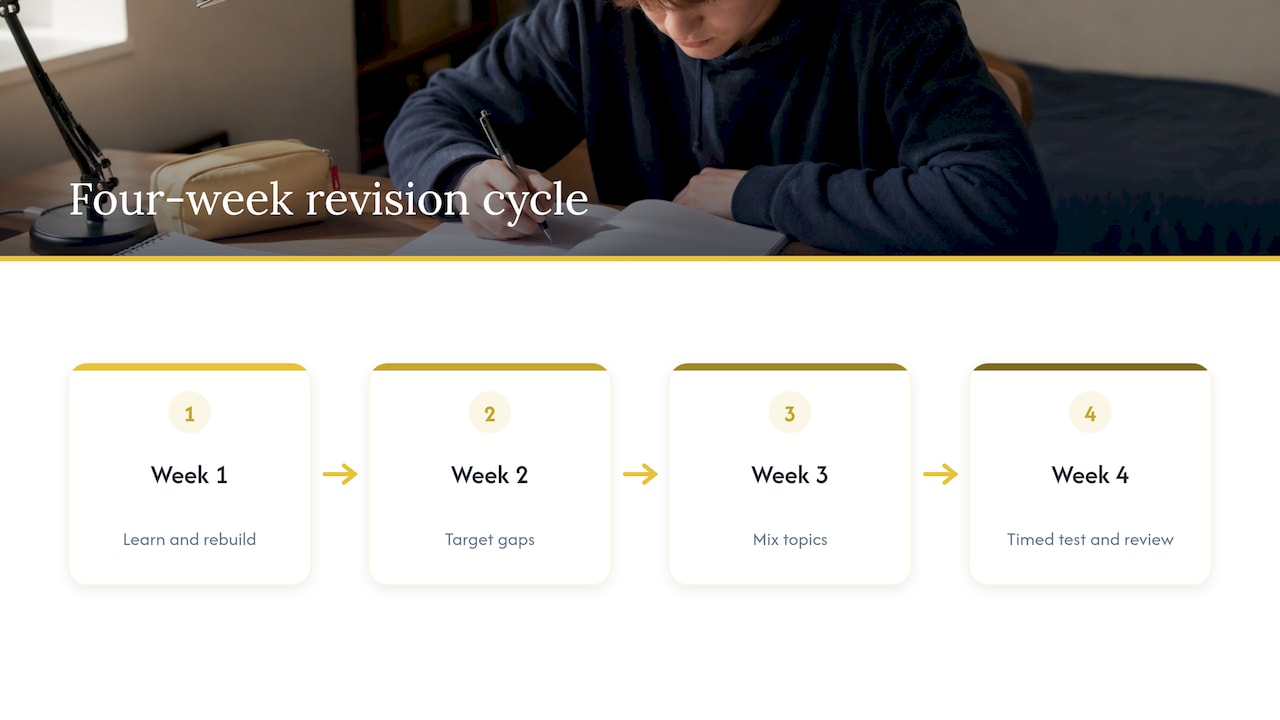
Week 1: Learn and rebuild. Choose a strand, for example algebra. List the sub-topics from your school’s scheme of work. Read your notes, then answer five questions on each sub-topic without help. Mark them and start your error log.
Week 2: Target the gaps. Look at your log. Pick the two sub-topics where you lost the most marks and re-learn them using a worked solution as a model. Then do ten fresh questions on those two.
Week 3: Mix it up. Combine your chosen strand with earlier ones. Mixed questions force you to recognise which method is needed, not just apply the one you have just practised. This is much closer to the real exam.
Week 4: Test and review. Do a short timed set of exam-style questions, roughly one mark per minute is a sensible guide for pacing, then mark with the mark scheme. Compare the result with week one and note what has changed.
At the end of the cycle, you will have a clear picture of what has become secure and what still needs time. Move on to the next strand and schedule the earlier one back into your older-topics session.
Tips for parents, tutors and teachers
If you are supporting a Year 10 pupil, your role is to make revision regular and easy to start, not to be the maths expert.
- Agree the timetable together. Pupils stick to plans they helped write.
- Ask about the error log. “What did you get wrong this week and what did you learn?” is a better question than “Have you finished?”
- Keep sessions short. Forty focused minutes is better than a two-hour argument.
- Provide the materials. Printed past questions, a calculator and a quiet table remove the usual excuses.
- Use topic resources. Tutors and teachers can pull board-specific questions and solutions by topic for supplementary work, such as OCR Sequences, OCR Number or OCR Vectors.
If your child is also thinking ahead to sixth form maths, it is never too early to look at how the revision habits they build now will transfer.
FAQ
How much maths revision should a Year 10 pupil do?
Two to three hours a week, split into three or four sessions of 30 to 45 minutes, is a sound target for most pupils. Increase it a little around assessment weeks and half terms. Regularity matters more than the total.
Should Year 10 pupils use GCSE past papers?
Yes, but selectively at first. Use individual questions on topics you have already been taught during the autumn and spring terms, and save full timed papers for the summer term when more of the course is covered.
What is the best way to revise maths without a tutor?
Attempt questions on paper, mark them against a fully worked solution, and record every error in a log. Redo the wrong questions a few days later. Free live Q&A sessions can help when you are stuck on a method.
Which topics matter most in Year 10?
All five strands matter, but algebra and number underpin almost everything else, so secure those first. Follow your own school’s scheme of work and your exam board’s specification, as the order and emphasis differ between schools and nations.
Leave a Reply