
Use a worked solution as scaffolding, not as an answer sheet. Attempt the question first, study the full reasoning, cover it up and reproduce the method, then try a similar question with less help. Check your final wording against the official mark scheme for your exam board, because a correct method and a mark-earning answer are not always the same thing.
This guide shows you exactly how to do that for GCSE and A-Level maths, how worked solutions differ from mark schemes and examiner reports, and where students most often go wrong. It is written for students, and for the parents, tutors and teachers who support them.
TL;DR
- Worked examples help most when a method is new to you. A 2023 meta-analysis found a medium average benefit for mathematics learning (g = 0.48), but it is an average, not a promise of a grade.
- Explain each line to yourself: what information it uses, why the step is valid, and what would change if the question changed.
- Gradually fade the support: study, cover, reproduce, then solve a similar question unaided and retest later under timed conditions.
- Use the question paper to attempt, the mark scheme to see what earns credit, and the worked solution to understand the missing reasoning.
- Always match the solution to your own exam board, tier and calculator or non-calculator paper.
Table of Contents
- What a worked solution is, and what it is not
- Worked solutions, mark schemes and examiner reports compared
- Why worked solutions help, and what the research does not say
- A six-step routine for using a worked solution
- Self-explanation: the habit that makes solutions work
- Check the solution against the right exam board
- Method marks, accuracy marks and the written form of your answer
- Diagnose your errors, then pick the right resource
- Vary your examples
- Our perspective on worked solutions
- Where to find worked solutions and past papers
- Common mistakes to avoid
- For parents, tutors and teachers
- FAQ
- Sources
What a worked solution is, and what it is not
A worked solution is a complete, step-by-step demonstration of how to answer a question, including the reasoning behind each step. MIT’s learning guidance describes these as step-by-step solutions to solved problems, and notes that when people are new to a concept, studying them tends to be more effective than struggling through problems with no model to follow.
The same guidance carries a condition that matters for your revision: worked examples work when learners explain the solution to themselves. Reading passively is not enough.
A worked solution is not:
- A mark scheme. A mark scheme tells examiners what to credit. It is concise by design.
- An examiner report. That is feedback on how candidates performed across the whole cohort.
- A substitute for practice. It is the first stage of learning a method, not the last.
Worked solutions, mark schemes and examiner reports compared
Three documents sit around every past paper. Each answers a different question, and strong revision uses all three.
| Document | What it tells you | Where it falls short |
|---|---|---|
| Question paper | What you will be asked, and how many marks each part carries | Nothing about method or credit |
| Official mark scheme | What earns method, accuracy and other marks, and what answers are accepted | Concise, so it often skips the reasoning between steps |
| Worked solution | One clear path through the question, with the thinking explained | It shows one route, and does not by itself define what the board will credit |
| Examiner report | Common errors and why candidates lost marks | It covers the cohort, not your own paper |
The distinction matters. Mark schemes are authoritative for awarding marks, while examiner reports add evidence about recurring errors. OCR describes its reports as feedback on performance, technical aspects, difficulties and whether problems came from knowledge or examination technique. You can see this in practice in OCR’s A Level Mathematics A examiner report for H240/01 (Summer 2023), a two-hour, 100-mark Pure Mathematics paper. It advises candidates to be familiar with command words and to include enough detail when showing a given answer.
So when you ask whether to use worked solutions or mark schemes, the honest answer is both, in a set order: the mark scheme tells you what counts, and the worked solution helps you understand why.
Why worked solutions help, and what the research does not say
When you meet a new method, your working memory is already busy. Trying to invent a method and apply it at the same time is heavy going. A worked example removes the invention step and lets you focus on the structure. That is the logic behind the worked-example effect, and the Kapor Foundation’s strategy guide recommends presenting examples when a concept is introduced and mixing them with independent practice.
The 2023 meta-analysis pooled 55 studies and 181 effect sizes, screened from 8,033 abstracts, and found an average effect of g = 0.48 for worked examples against problem-solving-only conditions. That is a medium effect, and it is worth taking seriously. Three cautions apply:
- It averages many ages, topics and formats, from elementary school to postsecondary study. It is not a GCSE-specific result.
- It supports worked examples for learning unfamiliar material. It does not say that reading solutions alone raises your exam grade.
- It does not replace timed practice, feedback and revisiting topics over time.
A separate caution comes from classroom research. A study of cognitive instructional principles points to the value of deep questioning alongside worked examples. In plain terms: if you only watch someone solve a problem, you may recognise each step without being able to produce it yourself. Recognition feels like understanding. It is not the same thing.
A six-step routine for using a worked solution
This routine suits GCSE and A-Level questions alike. Adapt the timings to the topic and to how confident you are.
- Attempt the question briefly, without help. Give it a few minutes. Even a failed attempt shows you which part you cannot start, and that makes the solution easier to read.
- Study the worked solution. Read it slowly, one line at a time, rather than skipping to the final answer.
- Annotate why each step is valid. Write a short reason beside each line: the rule used, the information drawn from the question, the reason the operation is allowed.
- Close it and reproduce the method. Cover the solution and rewrite it from memory. Where you stall is exactly where your understanding is thin.
- Solve a similar question with fewer prompts. Change the numbers, the wording or the context, and do it without the solution beside you.
- Retest later under timed conditions. Return after a few days, and again after a few weeks, with a timer running and exam-style conditions.
If you get stuck at step 4 or 5, do not copy the last line of the solution. Go back to the earliest step you could not explain and work forward from there. That single habit separates revision that sticks from revision that only feels productive.
The research behind this sequence is the idea of worked and faded examples: you start with full support and remove it gradually as your proficiency grows, so that you do more of the thinking each time. MIT’s guidance recommends self-explanation, a range of varied examples and fading support, and the routine above is a practical version of those three ideas.
Self-explanation: the habit that makes solutions work
Self-explanation means putting each step into your own words as you read. It is the difference between reading a solution and learning from it. After each line, ask yourself:
- What information did this line use?
- Why is this operation valid here?
- What does this value represent?
- What would change if the condition changed?
- Could a different method have worked?
These prompts matter most in algebra, calculus, mechanics and statistics, where it is common to copy the notation of a solution without grasping the decision between two lines. Copying notation is how a student can read ten solutions on differentiation and still freeze when an eleventh question is worded differently.
A short example: completing the square
Suppose a solution rewrites x² + 6x + 2 as (x + 3)² − 7. A passive reader nods. A self-explaining reader asks:
- Why is the number inside the bracket 3? Because it is half of the coefficient of x.
- Why does −7 appear at the end? Because (x + 3)² expands to x² + 6x + 9, which is 7 too many, so we subtract 7 to get back to the original +2.
- What would change if the coefficient of x were odd? The bracket would contain a fraction, but the idea is identical.
Three questions, a minute of thought, and you now own the method instead of the pattern.
Check the solution against the right exam board
A beautiful solution for the wrong specification can mislead you. Before you rely on one, confirm:
- The exam board. AQA, Edexcel and OCR cover similar content, but question styles, paper structures and command words differ. If you sit Edexcel, our guide to how Edexcel maths converts assessment objectives into marks across 240 total marks shows why structure matters.
- The tier. Foundation and Higher papers are not interchangeable.
- The paper type. Calculator and non-calculator papers reward different methods.
- The specification and year. Content can shift between specifications, so match the solution to the paper you are actually practising.
Also be realistic about availability. Pearson states that its past-paper library is free to teachers and students, but the most recent papers are restricted to teachers so they can be used for mocks. Rules differ by board, qualification and exam series, and they can change, so check your board’s current policy. This is one reason to work through older papers first and save the newest for a final, timed run once your school allows it.
Method marks, accuracy marks and the written form of your answer
Maths mark schemes award credit in different ways. Method marks reward a valid approach even if an arithmetic slip follows. Accuracy marks depend on the correct result from correct working. Some questions also carry marks for communication or reasoning.
This is where an unofficial solution can lead you astray. A solution may use a perfectly valid method yet omit the presentation or precision the board expects. The OCR report is a good illustration: when a question says “show that”, the examiners want enough detail to demonstrate the result without simply stating it. Mathematical correctness and mark-earning performance overlap, but they are not identical.
When you mark your own work, compare two things:
- The mathematics. Did you reach the right result by a valid route?
- The written form. Would an examiner see every step they need? Are your notation, units and rounding in line with what the scheme accepts?
Teachers and tutors can build this into feedback by asking students to annotate their answer with the marks they think each line earns, then compare it with the scheme.
Diagnose your errors, then pick the right resource
Not every wrong answer needs the same fix. After marking a question, label the error:
| Error type | What it looks like | What to do next |
|---|---|---|
| Conceptual | You did not know which method applied | Return to a worked example of the topic, then fade support |
| Algebraic | The method was right, but a sign or expansion slipped | Redo similar questions slowly, checking each line |
| Calculator | A wrong key sequence, rounding too early, or the wrong mode | Practise the calculator steps; check the answer by estimation |
| Exam technique | You misread the command word or skipped required working | Read the mark scheme wording and the examiner report for that paper |
The OCR report suggests this same split between knowledge and technique, and sorting your errors this way stops you from re-reading solutions for a problem that is really about layout or speed.
Vary your examples
Do not rely on a single worked example. If you study one solution on one question type repeatedly, you may memorise a surface pattern, such as “this kind of question always needs completing the square”, instead of the mathematical structure beneath it. Compare several examples with different numbers, wording and representations, then try an unfamiliar variant.
A practical way to do this on a past paper:
- Pick one topic, say quadratics or the laws of indices.
- Work through three or four questions on it from different years or papers.
- After each, note what was the same and what was different.
- Finish with one question you have not seen, closed-book.
Our perspective on worked solutions
We built Mathvault around a simple belief: students should be able to mark their own work properly. That means a past paper, the board’s mark scheme, and a fully worked solution that explains the steps in between. Each does a different job, and a student who has all three can find out not just that an answer was wrong but why.
We also see the same habit again and again among students who feel stuck: they read the solution, feel that it makes sense, and move on. The feeling of understanding arrives before the ability to do it. Our advice is always to close the page and reproduce the method. If you cannot, you have found what to revise.
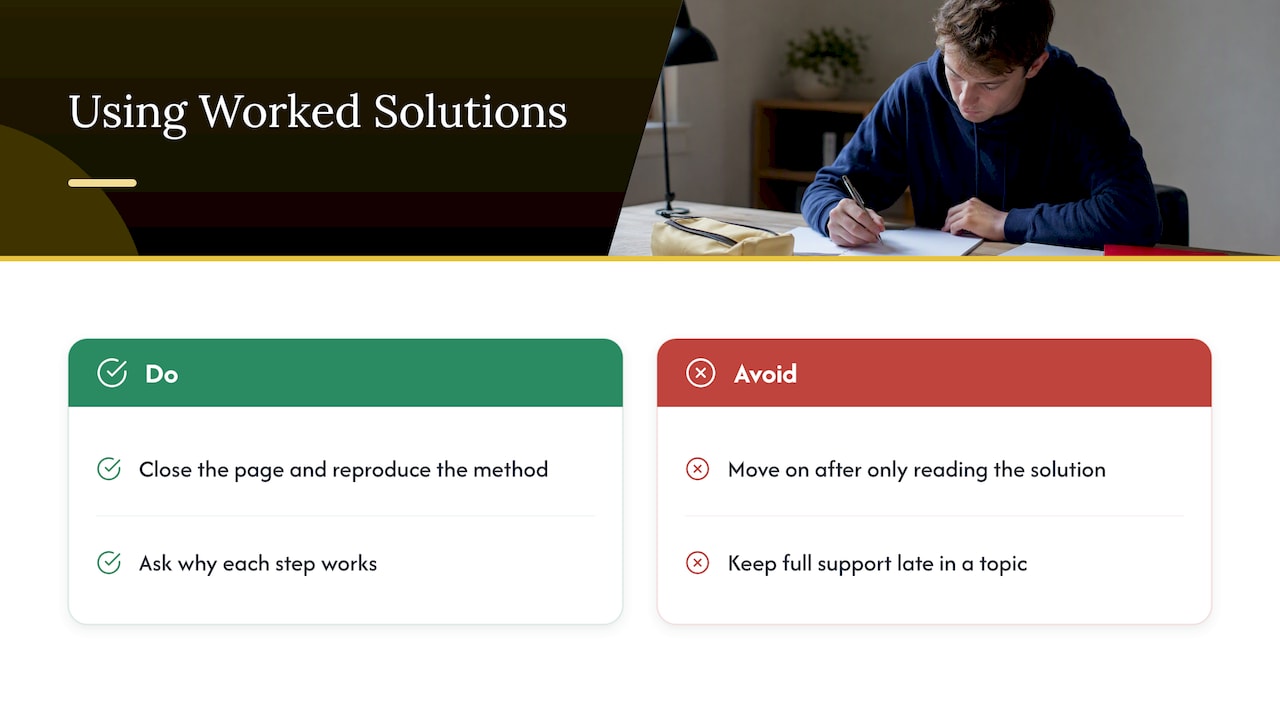
A worked solution is the right tool at the right moment. Early in a topic it saves you from wasted frustration. Later it should shrink, and your own unaided attempts under timed conditions should take over. Revision is a gradual handover of the thinking from the page to you.
For parents and tutors, the most useful question is rarely “is that right?” but “why does that step work?” Asking it takes no specialist knowledge, and it prompts the self-explanation that does the real learning.
— Oloru
Where to find worked solutions and past papers
Mathvault offers free GCSE and A-Level past papers organised by UK exam board, with fully worked step-by-step solutions, video walkthroughs, topic-based revision guides and live weekly Q&A sessions for students. Some recent or advanced resources and full downloadable packs are sold as one-off purchases, and you can support the site with a donation.
A sensible way to start:
- Marking your own paper. Our page on how to self-mark GCSE past papers with board-aligned solutions and live Q&A walks you through it.
- GCSE topics by board. Browse the OCR GCSE maths revision topics, or the Edexcel GCSE past-paper questions by topic.
- AQA papers. See the AQA maths past papers for GCSE, A-Level and more.
- A-Level. Practise with A-Level maths past-paper questions.
- Short on time. Follow the 48/24/8 plan for last-minute GCSE revision.
If you want a wider approach to planning, our article on effective GCSE maths revision strategies covers how to structure your weeks.
Common mistakes to avoid
- Reading the solution before trying. Even a short attempt makes the solution far more meaningful.
- Treating a video as the whole job. Watching a walkthrough is a good start, but pause it, predict the next step, and then redo the question yourself.
- Using only one solution source. Cross-check against the official mark scheme for your board.
- Never fading support. If you still need the full solution after several tries, go back one step to an easier or more similar question rather than rereading.
- Skipping timed practice. Worked solutions build understanding; timed papers build speed, stamina and judgement about where to spend time.
- Practising the wrong paper. Check board, tier and calculator rules every time.
For parents, tutors and teachers
You do not need to teach the topic to help. Try these approaches:
- Ask the student to explain a worked solution aloud, line by line, as though teaching you.
- Pick a similar question and ask them to solve it while you hold the solution.
- Ask them to say which mark scheme marks they think they earned, and why.
- Use varied questions rather than repeating the same one.
If you are supporting an older student, our 12-week A-Level maths plan for parents is designed to help without teaching. Teachers may find it useful to hold back the newest papers for mocks, in line with the exam boards’ own rules, and assign older papers with solutions for independent study.
FAQ
Should I look at the worked solution before or after trying the question?
Try the question first for a few minutes, then study the solution. If the topic is completely new to you, it is reasonable to study a worked example first, then attempt a similar question straight afterwards. The key is that you always follow the solution with your own attempt.
What is the difference between a worked solution and a mark scheme?
A mark scheme is the exam board’s guide for examiners: it shows what earns marks and which answers are accepted, and it is deliberately concise. A worked solution explains the reasoning between the steps, so you can understand the method. Use the mark scheme to check credit and the worked solution to understand the thinking.
Can reading worked solutions improve my grade by itself?
Not on its own. Research supports worked examples as an efficient way to learn new methods, but the evidence averages many settings and does not promise a fixed grade increase. You still need independent practice, feedback, spaced revisiting and timed papers.
Are worked solutions from any website safe to rely on?
Check them against your exam board’s official mark scheme. A solution can be mathematically valid yet leave out working or precision that the board expects, so always confirm the board, tier, paper type and specification match yours.
How many times should I redo a question?
There is no fixed number, because it depends on the topic and on you. A good guide: redo it from memory once, then solve a similar question unaided, then return to it after a few days. If you can do it cold and quickly, move on.
Sources
- Learning through step-by-step solutions to solved problems, MIT Open Learning
- A Meta-analysis of the Worked Examples Effect on Mathematics Performance
- Worked Examples, Kapor Foundation
- Cognitive instructional principles in elementary mathematics classrooms (Ding, Hassler and Li, 2021)
- OCR A Level Mathematics A, H240/01, Summer 2023 examiner report
- Past papers, Pearson qualifications
Leave a Reply