
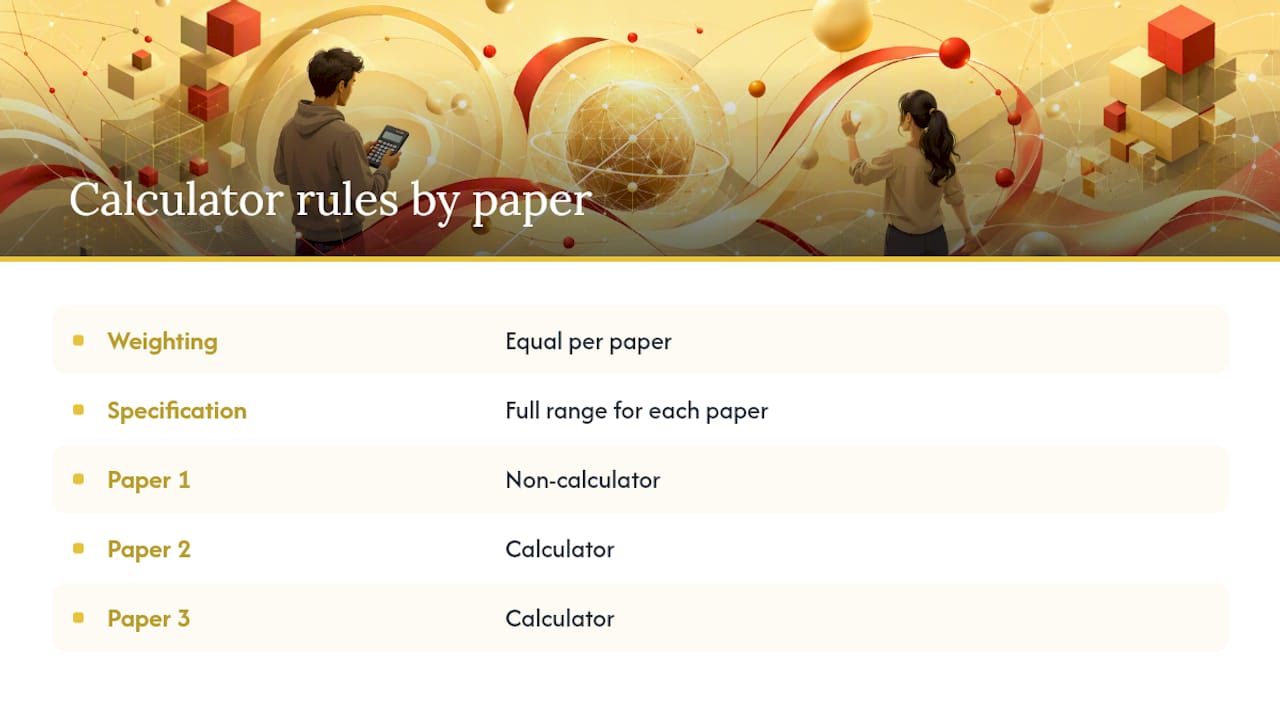
The Edexcel GCSE Maths exam consists of three equally weighted papers, each lasting 1 hour 30 minutes and worth 80 marks, for a total of 240 marks. Paper 1 is non-calculator, while Papers 2 and 3 allow calculators throughout. Students sit either the Foundation tier, covering grades 1 to 5, or the Higher tier, covering grades 4 to 9, and every paper must be taken at the same tier.
TL;DR:
- Students must practice both calculator and non-calculator questions, as Paper 1 relies on mental and manual skills, while Papers 2 and 3 focus on multi-step calculations.
- Tier choice heavily influences final grade potential, with Foundation capped at grade 5 and Higher offering grades up to 9, depending on exam performance.
- Exam questions can test multiple topics within a single problem, requiring flexible problem-solving and layered knowledge across algebra, geometry, and other areas.
- Marking depends on demonstrating correct methods for method marks and logical reasoning for higher grades, not just final answers.
- Using structured, timed practice with official past papers and detailed review of mistakes significantly improves exam performance.
Table of Contents
- Edexcel maths exam structure: the quick facts
- Paper 1, Paper 2 and Paper 3: what each one actually tests
- Foundation and Higher tiers: how content and difficulty differ
- AO1, AO2 and AO3: what examiners are actually marking
- How marks are actually awarded: method marks and question structure
- What to expect on exam day: equipment, formulae and timing
- From raw marks to final grade: how boundaries work
- Finding official specification documents and genuine past papers
- Turning past papers into real progress, not just practice
- Educator’s note: priorities for the final months
- Practise smarter with Mathvault’s Edexcel-aligned resources
- Sources
- FAQ
Edexcel maths exam structure: the quick facts
Before digging into the detail of each paper, it helps to see the whole picture in one place. Here’s what you’re actually walking into on exam day, and how the pieces fit together to produce your final grade.
- Three papers, equally weighted: Paper 1 (non-calculator), Paper 2 (calculator), Paper 3 (calculator), each 1 hour 30 minutes and 80 marks.
- Total available marks: 240 across the whole qualification, with no single paper carrying more weight than another.
- Calculator rules: No calculator permitted in Paper 1; calculators allowed and often essential in Papers 2 and 3.
- Formula sheet: A formulae page is provided within the exam paper itself, though it does not include every formula you need to know.
- Assessment series: Most students sit exams in May/June, with a smaller November series available mainly for post-16 resits.
- Grading: There’s no individual grade for each paper. Pearson adds the raw marks from all three together and converts that total into a single grade on the 9 to 1 scale, using grade boundaries published after each series.
- Tiers: Foundation (grades 1 to 5) and Higher (grades 4 to 9), decided by the school based on mock performance and teacher judgement.
That last point trips up more students than it should. A brilliant Foundation paper still caps out at grade 5, so tier choice is not a minor administrative decision. It’s arguably the single biggest lever a student has over their final grade before revision even starts.
Paper 1, Paper 2 and Paper 3: what each one actually tests
Each paper carries the same weight and covers the full range of topics in the specification, but the calculator rule changes the character of the questions in ways that catch students out if they haven’t practised deliberately.
1. Paper 1: the non-calculator paper
Paper 1 tends to lean on questions where mental arithmetic, fraction manipulation, and algebraic fluency matter more than raw computation. Expect a run of short, sharp questions early on, testing things like simplifying expressions, calculating percentages of amounts, or converting between fractions and decimals without a calculator to check your work. These early questions are worth one or two marks each and move quickly.
Mid-paper, questions extend into two or three steps, such as solving a linear equation and then using the answer to work out a related quantity, like a missing angle or a length. Because there’s no calculator, examiners often choose numbers that simplify neatly if you spot the right approach, which rewards recognising structure over grinding through arithmetic.
2. Paper 2 and Paper 3: the calculator papers
Removing the calculator restriction changes what’s practical to ask. Papers 2 and 3 tend to feature messier numbers, real-world contexts (compound interest, currency conversion, standard form calculations), and multi-step problems that would be needlessly time-consuming by hand. This is where you’ll typically see more of the longer, six-to-eight-mark extended questions, since a calculator frees up time for problem-solving rather than mental computation.
Multi-step structured questions dominate the second half of both papers. A typical example might combine a ratio calculation with a percentage change, then ask you to compare the result against a given condition, structured so each part builds on the last, and a slip in step one costs you marks all the way through unless you carry your own error forward correctly.
3. How topics get mixed across all three papers
The specification is explicit that any topic can appear on any paper, and the sample assessment materials confirm this. There’s no rule that says geometry only shows up in Paper 3 or that probability is reserved for Paper 2. A past paper such as the 1MA1-1H series shows exactly how a single question can weave together algebra, ratio, and geometric reasoning without warning.
This is precisely why single-topic revision, drilling twenty ratio questions in a row and nothing else, underprepares you for what the paper actually asks. A question might open with a straightforward substitution into a formula, then pivot into interpreting a graph, then finish with a written justification. Practising mixed-topic papers under timed conditions is the only way to build the flexibility that structure demands.
Foundation and Higher tiers: how content and difficulty differ
Every Edexcel GCSE Maths paper, regardless of tier, draws from six content headings set out in the Pearson specification:
- Number
- Algebra
- Ratio, proportion and rates of change
- Geometry and measures
- Probability
- Statistics
What changes between tiers is not the headings themselves but the depth and difficulty within each one. Foundation candidates work through the full range of topics but at a level capped at grade 5, with content like basic fraction and percentage manipulation, angle rules, and simple probability trees. Higher tier introduces additional content entirely absent from Foundation: trigonometric identities, algebraic proof, vectors, more advanced calculus-adjacent rates of change, and harder circle theorems, alongside significantly tougher versions of shared topics.
A quadratic equation on Foundation might ask you to solve by factorising with straightforward integer roots. The same topic on Higher could require completing the square, dealing with surds, or working backwards from a graph sketch. The content heading is identical; the cognitive demand is not.
Grade ranges per tier:
- Foundation: Grades 1 to 5 available.
- Higher: Grades 4 to 9 available, with grade 3 accessible as a “safety net” grade for borderline candidates.
Tier-selection guidance from schools generally hinges on mock results and consistency across topics rather than a single strong paper. A student capped around grade 4 or 5 territory, especially with weaker algebra or geometry, is often better served by Foundation, where the paper design gives more accessible marks throughout rather than a handful of very hard questions at the end.
AO1, AO2 and AO3: what examiners are actually marking
Every question on every Edexcel Maths paper is tagged against one of three assessment objectives, and how those objectives are weighted shapes the entire character of the exam.
- AO1 (use and apply standard techniques): Recalling a formula, carrying out a calculation, applying a known method. Example: solving a linear equation using the balancing method.
- AO2 (reason, interpret and communicate mathematically): Explaining why a method works, justifying a conclusion, interpreting a result in context. Example: explaining why two triangles are congruent using the correct condition.
- AO3 (solve problems within mathematics and in other contexts): Taking an unfamiliar or multi-stage problem and deciding, unprompted, which techniques to combine. Example: a real-world scenario requiring you to set up your own equation from a worded description before solving it.
Statistic callout: According to the Pearson specification, AO2 and AO3 together account for a substantial share of the marks available at both tiers, meaning fluency in standard techniques alone is not enough to secure a top grade. AO1 recall questions get you started, but the marks that separate a grade 6 from a grade 8, or a grade 4 from a grade 6, sit predominantly in AO2 and AO3 territory.
That balance has practical consequences for revision:
- Drilling standard technique questions builds AO1 confidence quickly but plateaus early.
- Reasoning-heavy practice (“explain why”, “prove that”, “show that”) builds AO2 skills that pure computation drills never touch.
- Multi-step, unscaffolded problems, the kind where you have to decide the method yourself, build the AO3 skills examiners increasingly test throughout the paper rather than saving them for the final question.
Students who plateau around the mid grades have often maxed out their AO1 fluency without ever practising the reasoning and problem-solving skills that unlock the marks above it.
How marks are actually awarded: method marks and question structure
Understanding the shape of a question matters as much as knowing the maths inside it. Edexcel questions generally fall into three structural types, and each rewards a slightly different approach.
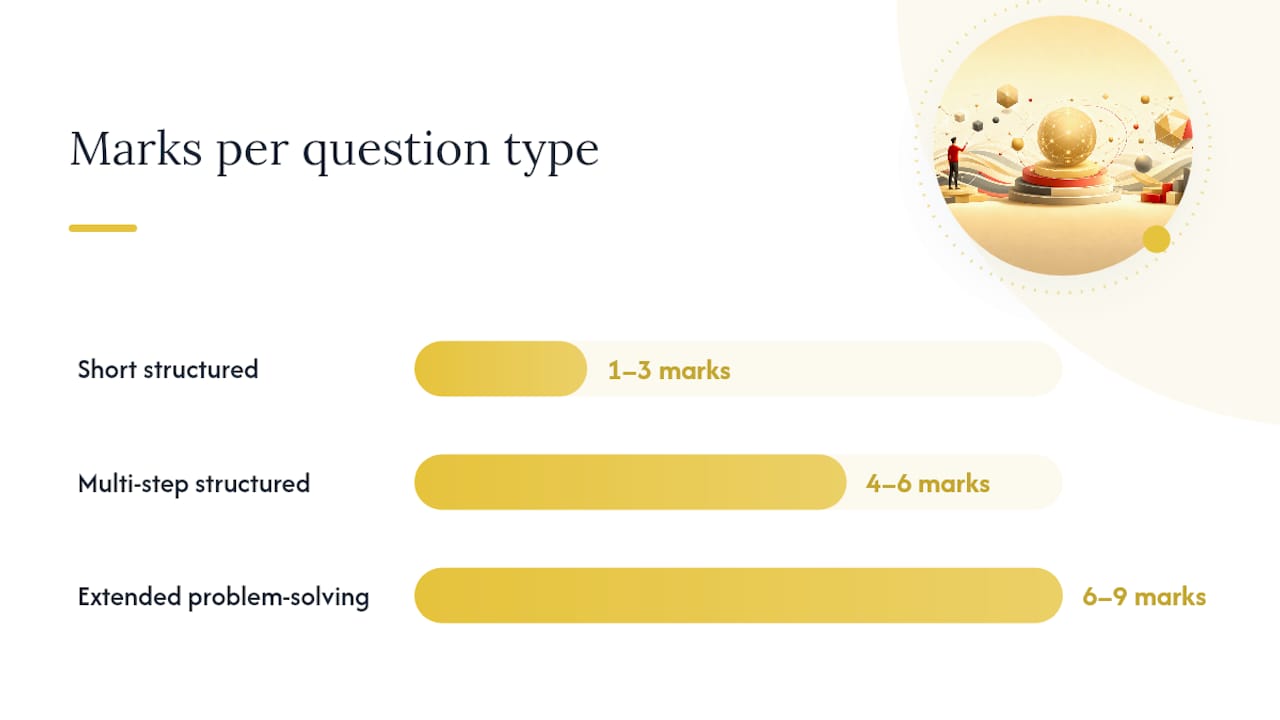
- Short structured questions (1 to 3 marks): A single calculation or fact recall, often with no “working” line needed, though showing it costs nothing and protects you if you make an arithmetic slip.
- Multi-step structured questions (4 to 6 marks): Broken into labelled parts (a), (b), ©, where each part typically depends on the answer to the one before. These carry a mix of method marks (M marks) and accuracy marks (A marks).
- Extended problem-solving questions (6 to 9 marks): Usually unscaffolded, presenting a scenario and expecting you to structure your own solution path from scratch. This is where AO3 lives.
Method marks are awarded for demonstrating a correct approach even when the final answer is wrong, provided the working shows the right process. A student who sets up the correct equation but makes an arithmetic error in the final line can still pick up two or three method marks out of four, while a student who writes only the (wrong) final answer with no working gets nothing. This single fact accounts for more lost marks than any content gap.
Pro Tip: If you’re stuck on an extended question, write down anything relevant, a formula, a partial calculation, a labelled diagram, rather than leaving the space blank. Examiners can only credit what’s on the page, and a partially correct method often banks marks even when you never reach a final answer.
The “back question” strategy is worth knowing too: if you’re stuck on an early part of a multi-step question, skip ahead within that question to see if a later part gives you information or a simpler sub-question you can answer first, then return. Papers are marked holistically per part, not strictly in sequence, so there’s rarely a penalty for working out of order within reason.
What to expect on exam day: equipment, formulae and timing
Exam-day logistics are where good revision gets undone by avoidable mistakes, so it’s worth treating this as seriously as content revision.
- Calculator (Papers 2 and 3 only): A scientific calculator with fraction, standard form, and trigonometric functions is the minimum standard; graphical or programmable calculators with pre-stored formulae are not permitted under JCQ and Pearson regulations.
- Formula sheet: A page of given formulae is printed within the exam booklet itself, covering things like the quadratic formula and volume of a sphere, but it deliberately excludes basics like area of a triangle or circumference, which you’re expected to know outright.
- Pens, pencils and equipment: Black pen for written answers, pencil for diagrams and graphs, plus a ruler, protractor and compasses for geometry-heavy questions.
- Timing: With 90 minutes and 80 marks, a rough guide is roughly a minute per mark, though short questions go faster and extended ones need more, so build in five to ten minutes of buffer for checking.
- If you’re running out of time: Prioritise picking up quick method marks on remaining questions over perfecting one you’ve half finished; a rushed attempt at every remaining question usually beats abandoning several to chase one perfect answer.
Worth noting for anyone planning further ahead: the government has opened a consultation on exam aids from 2028, which could eventually affect what’s permitted in the exam room. Current students sitting exams before then are unaffected, but teachers planning multi-year schemes of work should keep an eye on gov.uk for updates.
From raw marks to final grade: how boundaries work
Edexcel GCSE Maths doesn’t grade each paper separately. Pearson adds your raw marks from Paper 1, Paper 2 and Paper 3 together to get a total out of 240, then converts that total into a single grade on the 9 to 1 scale using boundaries set after each exam series.
Those boundaries shift from one series to the next because Pearson adjusts them to keep grading standards consistent even when a particular paper turns out harder or easier than intended. A raw mark that earns a grade 7 in one series might sit at grade 6 in another, purely because that year’s papers behaved differently in practice.
| Grade | Approx. % of total marks (illustrative pattern, varies by series) |
|---|---|
| Grade 9 | Roughly top 4 to 5% of Higher-tier candidates nationally |
| Grade 7 | Generally regarded as a strong pass, comparable to an old grade A |
| Grade 5 | The government’s “strong pass” benchmark |
| Grade 4 | The government’s “standard pass” benchmark |
Percentages are never fixed because boundaries move each series, which is exactly why you should check the official Pearson grade boundaries document for the relevant series rather than relying on a rule of thumb from a previous year. Teachers using mock results to predict grades should apply the most recent published boundaries rather than an average across several series, since a single year’s boundaries reflect that year’s paper difficulty specifically.
Finding official specification documents and genuine past papers
Revision built on the wrong materials wastes time you don’t have in the run-up to exams. Start with sources Pearson and the government actually publish, then layer in supporting explanation from trusted revision sites.
- The full Pearson specification lists every topic, the AO weightings, and sample assessment materials in one document.
- Genuine past papers, such as the 1MA1-1H series, show real question wording and formatting rather than a simulation of it.
- BBC Bitesize’s guidance on using past papers offers practical tips on turning a completed paper into targeted revision.
- MathVault’s Edexcel GCSE Maths hub organises specification content, papers and revision resources by exam board so you’re not hunting across multiple sites.
Mark schemes and examiner reports, published alongside each paper, matter as much as the questions themselves. Examiner reports explain the common mistakes candidates made in that specific series, which is often more useful for spotting your own blind spots than the mark scheme alone.
Turning past papers into real progress, not just practice
Sitting past paper after past paper without a system behind it produces diminishing returns fast. A structured routine gets far more out of the same number of hours.
- Sit a full paper under timed conditions. Ninety minutes, no notes, no calculator for Paper 1 practice, exactly as it will be in the exam hall.
- Self-mark using the official mark scheme, paying attention to where M marks (method) versus A marks (accuracy) were lost, not just the final score.
- Compare against a fully worked solution for any question you got wrong or guessed on, to see the intended method rather than just the correct answer.
- Log the error pattern. Was it a method error (wrong approach entirely) or an accuracy error (right approach, wrong arithmetic)? These need completely different revision responses.
- Return to targeted topic practice on whatever pattern emerged, rather than immediately moving to the next full paper.
This cycle, timed attempt, self-mark, compare, targeted fix, mirrors the approach BBC Bitesize recommends for closing topic gaps efficiently rather than repeating the same weak areas by accident.
The method-versus-accuracy distinction deserves particular attention because it changes what you revise next. A student losing marks to method errors needs to go back to the specification and relearn the underlying technique. A student losing marks to accuracy errors despite a correct method usually just needs more careful, unhurried practice, and perhaps a habit of double-checking calculator input.
Pro Tip: Keep a simple running list of every topic where you’ve lost a method mark across your last five past papers. If the same topic appears twice, that’s your next revision session, not whatever chapter comes next in the textbook.
Resolving a recurring error usually needs more than a mark scheme, since a mark scheme tells you what was expected but rarely explains why your approach went wrong. This is where video walkthroughs and worked solutions do heavier lifting than a mark scheme alone, showing the reasoning step by step rather than just the final calculation. For errors that persist even after watching a worked solution, a live Q&A session with a tutor talking through your specific working is often what finally closes the gap.
Educator’s note: priorities for the final months
If you’re guiding students through their last few months before exams, mixed-topic timed practice beats single-topic drilling every time. Students walk into the exam hall able to solve a ratio question in isolation, then freeze the moment that same skill is buried inside an unfamiliar wordy problem. Full, timed past papers under exam conditions expose that gap far earlier than a worksheet ever will.
Push students to show every step of their working, even on questions they find easy. Method marks are free marks sitting on the table, and students who skip working on straightforward questions often carry that same habit into questions where it costs them dearly. Mark-scheme review sessions, where you walk through exactly how M and A marks were awarded on a real past paper, tend to shift student behaviour faster than any amount of telling them “show your working” in the abstract.
— Oloru
Practise smarter with Mathvault’s Edexcel-aligned resources
A faster route to exam-ready practice than piecing together scattered PDFs and hoping the mark scheme explains itself is available. Instead of guessing where you’re losing marks, you get Edexcel GCSE Maths past-paper questions organised by topic, each paired with a fully worked solution so you can see exactly where a method mark was earned or lost.
Every resource is free to access: past papers, step-by-step written solutions, and video walkthroughs that talk through the reasoning behind each answer rather than just stating it. For persistent errors that survive a worked solution, live weekly Q&A sessions sometimes allow asking a tutor directly about specific questions, sometimes at no cost. If you’d rather work offline or want a structured pack to revise from, self-mark past papers with board-aligned solutions bring the mark scheme, worked answers and video support together in one place. Start with a single topic pack this week and build your revision routine from there.
Sources
- Specification: Level 1/2 GCSE (9-1) in Mathematics (Pearson Edexcel)
- Edexcel GCSE Mathematics past paper (example PDF) (Pearson)
- Using past papers effectively — Edexcel maths guidance (BBC Bitesize)
- Grade boundaries — June 2025 (Pearson)
FAQ
What grade is 65% in Edexcel GCSE Maths?
There’s no fixed answer, because grade boundaries change every series depending on how demanding that year’s papers were. Check the current Pearson grade boundaries document for the specific series in question rather than assuming a fixed percentage.
What is the syllabus for the GCSE Maths exam?
The Edexcel GCSE Maths syllabus covers six content headings: Number, Algebra, Ratio and proportion and rates of change, Geometry and measures, Probability, and Statistics, detailed in full in the Pearson specification.
What grade is 42% in GCSE Maths?
This also depends on the specific series and tier, since boundaries are recalculated every exam sitting. On Foundation tier, a mark in that range often sits around grade 3 or 4, but you should always confirm against the published boundaries for the relevant series rather than a general estimate.
What percentage is a grade 9 in Edexcel Maths?
The exact raw mark needed varies from one series to the next, so the official grade boundaries document is the only reliable source for a given series.
How many papers are in the Edexcel GCSE Maths exam?
There are three papers in total, each 1 hour 30 minutes long and worth 80 marks, giving 240 marks overall across Paper 1 (non-calculator) and Papers 2 and 3 (calculator).
Leave a Reply