
The single most useful thing you can do is act as facilitator, not tutor: build a steady rhythm of short exam-standard practice sessions most days, and lean on a free resource like Mathvault for the past papers and worked solutions that make that practice count. Structure and access matter more than subject expertise. When a topic won’t shift, UCAS or a school teacher can point you to the next step.
TL;DR:
- Using a structured three-pass cycle for past papers—untimed review, mixed practice, and timed exams—maximizes learning and exam readiness.
- Tracking confidence levels, last practice, and upcoming passes on a simple chart helps identify weak topics and focus revision effectively.
- Prioritizing routine, consistent support, and exam-specific resources like Mathvault enhances revision efficiency over just increasing study hours.
- Addressing exam stress early by normalizing struggle, maintaining routines, and seeking targeted tuition when gaps persist improves outcome chances.
Table of Contents
- Understanding A Level Maths: components, papers and what examiners reward
- Daily and weekly support routines parents can use
- Building a 12-week revision plan and topic tracker
- Turning past papers into marks: a workflow for parents
- Exam timeline, grading, and what mocks mean for university
- Spotting exam stress and supporting resilience
- When to bring in tuition or lean on school support
- Trusted resources parents can use right now
- What actually changes in the run-up to finals
- Free resources that help from tonight
- Where to check the official facts
- Sources
Understanding A Level Maths: components, papers and what examiners reward
A Level Maths is built from pure mathematics, which every student studies, combined with statistics and mechanics, which are compulsory strands rather than optional extras on the main specification. Further Maths, taken separately, adds extra pure content and lets students choose additional applied options. Papers are usually split three ways, and each one blends all three strands rather than testing them in isolation.
Examiners award marks in distinct categories, and understanding this changes how you support revision:
- Method marks reward correct working even when the final answer is wrong.
- Accuracy marks depend on reaching the right numerical or algebraic answer.
- Reasoning marks appear in “show that” or “prove” questions where logic matters as much as calculation.
- Presentation marks are lost silently. Sloppy layout or missing units cost marks examiners would otherwise give.
Every exam board runs its own specification, and the differences matter more than most parents expect. AQA, Edexcel, and OCR each set their own paper structure, formula sheets, and permitted calculator functions. Check your child’s exact AQA specification or equivalent board page early. Assuming last year’s advice from a friend’s child on a different board will send revision in the wrong direction.
Daily and weekly support routines parents can use
You don’t need to solve a single equation to make a real difference. What moves the needle is routine, consistency, and the right kind of attention at the right moments.
A weekly rhythm that works for most households looks like this:
- Set a fixed practice slot most weekdays, about half an hour, ideally straight after school before energy drops. Research from the University of Birmingham points to this length and frequency as the sweet spot: enough to build fluency, short enough to avoid burnout.
- Protect the space. Phones away, one device only for the maths itself, and a door that can close. Distraction is the silent killer of revision quality, not lack of ability.
- Ask for the working, not just the answer. Even without understanding the maths, you can ask “can you talk me through how you got there?” This single question does more for retention than any amount of checking answers against a mark scheme.
- Praise effort and persistence over correctness. A student who wrestled with a mechanics question for twenty minutes and got it wrong has learned more than one who copied a worked solution.
- Review the week together on a Sunday. Ten minutes, no pressure: what topics went well, what needs another look next week.
The “teach it back to me” technique deserves its own mention. When your child explains a concept aloud, gaps in understanding surface immediately, and confidence tends to rise even when you have no idea whether the explanation is mathematically correct.
Pro Tip: Sit nearby doing your own work rather than hovering over the page. Quiet, parallel presence reduces exam anxiety far more than active supervision, and it signals “this matters” without turning into pressure.
Building a 12-week revision plan and topic tracker
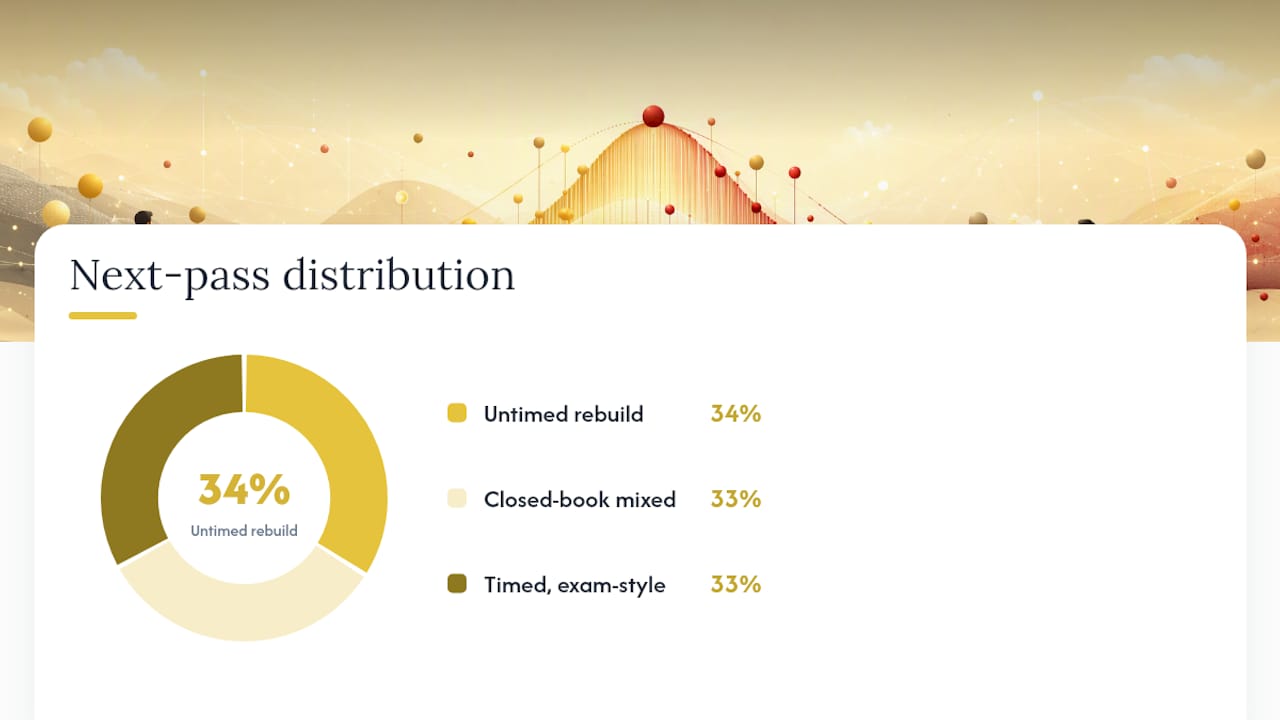
A calendar beats a vague intention every time. Twelve weeks before mocks or finals, break the syllabus into weekly blocks, weighting time toward topics that appear most frequently on past papers and those the child finds hardest. A 12-week revision timetable aligned to your child’s exam board takes the guesswork out of sequencing.
Within each topic, a three-pass cycle converts practice into marks far more reliably than random question-answering:
- Pass one: untimed rebuild. Work through examples slowly, using notes freely, to relearn the method.
- Pass two: closed-book mixed practice. No notes, questions mixed across topics, focus on recall under mild pressure.
- Pass three: timed, exam-style. Full past-paper conditions, strict timing, no interruptions.
A basic tracker makes this visible at a glance:
| Topic | Confidence (1 to 5) | Last practised | Next pass due |
|---|---|---|---|
| Differentiation | 2 | Week 2 | Untimed rebuild |
| Trigonometric identities | 4 | Week 3 | Timed paper |
| Hypothesis testing | 3 | Week 1 | Closed-book mixed |
If statistics is the weaker strand, a focused statistics revision guide can shortcut the rebuild pass considerably. Partner guidance on planning a revision calendar between February and April offers a useful cross-check if you’re building the schedule from scratch.
Turning past papers into marks: a workflow for parents
Past papers are the single highest-value revision tool in the A Level Maths toolkit, but they only work if used in the right order. Handing a full timed paper to a student who hasn’t rebuilt the topic first mostly teaches them what they don’t know, without teaching them how to fix it.
- Start with topic-organised questions, not full papers, so your child can practise one skill repeatedly before mixing it with others. Topic-by-topic past paper collections work well here.
- Move to mixed, closed-book sets once individual topics feel secure, to simulate the unpredictability of a real exam.
- Finish with full timed papers under strict exam conditions, calculator settings included.
- Mark against the official scheme, not a gut feeling. Method marks are frequently missed by students marking their own work generously.
- Log every mistake type in one place: careless arithmetic, misread question, wrong method, ran out of time. Patterns tend to emerge within two or three papers.
A quick checklist you can run without any maths knowledge: Did they show full working? Did they check the calculator was in the right mode? Did they attempt every question, even partially? A structured practice system combining a topic tracker with this three-pass approach is one of the more reliably effective ways to convert study hours into exam marks, according to independent revision guidance.
Exam timeline, grading, and what mocks mean for university
A Level grades run from A* down to E, and A* remains a genuinely demanding grade to reach in maths, awarded to a minority of candidates each year across the major boards. Mocks in Year 13, usually sat in the fourth or fifth term, are the clearest early signal of where a real grade is heading, though they’re a diagnostic tool, not a prediction carved in stone.
Key milestones worth marking on the family calendar:
- Year 12 (September to July): Core content delivery, first internal assessments, subject choices confirmed for Further Maths if relevant.
- Year 13, autumn to spring: UCAS applications submitted, often before mock results are known.
- Year 13, spring: Mock exams, typically the last major checkpoint before final revision begins in earnest.
- Summer term: Final exams across the three papers.
- August: Results day, when conditional university offers become confirmed or fall through.
Universities set conditional offers around specific grade combinations, and STEM courses in particular often require A Level Maths at a stated minimum grade. UCAS guidance on entry requirements explains how these conditions typically work and what happens if results fall short on the day.
Spotting exam stress and supporting resilience
Pressure around A Levels is often invisible until it isn’t. Watch for sudden changes in sleep, appetite, or withdrawal from friends and normal activities, particularly in the run up to mocks. These shifts are more telling than any drop in grades.
- Persistent difficulty sleeping or eating in the weeks before an exam.
- Avoidance of revision altogether, rather than the usual reluctance.
- Physical symptoms: headaches, nausea, or panic before study sessions.
- Comparing grades constantly with friends in a way that fuels anxiety rather than motivation.
Simple routines help more than most parents expect: protecting sleep, building short breaks into every revision block, and keeping meals regular even during intense weeks. The NHS offers practical, step-by-step advice for parents supporting a child through exam stress, including when to contact the school or a GP. Adolescent sleep quality is closely tied to how well the brain consolidates learning and manages stress, which is worth remembering the next time a “just one more hour” plea comes at midnight, according to peer-reviewed research on adolescent sleep.
Pro Tip: Normalise struggle explicitly. Say out loud that finding a topic hard is what learning looks like, not a sign something’s wrong. Students who hear this from a parent tend to persist longer before giving up on a difficult question.
When to bring in tuition or lean on school support
Some gaps close with more independent practice. Others need a second voice explaining the same method a different way. Watch for these signals that targeted tuition will help more than another evening of self-study:
- The same topic keeps reappearing as a weak spot across multiple past papers.
- Method is understood in isolation but falls apart under timed exam conditions.
- Mock results sit well below the grade needed for a university offer, with time still to close the gap.
When approaching a tutor or school teacher, ask directly: which exam board have you taught, what’s your track record repairing this specific topic, and will you follow up with homework linked to what we covered? Short, targeted sessions add the most value when paired with daily independent practice rather than replacing it, based on research from The Tutor Trust. One weekly one-to-one session alongside consistent home practice tends to outperform either approach alone.
Trusted resources parents can use right now
Start with Mathvault, which offers free, syllabus-organised past papers by topic, fully worked solutions, video walkthroughs, and weekly live Q&A sessions built specifically for students in England, Wales, and Scotland. Use it first for topic-based practice before moving to full timed papers.
Pair it with:
- Official exam-board textbooks and specifications for the exact wording and formulae your child’s board expects.
- Official mark schemes, downloaded directly from the board, for accurate self-marking.
- A permitted graphical or scientific calculator, checked against your child’s specific board’s approved list.
When judging fit, ask whether a resource matches your child’s exact board, whether solutions are fully worked rather than answer-only, and whether it’s actually free to access repeatedly, not just on a first visit.
What actually changes in the run-up to finals
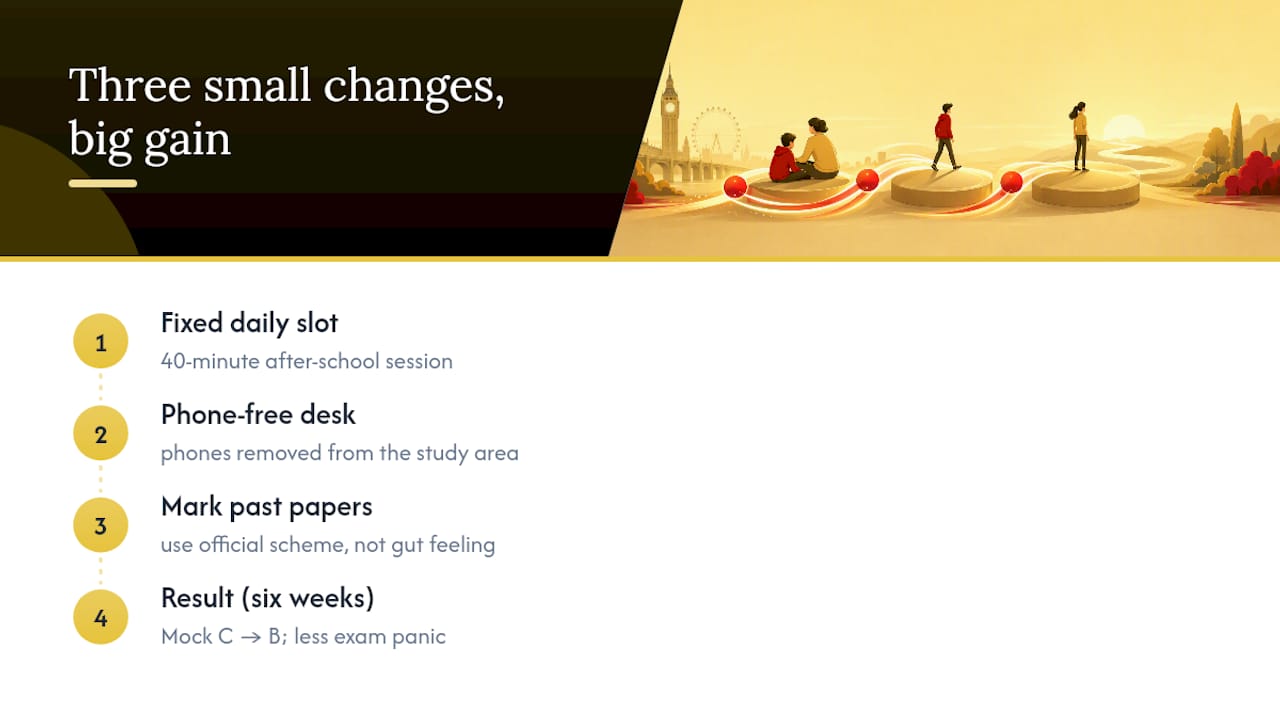
Supporting a student from mocks through to finals tends to follow a pattern: the families who see real movement in grades are rarely the ones adding more hours. They’re the ones fixing the structure. A calm space, a fixed daily slot, and past papers marked properly against the scheme do more in three weeks than months of unstructured “revising” ever will.
One case worth holding onto: a student stuck on a C grade through Year 13 autumn made three changes in a single week: a fixed 40 minute slot after school, phones removed from the desk, and every past paper marked against the official scheme rather than gut feeling. Six weeks later, the mock grade moved to a B, with the student reporting far less panic walking into the exam hall.
— Oloru
Free resources that help from tonight
Start small and specific tonight: pick one weak topic, pull a topic-by-topic Edexcel past paper set, and sit with your child while they attempt it. If AQA is the board, the AQA A Level Maths collection covers the same approach for that specification. From there, three actions build momentum fast: download a topic pack matched to the current weak spot, get your child booked onto the next live Q&A session, and set up a simple topic tracker like the one above so progress is visible week to week.
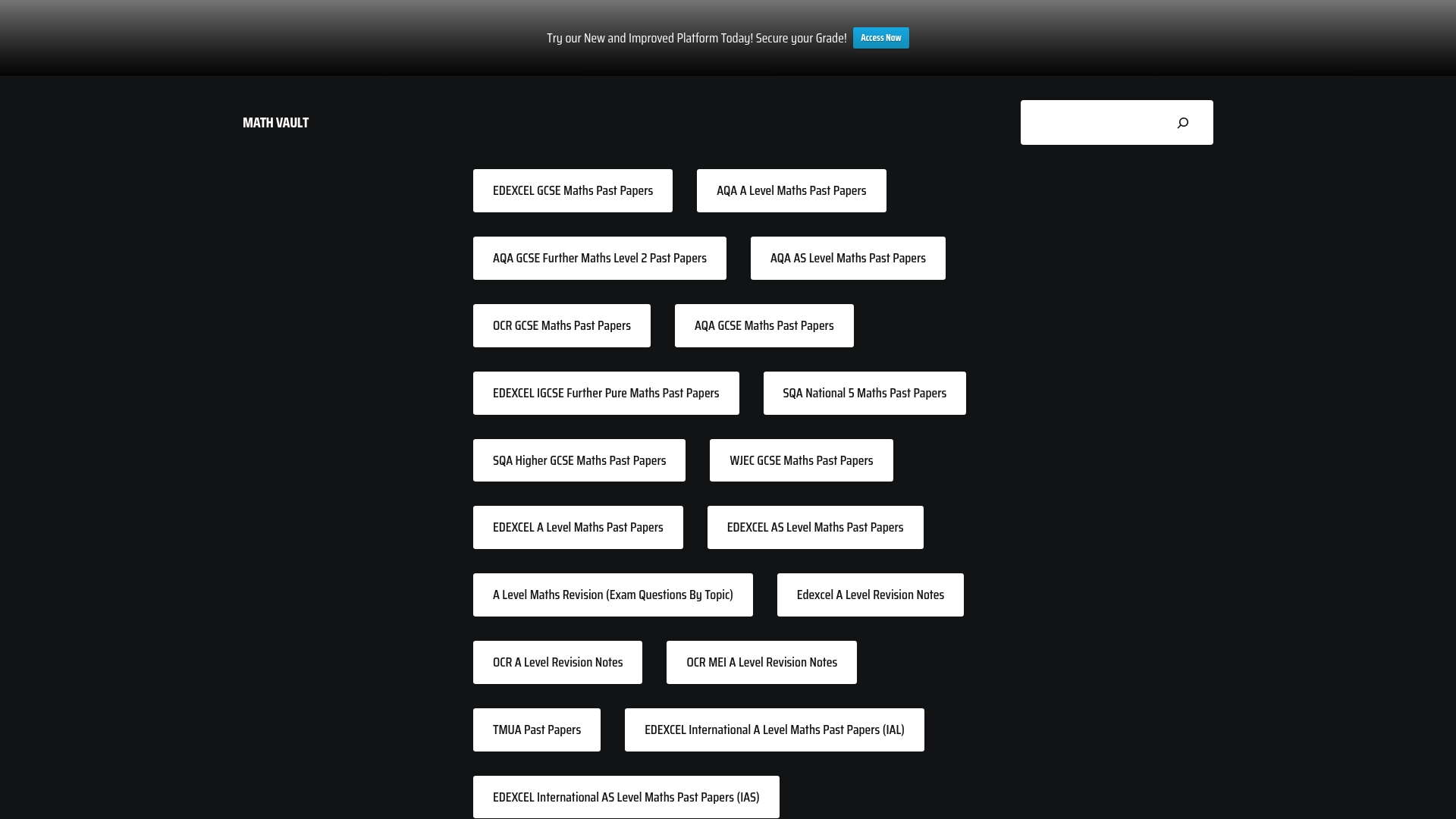
Most of what this resource offers, including past papers, worked solutions, and live Q&A, is completely free. There is also an option to purchase downloadable, fully organised revision packs for parents who want offline structure without hunting through separate PDFs. Either route gets your child exam-standard practice this week, not next month. Head to the MathVault homepage and pick the board-specific page that matches your child’s specification to get started.
Where to check the official facts
- Ofqual: exam regulation and grading rules.
Leave a Reply