
A mark scheme is the document examiners use to award marks. A model answer is a fully written solution that shows one good way to answer a question. In maths you need both: the mark scheme tells you what earns credit, and the model answer shows you how to set the work out so that it does.
Many students treat the two as the same thing and copy a mark scheme line by line. That is a quiet way to lose marks, because a mark scheme was never written to teach you a method. This guide explains what each document is, where they differ, and a simple routine for using them together on GCSE and A-Level papers.
TL;DR
- A mark scheme is written for examiners. It lists the marks available, the type of each mark and the answers that earn them.
- A model answer is written for learners. It shows full, readable working from the first line to the last.
- Mark schemes often record only the most common routes, so a method that is not listed can still earn marks if it is valid.
- Use the mark scheme to check and score your work, then a model answer to learn the setting-out you were missing.
- Show your working every time: it is what the method and follow-through marks reward.
Table of Contents
- What a mark scheme actually is
- What a model answer is
- Model answers vs mark schemes: the differences at a glance
- Reading the codes in a maths mark scheme
- Why copying a mark scheme goes wrong
- How to use both together: a five-step routine
- When each document is more useful
- Our view: why we publish both side by side
- Where to find mark schemes and worked solutions
- FAQ
- Sources
What a mark scheme actually is
Exam boards are clear about the purpose. OCR describes mark schemes as the documents given to examiners to mark candidate scripts. A draft is written by the question author and then finalised in a standardisation meeting, where senior examiners look at real student responses. Valid approaches discovered in those scripts are added, which is why the published scheme can differ from the first draft.
Two consequences follow:
- A mark scheme is a checklist, not a lesson. It records what earns a mark, in compact shorthand, for someone who already knows the maths.
- It is built for consistency. Pearson’s GCSE guidance states that all candidates must receive the same treatment, so the last script is marked exactly as the first. Its A-Level scheme adds that mark schemes should be applied positively, rewarding what a candidate has shown.
That last point is encouraging. Examiners are looking for reasons to give you marks, provided your working lets them see what you did.
What a model answer is
A model answer (you will also see it called a worked solution or a full solution) is written for you, the learner. It is complete, sequential and explained. Where a mark scheme might say a single line such as “M1 for correct rearrangement”, a model answer writes the rearrangement out, line by line, and says why each step follows.
In maths, a good model answer:
- starts from the information in the question and states what is being found;
- shows every step of algebra or calculation, including the ones that feel obvious;
- uses correct notation and units throughout;
- ends with a clearly stated final answer, in the form the question asks for;
- sometimes offers an alternative method and says when each is quicker.
A model answer is one route, not the only route. It is a standard to learn from, not a rule about what you must write.
Model answers vs mark schemes: the differences at a glance
| Mark scheme | Model answer | |
|---|---|---|
| Written for | Examiners | Students, teachers and parents |
| Main job | Award marks consistently | Teach a clear, complete solution |
| Level of detail | Compact, in shorthand (M1, A1, B1, ft) | Every step written out and explained |
| Alternative methods | Lists common routes and often says “or equivalent” | Usually shows one route, sometimes two |
| Shows mark allocation | Yes, line by line | Only if the author adds it |
| Best used for | Marking your own work and spotting where marks go | Learning how to set out working |
| Risk if used alone | You see the answer but not how to reach it | You copy a method without knowing what earns credit |
Neither document is better. They answer different questions: “what would an examiner give me?” versus “how do I write this properly?”
Reading the codes in a maths mark scheme
Maths mark schemes use a small set of letters. They are not identical across boards, but the core idea is shared. AQA’s marking guidance explains that M marks are awarded for a correct method that could lead to a correct answer, while A marks are for accuracy of the result. In most cases an A mark depends on the method mark before it, unless the method is implied by a correct answer.
- M (method): you used a valid process, even if you made an arithmetic slip along the way. WJEC’s guide says an M mark can be earned despite a numerical error and, once earned, cannot be lost.
- m (dependent method): a method mark that only counts if an earlier mark was earned. The same WJEC document uses the lower-case m for these.
- A (accuracy): the correct result, usually conditional on the method.
- B (independent): a mark for a correct statement or value that does not rely on a method.
- ft (follow through): credit for using your own earlier answer correctly. It is a safeguard: a single slip should not cost you the same marks again, provided the method is sound and identifiable. Check the board’s marking guidance for how it applies.
- oe (or equivalent): a different but equal form of the answer is accepted.
We go through these with examples in our guide to method marks and how they save marks after slips.
A worked illustration
BBC Bitesize gives a neat example from an OCR paper. To find a height using Pythagoras, rearranging to h² = 10² − 6² earns the method mark, and the answer mark is awarded for 8 cm.
Notice what the mark scheme does and does not tell you. It tells you which line earns the M mark and which result earns the A mark. It does not tell you to draw the right-angled triangle, label the sides, or write the units. A model answer would do all three. Both documents matter.
Why copying a mark scheme goes wrong
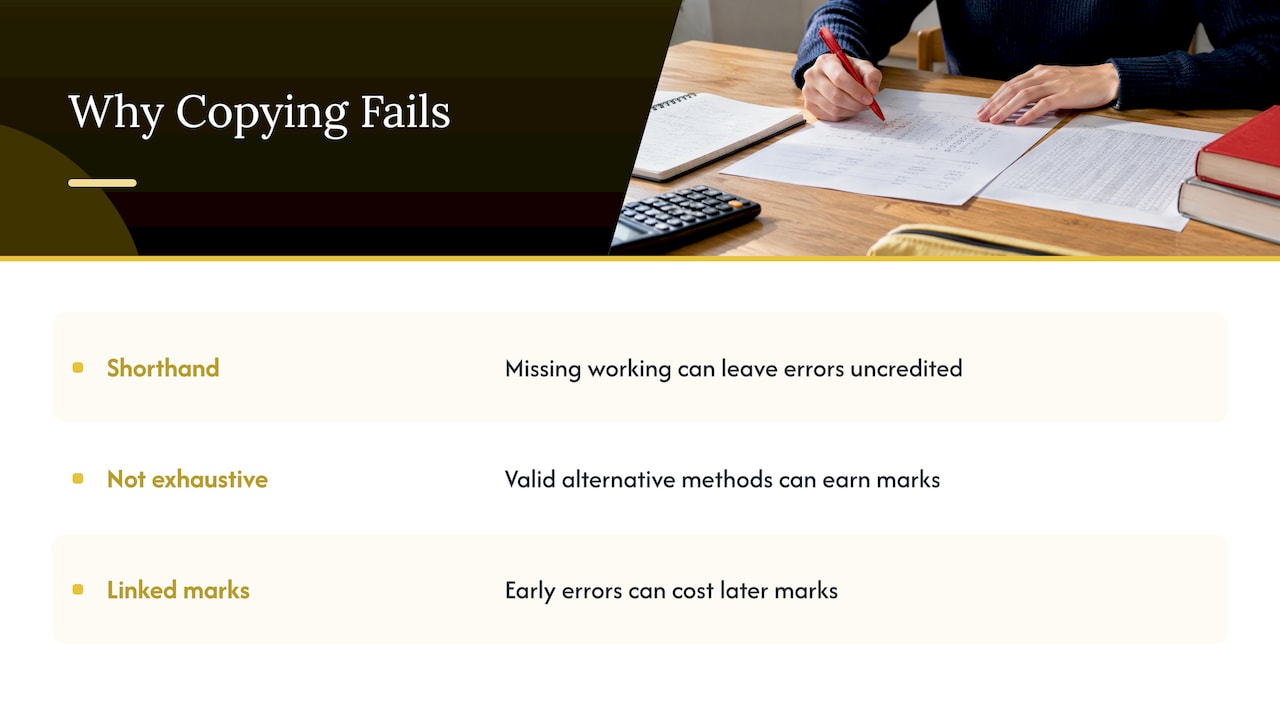
The common mistake is to treat a mark scheme as the answer you should have written. It cannot be, for three reasons.
1. It is shorthand. A mark scheme may show only the key line. In your exam, if you jump straight to that line with no preceding working, you may still earn the mark when the answer is correct, but one error and there is nothing for an examiner to credit.
2. It is not exhaustive. Because standardisation adds approaches that examiners meet in real scripts, the published scheme reflects the routes that turned up most. If your method is valid and differs from the one printed, examiners are trained to apply the scheme’s principles to it. Mark yourself the same way: ask whether your method is mathematically valid and complete, not whether it matches word for word.
3. Marks are linked. As the AQA guidance shows, accuracy marks usually rest on method marks. A small early error can cost several later marks if the method is not clearly shown. Clear, step-by-step working is the best protection, and it is exactly what a model answer demonstrates.
How to use both together: a five-step routine
Try this after every past paper question you do. It takes a few minutes and turns a marked paper into real progress.
- Attempt the question under exam conditions. Write full working. If you are practising a calculator-free paper, put the calculator away; our advice on stopping method-mark losses on non-calculator papers is a good companion.
- Mark it with the official mark scheme. Use a different colour pen. Award each M, A and B mark honestly, and write the mark total beside the question.
- Find where marks were lost. For each missed mark, name the cause: a knowledge gap, a slip, a misread question, or working that was not shown.
- Compare with a model answer. Look at the setting-out, not only the final answer. Where did the model answer write something you skipped?
- Redo it cold a few days later. Close the solution and try again. If you can score full marks from a blank page, the learning has stuck.
Our page on using official mark schemes as your fastest route to higher marks expands on step 2, and the self-marking guide for GCSE past papers shows how to do it with board-aligned solutions.
What to write in your own flashcards
A tip popular among students is to keep a short set of cards for the questions where you lost marks. Make them useful by recording three things: the question type, the method line that earns the M mark, and the slip you made. Avoid copying the mark scheme wording alone. Write the step in your own words, as a model answer would set it out.
When each document is more useful
Use the mark scheme first when you want to:
- score a paper accurately and estimate a grade;
- see how many marks a question carries and how they are split;
- check whether a different method of yours would be accepted;
- learn how examiners phrase accepted answers, such as “oe” or “awrt”.
Use a model answer first when you:
- cannot start a question and need to see the route;
- got the right answer but suspect your working was thin;
- are a parent or tutor explaining a topic you have not taught recently;
- want to compare two methods and choose the faster one.
Teachers use the two differently too. A mark scheme is the tool for consistent marking and moderation; a model answer is the tool for showing a class what good looks like. The Department for Education’s early career teacher materials make the broader point that modelling helps pupils understand new processes, and that novices need more structure early on. A worked solution is precisely that kind of model.
Our view: why we publish both side by side
When we built MathVault, we noticed a pattern in how students used past papers. They would mark a paper, see a total, feel good or bad, and move on. The marks that were lost, and why, rarely got a second look.
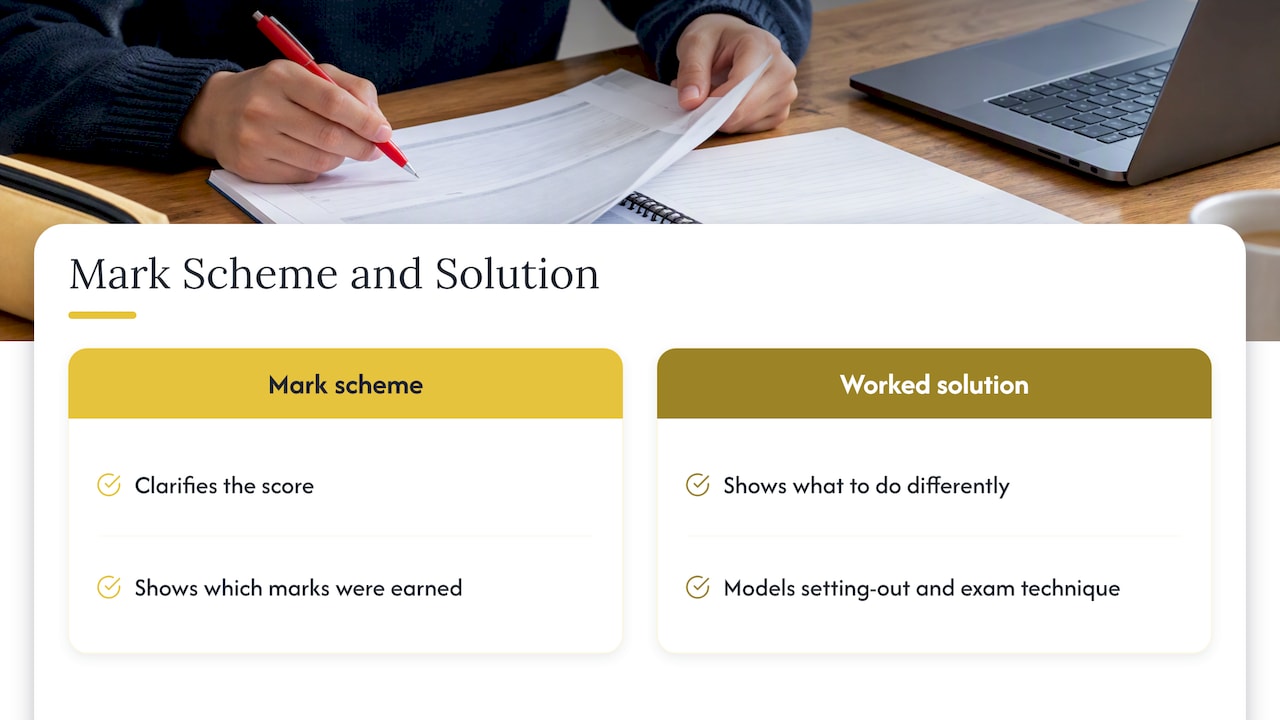
That is why we put official mark schemes and fully worked solutions next to each other, organised by exam board. The mark scheme tells you the truth about your score. The worked solution tells you what to do differently. Used together, a single past-paper question teaches you the content, the setting-out and the exam technique at once.
We also keep one rule above the rest: show your working, even when you are sure of the answer. Method marks and follow-through marks exist to reward clear thinking, and the only way an examiner can reward it is to see it. A neat page of working is not decoration. It is insurance for your grade.
If you take one habit from this article, make it this: never finish marking a question until you can say, in a sentence, which line of working would have earned every mark you missed.
— Oloru
Where to find mark schemes and worked solutions
All the free materials on MathVault are organised by exam board, so you can match the paper you sat to the right scheme and solution. A few places to start:
- Browse OCR GCSE maths revision topics with past questions by topic.
- Work through Edexcel GCSE past paper questions by topic and mark each against the scheme.
- Try A-Level past-paper questions when you move on to Year 12 and 13 content.
- See a real example of a board scheme in our AQA GCSE Further Maths 2025 Paper 1 mark scheme.
- Start with our GCSE maths revision guides if you are not sure which topics to prioritise.
Our resources are free to use, and we run live weekly Q&A sessions where you can ask about a question or a mark you could not account for. Some downloadable packs and advanced resources are paid, and donations are welcome, but you can revise effectively without spending anything. Visit mathvault.io to get started.
FAQ
Is a mark scheme the same as a model answer?
No. A mark scheme is an examiner’s tool that shows how marks are awarded, often in shorthand. A model answer is a complete written solution intended to teach. Boards publish mark schemes; model answers usually come from teachers, textbooks and revision sites.
Can I get full marks if my method differs from the mark scheme?
Yes, if your method is valid and complete. Mark schemes are finalised after senior examiners see real student scripts, and they are applied on principle, so alternative correct approaches can earn the marks. Clear working makes it much easier for an examiner to follow your route.
Do I lose all the marks if I make one arithmetic slip?
Not usually. A method mark can be earned even when a numerical error occurs, and follow-through marks can credit later steps that correctly use your wrong value. This only works if your method is visible, so always write out your steps.
Should I read the mark scheme before attempting a question?
No, attempt the question first under timed conditions. Reading the scheme beforehand hides what you do not yet know. Mark your attempt afterwards, then study the worked solution to see how to set the answer out better.
Sources
- OCR: Understanding mark schemes, how they are created and used
- OCR: Getting more from past papers
- AQA: GCSE Mathematics marking guidance
- Pearson: GCSE Mathematics Paper 2F mark scheme, June 2024
- Pearson: International Advanced Level Mathematics mark scheme, January 2025
- WJEC: GCSE Mathematics and Numeracy mark scheme, Unit 2 Higher
- BBC Bitesize: How to use OCR past papers to revise GCSE maths
- GOV.UK: Classroom practice, support for early career teachers
Leave a Reply