An algebraic fraction is a fraction with algebra in the numerator, the denominator or both, and every GCSE question on them comes down to the same habit: factorise first, then cancel or combine. Master that one move and simplifying, adding, subtracting, multiplying, dividing and solving all become routine. This guide takes you through each skill with worked examples, the mistakes examiners see most often, and practice questions with answers.
TL;DR
- An algebraic fraction has an algebraic expression on the top, the bottom or both, such as 3/x or (x + 3)/(x − 1).
- To simplify, factorise the numerator and denominator fully, then cancel common factors. Never cancel single terms that are added or subtracted.
- To add or subtract, find a common denominator, rewrite each fraction, then combine the numerators.
- To multiply, factorise and cancel across. To divide, keep the first fraction, flip the second and multiply.
- Equations with algebraic fractions are solved by multiplying every term by the common denominator, which often leads to a quadratic.
Table of Contents
- What algebraic fractions are and where they appear in GCSE
- Simplifying algebraic fractions
- Adding and subtracting algebraic fractions
- Multiplying and dividing algebraic fractions
- Solving equations with algebraic fractions
- Common mistakes examiners see
- How to approach exam questions
- Practice questions with answers
- Perspective: why worked solutions change how you learn this topic
- Using past papers, videos and live sessions
- Practise with MathVault
- FAQ
- Sources
What algebraic fractions are and where they appear in GCSE
An algebraic fraction is a fraction whose numerator, denominator or both are algebraic expressions, for example 3/x, (x + 3)/(x − 1) or (9x² − 1)/(3x² − 2x − 1). They behave exactly like numerical fractions. The only difference is that you cannot finish with a single number, so you finish with a neater expression.
The topic is mainly a Higher tier skill, although simple cases, such as cancelling a number factor from (3x + 6)/9, can appear on Foundation papers. The skill that underpins everything is factorising, and the Pearson Edexcel GCSE Mathematics specification lists factorising quadratic expressions, including the difference of two squares. If your factorising is shaky, fix that first, because almost every error with algebraic fractions begins there.
The factorising patterns you need are:
- Common factor: 6x + 9 = 3(2x + 3)
- Difference of two squares: x² − 25 = (x − 5)(x + 5)
- Simple quadratic: x² + 7x + 10 = (x + 2)(x + 5)
- Harder quadratic (a ≠ 1): 2x² + x − 1 = (2x − 1)(x + 1)
Simplifying algebraic fractions
The rule is short. Factorise the numerator and denominator completely, then cancel common factors. Cancelling means dividing the top and bottom by the same factor, and BBC Bitesize describes it the same way: factorise anything that needs it, spot the common factors, and divide top and bottom by them.
Example 1: a common factor
Simplify (3x + 6)/9.
- Factorise the top: 3(x + 2).
- Cancel the common factor of 3: (x + 2)/3.
Example 2: a difference of two squares
Simplify (x² − 9)/(x² − 3x).
- Factorise the top: (x − 3)(x + 3).
- Factorise the bottom: x(x − 3).
- Cancel (x − 3): (x + 3)/x.
Example 3: two quadratics
Simplify (x² + 5x + 6)/(x² + 4x + 3).
- Top: (x + 2)(x + 3).
- Bottom: (x + 1)(x + 3).
- Cancel (x + 3): (x + 2)/(x + 1).
Notice what you did not do. You did not cancel the x’s or the numbers in (x + 2)/(x + 1). That is the most common slip, covered below.
Excluded values
Some questions ask which values of x cannot be used. Any value that makes the original denominator zero is not allowed, because division by zero is undefined. In Example 3, the original denominator (x + 1)(x + 3) is zero when x = −1 or x = −3, so those values are excluded even though the simplified answer only seems to rule out x = −1. Always read the denominator before you cancel.
Adding and subtracting algebraic fractions
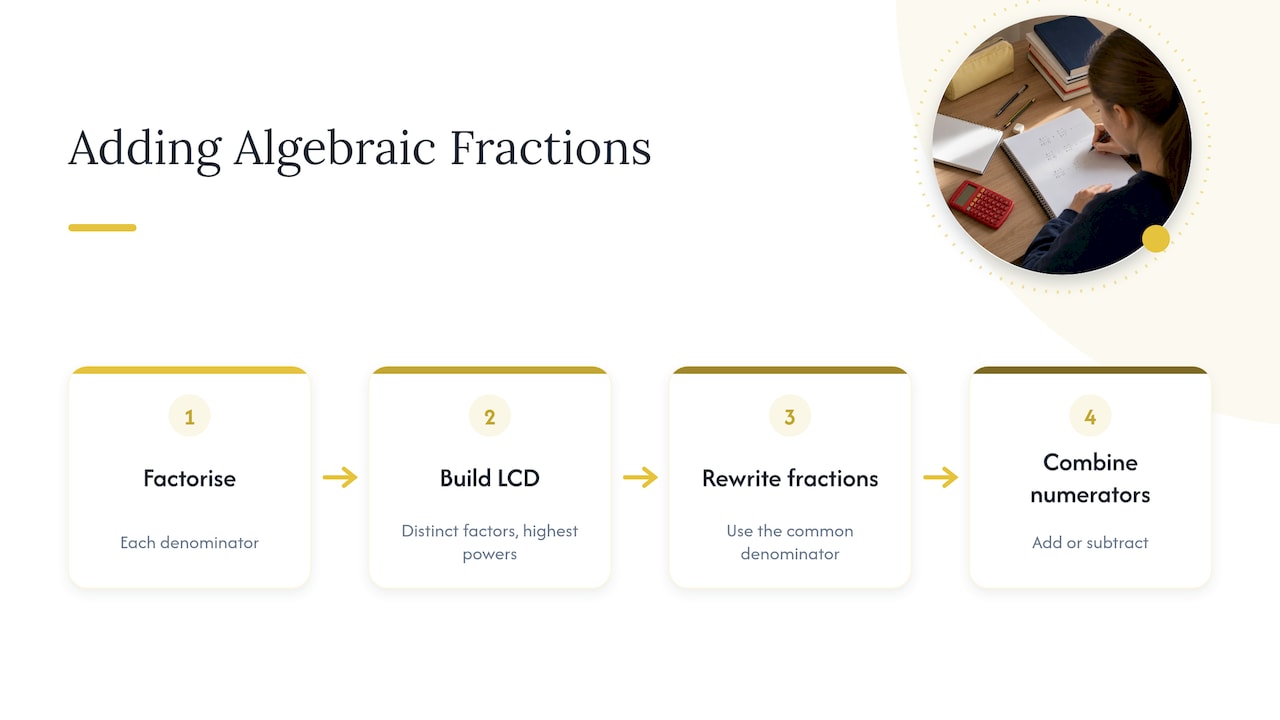
The method matches numerical fractions. Find a common denominator, write each fraction with it, then add or subtract the numerators. When the denominators contain brackets, the lowest common denominator comes from factorising each denominator and multiplying all the distinct factors, using each factor once at its highest power.
Example 4: adding
Write 2/x + 3/(x + 1) as a single fraction.
- Common denominator: x(x + 1).
- Rewrite: 2(x + 1)/[x(x + 1)] + 3x/[x(x + 1)].
- Combine the numerators: (2x + 2 + 3x)/[x(x + 1)].
- Answer: (5x + 2)/[x(x + 1)].
Example 5: subtracting
Write 3/(x − 2) − 2/(x + 1) as a single fraction.
- Common denominator: (x − 2)(x + 1).
- Rewrite: 3(x + 1) − 2(x − 2) over (x − 2)(x + 1).
- Expand carefully: 3x + 3 − 2x + 4.
- Answer: (x + 7)/[(x − 2)(x + 1)].
The step that loses most marks is the minus sign. When you subtract a fraction, the minus applies to the whole numerator, so put the second numerator in brackets before expanding. Writing −2x − 4 instead of −2x + 4 is a classic error.
If you have a denominator you can factorise, do it before choosing the common denominator. For 1/(x² − 4) + 1/(x + 2), factorise to (x − 2)(x + 2) and you will see that the common denominator is just (x − 2)(x + 2), not a much longer product.
Multiplying and dividing algebraic fractions
For multiplication, multiply the numerators and the denominators, then cancel down. Factorising first makes the cancelling far easier than expanding everything and trying to simplify a huge expression afterwards.
For division, keep the first fraction the same, change the division to multiplication and flip the second fraction upside down.
Example 6: multiplying
Simplify x/(x + 2) × (x² − 4)/(3x).
- Factorise: x² − 4 = (x − 2)(x + 2).
- Write as one fraction: x(x − 2)(x + 2) over 3x(x + 2).
- Cancel x and (x + 2): (x − 2)/3.
Example 7: dividing
Simplify (x² + 3x)/(x − 1) ÷ (x + 3)/(x² − 1).
- Flip and multiply: (x² + 3x)/(x − 1) × (x² − 1)/(x + 3).
- Factorise: x(x + 3)/(x − 1) × (x − 1)(x + 1)/(x + 3).
- Cancel (x + 3) and (x − 1): x(x + 1).
The answer is x(x + 1), or x² + x. Either is acceptable unless the question asks for a particular form.
Solving equations with algebraic fractions
When an equation contains fractions, clear them by multiplying every term by the common denominator. Then solve what is left.
Example 8: one fraction on each side
Solve 5/(x − 1) = 2/(x + 2).
- Cross-multiply: 5(x + 2) = 2(x − 1).
- Expand: 5x + 10 = 2x − 2.
- Rearrange: 3x = −12, so x = −4.
- Check: 5/(−5) = −1 and 2/(−2) = −1. Correct.
Example 9: an equation that becomes a quadratic
Solve 1/x + 1/(x + 1) = 5/6.
- Multiply every term by 6x(x + 1): 6(x + 1) + 6x = 5x(x + 1).
- Expand: 12x + 6 = 5x² + 5x.
- Rearrange to zero: 5x² − 7x − 6 = 0.
- Factorise: (5x + 3)(x − 2) = 0.
- Solutions: x = 2 or x = −3/5.
- Check x = 2: 1/2 + 1/3 = 5/6. Correct.
Once you reach a quadratic, you can choose between factorising, the formula and completing the square. Our guide to quadratic equations at GCSE covers each method with examples, which helps when the factorising in step 4 is not obvious.
Common mistakes examiners see
Most lost marks come from a small set of habits. Check your own work against this list.
- Cancelling terms instead of factors. In (x + 2)/(x + 1) you cannot cancel the x’s. You cannot cancel single terms that are added within the numerator or denominator. Only whole factors multiplied together can go.
- Cancelling before factorising. If the top or bottom has more than one term, put it into brackets first.
- Adding denominators. 1/x + 1/y is not 2/(x + y). Find the common denominator.
- Forgetting the minus sign. When subtracting, bracket the whole second numerator.
- Flipping the wrong fraction in division. Only the second fraction is inverted.
- Stopping too early. If the question says “simplify”, check whether your answer still has a common factor.
- Skipping the check. In equations, substitute your answer back in. If a solution makes any original denominator zero, it is not valid.
- Poor presentation. Method marks depend on visible working. Our guide on how to show working in maths explains how to lay it out so an examiner can follow it.
How to approach exam questions
A reliable routine saves time under pressure:
- Read the command word. “Simplify”, “write as a single fraction”, “solve” and “show that” ask for different end points.
- Factorise every numerator and denominator you can.
- Decide the operation. Cancelling uses factors, adding needs a common denominator, dividing needs a flip.
- Work line by line, one change per line.
- Check by substituting a simple value such as x = 2 into the original and your final answer. If the two results differ, there is an error somewhere.
That substitution check is quick and catches most slips in simplifying and combining. It does not prove the answer, but it is a good warning light. Choose a value that does not make any denominator zero.
Questions marked “show that” give you the final answer, so your working has to reach it exactly. Write every step, including the expansion, because the marks are for the route.
Practice questions with answers
Try each one on paper before looking at the answer.
Foundation-style
- Simplify (4x + 8)/12.
- Simplify (5x²)/(10x).
Higher-style
- Simplify (x² + 7x + 10)/(x² − 25).
- Simplify (2x² + x − 1)/(x² − 1).
- Write 3/x + 4/(x + 2) as a single fraction.
- Solve 3/(x + 1) = 1/(x − 3).
Answers
- (x + 2)/3, from 4(x + 2)/12.
- x/2.
- (x + 2)(x + 5) over (x − 5)(x + 5), which gives (x + 2)/(x − 5).
- (2x − 1)(x + 1) over (x − 1)(x + 1), which gives (2x − 1)/(x − 1).
- [3(x + 2) + 4x]/[x(x + 2)] = (7x + 6)/[x(x + 2)].
- 3(x − 3) = x + 1, so 3x − 9 = x + 1, 2x = 10, x = 5. Check: 3/6 = 1/2 and 1/2 = 1/2.
For real exam wording and mark schemes, work through genuine papers. The AQA GCSE maths past papers are organised by year, and papers such as the AQA GCSE 2024 June Paper 2 Foundation worked solutions show how marks are awarded for method and accuracy. Algebraic fractions questions are most likely on Higher papers, so look for the later, multi-mark algebra questions.
Perspective: why worked solutions change how you learn this topic
Algebraic fractions are rarely hard because of the ideas. They are hard because one slipped sign or one premature cancellation undoes a whole page of good work, and you often cannot see where it went wrong.
That is why we built our resources around fully worked solutions. When you compare your line-by-line working with a model solution, you find the exact step where you diverged, and you start to recognise the examiner traps before you fall into them. We also think method and accuracy marks deserve to be understood, not just collected: seeing how a mark scheme rewards factorising first teaches you what to do under exam pressure.
Our approach is to pair past papers with step-by-step solutions, video walkthroughs and live weekly Q&A, so you can attempt a question, check it and ask about anything that still does not click. We believe that combination, used with honest first attempts, builds the kind of confidence that lasts into the exam hall.
Oloru
Using past papers, videos and live sessions
A sensible pattern for this topic is to learn one skill at a time, then mix them. Spend a session on simplifying, another on adding and subtracting, then move on to multiplying, dividing and solving. After that, attempt mixed questions from past papers under timed conditions.
When you get stuck, try the question again before reading the solution. Our guide on written versus video solutions explains when to check a written answer and when to watch a walkthrough. If you want a structured schedule, the 4 to 6 week plan using video walkthroughs shows how to fit this into a revision calendar. For questions that still will not resolve, live maths Q&A gives you a place to ask in real time.

Practise with MathVault
We offer GCSE and A-Level past papers organised by exam board, with fully worked step-by-step solutions, video walkthroughs, topic-based revision guides and live weekly Q&A sessions. Our revision materials are free, and some recent or advanced resources and downloadable packs are available as one-off purchases for those who want offline access.

If you are ready to put algebraic fractions into practice, start with the AQA GCSE maths past papers or browse everything at MathVault.
FAQ
Are algebraic fractions on the Foundation tier?
Simple cases, such as cancelling a numerical factor from an expression like (3x + 6)/9, can appear on Foundation papers. The harder work, with quadratics, adding with different denominators and solving, is mainly a Higher tier skill. Check your exam board’s specification to see exactly what is listed for your tier.
What is the first thing I should do with an algebraic fraction?
Factorise the numerator and denominator as far as you can. Factorising reveals common factors to cancel, and it shows the lowest common denominator when you need to add or subtract. Doing it first prevents most errors.
Can I cancel the x on the top and bottom of (x + 2)/(x + 1)?
No. Cancelling only works on factors that multiply the whole numerator and the whole denominator. In (x + 2)/(x + 1), the x’s are terms inside sums, so nothing cancels and the fraction is already in its simplest form.
How do I divide one algebraic fraction by another?
Keep the first fraction, change the division sign to multiplication and turn the second fraction upside down. Then factorise and cancel as you would for any multiplication. Example 7 above shows the whole process.
Why do I need to check solutions in equations with fractions?
A solution that makes any original denominator equal to zero is not allowed, because division by zero is undefined. Substituting back into the original equation confirms your answer is valid and catches arithmetic slips.
Sources
- Module 3 Algebra: Algebraic fractions, BBC Bitesize
- Multiply and divide rational expressions, BBC Bitesize
- Simplify Rational Expressions, Elementary Algebra 2e, OpenStax
- Rational Expressions, College Algebra 2e, OpenStax
- Algebraic Fractions, HELM, University of Manchester
- Pearson Edexcel GCSE (9-1) Mathematics specification
Leave a Reply