
National 5 and GCSE are treated as equivalent qualifications. They sit at the same academic level, are taken at the same age, and are accepted as comparable by colleges and employers across the UK. They are not identical, though. Grading, assessment, course length and the route that follows them all differ, and those differences matter most in maths, where content and exam structure shape how you revise.
This guide explains how the two compare, what separates GCSE from IGCSE, and how to prepare whichever route you are on.
TL;DR
- National 5 (Scotland) and GCSE (England, Wales and Northern Ireland) are comparable qualifications at the same level, usually taken at age 15 to 16.
- National 5 is graded A to D, with all four grades passing. GCSEs in England use a 9 to 1 scale, and grade 4 is the usual benchmark for a standard pass.
- GCSE maths is tiered (Foundation or Higher). National 5 maths uses two papers, one without a calculator and one with.
- IGCSE is an international version of GCSE, widely accepted by UK universities, with some content differences in maths.
- Past papers with worked solutions are the most reliable way to learn how your own exam rewards marks.
Table of Contents
- Is National 5 equivalent to GCSE?
- Age, timing and course length
- How the grading systems differ
- National 5 maths vs GCSE maths
- How results compare
- What about IGCSE?
- Which should you focus on?
- How to revise for either exam
- Where MathVault fits
- Our perspective
- FAQ
- Sources
Is National 5 equivalent to GCSE?
Yes, at the level of qualification framework. UK ENIC lists GCSE and Scottish National 5 as comparable academic qualifications, at RQF Level 2 and SCQF Level 5. The grades it compares are A to C at National 5 and 9 to 4 at GCSE.
The same ENIC page makes a point worth remembering: the overall level is the same, but the comparison for an individual subject can depend on factors such as the pass mark. So “equivalent” means “sits at the same level and serves the same purpose”. It does not mean the courses are the same size or are marked the same way.
In practice:
- A National 5 pass at grades A to C is generally read as comparable to a GCSE at grades 9 to 4.
- Colleges and employers outside Scotland usually treat a National 5 Maths pass as meeting a “GCSE maths grade 4” requirement, but individual institutions set their own policies, so check the entry requirements of the course you are applying to.
- Scottish students applying to university are generally assessed on Higher and Advanced Higher results rather than National 5.
Age, timing and course length
National 5 courses are typically taken by students aged 15 to 16 in S4, which is the same age at which most English students sit GCSEs in Year 11. The big difference is how long you spend getting there.
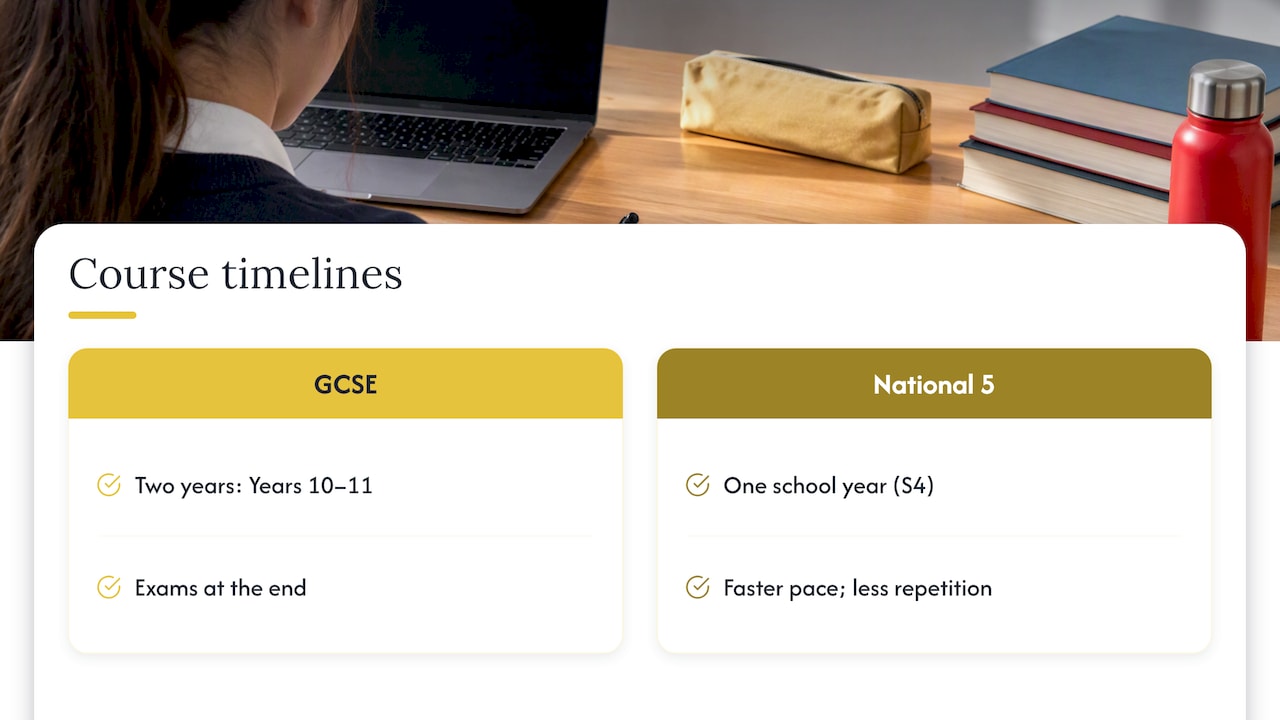
GCSE courses are normally taught across two years, Years 10 and 11, with the exams at the end. Scottish pupils typically cover a National 5 in one school year, which means the pace is faster and each topic gets less repetition in class. If you are a National 5 student, this is why independent practice matters so much: there is less time in lessons to meet every question type.
A National 5 can also be repeated. A student may take the course again the following year if the school, college or training provider agrees to re-enter them. Repeating means taking the full course and its assessments again, and coursework generally has to be produced afresh.
How the grading systems differ
This is the difference most families notice first.
| Feature | National 5 | GCSE (England) |
|---|---|---|
| Grades | A to D, or no award | 9 to 1, plus U for ungraded |
| Highest grade | A | 9 |
| What counts as a pass | All of A to D are passing grades | 4 is the usual standard pass benchmark, 5 a strong pass |
| Typical teaching time | One year (S4) | Two years (Years 10 and 11) |
National 5 courses are graded A to D or “no award” and total 24 SCQF credit points. All four grades A to D are passing grades, which is why a grade D at National 5 is a pass but is not treated as comparable to a GCSE grade 4 for entry purposes.
GCSEs in England have been graded on a 9 to 1 scale since 2017, with 9 the highest and U meaning ungraded. The scale gives more separation at the top than the old A* to G system, which is why grade 9 is seen as the mark of exceptional performance. If that is your target, our guide on why the last four questions decide grade 9 is a useful next read.
Both systems adjust grade boundaries every year rather than fixing them in advance. Ofqual-regulated GCSEs set new boundaries each year using data and expert judgement to keep standards comparable across exam series. The SQA likewise sets National 5 boundaries annually so difficulty stays consistent from year to year. The practical result is the same on both sides of the border: the raw mark needed for a given grade moves a little each year, so aim well above the boundary rather than at it. You can see how much it moves in our GCSE maths grade boundaries dataset for 2018 to 2025.
National 5 maths vs GCSE maths
The two maths courses cover broadly similar ground: number, algebra, geometry, trigonometry, statistics and, at the upper end, some more demanding algebraic work. The differences lie mostly in how they are examined.
How National 5 maths is assessed
National 5 Mathematics is assessed by two question papers: one non-calculator paper and one calculator-allowed paper. There is one course for everyone, so every candidate faces the same papers and the grade (A to D) reflects how many marks they earn.
The SQA also describes its design aim for most National Courses: a competent candidate should be able to score a minimum of 50% of the available marks for the notional grade C boundary. That is a useful way to think about the paper. Questions are meant to be reachable for a candidate who knows the course well, and the higher grades come from handling the more demanding questions accurately.
If you are a Scottish student, our National 5 maths topics revision guide sets out what the course covers in a topic-by-topic checklist.
How GCSE maths is assessed
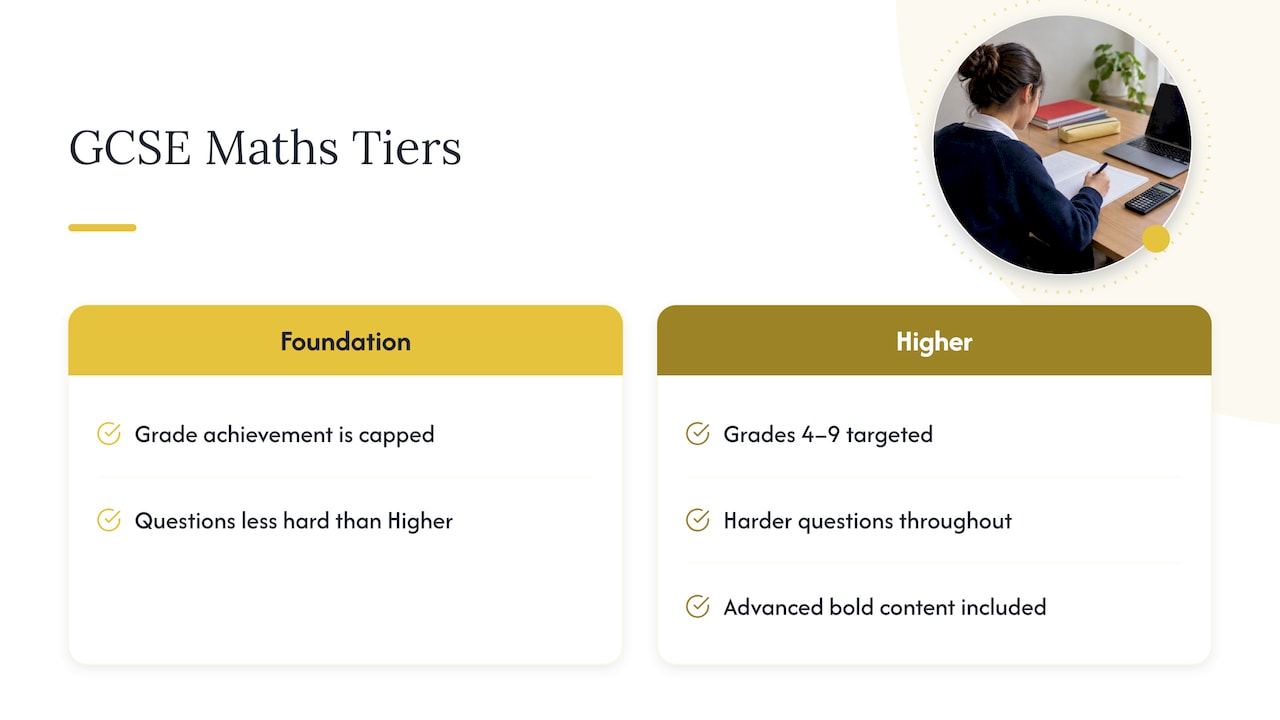
GCSE Maths in England is tiered. GCSE Mathematics question papers must be targeted at either Foundation or Higher tier. Ofqual specifies that Higher tier assessments are targeted at grades 4 to 9, which separates them from Foundation tier. Higher-tier students are expected to master the more advanced content too, including what Ofqual calls bold content.
The tier choice is therefore a strategic decision that National 5 students do not face. Foundation caps the grade a student can achieve, while Higher offers the full range but with harder questions throughout. Teachers usually advise on tier from mock results. If you are weighing up tutoring or extra support to help with that decision, this overview of exam-focused tutoring shows how that kind of preparation is structured.
Also check which exam board your school uses, because content and paper style vary a little between AQA, Edexcel, OCR and WJEC. Our Edexcel GCSE maths topics guide maps one board’s specification in detail.
A side-by-side view
| Question | National 5 Maths | GCSE Maths |
|---|---|---|
| Who sets it | SQA (Qualifications Scotland) | Exam boards regulated by Ofqual in England |
| Papers | Two: non-calculator and calculator | Three papers, one non-calculator and two calculator (check your board) |
| Tiers | Single course | Foundation or Higher |
| Grades | A to D | 9 to 1 |
| Usual next step | Higher Maths in S5 | A-Level, BTEC or other Level 3 courses |
The number of GCSE papers is a feature of the current specifications from the main boards, so confirm it on your own board’s page.
How results compare
It is tempting to compare pass rates, but treat that with care because the cohorts and grade structures differ. For reference, EngineeringUK describes National 5 as Scotland’s equivalent to GCSEs elsewhere in the UK and reports that 69.3% of National 5 Mathematics entries achieved A to C in 2025. Because every candidate sits the same course and the pass grades run A to D, that figure is not directly comparable with a GCSE grade 4 pass rate.
A better use of results is personal: look at how your own marks compare with the boundaries in past papers, and track which question types lose you marks.
What about IGCSE?
IGCSE (International GCSE) is the other qualification that regularly causes confusion, and it answers a different question from National 5 vs GCSE. It is not a Scottish or English regional variant. It is an international qualification offered by exam boards, often taken at schools abroad and at some independent schools in the UK.
Is IGCSE the same standard as GCSE?
By design, yes. Pearson states that its International GCSEs are regulated by Pearson and that UK NARIC confirmed they are comparable to the UK GCSE standard. The same guidance says UK universities, including Oxford and Cambridge, recognise International GCSEs as GCSE equivalents for admissions on a grade-for-grade basis.
What differs in maths?
Content is where the two diverge. The Edexcel IGCSE Mathematics A teachers’ guide says the course is equivalent in standard to the same board’s UK GCSE and includes set notation, function notation and calculus, none of which appear in the GCSE content. The same material notes that some GCSE topics are omitted, so the two syllabuses overlap heavily without matching.
That guide dates from 2011, and boards revise their specifications, so check your own board’s current specification before assuming the topic list. Where you are revising for IGCSE, our IGCSE maths past-paper questions let you practise on the style your exam uses.
Which should you focus on?
You rarely choose between National 5 and GCSE. Where you live and where your school sits decide it. The question is usually one of these:
- You are in Scotland and need to understand what an English employer or college will accept. A National 5 Maths pass at grades A to C is generally treated as comparable to a GCSE grade 4 or above, but ask the institution directly.
- You have moved between the Scottish and English systems. Ask your new school about course content, because the structure differs. Scottish students moving to England will meet tiers and a different grade scale. English students moving north will meet a single course in one year and a Higher in S5.
- You are a parent trying to read results. Treat A, B and C at National 5 as the headline pass band for comparison with GCSE 9 to 4, and remember that D is a pass in Scotland but sits below that comparison band.
- You are a teacher or tutor building materials. Reuse shared topics such as algebra, ratio, trigonometry and statistics across both courses, and adapt question style to each exam.
How to revise for either exam
The qualification label matters less than the habit of practising the exact style of paper you will sit. A simple routine works for both.
- Map the course. Use the specification or a topic checklist so you know what is examined.
- Learn the method first. Work a topic through with notes or a video, then try questions unaided.
- Do timed past papers. Sit them under exam conditions, including the non-calculator paper.
- Mark with the scheme. Learn how method marks and accuracy marks are awarded, because a wrong answer with clear working still earns credit.
- Log errors by topic. Return to your weakest areas every week rather than redoing what you already know.
- Ask when you are stuck. A question you cannot unpick alone is worth bringing to a teacher or a live session.
For video support, our 4 to 6 week plan for exam-aligned walkthroughs shows how to fit walkthroughs into a revision calendar, and our guide to written versus video solutions explains when to try a question first and when to check the answer.
Where MathVault fits
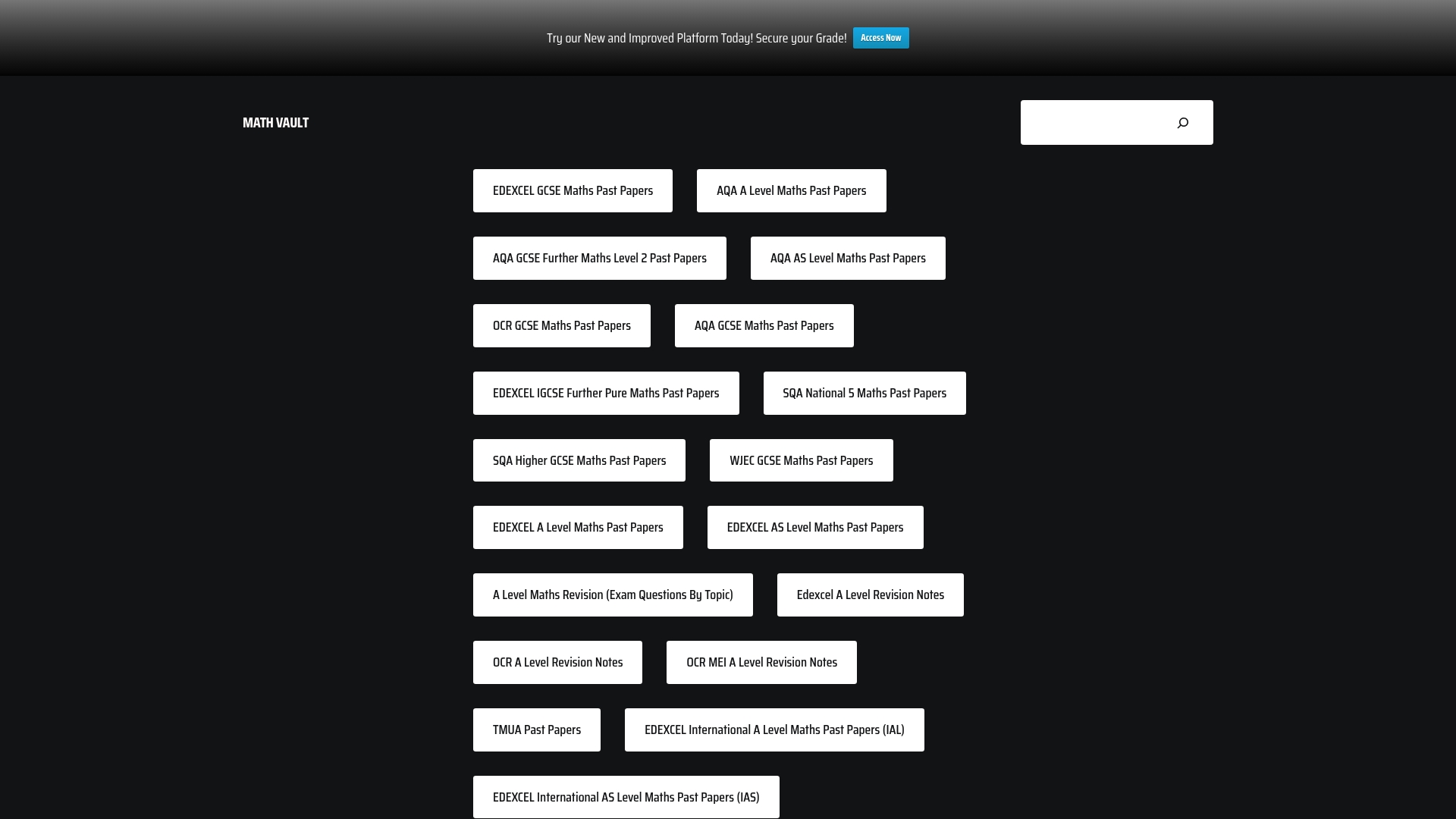
MathVault is a free platform built around the way these exams are marked: past papers, fully worked solutions, video walkthroughs, topic revision guides and live weekly Q&A sessions, organised by UK exam board.
If you are preparing for GCSE, start with the GCSE maths past papers on AQA or browse the full range on our maths past papers hub, which covers AQA, Edexcel, OCR, WJEC and CIE. Most materials are free. Some recent or advanced resources and full downloadable packs are available as one-off purchases, and small donations help us keep the rest open.
Students in Scotland can use the National 5 maths topics guide alongside past-paper practice, and you can bring questions to the live Q&A sessions when a method will not click.
Our perspective
Comparing National 5 and GCSE is useful for understanding what a qualification means. It is much less useful for deciding how to revise. Whichever exam you sit, marks come from the same habits: knowing the method, showing clear working, and being comfortable with the way your own papers are set.
We built MathVault around that idea. A past paper on its own tells you what the questions were. A fully worked solution tells you why a method earns its marks, where students typically slip, and how a mark scheme rewards working. Video walkthroughs and live sessions add the explanation that a page of text cannot, which is why we offer all of them free to students across England, Wales and Scotland.
Our aim is to give every student, whether on a Scottish National 5 course or a tiered GCSE, a place to practise properly and ask for help without cost being the barrier. Confidence in maths comes from repetition with feedback, and that is what we try to provide.
Oloru
FAQ
Is National 5 harder than GCSE?
Neither is simply harder, because they are built differently. National 5 is taught over about one year, with a single course and A to D grades, while GCSE is taught over two years with tiers and a 9 to 1 scale. UK ENIC places both at the same level, so the best test of difficulty is how well you do on past papers for your own exam.
What GCSE grade is a National 5 pass?
A National 5 at grades A to C is generally read as comparable to GCSE grades 9 to 4, according to UK ENIC’s comparison. A grade D is still a pass in Scotland, but it sits below that comparison band. Always confirm with the college or employer, as policies vary.
Can you resit National 5 maths?
Yes. A student can repeat a National 5 course the following year if their school, college or training provider agrees to re-enter them. You take the full course and its assessments again, and coursework generally has to be completed anew.
Is IGCSE maths the same as GCSE maths?
They are designed to be of comparable standard, but the content is not identical. The Edexcel IGCSE Mathematics A teachers’ guide notes topics such as set notation, function notation and calculus that are not in the GCSE. UK universities, including Oxford and Cambridge, accept International GCSEs as GCSE equivalents.
Sources
- Band 3, UK ENIC
- National Qualifications explained, Qualifications Scotland
- Results, Qualifications Scotland
- GCSE and Scottish National 5 results, EngineeringUK
- Grades and marking explained ahead of SQA results day, Glasgow World
- National 5 Mathematics Course Specification
- National 5 Mathematics course report 2024
- GCSE 9 to 1 grade scale explained, GOV.UK
- GCSE Subject Level Conditions and Requirements for Mathematics, Ofqual
- GCSE Subject Criteria for Mathematics
- Edexcel IGCSE in Mathematics (Specification A) teachers’ guide
- Pearson Edexcel International GCSE and GCSE guidance for universities
- What is exam-focused tutoring: a student’s guide
Leave a Reply