
To aim for a grade 9, you must sit the Higher tier, work through board specific past papers, and practise mixed multi-topic final questions under timed conditions. Start today with one Higher paper and mark the last four or five questions properly. Then follow a fixed sequence: secure core topics first, run timed mixed diagnostics next, drill multi-topic final questions after that, and only then move to full timed papers. Skip Foundation entirely. It cannot produce a grade 9.
TL;DR:
- Only Higher tier papers can provide the opportunity to achieve a grade 9, as foundation exams do not test the required content at this level.
- Mastery of advanced topics like surds, algebraic proofs, circle theorems, and vectors, especially when combined across multiple subjects, is essential for grade 9 questions.
- Regular practice of recent board past papers, especially the last four questions, enhances problem-solving fluency and reveals persistent mistake patterns.
- Consistent cycles of core topic reinforcement, timed diagnostics, and targeted question practice improve exam performance more effectively than random revision.
- Careful self-marking, including preserving crossed-out working and accurate notation, is crucial to securing method marks and avoiding careless errors.
Table of Contents
- Practice resources for GCSE maths and how to use them properly
- What a grade 9 actually requires: tiers, boundaries and the specification
- Topics and skills you need to master for grade 9
- A revision sequence that actually gets you to grade 9
- Exam technique: protecting marks and earning method points
- Sample 8 to 12 week plan and session templates
- How Mathvault supports a grade 9 revision programme
- A short, practical note on what actually works
- Start with the resources built for your board and tier
- Sources
- FAQ
Practice resources for GCSE maths and how to use them properly
Not all resources deserve equal time. The order below reflects what actually moves a grade 9 candidate forward, from broad foundation checks through to exam-day simulation.
- Board past papers and mark schemes. Select papers by your exact board and series, Higher tier only. Foundation papers cannot show you grade 9 style questions because that content simply isn’t tested there.
- BBC Bitesize short quizzes. These offer five ten-question activities of exam-style questions, each taking around 5 to 10 minutes, ideal for daily retrieval practice between longer sessions.
- Grade 7–9 topic packs and “final questions” collections. These isolate the hardest question types so you’re not wading through easy marks to reach the ones that actually separate a 9 from a 7.
- Mark schemes for self-marking. Identify which marks are method marks (M) versus accuracy marks (A), and mark your working, not just your final answer.
Pro Tip: Never rub out working you think is wrong. Cross it through with a single line instead. Examiners often award method marks for crossed-out working when no better attempt exists.
What a grade 9 actually requires: tiers, boundaries and the specification
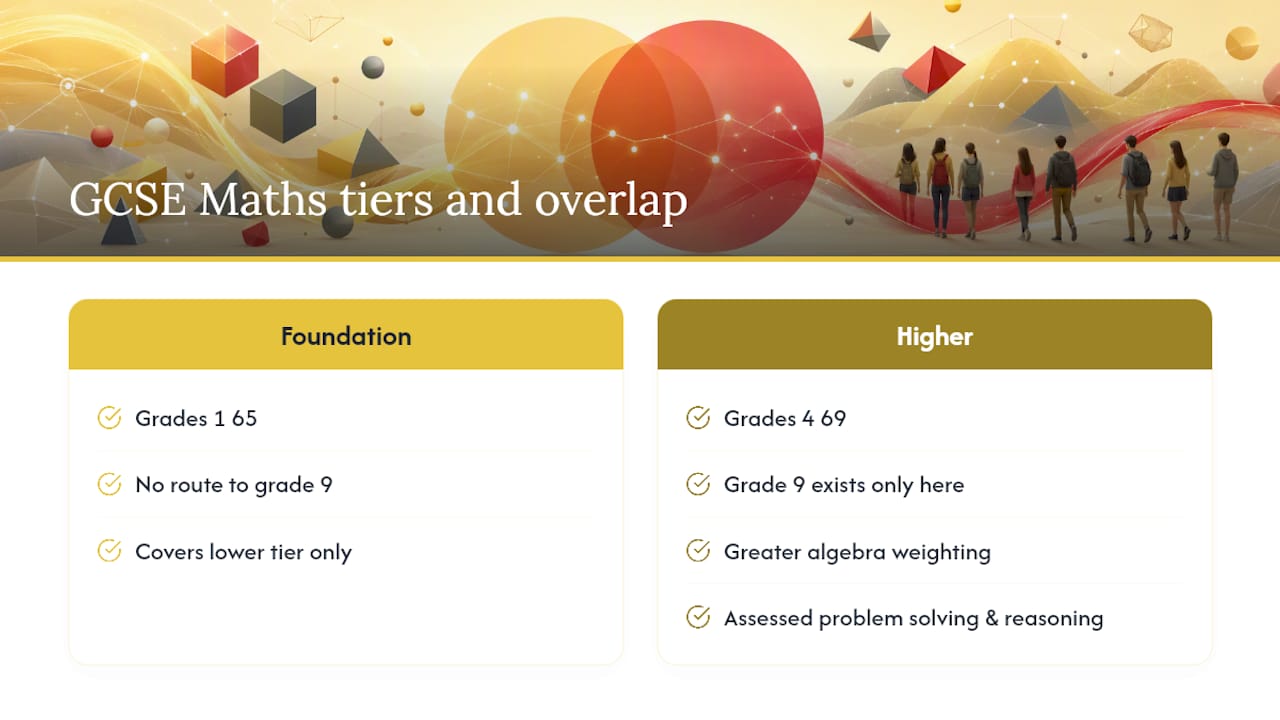
Grade 9 exists only on the Higher tier. Foundation covers grades 1 to 5, while Higher covers grades 4 to 9 under the overlapping tier system, which means there’s no route to a 9 through Foundation, however strong your arithmetic.
Grade boundaries vary each exam series, so the percentage needed can change. Awarding bodies set them after each series, judging how difficult that particular paper was, so a grade 9 might sit at 78% one year and 82% the next. Check your board’s published boundaries rather than aiming at a round number.
The DfE’s subject content document confirms that algebra carries greater weighting on Higher papers than any other domain. Problem solving and reasoning, not just calculation speed, are explicitly assessed objectives. That single fact should shape most of your remaining revision time.
Topics and skills you need to master for grade 9
Grade 9 questions rarely test a single skill in isolation. They test whether you can combine several at once, under pressure, without a hint about which method to use.
The advanced topics that appear repeatedly in grade 9 style questions include:
- Surds and rationalising denominators
- Upper and lower bounds
- Algebraic fractions and algebraic proof
- Quadratic inequalities
- Iteration
- Circle theorems
- Vectors
- Exponential growth and decay
- Converting recurring decimals to fractions
Beyond individual topics, examiners test cross-topic fluency: algebra combined with geometry, ratio combined with probability, bounds applied inside an area or volume problem. This kind of blending is deliberate policy, since the subject content document sets fluency, reasoning, and problem solving as formal assessment objectives, not optional extras. Correct notation and visible units matter here too. Losing a mark for missing units on an otherwise perfect answer is one of the most avoidable errors at this level.
A revision sequence that actually gets you to grade 9
Random topic revision wastes time you don’t have. Follow this order instead, and repeat the cycle every one to two weeks depending on how close you are to the exam.
- Secure core topic knowledge. Fix any gaps in number, ratio, basic algebra, and geometry before touching anything advanced.
- Run timed mixed-topic diagnostics. Short, unfamiliar problem sets reveal genuine weaknesses far faster than re-reading notes, and exposing yourself to mixed problems early builds the transfer skills grade 9 questions demand.
- Practise multi-topic final questions. These are deliberately the hardest questions on any Higher paper, so drill them specifically rather than leaving them for last.
- Alternate full timed papers with targeted correction sessions. A paper without a proper correction session teaches you almost nothing new.
Classify every mistake by type: knowledge gap, misreading the question, wrong method, arithmetic slip, calculator error, notation error, or running out of time. Fixing the same error mode across several papers is far more valuable than a general “revise everything again” pass.
Pro Tip: Keep a running error log with one line per lost mark. After three papers, one or two error modes usually account for most of your dropped marks. Attack those specifically.

Exam technique: protecting marks and earning method points
Grade 9 candidates lose marks through carelessness far more often than through lack of knowledge. Protecting the marks you’ve already earned matters as much as chasing new ones.
- Show full working on every question worth more than one mark. AQA’s own sample Higher paper and instructions confirm that method evidence can secure marks even when the final answer is wrong.
- Draw diagrams in pencil and label them clearly. A well annotated sketch often reveals the route to a solution that pure algebra hides.
- Never fully erase incorrect working. A single line through it preserves visible method for the marker.
- Allocate time by question difficulty: roughly a minute per mark on straightforward questions, more on multi-step ones, and always flag hard questions to revisit rather than stalling on them.
Sample 8 to 12 week plan and session templates
A weekly structure removes the guesswork from “what should I revise tonight?” Adapt the following to your own timetable and how many weeks remain.
- Weekly rhythm: two timed papers (one at the weekend), two focused topic blocks on weaker areas, daily 10-minute diagnostics, and a weekly review of your error log.
- Ninety-minute full paper session: sit a complete Higher paper under exam conditions, mark it fully against the scheme, then log every lost mark by error type before moving on.
- Sixty-minute targeted session: pick one weak topic, then spend the final 20 minutes exclusively on final-question style problems drawing on that topic.
Track two numbers over time: how often each error mode recurs, and your full-paper percentage trend. Both should move in the right direction within three or four weeks if the sequence is working.
How Mathvault supports a grade 9 revision programme
Past papers are organised by awarding body and by topic, alongside fully worked solutions and video walkthroughs for each question. That structure matters because grade 9 preparation depends on precise, board-matched practice rather than generic questions.
- Use the Edexcel past paper questions by topic page to isolate exactly the advanced topics covered above.
- Self-mark against fully worked solutions to check whether you’re losing method marks or accuracy marks, then join a live Q&A session when a mark scheme step doesn’t make sense.
- Video walkthroughs are particularly useful for multi-topic final questions, where seeing the examiner’s intended route often clarifies more than the mark scheme text alone.
A short, practical note on what actually works
Consistency beats cramming, and correction beats repetition. If you only take one non-obvious tactic from this article, make it this: practise the last four questions from as many Higher papers as you can early in your programme, not in the final fortnight. That’s where grade 9 is actually decided. Check your board’s official boundary documents regularly. They shift.
— Oloru
Start with the resources built for your board and tier
Free, board-organised past papers with fully worked solutions are available, so you’re never guessing whether your self-marking matches what an examiner would actually award. That’s the practical edge over generic question banks that mix boards and tiers without warning you which is which.
If you sit Edexcel, the Edexcel past paper questions by topic page is the fastest way to start targeted grade 7 to 9 practice today, and it’s free to use. Once you’re correcting your own papers, the self-mark past papers pack pairs board-aligned solutions with live Q&A sessions, useful when a mark scheme step doesn’t quite make sense on its own. Within eight weeks of the exam, switch to the last-minute revision plan for a tighter 48/24/8 day structure. Most of Mathvault’s material, including papers, solutions, and live sessions, is free. Downloadable revision packs for offline consolidation are available as one-off purchases for students who want everything organised outside a browser tab.
Sources
For canonical subject requirements, check the DfE subject content document and your awarding body’s own specification. Always confirm current grade boundaries directly from your board rather than relying on last year’s figures. For daily five to ten minute retrieval practice, BBC Bitesize’s exam-style quizzes remain a reliable quick check between longer revision sessions.
- GCSE maths: choosing the right tier (Ofqual blog)
- GCSE mathematics subject content and assessment objectives (DfE)
- GCSE maths quizzes – exam practice (BBC Bitesize)
- AQA sample higher tier paper and instructions (AQA)
FAQ
What is grade 9 in GCSE maths?
Grade 9 is the highest grade on the reformed 1 to 9 GCSE grading scale used across England, sitting above the old A* equivalent. It’s awarded only to Higher tier candidates and typically represents the top few percent of that tier’s entry in a given series.
Is a grade 9 in GCSE maths good?
Yes. It’s the top possible grade and signals mastery of advanced algebra, geometry, and problem-solving content that Foundation tier never tests. Universities, sixth forms, and employers treat it as clear evidence of strong mathematical ability.
What grade is 37% in GCSE maths?
There’s no fixed percentage answer, because grade boundaries shift every series depending on how difficult that paper was judged to be. A raw score of 37% could sit anywhere from a low grade to a mid grade depending on the tier and the year, so always check your specific board’s published boundary table rather than a general rule.
What are grade 9 maths topics?
Grade 9 questions draw heavily on surds, algebraic proof, quadratic inequalities, iteration, circle theorems, vectors, and bounds, usually blended together rather than tested alone. Practising board-organised past papers, such as those on Mathvault’s Edexcel topic pages, is the most direct way to see how these topics combine in real exam questions.
Leave a Reply