
This page gives you a printable GCSE maths revision checklist, organised by topic and matched to your tier. It reflects current UK exam arrangements, including the formulae sheets provided for exams in 2025, 2026 and 2027. Pick Foundation or Higher below and start ticking off topics as you revise.
TL;DR:
- For each of the five topic areas, complete two targeted past paper questions, then use the formula sheet to practise applying relevant formulas rather than memorizing them.
- AQA’s specification puts roughly 30% of marks toward algebra and 25% toward number, while geometry and measures account for 15–20%, useful when prioritizing revision.
- Higher candidates need to add formal proof, advanced algebraic manipulation, and trigonometric relationships; grade 7 or above also calls for harder linked algebra and geometry problems.
- With 12 weeks, revisit all five areas twice and reserve the final three weeks for timed mixed papers; shorter plans prioritize weak topics.
- Before the exam, check your calculator’s reset procedure, clear stored memory and programs, remove any cover bearing printed formulas, and switch it to exam mode.
Table of Contents
- 1. The complete GCSE maths topic checklist
- 2. Foundation vs higher: where to focus your revision
- 3. Exam-day checklist and calculator rules you must follow
- 4. Turning the checklist into a revision timetable
- 5. Where to find reliable GCSE maths resources
- 6. What actually moves the needle before exam day
- Get organised revision packs and topic-based past papers
- FAQ
- Sources
1. The complete GCSE maths topic checklist
Work through each topic area and tick off what you have revised. For every topic, aim to complete two targeted past-paper questions and check the relevant section of your exam board’s formulae sheet before moving on.
- Number: fractions, decimals and percentages (FDP conversions), standard form, indices, and bounds. Practise shortening your calculation steps on past-paper questions so you do not lose time under pressure.
- Algebra: algebraic manipulation, factorising, quadratic equations, simultaneous equations, inequalities and sequences. Rearranging formulae and showing full working are where most marks are won or lost.
- Ratio and proportion: ratio problems, direct and inverse proportion, and compound measures. Worked examples followed by timed practice help you spot the method quickly in the exam.
- Geometry and measures: angle facts, circle theorems, Pythagoras, trigonometry, constructions, and area and volume. Practise drawing and labelling diagrams, since a clear sketch often reveals the method.
- Probability and statistics: averages, range, basic measures of spread, sampling, probability trees, charts and interpreting data. These questions are usually set in context, so practise reading the scenario carefully before calculating.
For each of these five areas, repeat the same two actions: complete two targeted past-paper questions on that topic, then check the GCSE maths formula sheet for anything relevant and practise the method it supports, rather than trying to memorise it from scratch.
Pro Tip: Keep a single page per topic where you jot down every mistake, then glance at it the night before the exam instead of redoing hours of practice.
2. Foundation vs higher: where to focus your revision
Higher tier includes everything on Foundation plus extra depth: more advanced algebraic manipulation, formal proof, additional trigonometric relationships, and more demanding multi-step reasoning within applied questions. If you are sitting Higher, treat these as genuine additions rather than harder versions of Foundation content, since they often appear as standalone questions.
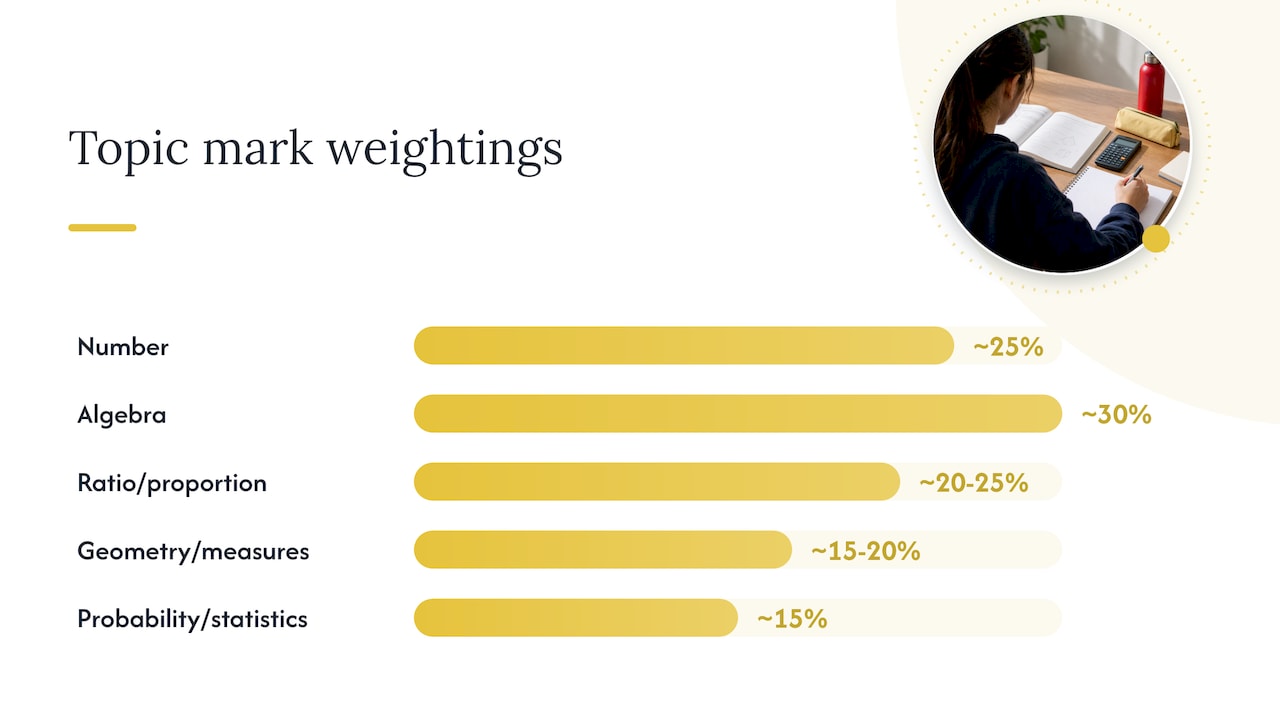
Exam-board specifications, such as AQA’s GCSE mathematics specification, set out approximate weightings you can use to prioritise your time:
- Number: roughly 25% of marks
- Algebra: roughly 30% of marks
- Ratio and proportion: roughly 20-25% of marks
- Geometry and measures: roughly 15-20% of marks
- Probability and statistics: roughly 15% of marks
If you are aiming for grade 7 or above, spend extra time on bridging topics that link algebra and geometry, such as algebraic proof involving shapes, and practise harder multi-step exam questions rather than repeating easier material you have already mastered.
3. Exam-day checklist and calculator rules you must follow
Exam boards apply JCQ’s calculator guidance strictly, so check your calculator the night before, not in the exam hall.
- Switch your calculator into exam mode and confirm it is working correctly.
- Clear all stored memory, programs and notes, since some graphical calculators need a specific reset procedure beyond a simple restart.
- Remove any cover or case with printed formulae or instructions on it.
- Pack black pens, spare batteries, a clear water bottle and any ID your centre requires.
- Arrive at least 10 minutes early and listen carefully to the invigilator’s instructions.
- Tell the invigilator immediately if you receive the wrong paper or need an agreed access arrangement.
A simple memory clear and a practice run in exam mode the night before can prevent lost time or disqualification on the day, according to JCQ’s written-exams guidance.
4. Turning the checklist into a revision timetable
A checklist only works once it has a schedule behind it. Build your revision timetable around however many weeks you have left:
- 12-week plan: revisit each of the five topic areas twice, then spend the final three weeks on timed, mixed-topic past papers.
- 8-week plan: cover each topic once in detail, then use the remaining fortnight for mixed practice and weak-spot repair.
- 4-week plan: prioritise your weakest topics from the weighting list above, then fill remaining days with full timed papers.
Whichever timetable you choose, practise past papers by topic rather than jumping straight to full mixed papers. Pick a topic, time yourself realistically, mark your answers against the official mark scheme, and log every mistake before moving to similar questions. This loop does more for your grade than passive re-reading.
It also helps to practise against the three assessment objectives examiners actually mark: AO1 tests routine technique, AO2 tests interpretation and communication, and AO3 tests problem-solving, where showing full working earns you method marks even if your final answer is wrong. Our guide on showing working in GCSE maths walks through exactly how examiners award those marks.
Pro Tip: In the final week, stop learning new content and instead rework the formulae sheet alongside a handful of focused past-paper questions from your weakest topic.
5. Where to find reliable GCSE maths resources
Use official sources for anything exam-critical, then use structured practice resources to build speed and confidence.
- Download genuine past papers and formulae sheets directly from your exam board, such as AQA, Edexcel or OCR, to be certain you are practising with accurate material.
- Read JCQ’s exam conduct and calculator guidance in full so you understand what is and is not allowed.
- Use worked solutions and video walkthroughs to check your method, not just your final answer, since method marks are often where students lose the most.
- For organised, free practice, our GCSE maths revision guides bring together past papers sorted by topic and fully worked step-by-step solutions in one place.
If you suspect a specific learning difficulty is affecting your maths progress, a resource such as Omniprism’s dyscalculia test can help you understand whether extra support or exam access arrangements are worth discussing with your school.
6. What actually moves the needle before exam day
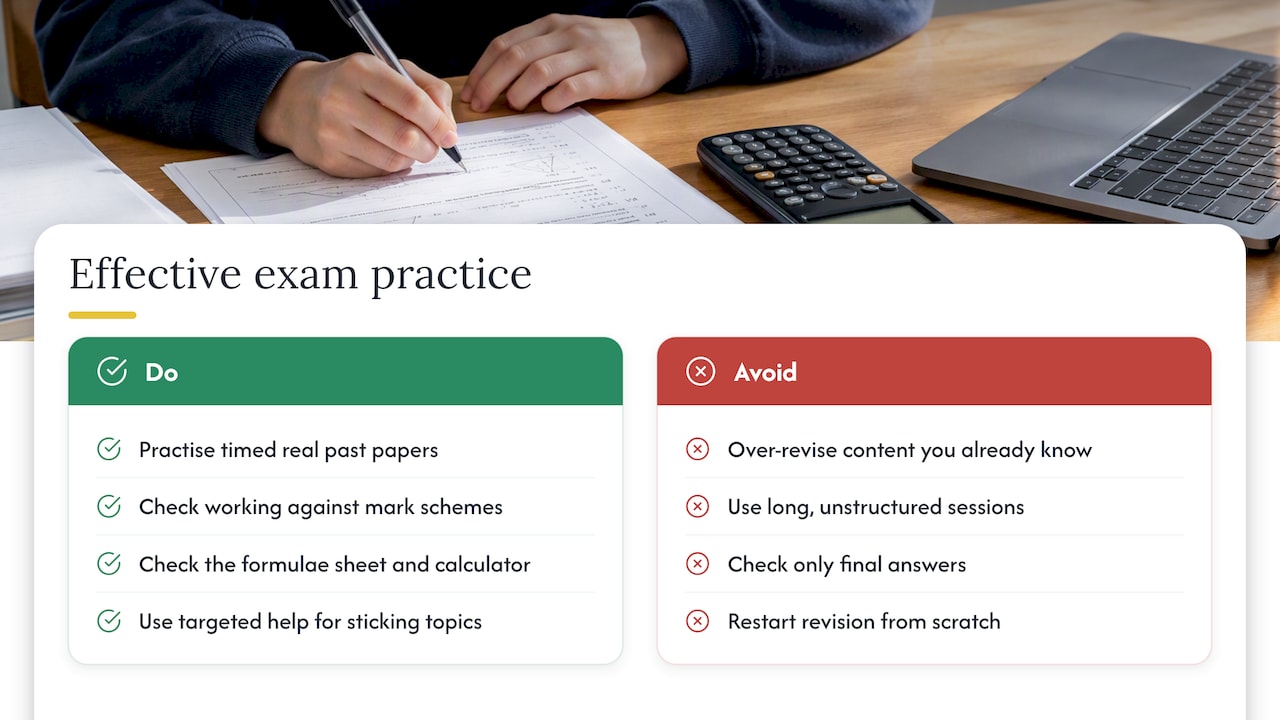
Most students over-revise content they already know and under-practise the exact exam conditions they will face. Small, regular timed sessions against real past papers beat long, unstructured study sessions every time, and checking your working against a mark scheme teaches you more than checking only your final answer.
Familiarity with the formulae sheet and a calculator check the night before remove two sources of needless stress that have nothing to do with how well you actually know the maths. If a topic still will not stick, worked solutions and live Q&A sessions can help fill that specific gap rather than making you start revision from scratch.
— Oloru
Get organised revision packs and topic-based past papers
We built our GCSE maths revision guides so you never have to hunt across exam board websites for the right paper or wonder whether your working matches the mark scheme. Many revision resources are free to use online, with some downloadable packs offered for offline use.
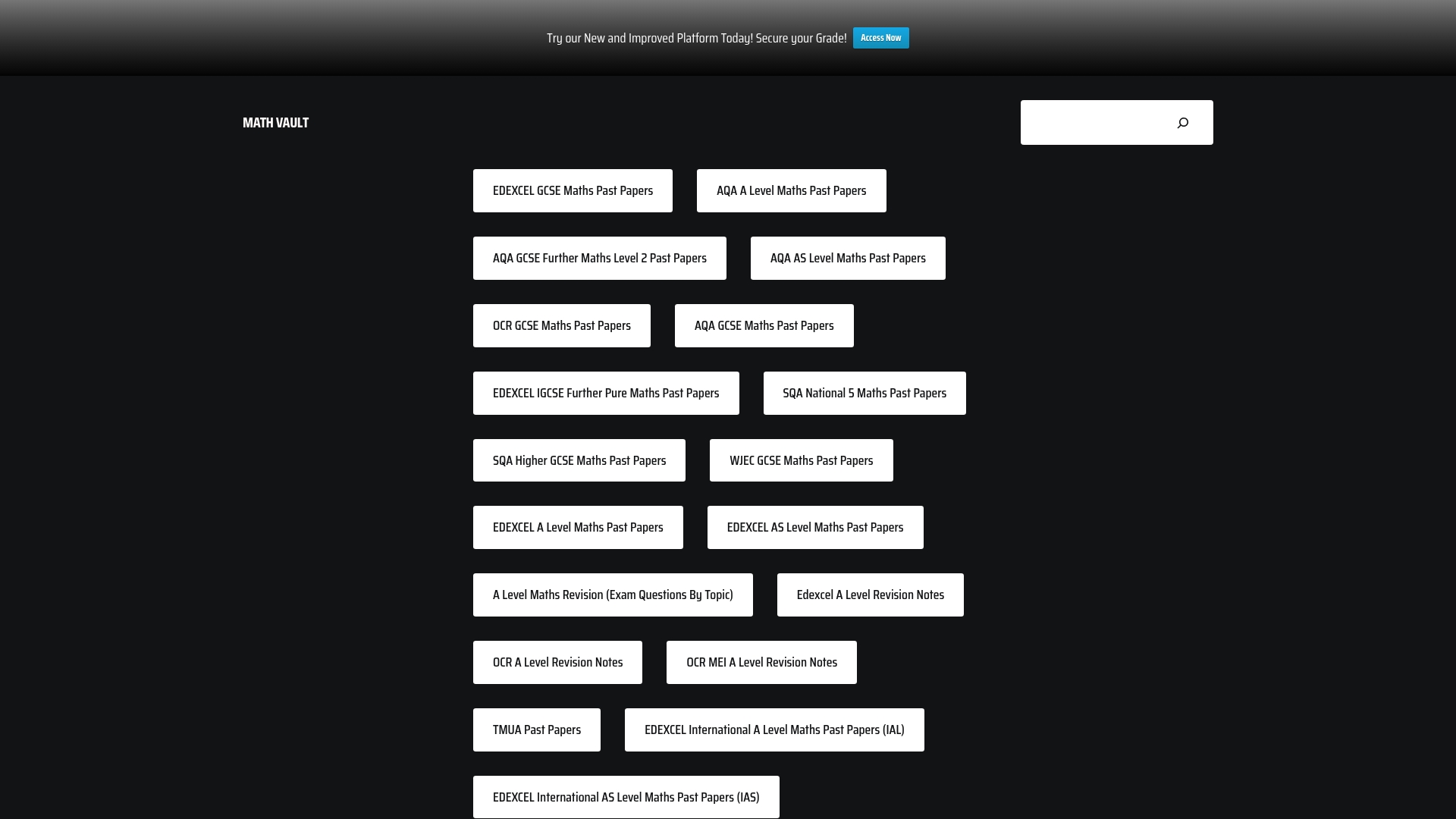
- Access past papers sorted by topic to target weaker areas.
- Check answers using detailed step-by-step solutions.
- Participate in live Q&A sessions for additional support when needed.
If you want to put today’s checklist into practice straight away, try our Edexcel GCSE past papers by topic and work through one topic under timed conditions before checking the worked solution.
FAQ
What is on the GCSE maths formulae sheet for 2026?
Exam boards must publish formulae sheets in advance for maths exams in 2025, 2026 and 2027, so you can see exactly what will be provided before the exam itself. You still need to know when and how to apply each formula, which is why practising with the sheet beside you matters more than memorising it.
Which calculators are allowed in GCSE maths exams?
JCQ guidance sets out which calculator functions are permitted and requires candidates to clear stored memory and remove any cover printed with formulae before the exam. Scientific and many graphical calculators are allowed provided they meet these conditions, so check your specific model’s reset procedure in advance.
What should I bring on GCSE maths exam day?
Bring black pens, spare batteries for your calculator, a clear water bottle and any identification your centre requires, and arrive at least 10 minutes early. JCQ’s written-exams guidance also covers what to do if you are given the wrong paper or need an agreed access arrangement.
How do Foundation and Higher tier maths differ?
Higher tier includes everything in Foundation plus extra depth, such as more advanced algebraic manipulation, formal proof, and additional trigonometric relationships. Weightings from exam board specifications, such as AQA’s, show algebra carries the largest share of marks on both tiers, so it is worth prioritising.
How do I use past papers to revise for GCSE maths?
Pick one topic at a time, time yourself under exam conditions, then mark your work against the official mark scheme to see exactly where marks were lost. Our past papers by topic let you repeat this cycle on a single weak area before moving to full mixed papers.
Sources
- Decisions on changes to the assessment of mathematics, physics and combined science GCSEs in 2025, 2026 and 2027
- Mathematics (8300) specification – AQA
Leave a Reply