
If you have 12 weeks or more before your exams, follow the 12-week plan below. With around 8 weeks left, use the 8-week variant. Under 4 weeks? The 4-week intensive is built for exactly that situation. Whichever timeline applies to you, your first action is the same, and it comes before you write a single revision slot in your diary.
Sit one full past paper today, under timed exam conditions, and mark it against the official mark scheme. That single paper tells you more about where your grade currently sits than a month of passive notes-reading. Use it to build a RAG list: red for topics you got badly wrong, amber for shaky, green for solid. Red topics go first in your timetable, and they get revisited most often.
- 12+ weeks left: follow the 12-week plan
- 8 weeks left: follow the 8-week plan
- Under 4 weeks left: follow the 4-week intensive
- First action, whichever plan applies: sit and mark a timed past paper today
One practical note before you build anything: check your school’s own issued timetable against the national exam calendar, including the contingency day set for 24 June 2026, since your actual paper dates will come from your school, not a generic calendar.
Key Takeaways
A GCSE maths revision timetable works only when it starts from a diagnostic past paper, splits red and amber topics into scheduled priority slots, and builds in rest days from week one.
| Point | Details |
|---|---|
| Start with diagnosis | Sit and mark a timed past paper before writing any timetable to build your RAG priority list. |
| Match plan to time left | Use 12 weeks if possible, 8 weeks if compressed, or 4 weeks as an intensive emergency plan. |
| Separate calculator practice | Schedule non-calculator drills weekly, rising to twice weekly before Paper 1. |
| Log every mistake | Track question reference, error type, and a scheduled revisit date for each error. |
| Protect rest days | Build at least one full rest day weekly to prevent burnout and maintain focus. |
Table of Contents
- How to choose your gcse maths revision timetable length
- Week-by-week templates for 12, 8 and 4 weeks
- Splitting calculator and non-calculator practice
- What a real weekly timetable looks like
- Study techniques that make each session count
- Where to find UK past papers and official exam dates
- When illness or school closures wreck your plan
- Fitting maths revision around other subjects and clubs
- Why rest days belong in your revision timetable
- Adjusting your plan for Foundation, Higher and different boards
- Get exam-ready with MathVault’s free resources
- Editorial take: what actually matters in a revision timetable
- Sources
How to choose your gcse maths revision timetable length
The right revision plan depends on how much runway you have, not on what worked for your friend. A 12-week plan covers full topic revision, spaced revisits, a mock, targeted fixes and exam technique, all without cramming any single week. An 8-week plan compresses topic coverage and brings the mock forward, while a 4-week plan drops straight into intensive daily targeting because there is no time left for a leisurely build-up.
Session length matters more than most students expect. On a 12-week plan, aim for 40 to 60 minutes on weekday evenings and 90 to 120 minutes across the weekend, split into two sittings rather than one long slog. Shorter plans need longer sessions, which is exactly why they are harder on concentration and why breaks become non-negotiable.
- 12-week plan: moderate-length sessions on weekdays and weekends
- 8-week plan: slightly longer sessions on weekdays and weekend blocks
- 4-week plan: intensive daily sessions lasting over an hour most days
Your diagnostic paper drives the whole schedule through the RAG method: red topics (badly wrong) get scheduled earliest and revisited most, amber topics get one solid pass plus a later check, and green topics only need a light refresher near the exam. Fit revision around school and rest, not instead of it. A student who revises every evening with no break burns out by week six of a twelve week block, which defeats the plan before the real exam pressure even starts.
Pro Tip: Colour-code your RAG list on paper or in a spreadsheet before you touch a timetable template. Once you can see your red topics at a glance, slotting them into weeks 1 to 4 takes minutes instead of guesswork.
Week-by-week templates for 12, 8 and 4 weeks
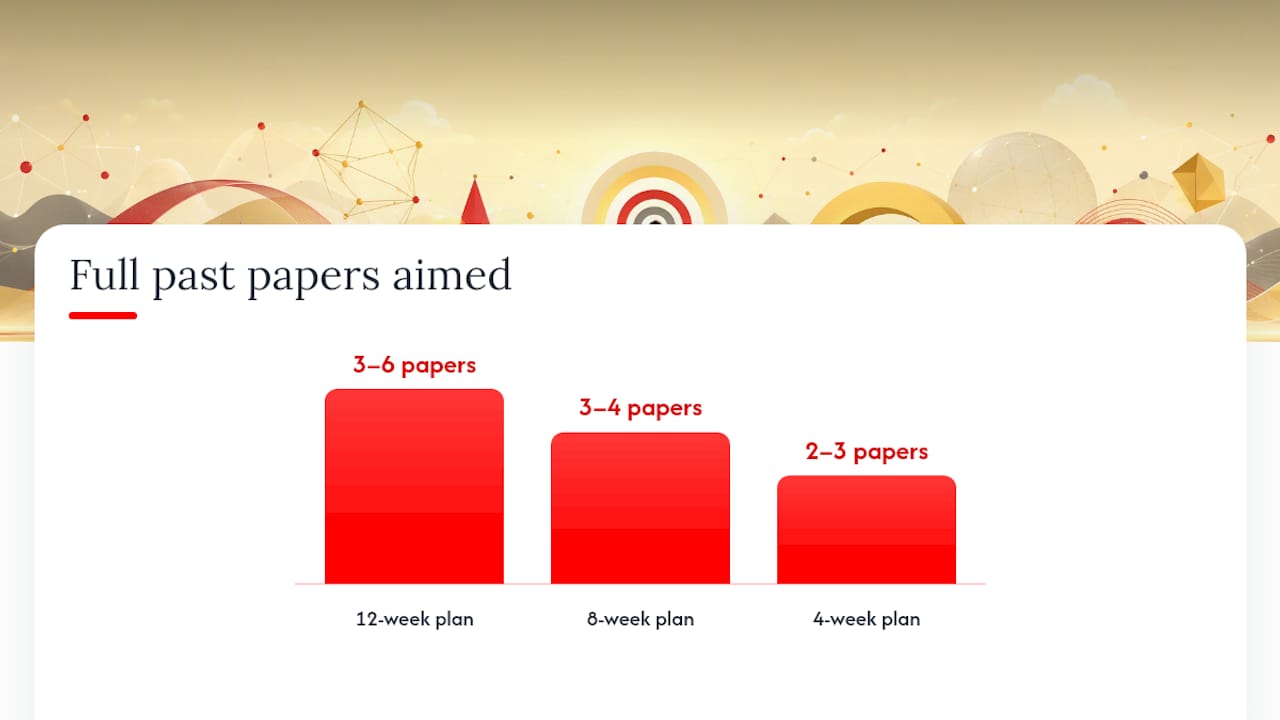
Each template below assumes you have already sat your diagnostic paper and built a RAG list. Adjust the topic weeks to match your own red and amber list rather than following someone else’s order blindly.
12-week plan (aim for 3 to 6 full past papers across the block):
- Week 1: Diagnostic paper, marking, and RAG list construction
- Weeks 2 to 8: Topic coverage in RAG order, with each red topic revisited at least once before week 8
- Week 9: First full timed mock, marked within 48 hours
- Weeks 10 to 11: Targeted fixes on whatever the mock exposed, plus a second shorter mock
- Week 12: Exam technique, formula sheet familiarisation, and light timed practice only, no new topics
This sequencing broadly matches what independent tutoring guides recommend for a 12-week window, and school-issued booklets follow a similar diagnostic-first structure, including St Margaret’s Academy’s Year 10 revision plan, which places a mock around the two-thirds mark rather than right at the end.
8-week plan (aim for 3 to 4 full past papers):
- Week 1: Diagnostic paper and RAG list
- Weeks 2 to 4: Compressed topic coverage, red topics only
- Week 5: First full mock, marked immediately
- Weeks 6 to 7: Intensive targeted fixes on mock weaknesses
- Week 8: Second mock plus exam technique review
4-week emergency plan (aim for 2 to 3 full past papers):
- Week 1: Diagnostic paper, RAG list, and daily intensive targeting of red topics only
- Week 2: Continue red topics, alternating non-calculator and calculator practice daily, first full timed paper at the end of the week
- Week 3: Amber topics plus continued red revisits, second full timed paper
- Week 4: Marking review, formula sheet drilling, light exam technique, no new content after the midpoint
In every plan, marking and review sit as their own scheduled slot, never squeezed in “if there’s time” after the paper itself. A mock without a proper marking session the same week or the next is close to wasted effort.
Splitting calculator and non-calculator practice
GCSE maths papers test two different skill sets, and revising them together tends to blur both. Non-calculator work depends on mental arithmetic, manual fraction handling, and estimation. Calculator work depends on graphing, trigonometric functions, and multi-step algebra where a slip in calculator use costs marks as easily as a slip in method.
Treat these as separate sessions rather than a mixed bag of questions. Early in your plan, one non-calculator session a week is enough. In the fortnight before Paper 1, bump that up to two sessions a week so mental methods are sharp when it counts.
- Non-calculator skills: mental arithmetic, manual fractions, estimation, exact-value working
- Calculator skills: graphing, trigonometry, multi-step algebra, standard form conversions
- Weekly split early on: one non-calculator session
- Weekly split near Paper 1: two non-calculator sessions
Pro Tip: Run a 10-minute mental arithmetic warm-up before every session, calculator or not, and sit one timed non-calculator mini-paper each week. Ten minutes daily adds up to hours of fluency by exam week, without ever feeling like a big commitment.
What a real weekly timetable looks like
Templates only work once they become an actual week in your diary. Here is a sample structure for a typical UK student balancing school, revision and downtime.
- Monday, 4 to 5pm: Topic session (red topic, new content or revisit)
- Tuesday, 6 to 7pm: Past-paper questions by topic, marked same evening
- Wednesday, 4 to 5pm: Non-calculator drills and mental arithmetic
- Thursday, 6 to 7pm: Amber topic revisit
- Friday: Rest, no scheduled revision
- Saturday, 90 to 120 minutes: Timed mini-paper or full paper (mock weeks) plus marking
- Sunday, 60 minutes: Error log review and next week’s topic selection
To turn this into something printable, put it in a simple table with days across the top and time slots down the side, then colour-code by RAG status so red slots stand out at a glance. Add school clubs, part-time shifts, or family commitments as fixed blocks first, then fit revision sessions around them rather than the other way round.
- Log every completed session with a tick and a one-line note on how it went
- Move a topic forward to the next week automatically if you scored below 60% on it
- Green topics can drop to fortnightly check-ins once logged as solid
Study techniques that make each session count
A timetable slot only earns its place if you use it properly. Spaced repetition, revisiting a topic at increasing intervals rather than once and never again, has consistent evidence behind it for long-term retention, and it is worth building into every red and amber topic on your RAG list rather than treating revision as a one-pass exercise.
Active recall does the rest of the work. That means closed-book problem solving rather than re-reading notes, and testing yourself on formulae from memory before checking the formula sheet to see what you actually needed. Time yourself on practice questions and mark immediately, while the working is still fresh in your mind.
Keep an error log alongside your timetable. For every mistake, note the question reference, the type of error (method, arithmetic, misread question), a corrective step, and a date to revisit it.
- Question reference: paper, question number, topic
- Error type: method, arithmetic, misread, or timing
- Corrective step: what you will do differently next time
- Revisit date: scheduled into a future amber or green slot
Pro Tip: Review your error log every Sunday for five minutes before planning next week’s sessions. Patterns jump out fast, three arithmetic slips in a row usually means your mental maths warm-up needs to come back into rotation.
Spaced practice is one of the more consistently supported study techniques in education research, which is exactly why it earns a place in every template above rather than being left as an optional extra.
Where to find UK past papers and official exam dates
MathVault fits directly into every template above. Use past paper questions sorted by topic for your red and amber sessions, fully worked solutions to check your method rather than just your answer, video walkthroughs when a written solution isn’t clicking, and downloadable revision guides for offline practice during exam week itself.
For exact dates, always go to the primary source rather than a generic calendar. GOV.UK’s Ofqual guidance confirms GCSE exams run through May and June 2026, with a national contingency day on 24 June 2026. Pearson Edexcel and OCR both publish final timetables you should check against your own board.
A simple session structure to follow: select a topic from your RAG list, work timed questions from MathVault’s topic bank, mark against the official scheme, then log any mistakes for a scheduled revisit.
When illness or school closures wreck your plan
A missed week does not mean starting your timetable over. Treat disruption as a scheduling problem, not a crisis. If you are ill for a few days, shift that week’s content forward rather than trying to cram it in alongside the following week’s plan, and drop any green topics from that period entirely since they need the least attention anyway.
For longer disruptions, such as a school closure or a longer illness, recalculate from where you actually are rather than where the original timetable assumed you’d be. Sit a short diagnostic on the topics you were meant to cover, treat weak spots as new red topics, and compress the remaining plan using the 8-week or 4-week template structure, even if you technically started on a 12-week plan.
The instinct to “catch up” by doubling every session is usually counterproductive. Two rushed, low-focus sessions teach you less than one properly paced one, and the fatigue carries into the next week. Instead, protect your red-topic slots first and let amber and green topics absorb the lost time; they can shift later or shrink without much cost to your overall grade.
If disruption hits close to a scheduled mock, it is usually better to push the mock back by a week than to sit it underprepared and demoralised. A mock exists to diagnose gaps, not to punish you for circumstances outside your control. Update your RAG list as soon as you’re back on track, since a week away often changes which topics count as genuinely red.
Fitting maths revision around other subjects and clubs
GCSE maths rarely has your full attention, and it shouldn’t need to. Most students are juggling five or more subjects, plus sport, music, part-time work, or other commitments, so a maths timetable that assumes unlimited free time will fail within a fortnight.
Treat your weekly commitments as fixed blocks first, then fit maths sessions around them rather than hoping spare time will appear. If Tuesday evenings are taken by football training, don’t schedule maths there and expect to “find the energy” afterwards, move that session to a quieter evening instead.
Rotate subjects across the week rather than dedicating entire days to a single one. A pattern such as maths on Monday and Thursday, English on Tuesday, science on Wednesday and Friday, spreads cognitive load and stops any one subject from dominating your week or being neglected until the last fortnight.
Maths often needs slightly more frequent, shorter sessions than essay-based subjects, because procedural skills like algebra manipulation fade faster than conceptual knowledge if left untouched for more than a week. Two 45-minute maths sessions most weeks tend to outperform one long Sunday session, even if the total time is similar.
If a clash is unavoidable, such as a mock exam falling in the same week as a school production or a big fixture, shift lighter green-topic sessions rather than cancelling red-topic ones. Your RAG list should be the deciding factor in what gets sacrificed when time runs short, not simply whatever was scheduled last.
Why rest days belong in your revision timetable
Skipping rest days feels productive in the short term and costs you in the long term. Revision without recovery leads to declining focus, sloppier mistakes on questions you’d normally get right, and a rising temptation to skip sessions altogether once burnout sets in.

Build at least one full rest day into every week of your timetable, not as a reward for finishing everything, but as a fixed, non-negotiable slot. The sample weekly timetable above uses Friday, but any day works as long as it stays consistent so your brain learns to expect the break.
Within revision sessions themselves, shorter and more frequent breaks beat one long session powering through fatigue. A 45 to 60 minute session followed by a genuine 10 to 15 minute break, away from your phone and your desk, tends to produce sharper recall than a 90-minute block with no pause.
Watch for early burnout signs: rereading the same page without absorbing it, rushing through past-paper questions just to finish rather than to learn, or dreading a session before it starts. Any of these usually mean the timetable needs a lighter week, not more willpower.
Weekend timetables deserve particular care since they carry the longest sessions in most plans. Splitting a two-hour Saturday block into two 60-minute sittings with a proper break, rather than one unbroken stretch, keeps concentration higher through the second half and makes marking your work afterwards far more useful.
Adjusting your plan for Foundation, Higher and different boards
Tier changes what belongs in your red list. Foundation papers weight heavily towards number, ratio, and straightforward algebra, so a Foundation student’s timetable should push extra sessions towards fluency and speed on core methods rather than chasing the hardest algebraic proofs, which barely feature. Higher papers introduce more multi-step problem solving and topics like some of the genuinely hardest GCSE maths content, so Higher timetables need more weeks allocated to problem-solving practice rather than pure procedure drilling.
Exam board changes the fine detail rather than the overall shape. The 12/8/4-week structure works whichever board you sit, but the topic order and paper style differ enough to matter. Edexcel, AQA and OCR each phrase questions differently and weight some topics slightly differently across their papers, so once you know your board, map your RAG list against board-specific topic lists rather than a generic GCSE syllabus outline.
Practically, this means your Week 2 to 8 (or equivalent) topic sessions should pull past papers from your actual exam board wherever possible, not a mixed bag from whichever board happens to have the most freely available questions. A Higher-tier Edexcel student and a Foundation-tier AQA student following the same 12-week shell should end up with genuinely different weekly content once their RAG lists and board-specific topic weightings are applied.
Get exam-ready with MathVault’s free resources
Building the timetable is half the work; filling it with the right practice material is the other half. Mathvault gives you free access to past exam papers organised by topic and exam board, fully worked step-by-step solutions, video walkthroughs for the topics that don’t click on paper, and live weekly Q&A sessions when you get stuck between scheduled sessions.
For students working through the templates above, the Edexcel GCSE past paper questions by topic page slots directly into your weekly topic sessions, letting you pull exactly the questions your RAG list flags as red without wading through entire papers to find them. If your board or route is different, Mathvault also covers AQA Further Maths Level 2 and a full range of A-Level boards for students planning ahead. Whichever plan you follow, all resources remain free to access, with optional downloadable packs available for students who want offline, printable material for the final fortnight.
Editorial take: what actually matters in a revision timetable
Most GCSE maths revision advice treats the timetable itself as the achievement, weeks of colour-coded boxes that look thorough on paper. The evidence points elsewhere: the diagnostic paper and honest RAG tagging matter more than the template’s shape. A student who skips the diagnostic and jumps straight to “Week 1: Number” is guessing at priorities that a single marked paper would have told them in an hour.
Conventional advice also underrates how much damage comes from revising comfortable topics on repeat. It feels productive, and it is almost entirely wasted time if those topics were already green. The tutoring and school-booklet consensus on diagnostic-first planning exists precisely because it forces students to confront weak topics instead of quietly avoiding them.
If there’s one thing to prioritise above the template you choose, it’s the marking and error-log discipline that runs underneath it. A mock without proper marking teaches you almost nothing. A timetable without a rest day breaks down by week six. Get those two things right, and the 12, 8, or 4-week shape becomes a formality rather than the main event.
*— Oloru
Sources
- Gov
- Examination timetables – Pearson Edexcel
- Key dates and timetables – OCR
- Year 10 maths revision booklet – St Margaret’s Academy
Leave a Reply