
What is the official GCSE maths formula sheet for 2026?
The Department for Education and Ofqual confirmed that formula sheets will accompany every GCSE Mathematics question paper in 2025, 2026, and 2027. Every student receives one as an insert with their paper on exam day. There are two versions: one for Foundation tier and one for Higher tier, with the Higher sheet containing additional formulae.
Across AQA, Edexcel, and OCR, the content is consistent. The only format difference is that OCR embeds formulae directly into the relevant questions rather than providing a standalone sheet, though the practical effect for students is the same.
| Specification | Foundation tier | Higher tier |
|---|---|---|
| Number of formulae on sheet | 4 | 9 |
| Provided as | Insert with question paper | Insert with question paper |
| Applies to | All papers (calculator and non-calculator) | All papers (calculator and non-calculator) |
| Official source | AQA, Edexcel, OCR websites | AQA, Edexcel, OCR websites |
| Available for mock use now? | Yes | Yes |
Pro Tip: Download the official PDF from your exam board’s website and use it in every mock exam from now on. Familiarity with the layout saves time on the actual day.
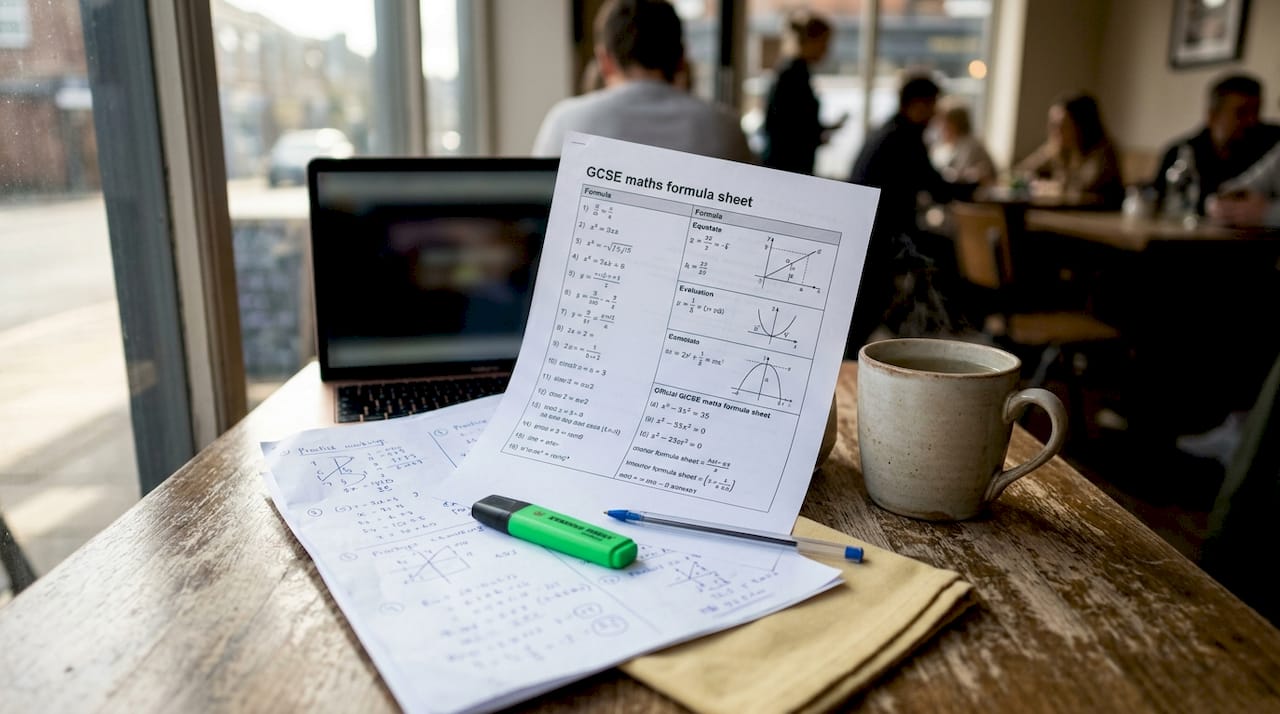
Formulae provided on the Foundation tier sheet
The Foundation tier sheet is deliberately concise. It covers four formulae that the government judged most reasonable to provide, given the disruption students experienced in recent years.
- Pythagoras’ theorem: a² + b² = c², where c is the hypotenuse of a right-angled triangle.
- Trigonometric ratios: sin θ = opposite/hypotenuse, cos θ = adjacent/hypotenuse, tan θ = opposite/adjacent. These apply only to right-angled triangles.
- Area of a trapezium: ½(a + b)h, where a and b are the parallel sides and h is the perpendicular height between them.
- Compound interest and growth/decay: Total = N × (1 ± r/100)ⁿ, where N is the starting value, r is the percentage rate, and n is the number of periods.
A common misconception is that circle formulae appear here. They do not. Area of a circle (πr²) and circumference (2πr) are absent from both tier sheets and must be memorised. Formulae such as the curved surface area of a cone or volume of a sphere are provided within questions when needed, which means they are separate from the formula sheet entirely.
Additional formulae on the Higher tier sheet
Higher tier students receive everything on the Foundation sheet, plus five advanced formulae that Foundation students do not get.
- Quadratic formula: x = (−b ± √(b² − 4ac)) / 2a, which solves any equation in the form ax² + bx + c = 0 where a ≠ 0.
- Sine rule: a/sinA = b/sinB = c/sinC, used to find sides or angles in non-right-angled triangles when you have a matching side-angle pair.
- Cosine rule: a² = b² + c² − 2bc cosA, used when the sine rule cannot be applied, typically when you know two sides and the included angle.
- Area of a triangle using two sides: Area = ½ab sinC, distinct from the basic ½ × base × height formula, which is not on the sheet.
- Addition law of probability: P(A or B) = P(A) + P(B) − P(A and B), covering non-mutually exclusive events.
Having these formulae available does not mean you can simply read them off and substitute numbers. The exam will not tell you which rule to apply. You need to recognise the scenario, select the correct formula, and execute it accurately under timed conditions. Understanding what each variable represents is half the work.
Formulae you still need to memorise for GCSE maths
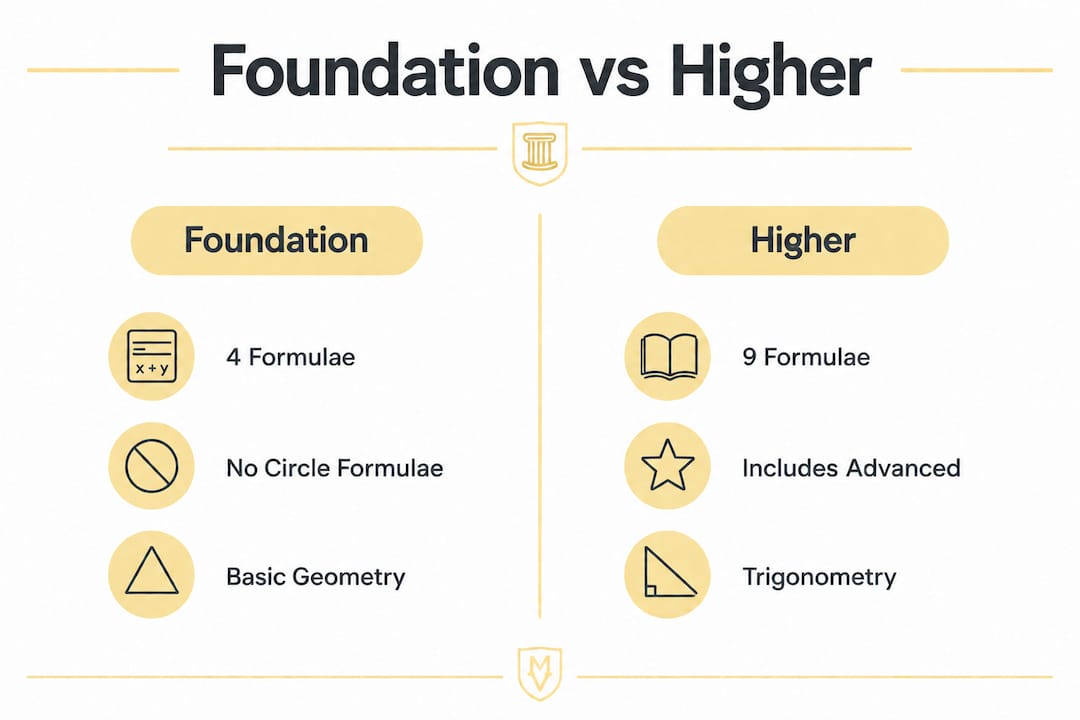
The formula sheet covers roughly 9 formulae. Over 20 others are not provided and must be committed to memory. This is the section that catches students out most often.
Geometry formulae to memorise:
- Area of a rectangle = length × width
- Area of a triangle = ½ × base × height
- Area of a circle = πr²
- Circumference of a circle = 2πr (or πd)
- Volume of a cuboid = length × width × height
- Volume of a cylinder = πr²h
- Volume of a prism = area of cross-section × length
Algebra, number, and statistics formulae to memorise:
- Gradient = (y₂ − y₁) / (x₂ − x₁)
- Equation of a straight line: y = mx + c
- nth term of an arithmetic sequence = a + (n − 1)d
- Speed = distance ÷ time
- Density = mass ÷ volume
- Pressure = force ÷ area
- Mean = sum of values ÷ number of values
- Percentage change = (change ÷ original) × 100
Students who assume the formula sheet removes the need for memorisation tend to lose marks on the most straightforward questions. Circle area and speed-distance-time both appear constantly across the tiers, yet neither is on the sheet.
How to use the formula sheet effectively in revision and exams
Active use of the formula sheet during revision produces better results than passive reading. The goal is to reach a point where you understand every formula on the sheet well enough that you rarely need to glance at it during the exam.
- Practise identifying which formula applies. Work through past papers and, before writing anything, name the formula you will use and state what each variable means in that specific question.
- Cover the sheet and test yourself. Write out the formulae from memory, then check. This builds the recognition speed you need under exam conditions.
- Use the sheet in every mock exam. Teachers recommend using the official formula sheets in mock assessments so students become familiar with the layout before the real exam.
- Redirect memorisation effort. Since Pythagoras and trigonometry are provided, focus your memorisation time on circle formulae, volume formulae, and speed-distance-time, which are not on the sheet.
- Calculator vs. non-calculator papers. The formula sheet is provided for all papers, so there is no difference in what is available between the two. The distinction that matters is whether your calculator can handle the arithmetic once you have set up the formula correctly.
Educators caution against overreliance, stressing that deep conceptual understanding is what converts a formula into a correct answer. Knowing the cosine rule is on the sheet is not the same as knowing when and how to use it.
Pro Tip: When you pick up the formula sheet at the start of the exam, spend 30 seconds scanning it. Confirm the layout matches what you practised with. This brief check settles nerves and confirms you are working with the right tier sheet.
How the 2026 formula sheet compares to previous years
The 2026 formula sheet content is unchanged from 2025. AQA confirmed that the equations and formulae sheets for 2026 are the same ones used in 2025, which means any revision work done with the 2025 sheet remains fully valid.
Before 2025, no formula sheet existed for GCSE Maths at all. Students were expected to memorise every formula, including Pythagoras, trigonometric ratios, and the quadratic formula. The introduction of the sheet in 2025 was a direct response to the disruption students experienced during the pandemic years.
The provision is confirmed as a temporary measure covering 2025, 2026, and 2027 only. Future assessments may revert to no sheet, so building genuine understanding now, rather than relying on the sheet as a crutch, protects students beyond this exam cycle. Formulae given within questions, such as the volume of a sphere and curved surface area of a cone, have always been provided in this way and that practice continues unchanged in 2026.
Key takeaways
The GCSE maths formula sheet provides 4 formulae for Foundation tier and 9 formulae for Higher tier, but students must still memorise over 20 others to be fully prepared for the exam.
| Point | Details |
|---|---|
| Official provision confirmed | DfE and Ofqual confirmed formula sheets for 2025, 2026, and 2027 exams across all major boards. |
| Two tier-specific sheets | Foundation receives 4 formulae; Higher receives those 4 plus 5 additional advanced formulae, totalling 9. |
| Many formulae not provided | Circle area, circumference, volume formulae, speed-distance-time, and gradient must all be memorised. |
| 2026 content unchanged from 2025 | Students can use 2025 formula sheets and past papers for accurate 2026 mock practice. |
| Temporary measure only | Provision runs through 2027; understanding each formula, not just recognising it, remains the priority. |
Ready to put the formula sheet into practice? Mathvault offers free GCSE past papers and worked solutions across AQA, Edexcel, OCR, and WJEC, so you can practise every formula in real exam contexts. If you are sitting WJEC, the WJEC GCSE resources include past papers, mark schemes, and video walkthroughs, all free.
Leave a Reply