
GCSE trigonometry focuses on two core skills: applying SOHCAHTOA to right-angled triangles and using the sine and cosine rules for non-right triangles. When a trig question appears in your exam, the very first thing to do is label the triangle. Write “hyp”, “opp” and “adj” on the diagram before you touch your calculator. That single habit prevents the most common errors and secures method marks even if your arithmetic slips.
Your five-step action plan for any trig question:
- Label the triangle (hyp, opp, adj relative to the angle you are working with).
- Identify what you know and what you need to find (side or angle).
- Pick the correct ratio using SOHCAHTOA, or the sine/cosine rule for non-right triangles.
- Substitute the known values into the formula.
- Rearrange to find the unknown, or apply the inverse function if finding an angle.
Must-know facts before your exam:
- Set your calculator to degrees mode before every trig calculation.
- Always show your working — method marks are awarded for clear, logical steps even when the final answer is wrong.
- Memorise the exact values for sin, cos and tan at 30°, 45° and 60°.
- For non-calculator papers, leave answers in surd or fraction form unless asked to round.
Start your practice now with Mathvault’s GCSE maths revision guides, which include fully worked solutions and exam-board-aligned worksheets.
Key takeaways
Mastering GCSE trigonometry comes down to one repeatable habit: label the triangle, pick the correct ratio, show every step, and check your answer makes geometric sense.
| Point | Details |
|---|---|
| Label before calculating | Write hyp, opp and adj on every triangle before choosing a ratio or touching the calculator. |
| SOHCAHTOA is the core tool | Use sin, cos or tan for right-angled triangles; switch to the sine or cosine rule for non-right triangles. |
| Degrees mode is non-negotiable | Check your calculator shows DEG before every trig calculation to avoid silent errors. |
| Show working for method marks | Write the ratio, the equation and the rearrangement — examiners award marks for clear logical steps even when arithmetic slips. |
| Mathvault packs for structured practice | Topic-sorted past papers with fully worked solutions help you isolate errors and build method confidence efficiently. |
Table of Contents
- What is right-angled trigonometry and when should you use it?
- How to pick the correct ratio using SOHCAHTOA
- How to find a missing side: a fully worked example
- How to find a missing angle using inverse trigonometric functions
- Exact trig values for 30°, 45° and 60°: what you must memorise
- When to use Pythagoras, the sine rule and the cosine rule
- How to build a practice plan and use Mathvault worksheets
- Exam technique: how to set out trig answers and avoid common mistakes
- A quick revision checklist and five-minute routine for the night before
- Trig graphs and their properties at GCSE
- A perspective on fitting this guide into your revision timetable
- Mathvault’s trig revision packs give you everything in one place
- Sources
What is right-angled trigonometry and when should you use it?
Right-angled trigonometry uses three ratios — sine, cosine and tangent — to connect the angles and sides of a right-angled triangle. BBC Bitesize sets out the core rules clearly: use sin, cos or tan to find a missing side when you know an angle and one side, or to find a missing angle when you know two sides.
The three ratios are:
- sin θ = opposite ÷ hypotenuse
- cos θ = adjacent ÷ hypotenuse
- tan θ = opposite ÷ adjacent
How to label the triangle correctly
The hypotenuse is always the longest side, opposite the right angle. The opposite side is directly across from the angle you are working with (θ). The adjacent side runs alongside that angle and is not the hypotenuse. Label all three before you do anything else.
When does a question call for right-angled trig?
- The diagram shows or implies a right angle.
- You are given one angle (not 90°) and one side and asked for another side.
- You are given two sides and asked for an angle.
- The context involves a ladder against a wall, a ramp, or an angle of elevation or depression.
When the triangle has no right angle, move to the sine or cosine rule instead. A quick visual check of the diagram usually makes this obvious. Year 10 students building towards GCSE can find early-stage trig concepts through GeniusHub Year 10 Maths resources, which bridge Key Stage 4 lessons into exam-ready practice.
How to pick the correct ratio using SOHCAHTOA
SOHCAHTOA is a mnemonic that tells you which two sides each ratio compares:
- SOH — Sin = Opposite / Hypotenuse
- CAH — Cos = Adjacent / Hypotenuse
- TOA — Tan = Opposite / Adjacent
Step-by-step procedure
- Mark the right angle on your diagram.
- Mark the angle you are working with (θ or a given value).
- Label the three sides: hyp (opposite the right angle), opp (opposite θ), adj (between θ and the right angle).
- Identify which two sides are involved — the one you know and the one you need.
- Choose the ratio that connects those two sides.
Mini worked example (ratio selection only)
A right-angled triangle has an angle of 40° at the base. You know the adjacent side is 8 cm and want the opposite side. The sides involved are opposite and adjacent, so you use tan.
tan 40° = opposite / 8
That single line of working, written on your script, is enough to secure the method mark for ratio selection.
Pro Tip: Write the ratio you have chosen on your answer script before you substitute any numbers. OCR examiners award method marks for identifying the correct ratio, so this one habit can save you marks even if you mis-key a value on your calculator.
How to find a missing side: a fully worked example
Which ratio and why: use cosine when you know the hypotenuse and need the adjacent side.
The question: A right-angled triangle has a hypotenuse of 12 cm and an angle of 35°. Find the adjacent side, x.
Step-by-step working
- Label the triangle: hyp = 12 cm, adj = x, angle = 35°.
- The sides involved are adjacent and hypotenuse, so choose cos.
- Write the equation: cos 35° = x / 12
- Rearrange to make x the subject: x = 12 × cos 35°
- Calculator steps: type 12, press ×, type cos, type 35, press =. Check your calculator is in degrees mode first.
- x = 12 × 0.8192 = 9.83 cm (3 significant figures)
Rounding and units: always state the unit (cm, m, etc.) and round to the precision the question requests. If no instruction is given, 3 significant figures is standard at GCSE.
Pro Tip: After calculating, ask yourself: “Is this answer smaller than the hypotenuse?” For the adjacent or opposite side, it must be. If your answer is larger than the hypotenuse, you have made an error — most likely dividing instead of multiplying.
Exam technique checklist for this type of question:
- State the ratio chosen (cos).
- Write the equation before substituting.
- Show the rearrangement step.
- Write the calculator result before rounding.
- State the final answer with units.
How to find a missing angle using inverse trigonometric functions
When the unknown is an angle, apply the inverse function. If you know the opposite and hypotenuse, the command is:
θ = sin⁻¹(opposite / hypotenuse)
The question: A right-angled triangle has an opposite side of 5 m and a hypotenuse of 11 m. Find angle θ.
Step-by-step working
- Label: opp = 5 m, hyp = 11 m, angle = θ.
- Sides involved are opposite and hypotenuse, so use sin.
- Write: sin θ = 5 / 11
- Apply the inverse: θ = sin⁻¹(5 / 11)
- Calculator sequence: press sin⁻¹ (usually SHIFT then sin), type (5 ÷ 11), press =.
- θ = 27.0° (1 decimal place)
Common calculator errors and how to avoid them
- Radians instead of degrees: check the display shows “D” or “DEG” before calculating. Reset via the MODE menu if needed.
- Pressing the wrong inverse key: sin⁻¹ is not the same as 1/sin. Use the SHIFT or 2nd function key.
- Rounding the fraction early: enter 5 ÷ 11 as a fraction inside the inverse function, not a rounded decimal, to avoid compounding errors.
Pro Tip: Annotate your working clearly: write “sin θ = 5/11, so θ = sin⁻¹(5/11) = 27.0°”. This annotation shows the examiner your method at every stage, which is exactly what OCR guidance on problem solving recommends for securing method marks.
Exact trig values for 30°, 45° and 60°: what you must memorise
Non-calculator papers require you to give exact answers. The table below covers every value you need.
| Angle | sin | cos | tan |
|---|---|---|---|
| 30° | 1/2 | √3/2 | 1/√3 (or √3/3) |
| 45° | √2/2 (or 1/√2) | √2/2 (or 1/√2) | 1 |
| 60° | √3/2 | 1/2 | √3 |
You also need sin 0° = 0, cos 0° = 1, sin 90° = 1 and cos 90° = 0.
A mnemonic for the sine column: read the values 0, 1/2, √2/2, √3/2, 1 for angles 0°, 30°, 45°, 60°, 90°. Each step adds one more “layer” under the square root. The cosine column is the same sequence in reverse.
Short worked example (non-calculator)
Find the exact length of the opposite side in a right-angled triangle where the hypotenuse is 10 cm and the angle is 30°.
sin 30° = opp / 10 → opp = 10 × 1/2 = 5 cm
No calculator needed; the exact value gives a clean integer answer.
- Use exact values whenever the question says “without a calculator” or “give an exact answer.”
- Use decimal approximations when the question asks you to round or gives a context requiring measurement.
- Maths with Sophie’s trig formula sheet recommends the cover-write-apply method: cover the table, write the values from memory, then check. Repeat until recall is instant.
When to use Pythagoras, the sine rule and the cosine rule
The choice of method depends on what information the triangle gives you.
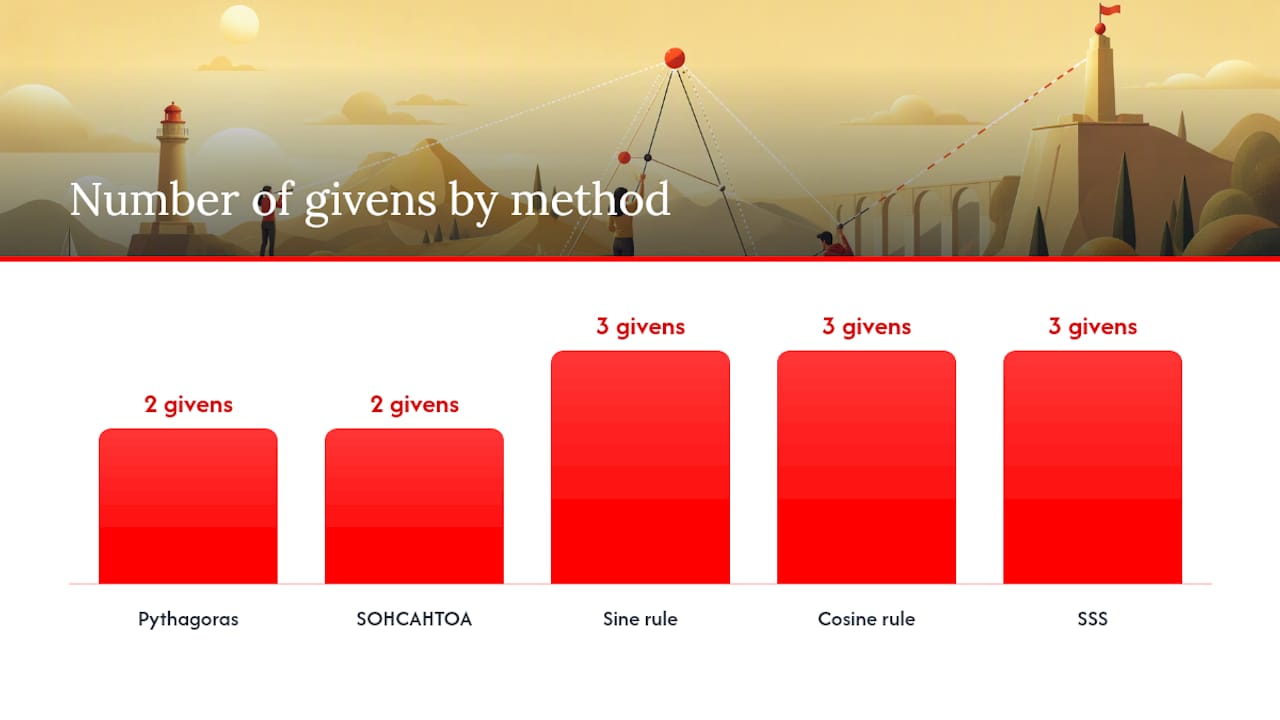
- Right-angled triangle, two sides known → Pythagoras: a² + b² = c² (where c is the hypotenuse).
- Right-angled triangle, one angle and one side known → SOHCAHTOA.
- Non-right triangle, two angles and one side known (ASA or AAS) → Sine rule: a/sin A = b/sin B = c/sin C.
- Non-right triangle, two sides and the included angle known (SAS) → Cosine rule: a² = b² + c² − 2bc cos A.
- Non-right triangle, all three sides known (SSS) → Cosine rule rearranged for the angle.
- Area of any triangle → Area = ½ ab sin C.
One short example for each
Pythagoras: sides 6 cm and 8 cm in a right-angled triangle → hypotenuse = √(36 + 64) = 10 cm.
SOHCAHTOA: angle 50°, adjacent 7 m → opposite = 7 × tan 50° ≈ 8.34 m.
Sine rule: angles 40° and 70°, side opposite 40° is 9 cm → side opposite 70° = 9 × sin 70° / sin 40° ≈ 13.1 cm.
Cosine rule: sides 5 cm and 8 cm, included angle 60° → a² = 25 + 64 − 2(5)(8) cos 60° = 89 − 40 = 49, so a = 7 cm.
For multi-step problems, split the triangle into parts. A 3D problem often requires you to identify a right-angled cross-section first, apply SOHCAHTOA to find a length, then use that length in a second calculation. Label every intermediate value clearly on the diagram.
How to build a practice plan and use Mathvault worksheets
Consistent, structured practice beats a last-minute cram. A practical session structure that works for most students:
- Session 1: Work through one set of SOHCAHTOA questions (finding sides). Mark against the worked solutions and note every error type.
- Session 2: Repeat with inverse trig (finding angles). Focus on the errors from Session 1.
- Session 3: Mixed questions including exact values and non-right triangle rules. Time yourself.
- Spaced repetition: return to trig questions every three to four days, not just the night before.
Mathvault’s Edexcel topic-sorted past-paper packs organise questions by topic with fully worked solutions, making them ideal for this kind of focused session. Each pack includes:
- Exam-style questions at Foundation and Higher tier.
- Fully worked step-by-step solutions that model the method an examiner expects.
- Video walkthroughs for questions where the method is multi-step.
- Examiner tips embedded in the solutions.
Foundation tier students should prioritise SOHCAHTOA, basic angle-of-elevation problems and exact values for 30°/45°/60°. Higher tier students need all of the above plus the sine rule, cosine rule, area formula and 3D trig problems.
Mathvault’s live weekly Q&A sessions let you bring a specific question or a worked example you are unsure about and get real-time feedback. Use these sessions to check your method on multi-step problems before a timed paper.
Exam technique: how to set out trig answers and avoid common mistakes
OCR’s guidance on problem solving in GCSE Maths is clear: examiners award marks for clear, logical working where candidates show their reasoning at each step. This is the AO3 expectation — you are not just calculating, you are communicating your method.
How to set out working to secure method marks
- Define your variable: “Let x = the length of the opposite side in cm.”
- Write the equation: “tan 40° = x / 8”
- Rearrange: “x = 8 × tan 40°”
- Calculate: “x = 8 × 0.8391 = 6.71 cm”
- State the answer with units and rounding: “x = 6.71 cm (3 s.f.)”
Common mistakes that cost marks
- Choosing the wrong side as “opposite” because the triangle is drawn at an unusual angle.
- Calculator left in radians mode — the answer looks plausible but is completely wrong.
- Rounding a decimal mid-calculation and carrying the rounded value forward.
- Writing the final answer without units.
- Not labelling the triangle at all, then choosing the wrong ratio.
Verification checklist (use in timed practice)
- Does the answer make geometric sense? (A side cannot be longer than the hypotenuse.)
- Are the units stated?
- Is the rounding consistent with what the question asked?
- Does a rough mental estimate agree with the calculator result?
Pro Tip: For AO3 problem-solving questions, translate the worded context into a diagram first. Write the angle, the known side and the unknown side directly on the sketch. This “translation step” is itself worth marks and prevents you from misreading which side is opposite the given angle.
A quick revision checklist and five-minute routine for the night before
Use this checklist as a final sweep before your exam:
- Label every triangle (hyp, opp, adj) before touching the calculator.
- Write the ratio you have chosen on your script.
- Check your calculator is in degrees mode.
- Know the exact values for 30°, 45° and 60° without looking.
- Know when to switch from SOHCAHTOA to the sine or cosine rule.
- Show every rearrangement step, even if it feels obvious.
- State units in every final answer.
Your 10-minute practice routine
- Pick one exam-style question (finding a side, finding an angle, or a mixed problem).
- Work through it fully without looking at the solution (5 minutes).
- Mark it against the worked answer and identify any error (3 minutes).
- Write the correct method once from scratch (2 minutes).
One-minute sanity check in the exam
Before moving on from any trig answer: estimate the angle or side using common sense (a 35° angle in a right-angled triangle means the opposite side is shorter than the adjacent), check units are written, and confirm the answer is positive.
Download Mathvault’s GCSE maths formula sheet provides a one-page reference covering SOHCAHTOA, the sine and cosine rules, exact values and the area formula — ideal for the night-before review.
Trig graphs and their properties at GCSE
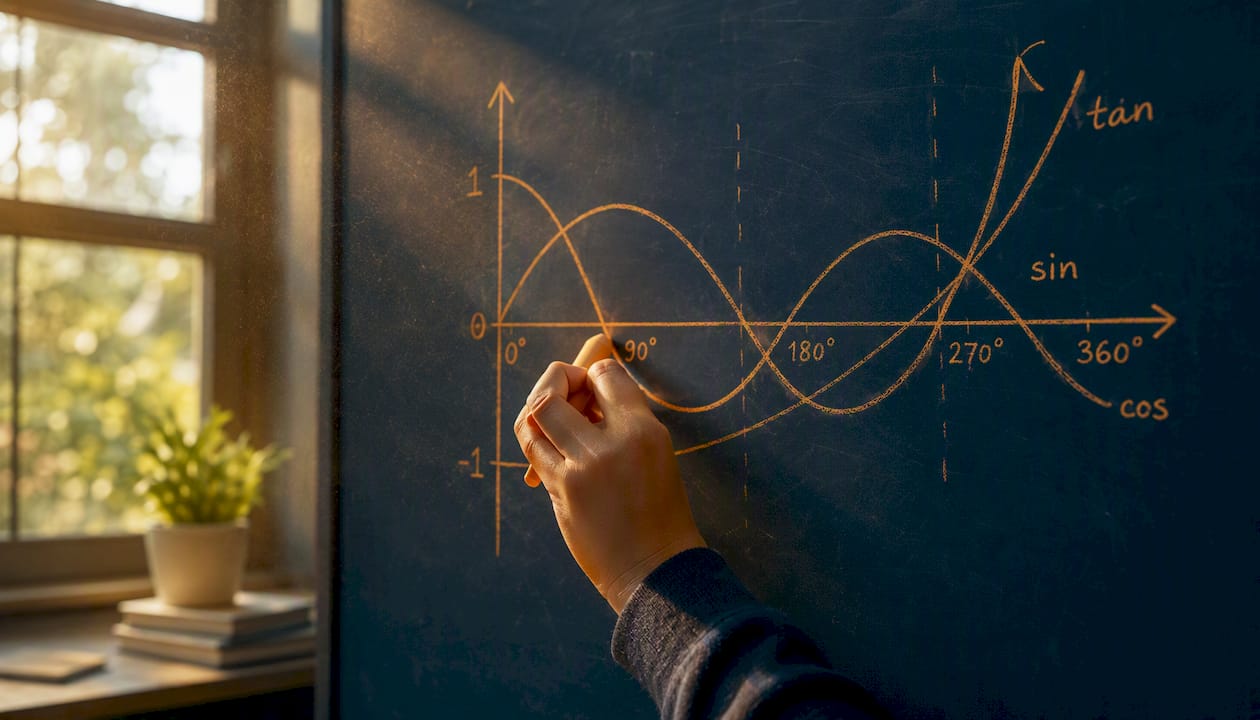
At Higher tier, you need to recognise and interpret the graphs of y = sin x, y = cos x and y = tan x.
Key properties of the sine graph (y = sin x)
The sine curve oscillates between −1 and 1. It crosses the x-axis at 0°, 180° and 360°, reaches its maximum of 1 at 90°, and its minimum of −1 at 270°. The period (one full cycle) is 360°.
Key properties of the cosine graph (y = cos x)
The cosine curve has the same shape as sine but is shifted 90° to the left. It starts at 1 when x = 0°, crosses zero at 90° and 270°, and reaches −1 at 180°. Its period is also 360°.
Key properties of the tangent graph (y = tan x)
The tangent graph behaves very differently. It has vertical asymptotes at 90° and 270° (where tan is undefined), crosses zero at 0°, 180° and 360°, and its period is 180°. The curve rises steeply as it approaches each asymptote.
What GCSE questions ask you to do with these graphs
- Read off the value of sin, cos or tan at a given angle.
- Identify the angle(s) at which a function equals a given value (e.g., where does sin x = 0.5 in the range 0° to 360°?).
- Sketch a transformed graph such as y = 2 sin x or y = cos(x + 30°).
Knowing that sin 30° = 0.5 and that the sine graph is symmetric about 90° tells you immediately that sin 150° = 0.5 as well. This symmetry argument is faster than any calculator and is exactly the kind of reasoning examiners reward in problem-solving questions.
A perspective on fitting this guide into your revision timetable
Most students approach trig revision in the wrong order: they read notes, then attempt questions, then check answers. The sequence that actually builds exam confidence is the reverse — attempt first, then use the worked solution to diagnose exactly where the method broke down.
Weekly cadence that works:
- Monday: 15 minutes on one SOHCAHTOA topic (sides or angles, not both). Mark immediately.
- Wednesday: 15 minutes on exact values or sine/cosine rule. Mark immediately.
- Friday: One timed mixed question under exam conditions. No notes.
- Weekend: Review all errors from the week. Redo the questions you got wrong.
For Foundation tier students, the priority order is: SOHCAHTOA → exact values → angle of elevation/depression → basic trig graphs. Higher tier students should add the sine rule, cosine rule, 3D trig and graph transformations once SOHCAHTOA is secure. Do not move to the harder topics until you can label a triangle and pick the correct ratio without hesitation.
The single biggest pitfall is passive revision — reading worked examples without covering them and attempting the question yourself. Mathvault’s GCSE revision guides hub is structured around active retrieval: you work the question, then compare your method step-by-step against the fully worked solution. That comparison is where the learning happens.
Join a live Q&A session when you hit a question type that keeps going wrong. Bringing a specific error to a live session is far more efficient than re-reading the same notes.
Mathvault’s trig revision packs give you everything in one place
Spending time hunting across multiple websites for practice questions, worked solutions and examiner tips costs revision time you cannot afford. Mathvault brings all of it together, free, organised by exam board and topic.
Every Mathvault trig pack includes exam-style questions aligned to AQA, Edexcel, WJEC and CCEA syllabuses, fully worked step-by-step solutions that model the method marks an examiner awards, and video walkthroughs for multi-step problems. The solutions do not just give the answer — they show every rearrangement step and explain the ratio choice, so you can see exactly where your own working diverged.
- Examiner-aligned marking guidance showing where method and accuracy marks fall.
- Foundation and Higher tier questions in the same pack so you can stretch or consolidate.
- Timed past-paper sets for exam-condition practice.
Head to Mathvault’s Edexcel topic-sorted past papers to start practising trig questions with full worked answers today, or browse the full GCSE revision guides hub to find the pack that matches your exam board and tier.
Sources
The sources below underpin this guide and are worth bookmarking for ongoing revision:
- Problem solving in GCSE (9-1) Maths: examples of good practice
- What is right-angled trigonometry? – BBC Bitesize
- GCSE Maths trigonometry formula sheet – Maths with Sophie
Leave a Reply