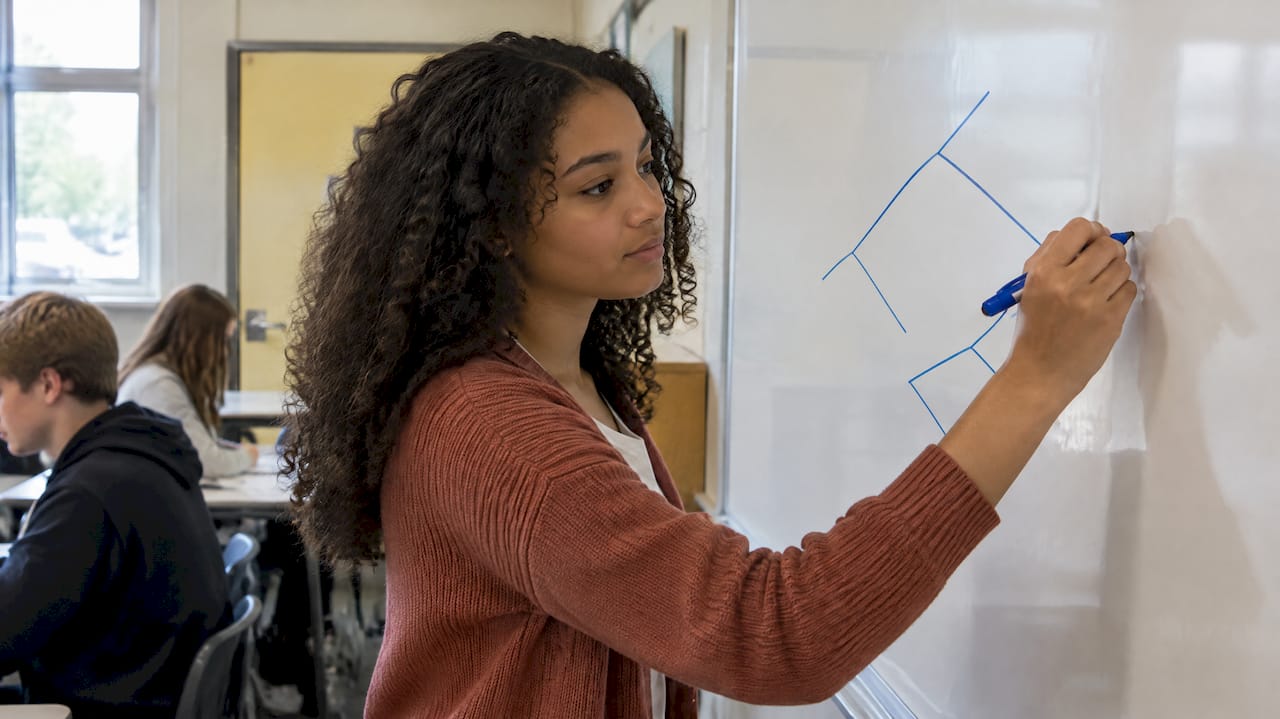
A tree diagram is a way of laying out every outcome of a probability problem that happens in stages, such as two spins, two draws from a bag or a chain of “if this, then that” events. You write the probability on each branch, multiply along a path to get the chance of that whole sequence, and add between paths when more than one sequence gives the result you want. This guide shows you how to do that, with worked examples, the mistakes that cost marks, and questions to try yourself.
TL;DR
- A tree diagram shows all the outcomes of combined events, with a probability on every branch.
- Multiply along the branches of a path; add the results of different paths that satisfy the question.
- Branches leaving any one point must add up to 1. Use this to find missing values and to check your work.
- “Without replacement” means the second set of branches changes, because the total has gone down.
- Leave fractions unsimplified until the end, and show every product: method marks depend on it.
Table of Contents
- What a probability tree diagram shows
- How to draw a tree diagram, step by step
- The two rules: multiply along, add between
- Worked example 1: independent events (with replacement)
- Worked example 2: dependent events (without replacement)
- Worked example 3: when the second stage depends on the first
- Where tree diagrams appear in the exam
- Mistakes that cost marks
- A short checklist before you move on
- Practise tree diagram questions and check your answers
- Our perspective: why trees reward patient students
- Free help from MathVault
- FAQ
- Sources
What a probability tree diagram shows
A probability tree diagram shows all the possible outcomes of combined events, together with the probability of each, according to BBC Bitesize. It is most useful when an experiment has more than one stage and you need to see which outcomes are possible at each. Another way to think of it is as a road map for probability: a systematic way to list outcomes and follow the whole sequence of a multi-stage experiment, as Mathematics LibreTexts puts it.
You will meet them in situations such as:
- tossing a coin or rolling a dice twice or three times;
- taking counters, sweets or socks from a bag, with or without putting them back;
- a weather or journey problem, where the second probability depends on the first outcome;
- a pass/fail or defective/not-defective problem in a factory setting.
The topic sits within the probability strand of the GCSE specification. Questions on it can turn up on any paper, including the non-calculator one, so you should be comfortable multiplying and adding fractions by hand. Our non-calculator practice routine is built around exactly that kind of fluency.
How to draw a tree diagram, step by step
The drawing method is the same every time. Start with a single point, draw a set of branches for the outcomes of the first event and label each with its probability. From the end of each of those branches, draw a new set of branches for the next event, again with probabilities. Repeat until every stage is done. This is the approach set out by BBC Bitesize.
In practice:
- Read the question twice and list the stages. Two draws from a bag is two stages; “a coin is flipped three times” is three.
- Draw the first set of branches, one per possible outcome, and label the end of each branch with its outcome (for example R and B).
- Write each probability on its branch, not at the end of it.
- Check the branches add to 1. If the first stage has probabilities 3/8 and 5/8, you are fine. If they come to anything else, something is wrong before you have started.
- Repeat from the end of every branch for the next stage. The second stage has a full set of branches coming off each first-stage branch.
- Write the outcome of each full path at the far right, such as RR, RB, BR, BB. This is where you will do your multiplication.
Use a ruler, leave plenty of room, and make the diagram big. Cramped trees are the main reason students misread their own probabilities.
Finding a missing probability
If you know the probability of an event, subtract it from 1 to get the probability of it not happening, as BBC Teach explains. On a tree this is how you fill in the second branch of any pair. If the probability of rain is 0.3, the probability of no rain is 1 − 0.3 = 0.7.
The two rules: multiply along, add between
These two rules do almost all the work.
Rule 1: multiply along the branches. To find the probability of a particular path, multiply the values along it. For two independent events, this is P(A and B) = P(A) × P(B), as BBC Bitesize states.
Rule 2: add between paths. When several paths satisfy the question, work out each one by multiplying, then add the results.
A useful way to remember it: “and” means multiply, “or” means add. A path is an “and” (first this, and then that). Several acceptable paths are an “or” (this path, or that path).
Worked example 1: independent events (with replacement)
Question. A bag has 3 red counters and 5 blue counters. A counter is taken at random, its colour recorded, and it is put back. A second counter is then taken. Find the probability that the two counters are different colours.
Because the counter is replaced, the second stage looks identical to the first. The events are independent.
| Path | Calculation | Probability |
|---|---|---|
| Red, Red | 3/8 × 3/8 | 9/64 |
| Red, Blue | 3/8 × 5/8 | 15/64 |
| Blue, Red | 5/8 × 3/8 | 15/64 |
| Blue, Blue | 5/8 × 5/8 | 25/64 |
Check: 9 + 15 + 15 + 25 = 64, so the four paths total 64/64 = 1.
“Different colours” is red then blue or blue then red, so you add:
P(different) = 15/64 + 15/64 = 30/64 = 15/32
Notice that the fractions stayed unsimplified until the final line. That is deliberate: it makes the sum-to-1 check easy and the addition simple, which is the advice given by BBC Bitesize.
Worked example 2: dependent events (without replacement)
Independent events do not affect each other’s probabilities. With dependent events, the outcome of the first affects the second, so the numbers on the second set of branches change, as BBC Bitesize explains. Taking an item and not replacing it is the classic example. Each selection reduces the total number of outcomes, as Mathematics LibreTexts notes.
Question. A box holds 6 red sweets and 4 blue sweets. Two sweets are taken at random without replacement. Find (a) the probability both are the same colour and (b) the probability that at least one is red.
First stage: P® = 6/10, P(B) = 4/10.
Second stage, if the first was red: 5 red and 4 blue remain out of 9, so P® = 5/9 and P(B) = 4/9.
Second stage, if the first was blue: 6 red and 3 blue remain out of 9, so P® = 6/9 and P(B) = 3/9.
| Path | Calculation | Probability |
|---|---|---|
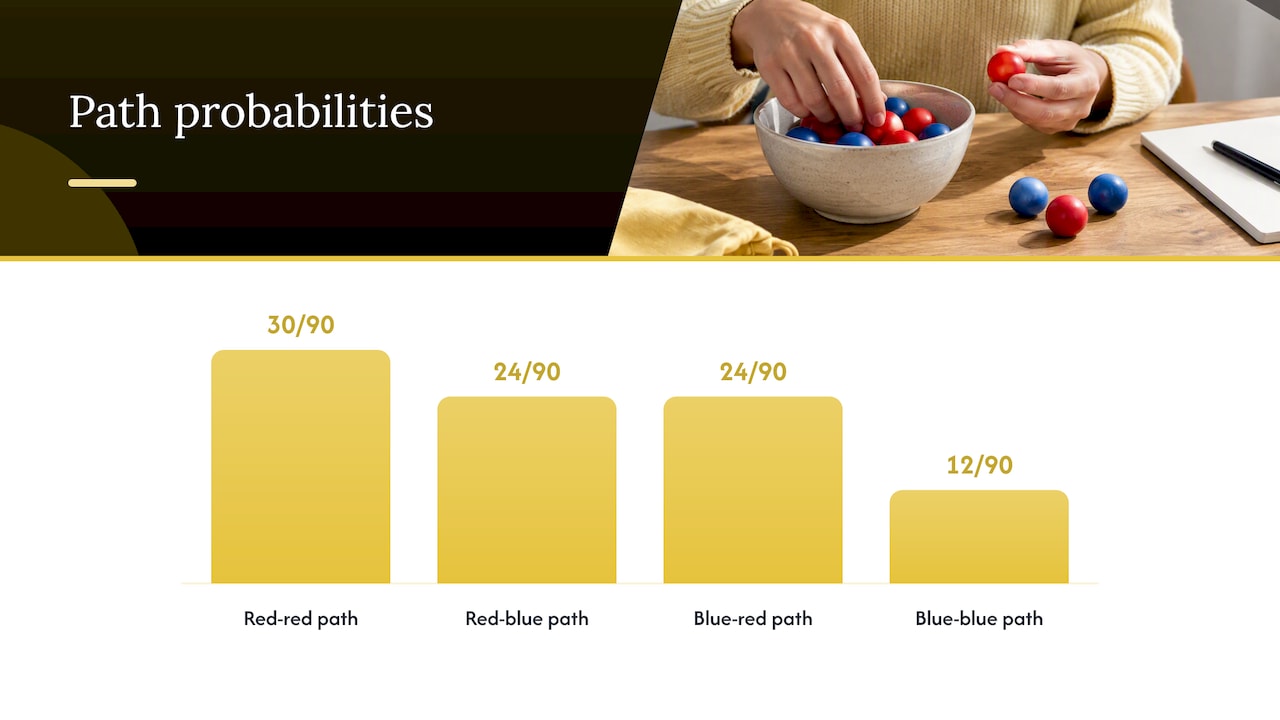
| RR | 6/10 × 5/9 | 30/90 |
| RB | 6/10 × 4/9 | 24/90 |
| BR | 4/10 × 6/9 | 24/90 |
| BB | 4/10 × 3/9 | 12/90 |
The total is 30 + 24 + 24 + 12 = 90, so 90/90 = 1.
(a) Same colour is RR or BB: 30/90 + 12/90 = 42/90 = 7/15.
(b) At least one red is every path except BB. You could add three paths (30 + 24 + 24 = 78/90), but it is quicker to use the complement: 1 − 12/90 = 78/90 = 13/15.
The “at least one” wording is a signal to think about the complement. It saves time and reduces the chance of an addition slip.
Worked example 3: when the second stage depends on the first
Not every dependent question is about bags. Sometimes the problem gives you probabilities that change depending on an earlier result.
Question. The probability that it rains on a given morning is 0.3. If it rains, the probability that Aisha is late for school is 0.4. If it does not rain, the probability that she is late is 0.1. Find the probability that Aisha is late.
The first stage is rain (0.3) or no rain (0.7). The second stage has different numbers on each branch:
- After rain: late 0.4, not late 0.6.
- After no rain: late 0.1, not late 0.9.
There are two paths that end in “late”:
- Rain and late: 0.3 × 0.4 = 0.12
- No rain and late: 0.7 × 0.1 = 0.07
P(late) = 0.12 + 0.07 = 0.19
A common slip here is to put 0.4 on the second branch after no rain as well. Each set of second-stage branches is its own pair and must add to 1 by itself.
This same structure is the foundation of conditional probability questions. If a question asks, “Given that Aisha is late, what is the probability it rained?”, you use the tree to find the path probability for “rain and late” (0.12) and divide by the total probability of being late (0.19). That gives 12/19. Higher tier questions often phrase this in words rather than notation, so read the wording slowly.
Where tree diagrams appear in the exam
Probability trees are Higher content in many GCSE settings, but simple two-stage trees also appear on Foundation papers, so check the tier you are sitting. Exam boards in England (AQA, Edexcel and OCR) all examine probability, and the way each paper is laid out differs slightly. The topic lists on our AQA, Edexcel and OCR revision pages show where probability sits in each board’s content, so you can match your practice to your own papers.
Typical tasks include:
- Completing a partly filled tree. Fill in the missing probabilities using “branches add to 1”.
- Drawing a tree from information in words. Often worth a couple of marks for correct structure and labels.
- Calculating a single path probability. One multiplication.
- Combining paths. Several multiplications and an addition.
- “At least one” and “exactly one” problems. Complement method or careful path selection.
- Without replacement problems. Changing denominators.
- Algebraic probabilities. For example, a bag with n counters, where you form and solve an equation from the tree.
Probability questions of this kind are usually worth several marks because they test multiple skills at once: reading the context, converting it to probabilities, multiplying and adding fractions or decimals accurately. Marks are generally split between method (setting up and multiplying the correct branches) and accuracy (the final value), so a clear tree can earn credit even if your arithmetic slips.
Mistakes that cost marks
These are the errors we see most often when students check their work against mark schemes.
- Not changing the second stage when there is no replacement. The denominator should fall by one, and the numerator of the colour you took should fall by one.
- Adding along branches or multiplying between paths. Remember: multiply along, add between.
- Branches that do not sum to 1. Check every pair or set before moving on.
- Simplifying too early. Keep 6/10 × 5/9 as it is. Simplifying midway makes it harder to see whether your probabilities sum to 1, which is why BBC Bitesize advises against it.
- Writing probabilities at the end of the branch instead of on it. The end of the branch is for the outcome label.
- Answering with the wrong path. Underline the question wording (“exactly one”, “at least one”, “same colour”) and tick the paths that match before you calculate.
- Forgetting to show working. A bare answer of 13/15 earns full marks if right, but a wrong bare answer earns nothing. Showing each product protects your method marks. If you tend to lose marks this way, our guide on method marks in non-calculator papers goes through the habits that help.
A short checklist before you move on
- Have I labelled the outcomes and written each probability on its branch?
- Does every set of branches sum to 1?
- Did the numbers change on the second stage if nothing was replaced?
- Did I list the paths that match the wording before calculating?
- Did I multiply along each path, then add the paths?
- Does my answer lie between 0 and 1?
Practise tree diagram questions and check your answers
Try these before looking at the answers underneath.
- A fair coin is flipped twice. Draw a tree diagram and find the probability of getting exactly one head.
- A biased coin lands on heads with probability 0.6. It is flipped twice. Find the probability of two heads, and of at least one tail.
- A bag contains 4 green and 6 yellow beads. Two beads are taken without replacement. Find the probability they are different colours.
- The probability a bus is on time is 0.8 on a dry day and 0.5 on a wet day. The probability of a wet day is 0.25. Find the probability the bus is on time.
Answers
- 1/2 × 1/2 + 1/2 × 1/2 = 1/4 + 1/4 = 1/2.
- Two heads: 0.6 × 0.6 = 0.36. At least one tail: 1 − 0.36 = 0.64.
- GY: 4/10 × 6/9 = 24/90; YG: 6/10 × 4/9 = 24/90. Total 48/90 = 8/15.
- Wet and on time: 0.25 × 0.5 = 0.125. Dry and on time: 0.75 × 0.8 = 0.6. Total = 0.725.
For exam-style questions with mark schemes, work through real papers. Past papers from the same board you are sitting give you the wording and mark allocation you will actually face. Our AQA GCSE 2018 papers and mark schemes are a good place to practise: find the probability questions, attempt them under timed conditions, then mark yourself line by line against the scheme.
Our perspective: why trees reward patient students
We see tree diagrams as one of the fairest topics in GCSE maths. The ideas are small: two rules and one check. Yet students still lose marks, and almost always for the same reason: they rush the set-up and then trust a calculation built on a shaky tree.
Our advice is to treat the diagram as the answer’s foundation. Spend the first minute drawing it large, labelling every branch and checking that each set adds to 1. The multiplication afterwards is then routine. When you review a past paper, mark the tree separately from the final answer. If the tree was right and the answer wrong, you have an arithmetic habit to fix. If the tree was wrong, go back to the wording of the question.
We also encourage students to do a few of these by hand, with fractions, without a calculator. It builds the fraction fluency that carries across the whole paper, and it makes the “keep fractions unsimplified” advice feel natural rather than fussy. Fully worked solutions matter here: seeing every line of a model answer shows you where method marks sit and how much working the examiner expects.
— Oloru
Free help from MathVault
All our revision materials are free to use, including past papers, worked solutions and topic-based guides, and we run live weekly Q&A sessions where you can ask about questions like the ones above. If you want a structured route through the course, start with our GCSE maths revision guides, and use the exam checklist to see which topics, formula sheets and tier rules to cover before the exam. Optional downloadable packs and donations help us keep the site running, but you never need to pay to practise.
FAQ
Are tree diagrams on the Foundation or Higher GCSE?
Simple two-stage trees, usually with replacement or with given probabilities, can appear at both tiers. Harder trees, such as without replacement, conditional probability and algebraic versions, are more typical of Higher. Check your exam board’s specification to see exactly what is listed for your tier.
Do I need to simplify fractions on a tree diagram?
Not until the end. Leaving fractions unsimplified makes it easier to check that probabilities sum to 1 and to add probabilities for combined events, as BBC Bitesize advises. Simplify only your final answer, unless the question says otherwise.
How do I know whether to multiply or add?
Multiply along a path, because the events in that path all happen together. Add the results of different paths when any of them would give the outcome you want. If the wording says “and then”, think multiply; if it says “or”, think add.
What changes when there is no replacement?
The total number of items falls with each selection, so the probabilities on the second set of branches change, as Mathematics LibreTexts explains. Reduce the denominator by one and adjust the numerator for whichever colour you removed. Each pair of second-stage branches must still sum to 1.
What if I cannot draw the whole tree?
Draw as much as you need. For some questions, only the paths that matter are required, but a full, labelled tree is the safest way to earn method marks. If time is tight, sketch the structure first and fill in the numbers after.
Sources
- What are tree diagrams? – BBC Bitesize
- Section 5.5: Tree Diagrams – Mathematics LibreTexts
- KS3 / GCSE Maths: Probability – BBC Teach
Leave a Reply