
On GCSE and A-Level non-calculator papers, method beats speed every time: examiners award marks for visible, correct working, so a slow but clear answer often scores higher than a rushed one. The two habits worth adopting today are writing every step of your working and keeping answers in exact form (fractions, surds, standard form) rather than rounding too soon. Free past papers and worked solutions are an effective way to see this in practice.
TL;DR:
- Showing all correct working steps and keeping answers in exact form maximizes method marks, often outweighing accuracy in non-calculator exams.
- Using specific problem-solving strategies like making up numbers and drawing diagrams helps overcome sticking points efficiently during timed questions.
- Allocating roughly one minute per mark and first securing easy marks improves overall time management and reduces exam stress.
- Regular targeted drills, self-marking with worked solutions, and logging errors enhance skills that frequently cause mark deductions, such as fraction handling and sign errors.
- Reviewing early questions and final answer checks during the last five minutes ensures sign, units, and answer format errors do not cost unnecessary marks.
Table of Contents
- Core habits that stop marks leaking on non-calculator papers
- Problem-solving toolbox: 8 tactical strategies to use when stuck
- Exam technique: timing, question triage and checking under pressure
- Practice plan: how to train specifically for non-calculator papers
- Fast checklist: what to do in the first 90 seconds and the final five minutes
- How to interpret and break down different question types in non-calculator papers
- Strategies for handling complex calculations under exam pressure
- Mental math techniques for quicker calculation
- Author perspective: why method beats speed
- How Mathvault helps with non-calculator paper practice
- Sources
- FAQ
Core habits that stop marks leaking on non-calculator papers
Method marks exist because exam boards want to see how you got to an answer, not just whether you got there. Pearson’s GCSE mathematics specification confirms that clear working can earn marks even when the final answer is wrong, which flips the usual exam instinct on its head. A student who writes nothing but a correct final number often scores less than one who shows a flawed method with one arithmetic slip.
That changes what “revision” should actually look like. Instead of drilling for speed, you’re training for legibility of method: every line should show what you did, not just the result of doing it.
A few written skills separate confident non-calculator candidates from the rest:
- Long multiplication and division, done in a consistent, tidy layout
- Fraction rules: common denominators, mixed number conversion, and cancelling before multiplying
- Handling negatives, particularly across two or three operations in one line
- Key trig values (30°, 45°, 60°) memorised, not derived under pressure
- Surd simplification and rationalising denominators
Keep exact answers exact. If a question asks for an answer “in the form a√b” or as a fraction, decimalising it, even correctly, usually forfeits accuracy marks. Cancel fractions early rather than at the end, label units as you go, and write the sign of every term explicitly, especially when substituting negative values into a formula.
Pro Tip: Write a short “method line” before your first calculation on any multi-step question, e.g. “Find AB using Pythagoras, then use trig to find the angle.” It costs seconds and often earns a mark on its own if the rest goes wrong.
Problem-solving toolbox: 8 tactical strategies to use when stuck
Getting stuck on a non-calculator question isn’t a sign you don’t know the topic. It’s usually a sign you need a different way in. Pedagogical guides list a set of strategies that map almost directly onto exam tactics, and having them named in advance means you can reach for one automatically instead of freezing.
- Try something. Start with any reasonable approach, even a wrong one; half-formed working still earns marks and often reveals the right method.
- Make up numbers. If a question is abstract, substitute simple values to see how the structure behaves.
- Try a simpler version. Struggling with a general case? Solve a specific, smaller example first, then scale the method up.
- Work systematically. Use tables, lists, or organised trials rather than guessing randomly, especially on “find all values” questions.
- Draw a diagram. Geometry, probability trees, and even algebra problems often become obvious once sketched.
- Work backwards. Start from the answer format required and reverse-engineer the steps that would produce it.
- Look for a pattern. Sequence and number questions almost always reward writing out the first four or five terms.
- Check your assumptions. Re-read what’s actually being asked; a surprising number of stuck moments come from misreading, not miscalculating.
These strategies come directly from established problem-solving frameworks used in maths education, not exam-specific tricks.
Pro Tip: If you’ve spent more than two minutes on one strategy with no progress, switch. Sticking with a dead approach out of stubbornness is the single biggest time-waster in a non-calculator paper.
Exam technique: timing, question triage and checking under pressure
Timing on non-calculator papers should be planned by marks, not by question number. A rough guide is just under a minute per mark, though 4 and 5-mark questions often need more thinking time relative to their mark count than 1 or 2-markers.
- Bank the easy marks first. Scan the paper in the first minute and answer every question you can do instantly before returning to harder ones.
- If you’re stuck, write down what you do know: the formula, a labelled diagram, or the first line of a method. Partial working preserved this way often earns a method mark even if you never reach an answer.
- Flag the question mentally (a small mark in the margin works) and move on rather than losing five minutes you can’t afford.
- In the final five minutes, run a checklist: does the answer make sense in context? Are units included? Is the sign correct? Is the answer in the exact form the question asked for?
Study guides on effective exam approach consistently recommend reading the full question twice before writing anything, then planning briefly rather than diving straight into calculation. That thirty seconds of planning is rarely wasted.
Practice plan: how to train specifically for non-calculator papers
Non-calculator fluency doesn’t come from doing more papers in general. It comes from targeted, repeated drilling on the specific skills that leak marks, followed by realistic timed conditions.
- Daily micro-drills (10 to 15 minutes). Pick one weak skill, fractions, negative numbers, surds, and drill it in isolation before moving to mixed questions.
- One timed past paper a week, under strict non-calculator conditions. Use an SQA National 5 past paper or an equivalent GCSE-style paper, then mark it yourself against the official scheme rather than guessing what you’d have scored.
- Use worked solutions to diagnose, not just check. When you mark a worked solution against your own attempt, look specifically at where the method diverged, not just whether the final answer matched.
- Log your error types. Keep a short running list: “lost a mark on fraction cancelling,” “sign error in substitution,” “forgot exact form.” Re-target your next micro-drill at whatever appears most often.
This approach echoes findings from a controlled study on test-taking strategies, which found that combining worked-solution videos with structured practice significantly improved students’ confidence and self-reported exam preparedness, more than passive revision tips alone.
Fast checklist: what to do in the first 90 seconds and the final five minutes
In the first 90 seconds: confirm the paper is genuinely non-calculator, note any formula sheet provided, and scan for the easiest marks on the page.
During the paper: write every step, keep answers in exact form unless told otherwise, and underline instruction words like “exact,” “show that,” or “give your answer to 2 significant figures.”
In the final five minutes: sanity-check magnitudes (is a length negative? Is a probability above 1?), confirm units are present, recheck signs on substituted values, and make sure your answer matches the form the question demanded.
How to interpret and break down different question types in non-calculator papers
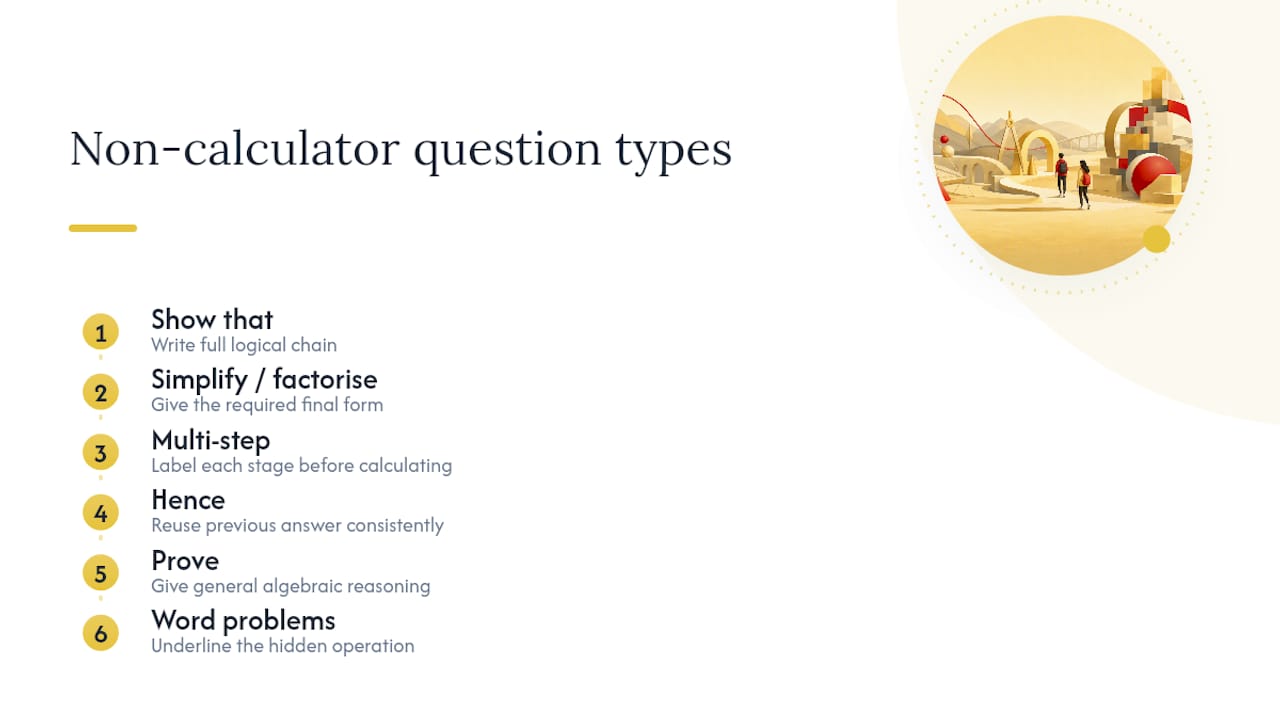
Non-calculator questions tend to fall into a handful of recognisable shapes, and spotting the shape early saves time. “Show that” questions require you to demonstrate a full logical chain, not just a final value; skipping steps here loses marks even if your answer is technically correct. “Simplify” or “factorise” questions expect a specific final form, so stopping halfway (say, at a partially factorised expression) usually costs accuracy marks.
Multi-step questions, often worth 4 to 6 marks, are frequently several smaller questions stitched together. Break them down explicitly: write “Step 1: find the missing angle” before you calculate it, rather than jumping straight into numbers. This is where the “method line” habit from earlier pays off directly.
Questions with the word “hence” are a signal, not decoration. They mean the answer to the previous part is a required input to this one; if your earlier answer was wrong, using it consistently in the “hence” part usually still earns follow-through marks. Questions asking you to “prove” or “show” that a statement is always true need general algebraic reasoning, not a single numerical example, though testing a number first can help you find the right approach.
Word problems disguise straightforward calculations behind context. Underline the actual mathematical operation buried in the sentence before writing anything, whether that’s a percentage change, a ratio, or a rearrangement.
Strategies for handling complex calculations under exam pressure
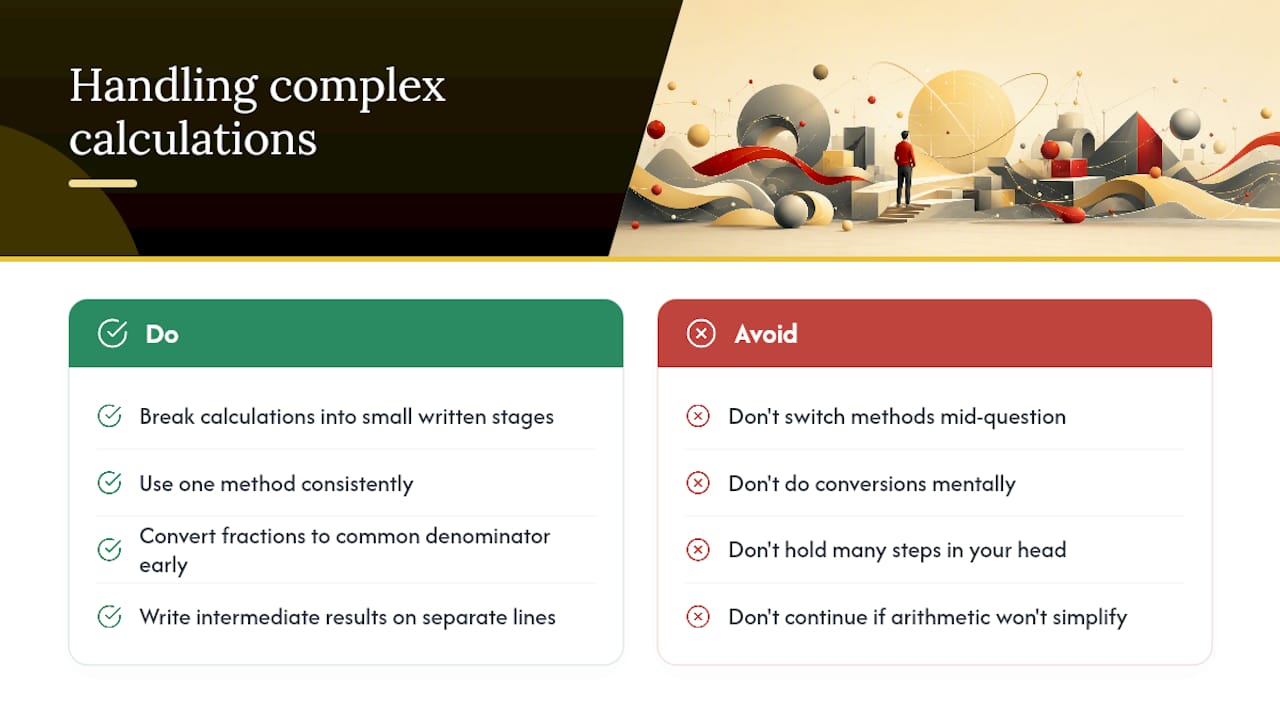
Long or multi-stage calculations without a calculator are where panic causes the most damage, not lack of knowledge. The fix is breaking the calculation into smaller written stages rather than trying to hold several steps in your head at once.
For a calculation like multiplying two two-digit numbers, use a grid or column method consistently rather than switching approaches mid-question; consistency reduces careless slips more than raw skill does. When dealing with fractions across several operations, convert to a common denominator early and write that conversion down explicitly rather than doing it mentally, even if you’re confident.
For questions involving several operations in sequence (BIDMAS-heavy problems), write each intermediate result on its own line. This does two things: it lets you spot an error before it compounds through the rest of the calculation, and it preserves method marks if the final step goes wrong.
If a number in the question looks deliberately awkward (an ugly fraction, a large prime), that’s often a hint you’re using the wrong method rather than a sign the question is genuinely that messy. GCSE and A-Level papers are typically designed so the arithmetic simplifies at some point; if it isn’t simplifying, step back and check your setup before continuing.
Mental math techniques for quicker calculation
Fast mental arithmetic still matters on non-calculator papers, particularly for the smaller 1 and 2-mark questions where full written method would waste time. A few techniques are worth practising until automatic.
Break multiplication into friendlier chunks: 23 × 12 becomes (23 × 10) + (23 × 2), which is easier to hold in your head than the original problem. For percentages, build from 10% and 1% rather than calculating directly; finding 17% of a number is faster as 10% + 5% + 2% than as a single unfamiliar calculation. Rounding and adjusting works well for near-round numbers: 998 × 6 is easier as (1000 × 6) minus (2 × 6).
Memorising square numbers up to 15², common fraction-to-decimal equivalents (like 1/8 = 0.125), and times tables to 12 removes small hesitations that otherwise cost seconds on every calculation. None of this replaces written method on larger questions, but it speeds up the smaller ones enough to bank extra thinking time for the harder ones later in the paper.
Author perspective: why method beats speed
Marking past papers repeatedly surfaces the same error types: a correct method undone by a single sign slip, or a right answer written in the wrong form and marked down. The free worked solutions and past-paper archives are designed to show every method line so students see where marks are actually won or lost, not just what the final number should be. Live Q&A sessions are offered because written text can’t always explain why a step matters.
Do one thing today: sit a single timed non-calculator paper, mark it against the scheme, then run one ten-minute micro-drill on whatever error type showed up most.
— Oloru
How Mathvault helps with non-calculator paper practice
This platform is a practical way to help close the gap between knowing a topic and scoring on it under exam conditions, without needing tutoring or paid courses. Past papers are organised by exam board, paired with fully worked solutions that show the method examiners are marking against, not just the final answer.
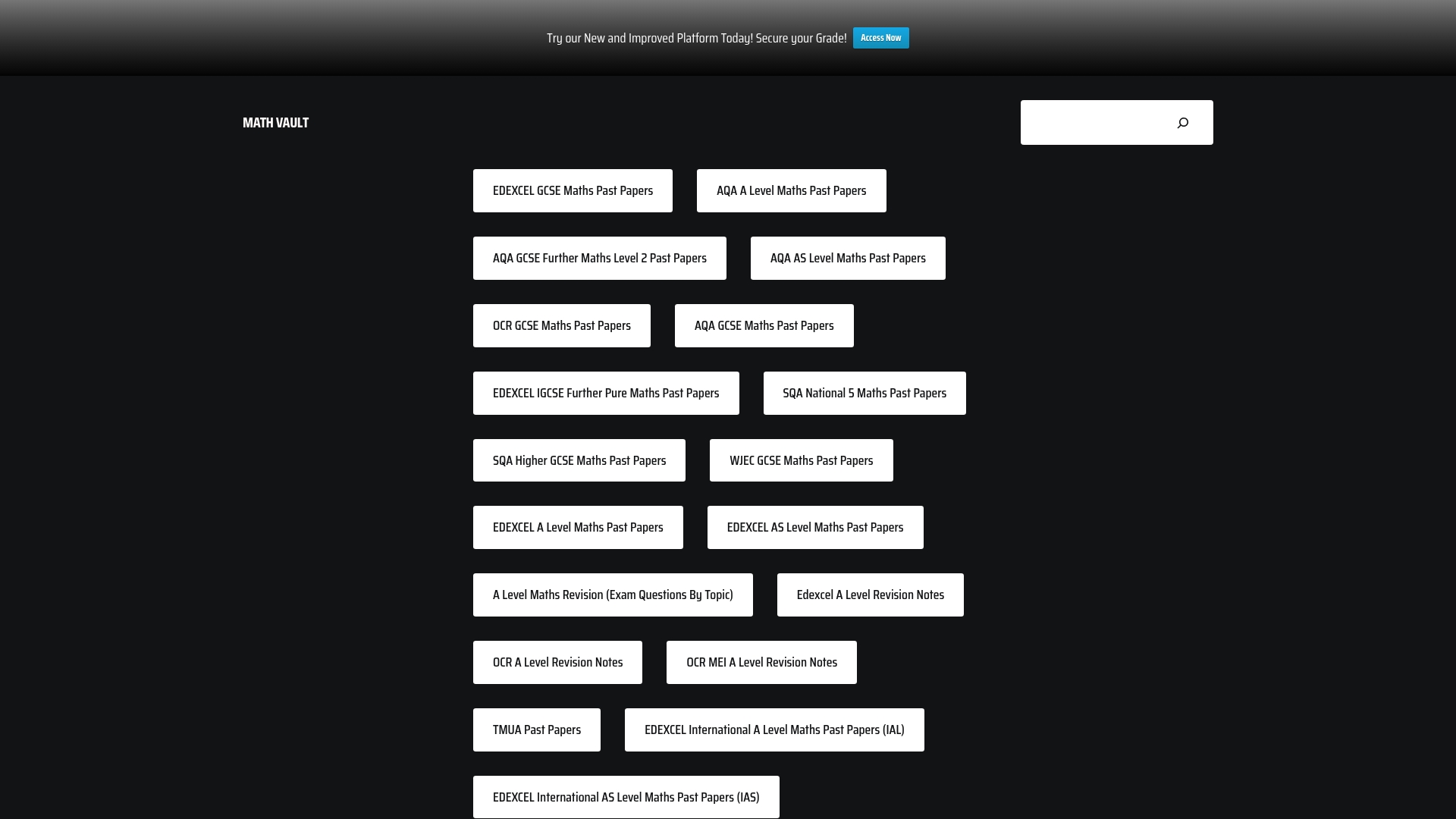
Start with a timed non-calculator paper, mark it yourself using the worked solution, and log which error type recurs, fractions, signs, surds, or missed exact form. If you want a structured route rather than picking papers at random, the GCSE maths revision guides organise topics and past papers so your next drill targets exactly what’s weakest, backed by video walkthroughs and weekly live Q&A sessions when a worked solution alone doesn’t explain the “why.”
Sources
Pearson’s GCSE specification confirms how method marks are awarded. The IES practice guide covers monitoring and reflection prompts. A PubMed study supports mixed worked-solution and practice-based revision.
- Pearson GCSE mathematics specification and sample assessment materials
- Study on immersive test‑taking strategies and student perceptions (PubMed)
- Problem solving strategies — LibreTexts
- How to work a math problem — Brownmath
FAQ
What is the best strategy for a non-calculator maths paper?
Show every step of your working and keep answers in exact form (fractions, surds, standard form) rather than rounding early, because method marks are awarded for correct steps even when the final answer is wrong. Pair that with regular timed practice on real past papers to build speed on the arithmetic you can’t avoid doing by hand.
How many minutes should I spend per mark on a non-calculator paper?
A common guide is roughly one minute per mark, though multi-step 4 to 6-mark questions often deserve slightly more thinking time relative to their mark value. Bank the easy, quick marks first, then return to harder questions with whatever time remains.
Does Mathvault have non-calculator practice papers?
Free past papers organised by exam board are provided alongside fully worked solutions, enabling students to practise under timed, non-calculator conditions and self-mark against detailed method breakdowns. Video walkthroughs and live Q&A sessions may also be available for additional explanation.
What are the most common mistakes on non-calculator papers?
The most frequent mark losses come from fraction arithmetic, sign errors with negative numbers, incorrect surd simplification, and rounding an answer that should have stayed in exact form. Most of these are caught by a final checklist covering units, signs, and required answer format in the last few minutes of the exam.
How do I improve my mental maths for GCSE without a calculator?
Practise breaking calculations into smaller chunks (splitting multiplication, building percentages from 10% and 1%), and memorise squares, key fractions, and times tables until they’re automatic. Combine that with short daily drills targeting your weakest written skill rather than broad, unfocused revision.
Leave a Reply