
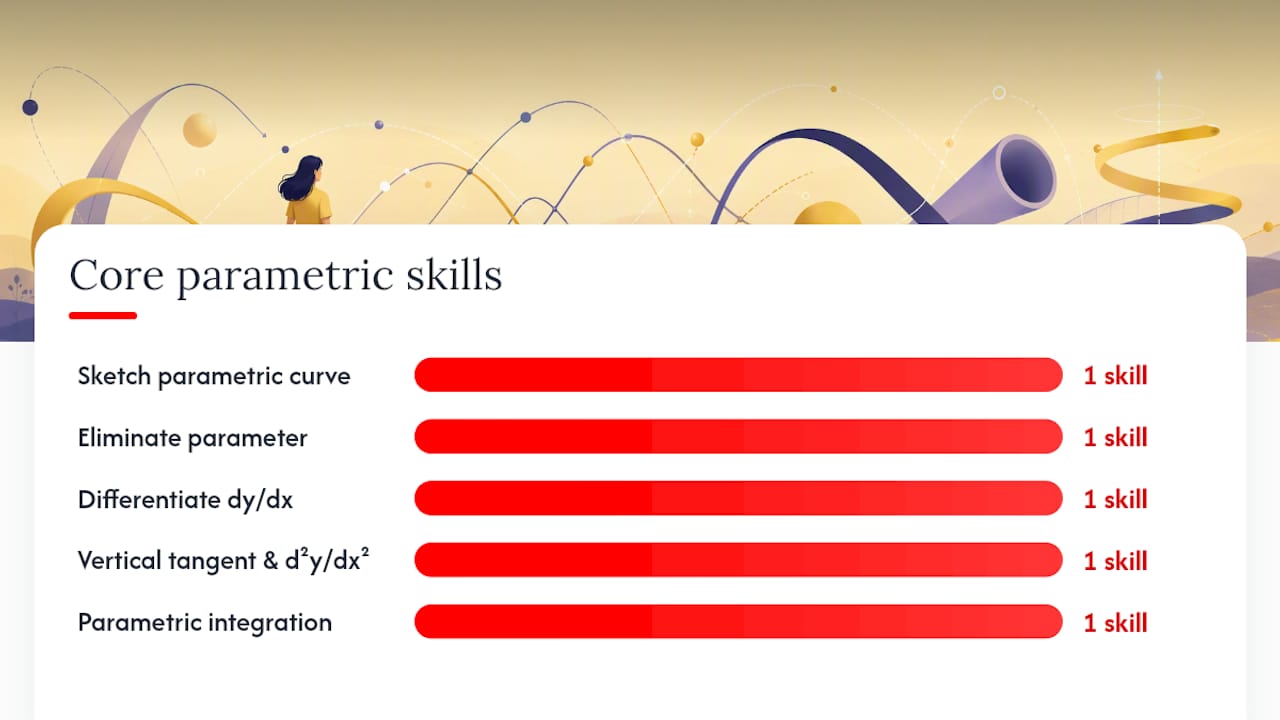
Parametric equations express x and y separately as functions of a third variable, t, so that x = x(t) and y = y(t). Rather than writing y directly in terms of x, you describe each coordinate through a shared parameter, which makes curves like circles, ellipses, and projectile paths far easier to handle. For Edexcel and AQA A Level, you need to master five specific skills:
- Sketch a parametric curve by tabulating t-values, computing (x, y) pairs, plotting points, and marking the direction of motion as t increases.
- Eliminate the parameter to obtain a Cartesian equation, using algebraic substitution or trigonometric identities such as sin²t + cos²t = 1.
- Differentiate using dy/dx = (dy/dt) ÷ (dx/dt), provided dx/dt ≠ 0.
- Handle dx/dt = 0, which signals a vertical tangent, and find the second derivative d²y/dx² to classify stationary points.
- Integrate parametrically by substituting dx = (dx/dt) dt and converting x-limits to t-limits.
Every parametric question on an Edexcel or AQA paper draws on one or more of these five skills. Knowing which one the question demands is half the battle.
Key takeaways
Parametric differentiation at A Level reduces to one formula, dy/dx = (dy/dt)/(dx/dt), applied carefully with attention to domain, direction, and exact values.
| Point | Details |
|---|---|
| Core differentiation formula | dy/dx = (dy/dt) ÷ (dx/dt); always check dx/dt ≠ 0 before applying it. |
| Vertical tangents | When dx/dt = 0, state the tangent as x = x(t₀) rather than writing dy/dx. |
| Parametric integration | Substitute dx = (dx/dt) dt and convert x-limits to t-values explicitly; mark schemes require clear justification. |
| Exact values required | Give answers as fractions, surds, or π multiples; decimal approximations lose accuracy marks on Edexcel papers. |
| Mathvault practice | Mathvault’s free Edexcel topic-based past papers and worked solutions cover every parametric question type in this guide. |
Table of Contents
- What do parametric equations actually mean?
- How do you sketch a parametric curve in an exam?
- How do you eliminate the parameter to get a Cartesian equation?
- How do you differentiate parametric equations to find dy/dx?
- How do you find the second derivative and classify stationary points?
- Edexcel-style worked questions with full solutions
- Common exam mistakes and how to avoid them
- An editorial note on this guide
- Consolidate your skills with Mathvault’s A Level resources
- Sources
What do parametric equations actually mean?
Formally, a pair of parametric equations is written as x = x(t) and y = y(t), where t is the parameter. The variable t often represents time in physical problems, but at A Level it is frequently an abstract angle or a real number with a stated domain. As t varies over its domain, the point (x(t), y(t)) traces a path in the xy-plane.
The classic example is the unit circle. Setting x = cos t and y = sin t, and letting t run from 0 to 2π, produces every point on the circle x² + y² = 1. The table below shows the key t-values and their corresponding coordinates, as introduced in the mathcentre parametric unit.
Diagram note: sketch these five points on a set of axes, join them with a smooth circle, and add an anticlockwise arrow to show the direction of motion as t increases from 0 to 2π. Label each point with its t-value. Examiners award marks for direction arrows, so never omit them.
How do you sketch a parametric curve in an exam?
Sketching under time pressure requires a clear method. Follow these steps every time:
- Identify the domain of t. Read the question carefully — the domain is almost always stated. If it is not, use the natural domain of the functions (e.g. t ∈ [0, 2π] for trigonometric curves).
- Choose t-values strategically. For trig curves, use quarter-turns: 0, π/2, π, 3π/2, 2π. For polynomial or rational parametric curves, include t = 0, any roots of dx/dt, and the endpoints of the domain.
- Compute x(t) and y(t) for each chosen value. Set these out in a clear table — examiners can award method marks from a correct table even if the sketch is imperfect.
- Plot the points and join them with a smooth curve. Do not connect points with straight-line segments.
- Mark the direction of motion with a small arrow on the curve, showing how the point moves as t increases.
- Label key points with their coordinates and, where asked, their t-values.
For rational or polynomial curves, include any t-value where dx/dt = 0 or dy/dt = 0, because these expose vertical tangents and stationary points respectively. A table that includes those critical t-values lets you read off the curve’s turning behaviour without extra algebra.
Pro Tip: For trig parametric curves, always include the quarter-turn values t = 0, π/2, π, 3π/2 in your table. These expose the extreme x and y values and any vertical tangents in one step, saving significant time under exam conditions.
Mini worked example: sketching x = 2cos t, y = sin t
| t | x = 2cos t | y = sin t |
|---|---|---|
| 0 | 2 | 0 |
| π/2 | 0 | 1 |
| π | −2 | 0 |
| 3π/2 | 0 | −1 |
| 2π | 2 | 0 |
Plot these five points and join them smoothly. The result is an ellipse with semi-axes 2 (horizontal) and 1 (vertical), traversed anticlockwise. Eliminating t confirms this: (x/2)² + y² = cos²t + sin²t = 1.
How do you eliminate the parameter to get a Cartesian equation?
Eliminating t converts a parametric pair into a single equation relating x and y directly. This is useful for identifying the curve type, finding intersections with axes, and setting up integration. There are two standard methods.
Substitution works when t appears algebraically. For x = t², y = 2t, solve the simpler equation for t: t = y/2. Substitute into the other: x = (y/2)² = y²/4, giving y² = 4x. This is a parabola opening to the right. The Mathvault is a useful reference if the Cartesian form turns out to be quadratic.
Trigonometric identities are the tool of choice when x and y involve sin t and cos t. For x = cos t, y = sin t, square both and add: x² + y² = cos²t + sin²t = 1. The identity sin²t + cos²t = 1 is the workhorse here. A similar approach handles x = a cos t, y = b sin t (an ellipse) and x = sec t, y = tan t (a hyperbola, using sec²t − tan²t = 1).
Key warning: eliminating the parameter can hide information. When t maps multiple values to the same (x, y) point, or when the domain of t restricts the curve to only part of the Cartesian locus, the Cartesian equation alone does not tell the full story. For example, x = cos t, y = sin t with t ∈ [0, π] traces only the upper semicircle, but x² + y² = 1 describes the full circle. Always state any domain restriction on x or y that arises from the t-domain. Prefer tabulation over elimination when direction or restricted range matters for the question.
When you move from sketching to integration, eliminating the parameter is often not the right approach. Parametric integration keeps the variable as t throughout, which is cleaner and avoids re-introducing square roots or multi-valued expressions.
How do you differentiate parametric equations to find dy/dx?
The core formula for parametric differentiation follows directly from the chain rule:
dy/dx = (dy/dt) ÷ (dx/dt), provided dx/dt ≠ 0
This is the formula you will use in every parametric differentiation question. The steps are always the same:
- Differentiate x(t) with respect to t to get dx/dt.
- Differentiate y(t) with respect to t to get dy/dt.
- Divide: dy/dx = (dy/dt) / (dx/dt).
- Substitute the given t-value to find the gradient at that point.
For a full review of the chain rule and related differentiation techniques, Mathvault’s differentiation rules guide covers every rule you need at A Level.
Worked example: gradient and tangent for x = cos t, y = sin t at t = π/4
Step 1: dx/dt = −sin t, dy/dt = cos t.
Step 2: dy/dx = cos t / (−sin t) = −cot t.
Step 3: At t = π/4: dy/dx = −cot(π/4) = −1/1 = −1.
Step 4: Find the point. x = cos(π/4) = √2/2, y = sin(π/4) = √2/2.
Step 5: Equation of the tangent. Using y − y₁ = m(x − x₁):
y − √2/2 = −1(x − √2/2), which simplifies to y = −x + √2.
Step 6: Equation of the normal. The normal has gradient +1 (negative reciprocal of −1):
y − √2/2 = 1(x − √2/2), giving y = x.
Handling dx/dt = 0: vertical tangents
When dx/dt = 0 at some t = t₀, the formula dy/dx breaks down because you would be dividing by zero. This signals a vertical tangent at the point (x(t₀), y(t₀)). In your exam answer, state: “dx/dt = 0 at t = t₀, so the tangent is vertical, with equation x = x(t₀).” Do not write dy/dx = ∞; instead, give the equation of the tangent line explicitly.
How do you find the second derivative and classify stationary points?
The second derivative in parametric form uses the chain rule a second time. The formula is:
d²y/dx² = (d/dt(dy/dx)) ÷ (dx/dt)
In words: differentiate dy/dx with respect to t, then divide by dx/dt again. Never differentiate dy/dx with respect to x directly — that is the most common error in this topic.
Worked example: d²y/dx² for x = t², y = t³ − 3t
Step 1: dx/dt = 2t, dy/dt = 3t² − 3.
Step 2: dy/dx = (3t² − 3) / (2t).
Step 3: Differentiate dy/dx with respect to t:
d/dt(dy/dx) = d/dt[(3t² − 3)/(2t)] = [(6t)(2t) − (3t² − 3)(2)] / (4t²) = (12t² − 6t² + 6) / (4t²) = (6t² + 6) / (4t²) = (3t² + 3) / (2t²).
Step 4: d²y/dx² = [(3t² + 3)/(2t²)] ÷ (2t) = (3t² + 3) / (4t³).
Pro Tip: Always simplify dy/dx fully before differentiating it with respect to t. A cleaner expression at Step 2 means far fewer sign errors in Step 3, and examiners follow your working line by line.
Checklist for stationary points and inflection
- Stationary point: set dy/dx = 0 (i.e. dy/dt = 0 and dx/dt ≠ 0). Find the t-value, then find the coordinates.
- Maximum: d²y/dx² < 0 at that t-value.
- Minimum: d²y/dx² > 0 at that t-value.
- Inflection: d²y/dx² = 0 and changes sign. Check values either side of the t-value.
When area or arc-length questions appear, you will need parametric integration. The key substitution is dx = (dx/dt) dt, which converts ∫ y dx into ∫ y(dx/dt) dt with limits changed to t-values.
Edexcel-style worked questions with full solutions
Solution 1: gradient and tangent
Question: The curve C is given by x = t + 1/t, y = t − 1/t, t > 0. Find dy/dx in terms of t, and find the equation of the tangent at t = 2.
Step 1: dx/dt = 1 − 1/t², dy/dt = 1 + 1/t².
Step 2: dy/dx = (1 + 1/t²) / (1 − 1/t²) = (t² + 1) / (t² − 1).
Step 3: At t = 2: dy/dx = 5/3.
Step 4: Point: x = 2 + 1/2 = 5/2, y = 2 − 1/2 = 3/2.
Step 5: Tangent: y − 3/2 = (5/3)(x − 5/2). Multiply through by 6: 6y − 9 = 10x − 25, giving 10x − 6y − 16 = 0 (or 5x − 3y − 8 = 0).
Solution 2: elimination and sketch
Question: For x = t², y = 2t, eliminate the parameter and sketch the curve for t ∈ [−2, 2].
Step 1: From y = 2t, t = y/2. Substitute: x = (y/2)² = y²/4, so y² = 4x.
Step 2: The Cartesian form is a parabola opening right, vertex at the origin.
Step 3: Build a table:
| t | x | y |
|---|---|---|
| −2 | 4 | −4 |
| −1 | 1 | −2 |
| 0 | 0 | 0 |
| 1 | 1 | 2 |
| 2 | 4 | 4 |
Step 4: Plot the five points and join smoothly. Mark an upward arrow on the curve to show direction as t increases from −2 to 2. Note that t = 1 and t = −1 both give x = 1, so the curve doubles back on itself in the x-direction — the Cartesian equation alone does not show this.
Solution 3: parametric integration for area
Question: Find the area enclosed between the curve x = cos t, y = sin t (t ∈ [0, π]) and the x-axis.
According to the Pearson Edexcel parametric integration resource, the substitution is dx = (dx/dt) dt, converting ∫ y dx into ∫ y(dx/dt) dt with limits in t. The MyEdSpace parametric integration notes confirm this step sequence for A Level students.
Step 1: dx/dt = −sin t.
Step 2: Area = ∫ y dx = ∫ sin t · (−sin t) dt from t = 0 to t = π.
Step 3: When x goes from 1 to −1 (left to right along the upper semicircle), t goes from 0 to π. To get a positive area, take the absolute value: Area = ∫₀^π sin²t dt.
Step 4: sin²t = (1 − cos 2t)/2. Integrate: [t/2 − sin 2t/4]₀^π = π/2 − 0 = π/2.
Exam tip: when converting limits, explicitly solve x(t) = x₀ for t and state which root you are using. Mark schemes expect clear justification of the chosen t-limits, as noted in Mathvault’s Edexcel past-paper collections.
Common exam mistakes and how to avoid them
These are the errors that cost students marks most often in parametric questions.
- Do show every intermediate step. Examiners award method marks for correct dx/dt and dy/dt even if the final answer is wrong.
- Do mark the direction of motion on every sketch. A sketch without a direction arrow loses a mark on most Edexcel mark schemes.
- Do convert integration limits to t-values explicitly. Writing “when x = 1, cos t = 1, so t = 0” earns a method mark.
- Do give exact values. Fractions, surds, and multiples of π are expected; decimal approximations lose accuracy marks.
- Don’t differentiate dy/dx with respect to x when computing d²y/dx². Differentiate with respect to t, then divide by dx/dt.
- Don’t forget to check whether dx/dt = 0 at the t-value in question before writing down dy/dx. If it does equal zero, the tangent is vertical.
- Don’t drop the domain restriction on x or y when you eliminate the parameter. State it explicitly.
- Don’t use the same variable limits after substituting dx = (dx/dt) dt. Once you change to t, the limits must be t-values.
Pro Tip: When an Edexcel question says “hence show that,” it expects you to use the result from the previous part. If you re-derive from scratch, you may still get the answer but you will not receive the “hence” method mark. Always look back at what you have already established.
Time-saving shortcut: for tangent and normal questions, compute the gradient first, then substitute the coordinates. Do not expand the point-slope form until the very last step — keeping it factored reduces arithmetic errors and is easier for the examiner to follow.
An editorial note on this guide
This guide was prepared with close reference to Edexcel A Level past-paper formats and the mark-scheme conventions used across recent series. The worked examples mirror the structure and phrasing you will encounter in actual Edexcel papers, though the same techniques apply equally to AQA and OCR students, since all three boards test the same core parametric skills at A Level.
For direct exam-style practice, Mathvault’s Edexcel A Level resources organise past-paper questions by topic, so you can work through parametric questions in isolation before tackling full papers. That targeted approach is particularly effective in the final weeks before an exam.
Consolidate your skills with Mathvault’s A Level resources
Worked examples in a guide get you so far. The real gains come from sitting down with actual past-paper questions under timed conditions, checking your answers against fully worked solutions, and identifying exactly where your method breaks down.
Mathvault gives you free access to Edexcel A Level past papers organised by topic, complete with step-by-step worked solutions that show every method mark. Every parametric question type covered in this guide — gradient and tangent, elimination and sketching, parametric integration for area — appears in those collections. AQA students will find the same depth of practice at Mathvault’s AQA A Level Maths pages. Downloadable revision packs are available for students who want offline access. Start with the topic-based past papers now and use this guide alongside them to check your technique at each step.
Sources
The sources below were used to prepare this guide and are the best places to follow up.
- Parametric (mathcentre) — mc-ty-parametric-2009-1.pdf
- Pearson Edexcel A level Maths – Parametric integration (PDF)
Leave a Reply