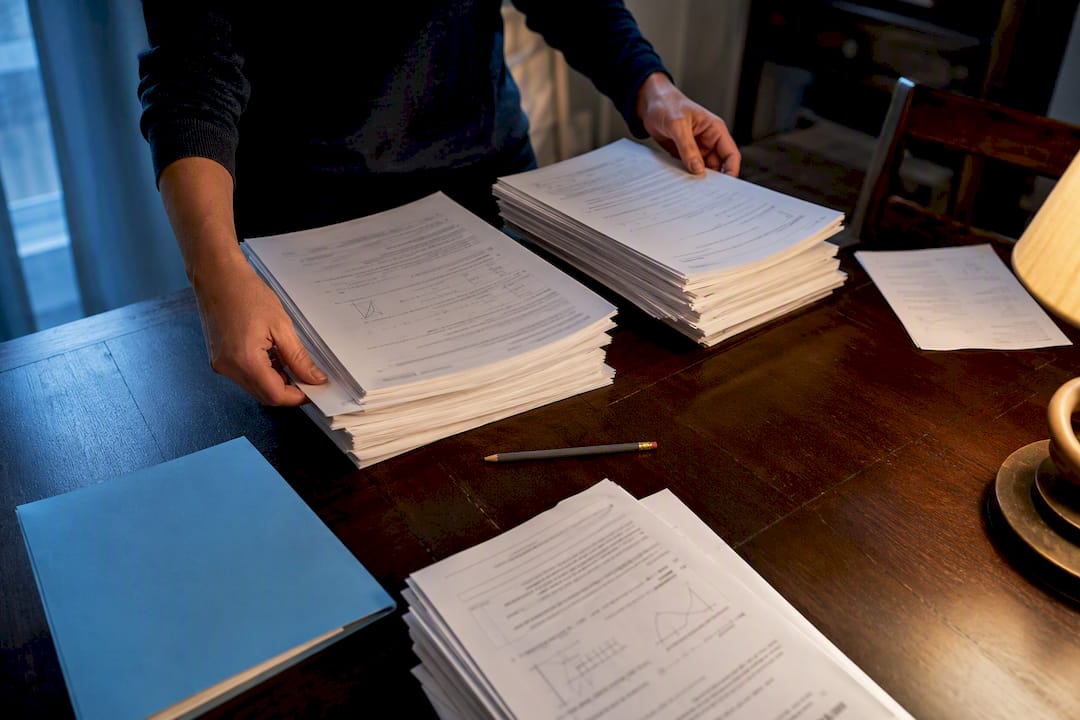
Gather five things before you switch off the router: board-aligned past papers with mark schemes, topic-by-topic worksheet packs, a printable worksheet generator, an offline app or desktop tool for extra practice, and a flashcard deck for spaced repetition. Fully worked solutions matter more than volume. Mathvault offers downloadable past paper packs by exam board, which makes it a sensible first stop for building this kit.
TL;DR:
- Focus on practicing board-aligned past papers and topic packs early in revision, reserving full past papers for later practice under exam conditions.
- Use printable worksheets with ample working space and organize printed sheets by topic and date to track progress and weak areas effectively.
- Select offline apps and tools that pass connectivity tests, offering exam-like mode, proper math input, detailed solutions, progress tracking, and spaced-repetition flashcards.
- Build a personalized, variation-rich revision schedule that rotates activity types weekly and adjusts based on evolving strengths and weaknesses.
- Maintain an honest self-marking routine with error logs and reprinted drills, avoiding overreliance on significant past paper volume to genuinely improve exam performance.
Table of Contents
- Which offline maths revision resources actually work?
- Offline apps and desktop tools worth installing
- Building a printable worksheet library that mimics real exams
- A practical offline study timetable you can actually stick to
- How to use past papers and mark schemes without going online
- How MathVault supports offline revision
- Designing a revision schedule that fits your actual week
- Active recall and spaced repetition without a screen in sight
- Flashcards and physical manipulatives for hands-on practice
- Tracking progress and spotting weak areas without an app
- Creating a distraction-free space to actually study in
- What I’ve noticed works, and what usually doesn’t
- Where to download offline-ready revision packs
- Quick links for offline generators and printable tools
- Sources
Which offline maths revision resources actually work?
Not every resource earns a place in your revision folder. Some suit the early weeks of topic learning; others only make sense once you’re drilling exam technique under time pressure. Knowing which is which saves you hours.
Topic packs work best when you’re still shaky on a method. A pack focused solely on trigonometric identities, say, lets you repeat the same skill ten times without the distraction of unrelated questions. Past papers, by contrast, mix everything together, exactly as the real exam will. Save these for once you’ve drilled the individual topics, not before.
Board alignment is non-negotiable. AQA, Edexcel, OCR, and WJEC each write questions with slightly different phrasing, mark allocations, and formula sheet conventions. A student revising Edexcel A-Level maths who trains exclusively on AQA-style papers will hit unfamiliar phrasing on results day, and that costs marks even when the underlying maths is sound. Downloading papers from your specific board, such as through Edexcel GCSE past paper questions by topic, keeps your practice honest.
Video walkthroughs feel like an odd fit for offline revision, but many platforms let you save or print the transcript, giving you the reasoning behind a method without needing data. Read the transcript like a worked example, pausing to redo the working yourself rather than just following along.
Here’s a rough breakdown of what to reach for and when:
- Printable worksheets — early-stage skill building, one topic at a time
- Topic-based PDF packs — consolidating a weak area before moving on
- Full past papers with mark schemes — mid to late revision, under timed conditions
- Video transcripts — when you’re stuck on the “why” behind a method, not just the “how”
- Mixed past-paper booklets — final fortnight, to simulate exam pressure across topics
Printable packs matter most for long-term revision because they’re reusable. You can photocopy a worksheet, attempt it cold, mark it, then redo it three weeks later to check the method actually stuck. A single past paper, done once under exam conditions, tells you something different: whether you can perform under pressure, not whether you’ve mastered the content. You need both, at different points in your term.
Offline apps and desktop tools worth installing
Plenty of maths apps claim offline support, but the claim doesn’t always survive contact with reality. Test it properly: switch on airplane mode, force-close the app, then reopen it and try to load a new set of questions. If it stalls or demands a connection, it isn’t genuinely offline, whatever the app store listing says.
Once you’ve found something that passes that test, judge it against a short checklist:
- Exam mode — a timed setting that hides the answer until you submit, mimicking real conditions
- A proper maths keypad — fractions, powers, and roots typed the way you’d write them on paper, not approximated with standard keyboard symbols
- Fully worked solutions, not just a final answer, so you can see where method marks would have been earned or lost
- Progress tracking that flags which topics you’re weakest on, ideally without needing a server connection to sync
- Formula recall tools, such as digital flashcards using spaced repetition
On that last point, MathFlash is a useful example: it holds a large number of flashcards across several tiers and runs on the SM-2 spaced repetition algorithm, which schedules a formula for review just as you’re about to forget it, rather than at a fixed daily interval. If you’re building your own deck instead, structure it by formula family (circle theorems together, differentiation rules together) rather than mixing topics randomly, since retrieval practice works better when you’re forced to recall which formula applies, not just recite one you already know is coming.
Some apps go further and combine offline structured lessons with guided practice, useful if you want a curriculum path rather than loose questions.
Desktop generators deserve a mention too, particularly for A-Level students who’ve exhausted the free past papers for their board. RandMatQuGeA is a cross-platform, open-source tool that runs entirely offline once installed, generating unlimited practice questions with instant feedback and LaTeX-rendered solutions, useful for algebra and calculus where handwritten notation matters. Because it’s a lightweight desktop build, it also avoids the pop-ups and notification pings that plague browser-based alternatives.

Pro Tip: Install any offline app or generator at least a week before you plan to rely on it. Compatibility issues and missing question banks are far easier to fix with time to spare than the night before a mock.
Building a printable worksheet library that mimics real exams
A worksheet generator is only as useful as the parameters you feed it. Set the topic, difficulty, and question count to match what you’ll actually face, not what’s easiest to generate.
Paper Math lets you build printable PDF worksheets and attaches a QR code to each one, so you can scan for the answer key instead of hunting through a separate document. That single feature turns a stack of paper into something close to self-marking software, without needing a screen during the actual practice. MathAnvil offers a similar route with UK curriculum-aligned topic pages and downloadable PDFs, handy if you want content mapped closer to what your school is actually teaching.
A few practical habits make printed practice far more useful:
- Leave generous space for workings, particularly for algebra and mechanics, where cramped answers hide the method marks an examiner would be looking for
- Number and label each sheet by topic and date, so you can find “Quadratics, week 3” without digging through a pile
- Print two copies of anything you get badly wrong, and reattempt the second copy after a week, cold
- Batch-print a week’s worth of sheets in one sitting to avoid printer queues eating into study time
- File completed sheets by topic in a ring binder rather than a single stack, so weak areas are visible at a glance
Organising by topic and date does more than tidy your desk. It creates a visible record of which areas you’ve drilled once and which you’ve drilled five times, which matters when you’re deciding what to prioritise with three weeks left.
A practical offline study timetable you can actually stick to
Vague plans like “revise maths every day” collapse within a week. A timetable with fixed slots for specific activities survives contact with a Tuesday evening.
Here’s a six-week structure that rotates activity types so no single method gets stale:
- Weeks 1 to 2: topic-by-topic worksheets, 40 minutes daily, targeting your three weakest areas first
- Weeks 3 to 4: mixed topic packs plus 15 minutes of flashcard review each session, shifting from single-skill drills to combined questions
- Week 5: full past papers under strict timed conditions, one every two days, marked the same evening
- Week 6: targeted re-drilling of whatever the past papers exposed, using fresh printed worksheets on those specific topics
For the final fortnight before an exam, compress the same logic:
- Days 1 to 4: one full past paper every other day, timed exactly
- Days 5 to 9: mini-packs built from your own error log, five to ten questions per weak topic
- Days 10 to 14: light review only. Flashcards, formula recall, and one final timed paper no later than two days before the exam
Rotate activity type daily rather than doing the same thing five days running. A student who does nothing but past papers for a fortnight often plateaus, because repetition without variation stops forcing new retrieval effort. Mixing in flashcards and topic drills keeps different memory pathways active.
Keep a simple paper tracker, a page per topic where you log the date and score of every attempt. When a topic’s scores stall, that’s your signal to reprint a fresh drill rather than reattempt the same sheet from memory.
Pro Tip: Book your last full timed paper no later than 48 hours before the exam. Anything closer risks the paper going badly and shaking your confidence right before you need it most.
How to use past papers and mark schemes without going online
Past papers only teach you something if you mark them properly and act on what you find. Done badly, they’re just extra questions. Done well, they’re the single most efficient offline revision tool available.
Work topic-first before attempting a full paper. Drilling one topic in isolation exposes method errors that get lost in a mixed paper, where you might guess your way to a partial mark without noticing the underlying gap.
- Time yourself strictly using a physical clock or timer, not a phone, since a phone invites the very distraction you’re trying to avoid
- Attempt the full paper in one sitting, exactly as you would on the day, including the reading time your board allows
- Mark honestly against the scheme before checking any worked solution, awarding method marks even where the final answer is wrong
- Compare your working against a fully worked solution for anything you marked incorrectly, since this is where you spot whether the error was arithmetic or conceptual
- Log every wrong answer by topic, then build a short mini-pack of five to eight fresh questions targeting exactly that gap within the week
This last step is what separates strong revision from busywork. A step-by-step guide to using past papers recommends converting recurring errors into one-page topic sheets you can redrill later, rather than simply moving on to the next paper. Self-marking bias is real, too. It’s tempting to award yourself a method mark you didn’t fully earn, so cross-reference against the exemplar solution rather than your gut instinct.
How MathVault supports offline revision
The site supplies downloadable past papers organised by exam board, alongside fully worked solutions, topic-based revision packs, and live weekly Q&A sessions for follow-up questions.
The value in an offline pack isn’t the paper itself. It’s whether the worked solution shows you exactly where a method mark was earned or lost, so you can fix the actual gap rather than just re-reading the question.
Downloading a pack takes a few minutes: pick your board and year range, save the PDF, and print immediately rather than leaving it on a device where it’s easy to forget. Organise printed packs in a folder by topic, the same way you’d file a worksheet generator’s output, so past papers and topic drills sit together rather than scattered across separate systems.
One limitation worth flagging honestly: past paper packs cover exam technique and content recall well, but they won’t replace the context your teacher gives around a specific method your class has been taught a particular way. Pair MathVault’s self-mark past papers with your own class notes for the fullest picture, and use the live Q&A sessions when a worked solution alone doesn’t clear up your confusion.
Designing a revision schedule that fits your actual week
A generic six-week plan is a starting template, not a rulebook. The version that works is the one built around your actual timetable, energy levels, and weakest topics, not somebody else’s ideal week.
Start by listing every topic from your specification and rating your confidence from one to five. Anything below three gets double the session time in week one. This single step prevents the common mistake of spending equal time on algebra, which you’re already solid on, and mechanics, which you’re not.
Match session length to when you actually concentrate well. If you’re sharper after dinner than straight after school, put your hardest topic drills in that slot and save flashcard review, which needs less mental energy, for the tired hour beforehand.
Build in one deliberately lighter day per week. Revision plans that assume seven full-intensity days almost always get abandoned by week three, because real weeks include football practice, family events, and days you simply don’t feel like it. A schedule with one planned rest day survives contact with actual life far better than one without.
Review and adjust every two weeks rather than sticking rigidly to the original plan. If topic drills from week one show you’ve cracked quadratics but you’re still shaky on trigonometry, shift week three’s balance accordingly. A GCSE maths revision guide can offer a useful starting structure, but treat it as a draft you’ll rewrite once your own weak spots become clear.
Active recall and spaced repetition without a screen in sight
Active recall means testing yourself before you check the answer, not rereading notes and assuming that counts as revision. It feels harder in the moment, which is exactly why it works better.
The simplest offline version: cover your notes, write out everything you remember about a topic from memory, then check what you missed. The gaps that show up are your actual weak points, often different from what you assumed.
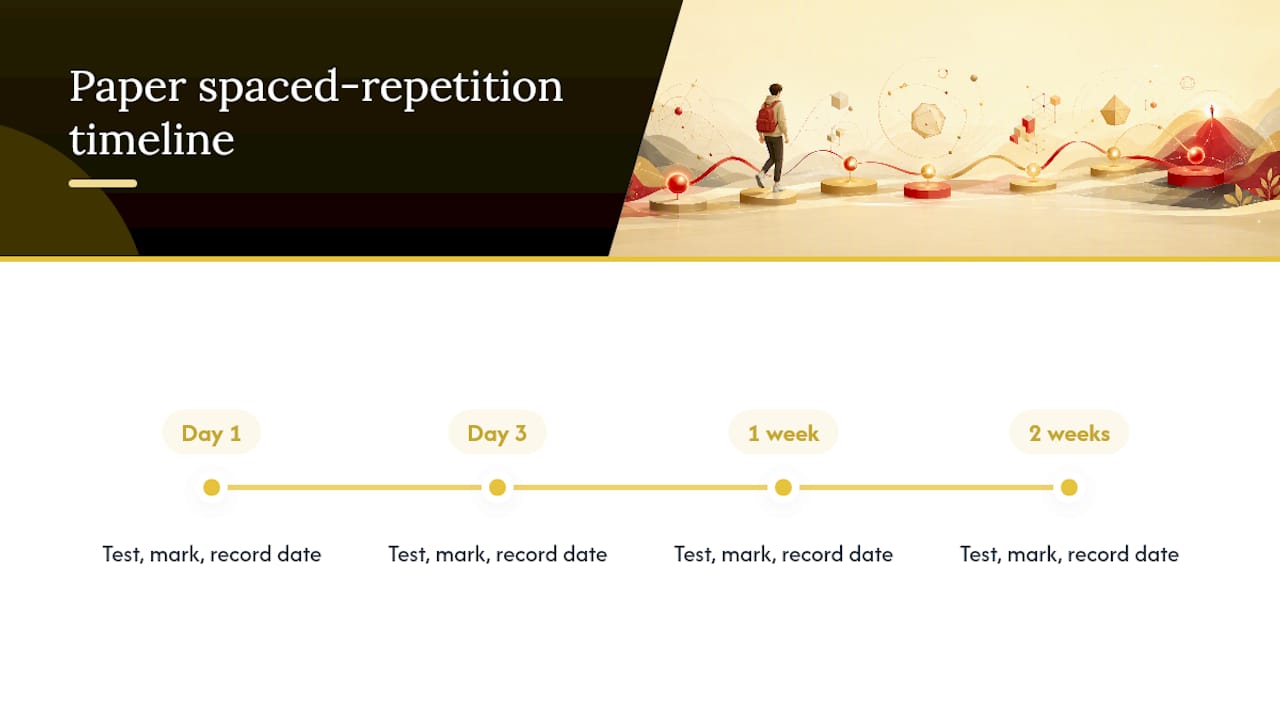
Spaced repetition, done on paper, just means deliberately revisiting a topic at increasing intervals rather than cramming it once and moving on. A rough offline version: revisit a topic after one day, then three days, then a week, then two weeks. Mark each attempt’s date on the worksheet itself so you can see the gap growing.
Flashcards are the classic tool here, but the technique works for full worked examples too. Write a past exam question on one side of an index card and the fully worked solution on the other, then shuffle a stack of twenty and test yourself cold. The physical shuffling matters more than it sounds, since it stops you memorising the order of questions rather than the maths itself.
A simple traffic-light system on each card, red for “got it wrong,” amber for “hesitated,” green for “confident,” lets you rebuild the pile each week with reds and ambers weighted more heavily. That’s spaced repetition without needing an algorithm to run it for you.
Flashcards and physical manipulatives for hands-on practice
Flashcards work best for formulae, definitions, and short procedural steps, the kind of thing you either know instantly or don’t know at all. Circle theorem names, differentiation rules, and trigonometric identities all suit this format well.
Structure your deck by formula family rather than by chapter order in a textbook. Grouping every “rate of change” formula together, for instance, forces you to distinguish between similar-looking rules, which is exactly the kind of confusion that costs marks in an exam.
Physical manipulatives matter more than most revision guides admit, particularly for geometry, vectors, and probability. Cutting out paper shapes to physically rotate them for a transformations question, or using coins and counters to model a probability tree, builds an intuitive sense of the maths that a worked example on a page sometimes can’t. This kind of pencil-and-paper spatial practice builds a feel for multi-step geometry problems that pure screen-based drilling tends to miss, since your hand is doing part of the thinking a screen would otherwise skip past.
For statistics, a physical dice or deck of cards makes probability questions concrete rather than abstract. Rolling a die ten times and recording actual outcomes before tackling a theoretical probability question grounds the maths in something you’ve just watched happen.

Keep manipulatives simple. String, counters, graph paper, and a protractor cover most of what GCSE and A-Level geometry and statistics demand, and none of it needs charging.
Tracking progress and spotting weak areas without an app
A paper tracker beats memory every time. Rule a page per topic, log the date and score of every attempt, and the pattern becomes obvious within a fortnight, often faster than you’d expect from just “feeling” unsure about a topic.
Colour-code each entry: green for a score above 80%, amber for 50 to 80%, red below that. A topic sitting in red after three attempts needs a different approach, not just another worksheet of the same difficulty. Drop back to a topic pack focused purely on that skill before attempting mixed questions again.
Keep a separate “error log,” a single notebook page listing every mistake by type: arithmetic slip, wrong formula, misread question, ran out of time. Reviewing this log after a fortnight often reveals that most lost marks come from one or two repeated habits rather than a genuine lack of knowledge, which changes what you actually need to fix.
Reprint fresh drills rather than reattempting the exact same sheet from memory, since redoing an identical worksheet tests recall of the specific questions, not the underlying method. A generator such as MathAnvil or Paper Math makes this easy, producing a new set on the same topic in seconds.
Creating a distraction-free space to actually study in
Where you revise shapes how well it sticks. A cluttered desk with a phone in reach undermines even the best-planned timetable.
Keep your phone in another room, not just face-down on the desk. Face-down still buzzes, and that buzz costs you the next several minutes rebuilding concentration, even if you don’t actually pick it up.
Fixed lighting and a consistent spot help more than they sound like they should. Revising in the same chair at the same desk each session builds a habit loop where sitting down itself signals “start work,” cutting the mental warm-up time.
Keep only the current session’s materials on the desk: one topic pack, one pencil, a calculator if the topic requires it, nothing else. A desk covered in every past paper you own is visually overwhelming before you’ve answered a single question.
If home is genuinely too noisy, a library or school study room offers a fixed block of quiet time with none of the pull of a bedroom’s other distractions. Whatever the space, treat the session boundaries as fixed. Forty minutes on, ten minutes off works better than an open-ended “I’ll stop when I’m done,” which tends to stretch or collapse depending on mood rather than actual progress.
What I’ve noticed works, and what usually doesn’t
Most students overestimate how much past-paper volume matters and underestimate how much the marking step matters. Grinding through paper after paper without honestly checking method marks against the scheme teaches you very little, no matter how many hours it eats.
What actually moves the needle is smaller and less glamorous: a proper error log, flashcards revisited on a genuine schedule rather than randomly, and worksheets reprinted fresh rather than reattempted from memory. None of that requires an internet connection, and all of it requires more discipline than downloading another app.
If you take one thing from this, make it the error log. Students who track why they lost a mark, not just that they lost it, close gaps faster than students doing double the practice volume. Use MathVault’s live Q&A sessions when a worked solution still leaves you stuck on the reasoning, and lean on downloadable packs for the raw material, but the habit of honest self-marking is what actually converts practice into marks on the day.
— Oloru
Where to download offline-ready revision packs
Building the kit described above is faster with a starting point, and MathVault.io gives you one without a paywall in the way. The site’s downloadable past paper packs are organised by exam board and topic, so you’re not stitching together resources from five different places before you can even print anything.
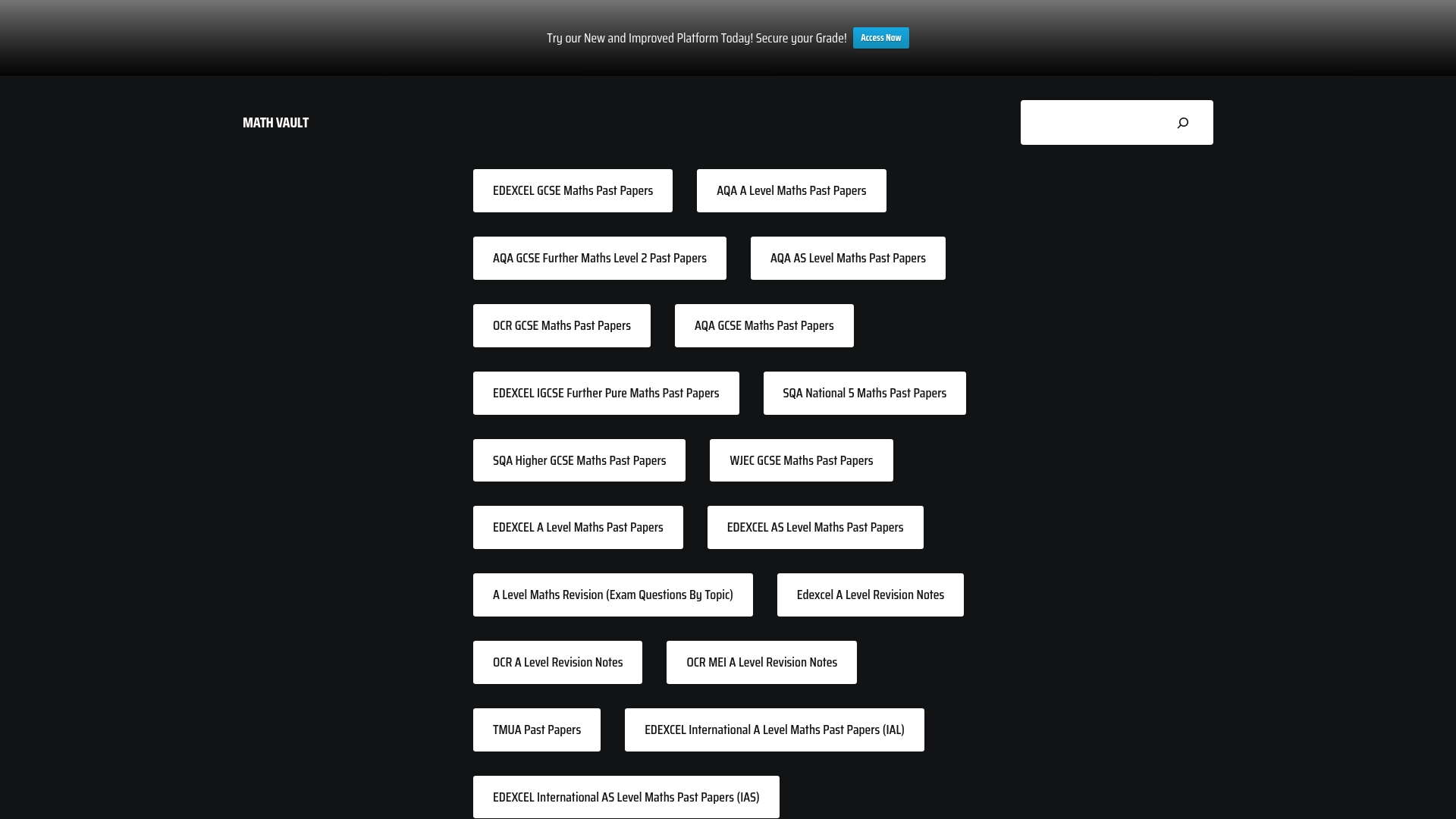
For GCSE students, the Edexcel GCSE past paper questions by topic pack breaks papers down by subject area rather than by year, useful for the topic-drilling phase of a six-week plan. The self-mark past papers pack pairs board-aligned mark schemes with optional live Q&A support, handy when a worked solution alone doesn’t explain where a method mark went missing. Running short on time before an exam, the last-minute GCSE maths revision plan sets out a 48/24/8-hour structure built entirely around printed materials and flashcards.
A-Level students following Edexcel can find topic-organised papers through the A-Level past paper questions by topic page, while AQA candidates have dedicated resources through the AQA A-Level maths hub. Choosing the right pack comes down to two questions: which board you sit, and whether you’re consolidating a single topic or simulating a full paper. Download the pack that matches, print it, and start your first timed attempt this week.
Quick links for offline generators and printable tools
Bookmark these before you go offline: Paper Math for printable PDF worksheets with QR-coded answer checks, MathAnvil for UK curriculum-aligned printable question banks, and RandMatQuGeA for a desktop generator that runs entirely without internet. MathFlash covers spaced-repetition flashcards, BBC Bitesize offers some offline-accessible revision content, and Resourceaholic tracks newly published printable resources worth checking each year. For app features worth prioritising when evaluating offline tools, the AI for Students guide is a useful reference point.
Sources
- MathFlash — Math flashcards (App Store)
- Paper Math — Generate Math Worksheets Instantly
- RandMatQuGeA (GitHub)
- Resourceaholic — New revision resources (2025)
Leave a Reply