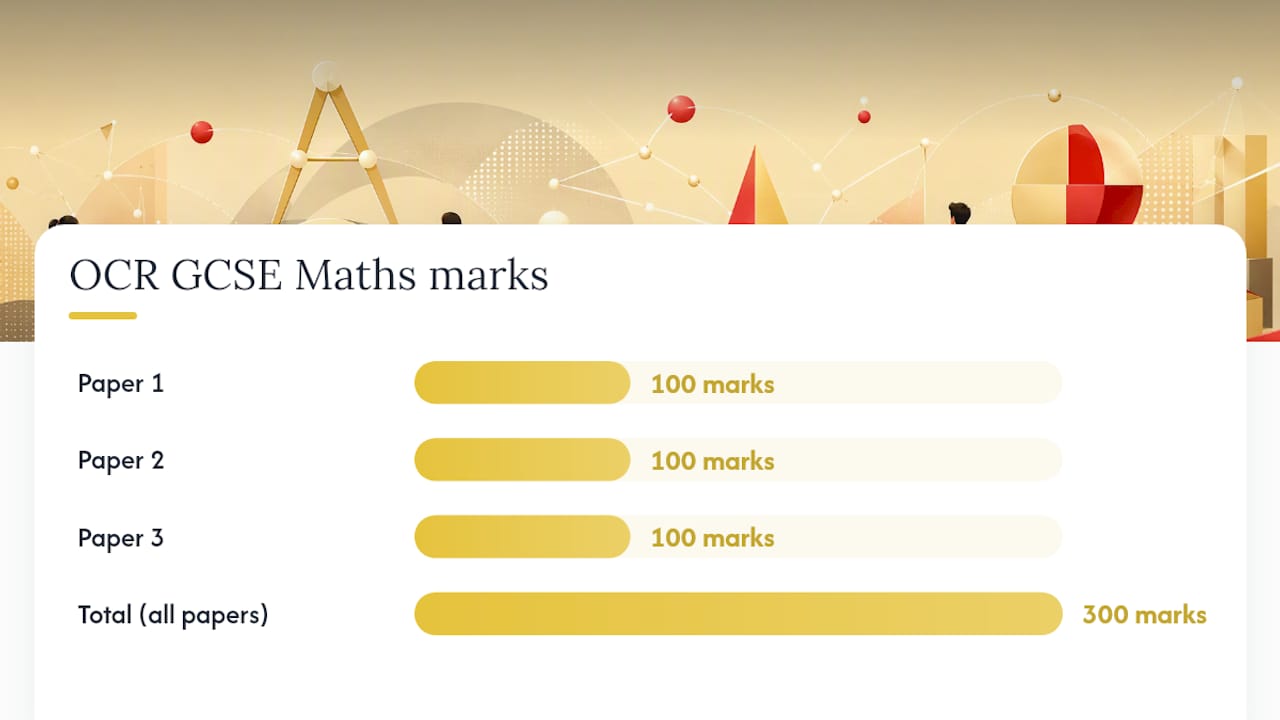
OCR GCSE Maths (J560) is split into three written papers per tier, each lasting 1 hour 30 minutes and worth 100 marks, for a total of 300 marks and a total exam time of three papers each lasting 1 hour 30 minutes. Foundation candidates sit Papers 1 to 3; Higher candidates sit Papers 4 to 6, and every student must be entered for all three papers at the same tier. The middle paper in each tier is non-calculator.
TL;DR:
- Students should focus on practicing Paper 2 or Paper 5 without a calculator to build discipline for the non-calculator section in the exam.
- All candidates must be entered for three papers at the same tier, with no mixing tiers, and each tier’s middle paper is always non-calculator.
- The three papers are sequenced so that the non-calculator paper is second, allowing students to start with calculator-enabled questions to reduce stress.
- Proper practice includes checking that practice sheets match the correct tier code, as papers from different tiers have different content and calculator allowances.
- Mark schemes emphasize showing clear working steps, as method marks reward process over the final answer, even when errors occur.
Table of Contents
- What is the OCR maths exam structure?
- Which OCR maths papers allow a calculator?
- How are marks awarded on OCR maths papers?
- How does the three-column content grid work?
- Where can I find OCR past papers and mark schemes?
- What are the biggest exam-day pitfalls to avoid?
- How Mathvault supports OCR GCSE Maths revision
- The one thing to do this week
- Try Mathvault’s OCR-aligned revision packs
- Sources
- FAQ
What is the OCR maths exam structure?
Every candidate sitting OCR’s GCSE (9–1) in Mathematics faces the same basic shape, whichever tier they’re on. The OCR specification confirms three 90 minute papers, each worth 100 marks, adding up to 300 marks and 4½ hours of assessment overall, and all of it externally examined. There’s no coursework and no controlled assessment hiding in the background.
Where it gets specific is the numbering, and this is where students sometimes trip up when downloading practice material.
- Foundation tier: Papers 1, 2 and 3 (paper codes J560/01 to J560/03)
- Higher tier: Papers 4, 5 and 6 (paper codes J560/04 to J560/06)
- Entry rule: you sit all three papers at one tier only. Mixing tiers isn’t permitted.
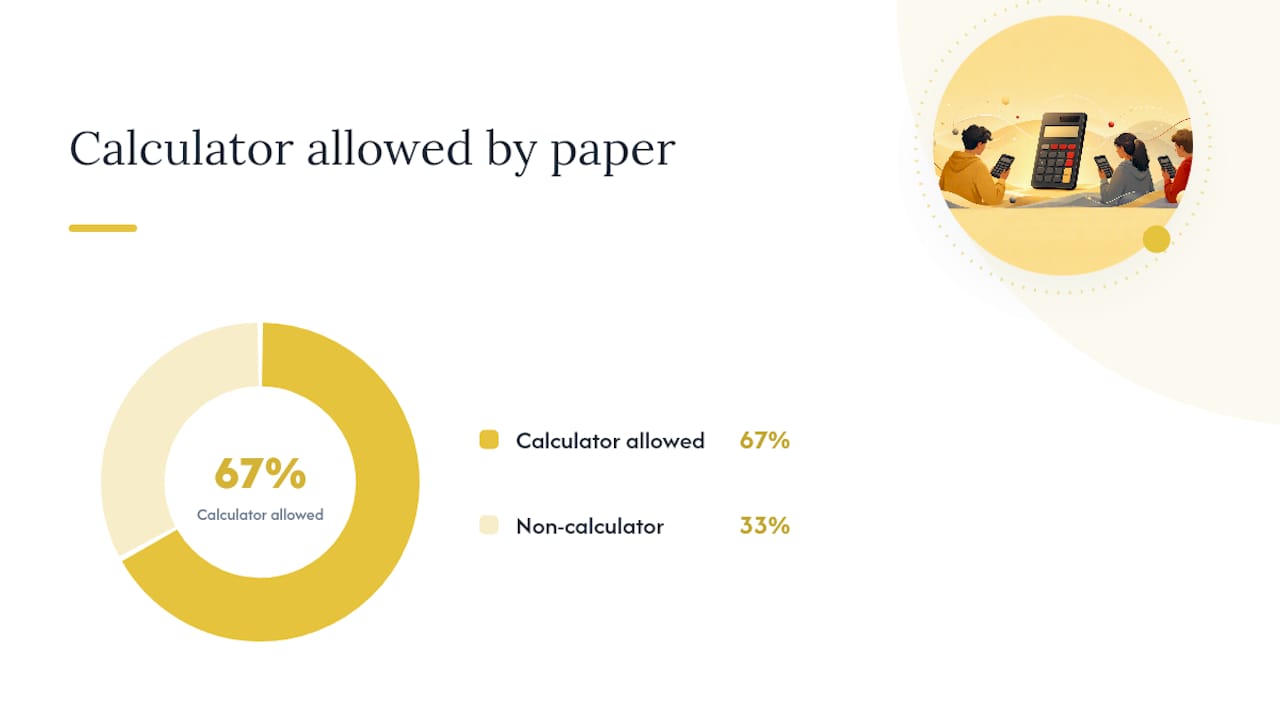
- Calculator pattern: the first and third papers in each tier allow a calculator; the middle paper doesn’t.
That middle-paper rule isn’t an accident. OCR has explained that placing the non-calculator paper second, rather than first, is meant to reassure candidates by giving them a calculator in their opening exam rather than throwing the toughest mental-arithmetic paper at them cold, according to OCR’s exploring our question papers guidance. If you’re building a revision timetable, that sequencing matters. Practise Paper 2 or Paper 5 style questions without reaching for a calculator, because that’s exactly the discipline the real exam demands.
One practical note: if you’re mixing OCR past papers with resources from other exam boards while revising, always check the J560 paper code before you start a timed practice run. It’s easy to grab the wrong tier’s paper by mistake, especially late at night when you’re rifling through a downloads’ folder.
Which OCR maths papers allow a calculator?
Papers 1 and 3 (Foundation) and Papers 4 and 6 (Higher) allow a calculator. Papers 2 and 5, the middle paper on each tier, are non-calculator, confirmed directly in the J560 specification.
Calculator rules themselves aren’t set by OCR alone. The JCQ conduct guidance, which Ofqual oversees as the exams regulator, governs what devices are actually permitted in the room. In practice that means:
- Scientific or graphical calculators are fine, but the device must not have internet access, a QWERTY keyboard, or the ability to store text.
- Calculators can’t be shared between candidates once the exam starts.
- Instruction manuals and cases must be left outside the exam room, and batteries should be checked (or replaced) the night before, not five minutes beforehand.
Beyond the calculator itself, bring black pens, a pencil, a ruler, a protractor and a pair of compasses. Spare batteries are worth packing even if your calculator seems fine. There’s no separate formula booklet to worry about either, because OCR embeds the relevant formulae directly into questions where they’re needed, according to the specification at a glance.
Pro Tip: Even though formulae appear in-question, don’t skip revising the ones OCR doesn’t provide, such as the area of a circle or the quadratic formula for Higher tier. “Provided where relevant” isn’t the same as “provided every time.” You’ll find a full breakdown in Mathvault’s GCSE maths formula sheet.
How are marks awarded on OCR maths papers?
Marks come from three assessment objectives. AO1 rewards accurate recall and use of standard mathematical techniques. AO2 rewards reasoning, interpreting and communicating mathematically, explaining why a method works rather than just applying it. AO3 rewards solving problems within mathematics and in real-life contexts, often by combining several techniques in one question.
Sitting underneath all three objectives is the method mark, and this is where students leave the most marks on the table unnecessarily. OCR has said its papers are designed to give scope for more method marks, rewarding correct steps in your working even when the final answer is wrong, as set out in exploring our question papers. A wrong answer with clear, correct method can still pick up two or three marks out of four. A correct answer with no working shown, on the other hand, can score zero if a slip happens further up the calculation and there’s nothing to give credit for.
Question formats vary across the paper:
- Short one or two mark questions testing a single fact or skill.
- Structured multi-step questions, often worth four to six marks, building from an easy opening part to a harder final part.
- Extended problem-solving questions that give you a scenario and expect you to plan your own route to the answer.
To capture method marks reliably: write down what you’re being asked to find before you calculate anything, define any variable you introduce, show each rearrangement of an equation on its own line, and label your final answer clearly. Mathvault’s guide on method marks walks through exactly how examiners apply this in practice.
How does the three-column content grid work?
OCR sets out its specification content in a three-column grid: initial learning, Foundation, and Higher extension. The columns are cumulative, so Foundation content draws on the first two columns, while Higher content is the sum of all three, according to the J560 specification.
That structure makes topic progression visible rather than guesswork. Take standard form: initial learning covers writing numbers in standard form, Foundation extends that to calculating with standard form, and Higher extension pushes into solving equations and problems where standard form is embedded in a wider context. Percentages follow a similar arc, from simple percentage change at the initial stage to compound interest and reverse percentage problems by Higher tier.
- Initial learning: foundational skills every candidate needs regardless of tier
- Foundation column: extends those skills to typical Foundation-level demand
- Higher extension: adds the reasoning depth and technique range expected at Higher
One catch worth flagging: any content from the grid can appear on any of the three papers within a tier, so don’t assume a topic is “safe” because it didn’t come up on last year’s Paper 1. Practise across all three papers, not just your favourite one.
Where can I find OCR past papers and mark schemes?
The J560 specification and OCR’s specimen materials are the primary source for genuine, board-set questions, and they’re free to download directly from OCR. Mark schemes published alongside them show exactly how method marks are split within each question, which is more revealing than any generic revision guide.
A practical way to work through them:
- Sit a full paper under timed conditions. Ninety minutes, no notes, calculator only where the paper allows it.
- Self-mark against the official scheme, ticking off each method mark separately rather than just checking the final answer.
- Review where marks were lost, particularly method marks dropped through missing working.
- Repeat with a different paper code, alternating calculator and non-calculator practice to mirror the real sequence.
OCR’s exploring our question papers document and examiner reports both explain the thinking behind how questions are marked, which is genuinely useful reading if you want to understand why a particular step earns credit and another doesn’t.
Pro Tip: Build your practice plan around six full papers, three Foundation or three Higher plus their specimen equivalents, spaced across your final six weeks rather than crammed into one weekend. Mathvault’s self-mark past papers tool pairs OCR-aligned papers with worked solutions so you can check your method marks question by question.
What are the biggest exam-day pitfalls to avoid?
Timing slips catch out more students than difficult content does. With 100 marks in 90 minutes, aim for roughly a mark a minute, leaving a small buffer. If a question stalls you for more than its mark allocation suggests, move on and come back at the end rather than losing five minutes you can’t recover.
Command words matter more than students expect. “Show that” demands full working towards a given answer, “hence” means use your previous answer rather than starting fresh, and “evaluate” wants a judgement, not just a calculation.
- Not showing working, even for calculator-allowed questions, costs method marks unnecessarily.
- Sign errors when rearranging equations are one of the most common slip points on Higher papers.
- Forgetting units on a final answer can cost a mark even when the number itself is correct.
In the last five minutes, check unit labels, confirm you’ve answered what was actually asked (not a step earlier), and make sure no page has been skipped entirely.
Pro Tip: Circle any question you skipped in pencil as soon as you move past it, so it’s impossible to miss when you loop back.
How Mathvault supports OCR GCSE Maths revision
Mathvault’s OCR GCSE Maths hub organises resources by the exact J560 paper codes, so you’re never guessing whether a downloaded paper matches Foundation or Higher. Alongside past papers, you’ll find fully worked solutions and topic-by-topic practice sets that mirror the three-column progression covered earlier.
The most effective approach is to sit an official OCR past paper first, then use Mathvault’s step-by-step solutions to self-mark and see exactly where method marks were missed. Most of this, including the worked solutions and weekly live Q&A sessions where you can ask about a specific question, is completely free.
The one thing to do this week
If you do nothing else before the exam, sit one timed past paper at your correct tier this week, marked strictly against the official scheme. Method marks, not flashes of insight, win the bulk of GCSE Maths marks. The fastest way to find where you’re dropping them is honest self-marking under real time pressure.
Worked solutions can make that self-marking exercise far more precise than checking a bare answer key.
— Oloru
Try Mathvault’s OCR-aligned revision packs
This resource gives you a faster route to exam-ready practice than piecing together random worksheets from scattered websites: everything is already sorted by OCR tier and paper code, so you spend your time practising rather than hunting for the right resource.
The GCSE maths revision guides map directly onto the Foundation and Higher paper structure covered above, with worked solutions that show exactly how method marks are earned on each question type. Most of the site, including past papers, video walkthroughs and live weekly Q&A sessions, is free to use. A small number of complete downloadable packs and offline revision bundles are available as one-off purchases, and if the free resources have helped, you can also support the site through a small donation via Buy Me a Coffee.
Start by pulling up a Foundation or Higher paper on the self-mark past papers page and running it under timed conditions this week.
Sources
For anything beyond what’s covered here, go to the primary documents directly rather than a summary of a summary.
FAQ
Is OCR maths harder than AQA GCSE?
No exam board is officially graded as harder than another; Ofqual regulates all boards to comparable standards. Question style differs, OCR places more emphasis on method marks, but content and grade boundaries are calibrated to be equivalent across boards.
What grade is 67% in maths GCSE?
Grade boundaries shift slightly every year depending on paper difficulty, so 67% doesn’t map to one fixed grade. As a rough guide it typically sits in the grade 6 to 7 range on Higher tier, but you should check the specific year’s boundaries published by OCR rather than relying on a fixed percentage.
How many marks do I need for a grade 4 in OCR Foundation maths?
This also varies by year, since boundaries are set after each exam series based on overall performance. Historically, a grade 4 on Foundation tier has needed somewhere around a third to two-fifths of the total 300 marks, but always check OCR’s published boundaries for the specific year.
Is OCR or Edexcel maths harder?
Neither board is inherently harder; both are regulated by Ofqual to the same national standard. The difference is in question phrasing and structure rather than underlying difficulty, so your best move is practising past papers from your own board rather than worrying about board-to-board comparisons.
Do all three OCR maths papers count equally?
Yes. Each of the three papers is worth 100 marks out of the total 300, so no single paper is weighted more heavily than another, and every mark across all three papers counts equally towards your final grade.
Leave a Reply