
A moment is the turning effect of a force about a point, and in A-Level mechanics you solve almost every moments question the same way. Pick a point to take moments about, multiply each force by its perpendicular distance from that point, and set the clockwise total equal to the anticlockwise total. This guide gives you the definition, the method, two fully worked examples and the mistakes examiners keep reporting. You can then practise on real exam questions with fully worked solutions in our A-Level maths past-paper questions.
TL;DR
- A moment is force × perpendicular distance from the pivot to the line of action of the force, measured in N m.
- If a body is in equilibrium, clockwise moments equal anticlockwise moments about any point you choose.
- Choose the point that removes the most unknown forces: usually a support or hinge.
- Always state which point you are taking moments about and check you have used the perpendicular distance, with the right angle if the force is tilted.
- Moments sit in the mechanics content of AQA, Edexcel and OCR A-Level Maths, so the method is the same whichever board you sit.
Table of Contents
- What a moment is
- The formula, units and the distance that trips people up
- The principle of moments
- A method that works for beams, levers and ladders
- What the exam boards ask for
- Mistakes examiners keep seeing
- How to practise moments properly
- Practise moments on real exam questions
- Our view: moments are a method, not a formula
- FAQ
- Sources
What a moment is
A force can do two things to a rigid body: push it along, or turn it. A moment measures the turning. The AQA A-Level Physics specification defines a moment as the force multiplied by the perpendicular distance from the pivot to the line of action of the force, and the idea carries over unchanged into the mechanics you meet in A-Level Maths.
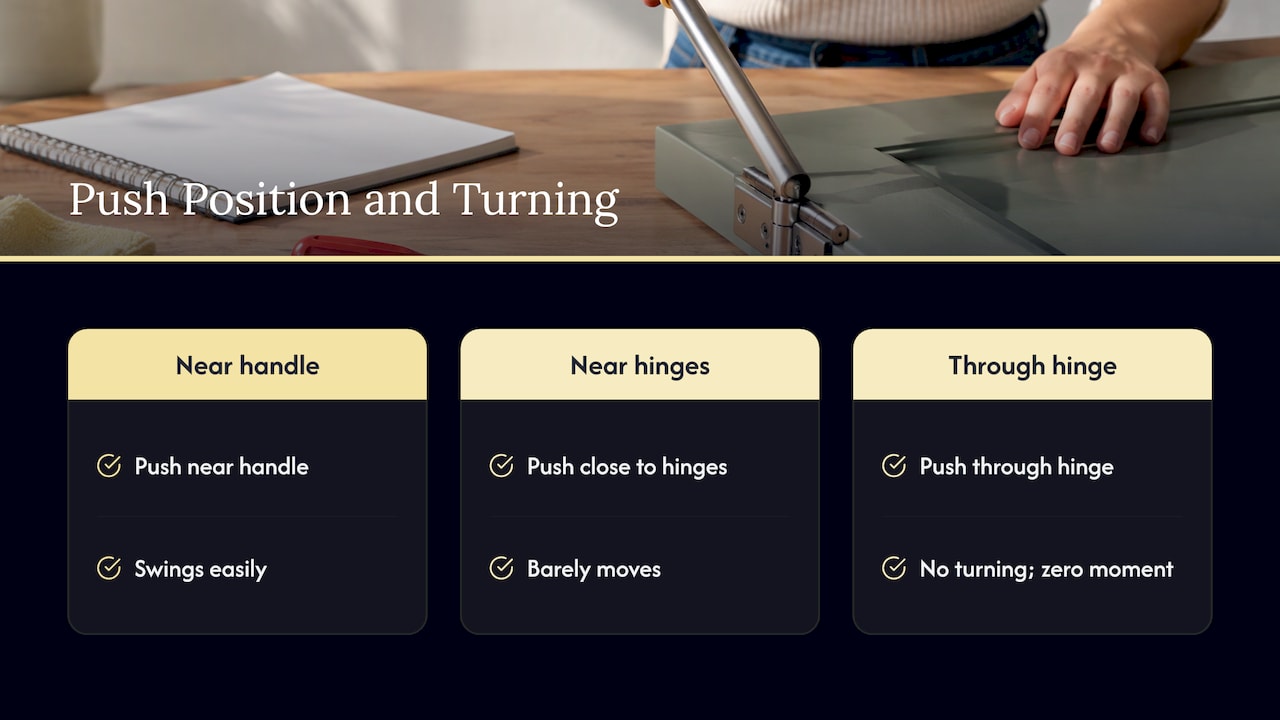
The door is the classic picture. Push near the handle and it swings easily. Push close to the hinges and it barely moves. Push exactly through the hinge and there is no turning at all, because the distance is zero and so the moment is zero.
The pivot is the point the body can turn about, such as a hinge, a fulcrum or a support. The line of action is the straight line along which the force acts, extended in both directions. The distance you need is the shortest distance from the pivot to that line, which always meets the line at a right angle.
The formula, units and the distance that trips people up
The formula is M = F × d. F is the force in newtons (N) and d is the perpendicular distance in metres (m), so the moment is in newton metres (N m), as BBC Bitesize’s guide to calculating moments sets out. The same page stresses that d is the normal, perpendicular distance from the pivot to the line of action, not just any distance along the object.
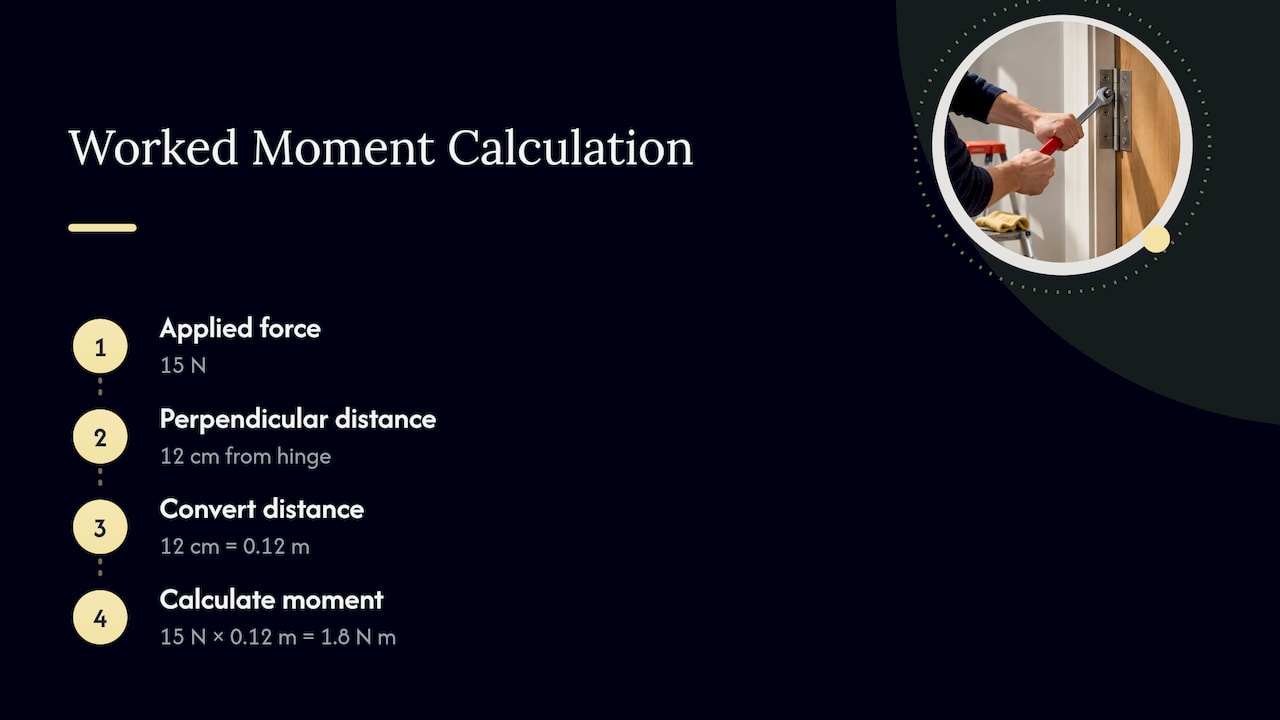
Units matter. If the distance is in centimetres, convert it first. Bitesize’s worked example has a 15 N force applied 12 cm from a hinge: M = 15 × 0.12 = 1.8 N m.
When the force is not at right angles
In A-Level questions the force is often at an angle to the beam, rod or ladder. There are two equivalent ways to handle it:
- Resolve the force. Split it into a component perpendicular to the beam and one along it. Only the perpendicular component turns the beam about a point on the beam, because the other component acts along a line passing through the pivot. The moment is F sin θ × d, where θ is the angle between the force and the beam.
- Find the perpendicular distance directly. Draw the line of action and measure from the pivot to it at a right angle.
Example: a 50 N force acts at 30° to a uniform rod, at a point 0.4 m from the pivot. The moment is 50 × sin 30° × 0.4 = 50 × 0.5 × 0.4 = 10 N m. Using cos 30° here is the single most common slip, so label your angle on a diagram before you pick sin or cos.
The principle of moments
When an object is balanced, the clockwise moments about any point equal the anticlockwise moments about the same point. A body in this state is in rotational equilibrium.
For a body that is completely at rest, two conditions hold together:
- the forces balance (resultant force zero), so you can resolve vertically and horizontally, and
- the moments balance about every point.
The second condition is what makes moments so useful. You are free to choose any point, and a good choice makes an equation with one unknown instead of three.
A method that works for beams, levers and ladders
Follow the same six steps every time.
- Draw a clear diagram. Mark every force: weights at the centre of a uniform body, reactions at supports, tensions, friction. Label distances along the body.
- Place the weight of a uniform beam at its midpoint. A uniform beam’s centre of mass is at its centre, so a 4 m beam has its weight 2 m from either end.
- Pick the point to take moments about. Choose a point where one or more unknown forces act. Those forces have zero distance, so they drop out of the equation.
- Write the equation. Clockwise = anticlockwise, with each term force × perpendicular distance.
- Solve, then use the vertical equation. Once you have one reaction, resolving vertically gives the other.
- Sanity-check. Reactions at supports should be positive. A negative value means the support would be pulled, which a simple support cannot do, so the body would be tipping.
Worked example 1: a beam on two supports
A uniform beam AB has length 4 m and weight 90 N. It rests on a support at A and a support at C, where AC = 3 m. A load of 30 N hangs from B. Find the reactions at A and C.
Take moments about A, because the unknown reaction at A then has no moment:
- Clockwise (weights, which act downwards to the right of A): 90 × 2 + 30 × 4 = 180 + 120 = 300 N m
- Anticlockwise (the reaction at C, acting upwards): R_C × 3
So 3R_C = 300 and R_C = 100 N.
Now resolve vertically: R_A + R_C = 90 + 30 = 120, so R_A = 20 N.
Both reactions are positive, so the answer is physically sensible.
Worked example 2: on the point of tilting
Using the same beam, what load at B would make the beam just about to tilt about C?
“On the point of tilting” means the reaction at the other support is zero, here R_A = 0. Call the load x newtons and take moments about C:
- Anticlockwise (the weight, 1 m to the A side of C, with the beam’s centre 2 m from A): 90 × 1
- Clockwise (the load at B, 1 m beyond C): x × 1
So x = 90 N. Check by moments about A: R_C × 3 = 90 × 2 + 4x. With R_C = 90 + x, you get 270 + 3x = 180 + 4x, so x = 90. The two routes agree.
The phrases to watch for in a question are “on the point of tilting”, “about to turn” and “in limiting equilibrium”. Each tells you one reaction is zero, or that friction is at its maximum.
Ladders and non-parallel forces
Ladder problems add friction and a wall. The Pearson Edexcel A-Level Maths specification gives ladder problems as an example of equilibrium with non-parallel coplanar forces. The routine is the same, with one extra habit: take moments about the foot of the ladder, where both the normal reaction and the friction act, so neither appears in the equation. Then resolve horizontally and vertically for the rest, using F ≤ μR for friction.
What the exam boards ask for
The moments content is small on paper, but it is tested in harder, multi-step questions.
| Board | Where moments appear | What the specification says |
|---|---|---|
| AQA A-Level Maths (7357) | Paper 2, content strand “S: Moments” | Understand and use moments in simple static contexts |
| Pearson Edexcel A-Level Maths (9MA0) | Paper 3, Topic 9 “Moments” | Content 9.1 covers moments in simple static contexts, with equilibrium of rigid bodies and ladder problems in the guidance |
| OCR A-Level Maths A (H240) | Paper 3, Mechanics section | Tested within mechanics questions on equilibrium |
If you take A-Level Physics, the topic returns with a slightly different emphasis: AQA Physics places moment, couple, principle of moments and centre of mass in its mechanics and materials content. The Maths version is more algebraic and more focused on beams and ladders. Check your own board’s specification for the exact wording and use its past papers for practice. Our AQA mechanics revision page lists the topics in order, and Edexcel students can see how Paper 3 is organised in our Edexcel Paper 3 predicted topics guide.
Mistakes examiners keep seeing
The OCR Summer 2025 examiners’ report on A-Level Maths A Paper 3 is a useful reality check. On a question where candidates had to find a tension, it noted that most candidates realised that taking moments about A was the effective approach, but many forgot a distance or used a wrong angle. It also advised candidates to make clear which point they are taking moments about.
Those comments point to a short list of habits:
- Not stating the point. Write “Moments about A” at the start of the equation. A marker can then follow your method and award method marks even if an arithmetic slip follows.
- Missing a force. Every force with a non-zero distance needs a term, including the weight of the beam itself and any weight of a hanging object.
- Wrong distance. Measure from the chosen point, not from the end of the beam. If the point is 1 m from A, a weight at the centre of a 4 m beam is 1 m from it, not 2 m.
- Wrong trig ratio. Draw the angle on the diagram. If the angle is between the force and the beam, the perpendicular component uses sin; if it is between the force and the perpendicular to the beam, it uses cos.
- Mixing directions. Pick “clockwise” or “anticlockwise” as positive and stick to it. Equating the two totals, as in the examples above, avoids sign confusion.
- Units. Convert centimetres to metres before you multiply, and give the answer in N m.
- Skipping the vertical equation. Moments give one unknown. The second comes from resolving forces, so do not stop after the first answer.
- Ignoring the tilting condition. If the question says the beam is about to tilt, set the right reaction to zero rather than introducing a new unknown.
How to practise moments properly
Moments reward repetition, because the skill is setting up a clean equation quickly. A sensible routine:
- Do five or six beam-on-two-supports questions until the setup is automatic.
- Move to tilting and “smooth peg” questions, where the reaction acts perpendicular to the beam.
- Add ladders with friction, and then angled strings or cables where you must resolve a tension.
- Attempt each question without help, then compare with a fully worked solution line by line. Check the method as well as the final number: did you pick the same point, and did you include every force?
Our guide on using worked solutions to revise GCSE and A-Level maths shows how to do the comparison step without just copying. If you prefer to see someone set a question out, our A-Level maths walkthroughs guide explains how to use video solutions to pick up marks. International A-Level students can try Cambridge mechanics papers, such as the CAIE A-Level Mechanics 1 June 2024 Variant 3 question paper, and then check against the matching mark scheme, for example the June 2023 Variant 3 mark scheme.
Teachers, tutors and parents can use the same sequence as a lesson plan or a homework set: it moves from one-step equations to the multi-step problems that appear late in Paper 3 or Paper 2.
Practise moments on real exam questions
MathVault gives students in England, Wales and Scotland free access to past exam papers, step-by-step solutions, video walkthroughs and topic-based revision guides, organised by exam board, plus weekly live Q&A sessions. For moments, that means you can work through genuine mechanics questions and see every line of the method, including the point moments are taken about and the distance used for each force.
Start from the A-Level maths past-paper questions, choose your board, and filter to mechanics. Parents and teachers who want offline copies can find downloadable revision packs on the site, while the revision materials themselves are free to use.
Our view: moments are a method, not a formula
Students often treat moments as a formula to memorise. We see it as a habit of setting out. The formula M = F × d takes seconds to learn. The marks are won by the choices around it: which point to take moments about, which forces to include, which distance is perpendicular.
That is why we put fully worked solutions beside every past paper. A final answer only tells you that you were right or wrong. A worked solution shows where the method marks were earned, so you can compare your own diagram, your chosen point and your equation with the mark scheme’s logic and find the exact line where your solution diverged.
We also offer all of this free, along with weekly live Q&A sessions, because a topic like moments is best learned by doing many questions and getting prompt feedback. Our aim is that every student in the UK can practise on real exam material, whichever board they sit, and walk into the exam knowing how to set out a moments question from the first line.
Oloru
FAQ
Is moments in A-Level Maths or only in Physics?
Both. In A-Level Maths, moments are part of the mechanics content: AQA lists “S: Moments” and Pearson Edexcel has Topic 9 “Moments”. In A-Level Physics, moments appear in the mechanics and materials content. The Maths questions lean on beams, ladders and algebra, so check your own specification.
Does it matter which point I take moments about?
The answer will be the same whichever point you choose, because a body in equilibrium has balanced moments about every point. The choice affects how easy the algebra is. Pick a point where an unknown force acts, so that force has zero distance and disappears from the equation. Always write down the point you chose.
How do I know when to use sin or cos for an angled force?
Find the component of the force perpendicular to the beam, then multiply by the distance along the beam. If the angle is measured between the force and the beam, that component is F sin θ. If it is measured from the perpendicular, use F cos θ. Drawing the angle on your diagram prevents most errors.
What does “on the point of tilting” mean?
It means the beam is just about to rotate, so the reaction at the support it is lifting away from is zero. You then take moments about the other support, with one fewer unknown. In worked example 2 above, setting R_A = 0 gave the load of 90 N.
Sources
- AQA A-Level Physics 7408 specification: mechanics and materials
- BBC Bitesize: How to calculate moments
- BBC Bitesize: What is a moment of a force?
- BBC Bitesize: Investigating the principle of moments
- AQA A-Level Mathematics 7357 specification
- Pearson Edexcel A-Level Mathematics specification
- OCR A-Level Mathematics A H240/03 examiners’ report, Summer 2025
Leave a Reply