
GCSE maths papers typically run 1 hour 30 minutes each, and A-Level maths papers are commonly 2 hours long, though some specifications vary. The single rule that matters most is to pace by marks per minute rather than by question count: divide total marks by total minutes, then treat that figure as a ceiling for every question you meet. Rehearse this on your exact board and tier before exam day.
TL;DR:
- Pacing should be based on marks-per-minute rather than question count, with roughly 1.1 minutes per mark on GCSE papers and slightly more on A-Level exams.
- Different exam boards and tiers have varying time allocations, so always check your specific paper’s duration and total mark count before practicing.
- Practice under timed conditions with full past papers and review your method to identify where faster alternatives can be applied.
- Set a strict time ceiling for difficult questions and move on once exceeded to avoid losing valuable exam time.
- Use a rehearsed, step-by-step routine, including early scan, quick-answer questions, targeted second passes, and final review, to improve pacing accuracy.
Table of Contents
- Quick reference: common GCSE and A-Level paper durations
- How to pace a paper: marks-per-minute explained with worked examples
- Step-by-step exam-day routine: a minute-by-minute checklist
- How to practise timing effectively with past papers and drills
- Common timing pitfalls and quick fixes
- MathVault’s perspective: how board-aligned practice reduces timing errors
- Get started: Mathvault resources to practise timing right now
- FAQ
- Sources
- Key exam-board and official pages to check
Quick reference: common GCSE and A-Level paper durations
Before you can pace a paper, you need to know how long it runs and how many marks are on offer. Durations are broadly consistent across boards, but small differences between tiers and specifications matter when you are planning minutes per mark.
AQA GCSE mathematics sets each paper at 1 hour 30 minutes with 80 marks per paper, across three papers at the same tier, one non-calculator and two calculator-allowed, according to AQA’s specification at a glance. OCR follows a similar structure: three papers of equal length per tier, with many OCR GCSE papers also running 1 hour 30 minutes, as set out in the OCR GCSE (9-1) Mathematics specification. WJEC specifications show more variation by tier and unit, with some WJEC units running 1 hour 45 minutes at higher tier and 1 hour 30 minutes at foundation. Edexcel timetables and specimen materials confirm the same 1 hour 30 minute pattern for GCSE papers, with many A-Level maths papers lasting 2 hours, according to Pearson’s examination timetables.
- Check your own specification and tier before rehearsing, since durations and mark totals differ between boards and even between papers on the same board.
- Note the calculator status of each paper before you start timing yourself, since calculator papers often carry different question mixes.
How to pace a paper: marks-per-minute explained with worked examples
Question count is a poor guide to pacing because marks are not spread evenly. A one-mark recall question and a six-mark proof can sit side by side, and the mark scheme weights them very differently through assessment objectives like method and accuracy marks. Pacing by marks tells you how much a question is actually worth to your final score, which is the number that counts.
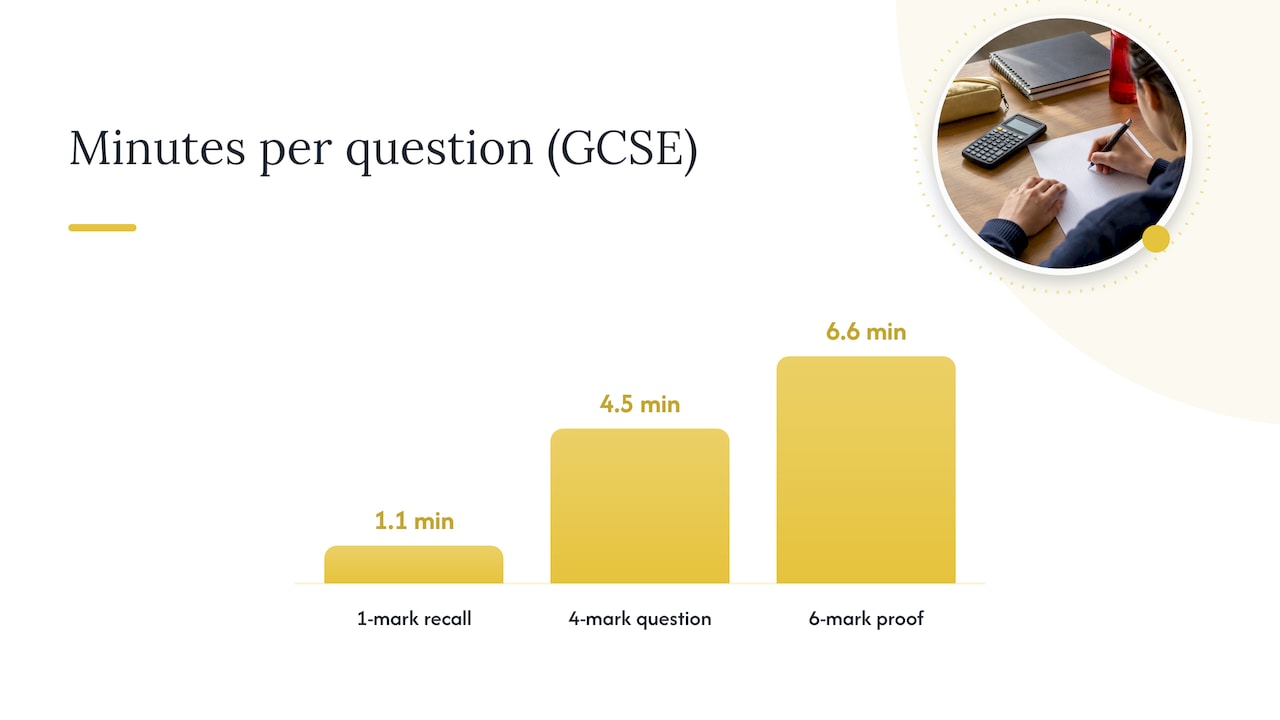
One mark on an AQA GCSE paper is worth roughly 1.1 minutes, based on AQA’s published paper structure of 80 marks over 90 minutes. That means a four-mark question should take around 4.5 minutes, and anything running well past that deserves a second look rather than more time.
On an A-Level paper with 100 marks over 2 hours, the baseline works out at typical minutes per mark, so a nine-mark mechanics question should take roughly the corresponding time including setting up equations and checking units.
- Treat your marks-per-minute figure as a ceiling, not a target: finishing a question early banks spare time for harder parts later.
- When a question overruns its ceiling, write down your best method line, leave a gap, and move on rather than losing further minutes.
- Reserve the final few minutes of the paper for checking rather than attempting new ground you have already skipped.
- Multi-part questions often front-load easy marks in parts (a) and (b), so secure those quickly before committing time to a tricky final part.
Step-by-step exam-day routine: a minute-by-minute checklist
A routine you have rehearsed removes decision-making under pressure. The same four-stage pattern works whether you are sitting a GCSE paper or an A-Level unit.
- Scan the paper for two to four minutes. Note which questions carry the highest marks, confirm whether a calculator is allowed, and check where the formulae sheet sits in the booklet.
- Run a first pass for easy marks. Answer every question you can do immediately, writing enough working to secure method marks even when the final answer is wrong.
- Run a second pass using your marks-per-minute ceiling. Attempt harder questions within their time budget, flag any part you cannot finish, and note roughly how long to come back for.
- Spend the final eight to twelve minutes checking. Recheck calculator entries, confirm units are included, make sure answers are transferred to the right boxes, and tidy any workings an examiner might struggle to follow.
Pro Tip: Write the time you should finish each section in the margin before you start, based on your marks-per-minute ceiling, so you have a running check rather than guessing halfway through.
Showing working matters throughout this routine, since method marks are awarded independently of the final answer; our guide on showing working in GCSE maths covers exactly how much detail examiners expect.
How to practise timing effectively with past papers and drills
Timing improves fastest when practice conditions match the real exam as closely as possible. Set a fixed slot with no interruptions, use the correct calculator (or none, for non-calculator papers), and time yourself against the paper’s actual duration rather than a round number.
- Log how long each question type takes you against your marks-per-minute baseline, so you can see exactly where time disappears.
- Target drills at the question types that consume disproportionate time for you specifically, whether that is multi-step algebra, applied mechanics, or statistics interpretation.
- After each timed mock, review the paper against full worked solutions rather than just the final answers, since the method is where most time is lost or saved.
- Rotate between board-matched papers so your timing habits transfer directly to the paper you will actually sit.
Our past paper packs with step-by-step solutions let you self-mark against board-aligned answers and bring questions to live Q&A sessions when a method is not clicking. For structured practice in the final weeks, our 48/24/8 last-minute revision plan sequences timed papers across the days before the exam.
Pro Tip: Practise applied word problems separately from pure technique, since translating a scenario into equations often eats more time than solving the equations themselves; tactics for maths word problems are worth a focused session on their own.
Common timing pitfalls and quick fixes
Most timing problems come down to a handful of repeated habits rather than a lack of knowledge.
- Getting stuck on one hard question. Fix: set a strict time ceiling based on its marks, and move on the moment you hit it, returning only if time allows.
- Writing too little working to earn method marks. Fix: build the habit of jotting the key intermediate step on every question, even ones you are confident about.
- Relying on memorised formulae instead of the formula sheet. Fix: practise locating and applying formulae from the GCSE maths formula sheet under timed conditions, since the sheet will be provided in 2026 exams according to Ofqual’s guide for schools and colleges.
- Skipping calculator rehearsal. Fix: run timed checks of your calculator’s key sequences for statistics and trigonometric functions before the exam, not during it.
MathVault’s perspective: how board-aligned practice reduces timing errors
Timing problems are usually method problems in disguise. A student who loses four minutes on a six-mark question is often missing a faster route, not more time. Working through past papers against fully worked solutions, rather than just final answers, shows exactly where a quicker method existed, which turns each timed mock into a specific, fixable lesson rather than a vague sense of running late. Live Q&A sessions let a student test that fix against a real question within days rather than guessing until the next mock. Watching that gap close, paper after paper, is the clearest evidence that board-aware, worked-solution practice changes pacing faster than timing advice alone.
— Oloru
Get started: Mathvault resources to practise timing right now
We built our resources around the same principle running through this guide: timing improves fastest when practice is matched to your exact board and tier, and reviewed against full working rather than guesswork. Every past paper, worked solution and video walkthrough on our site is free to use, with optional downloadable packs and live Q&A for anyone who wants extra structure.
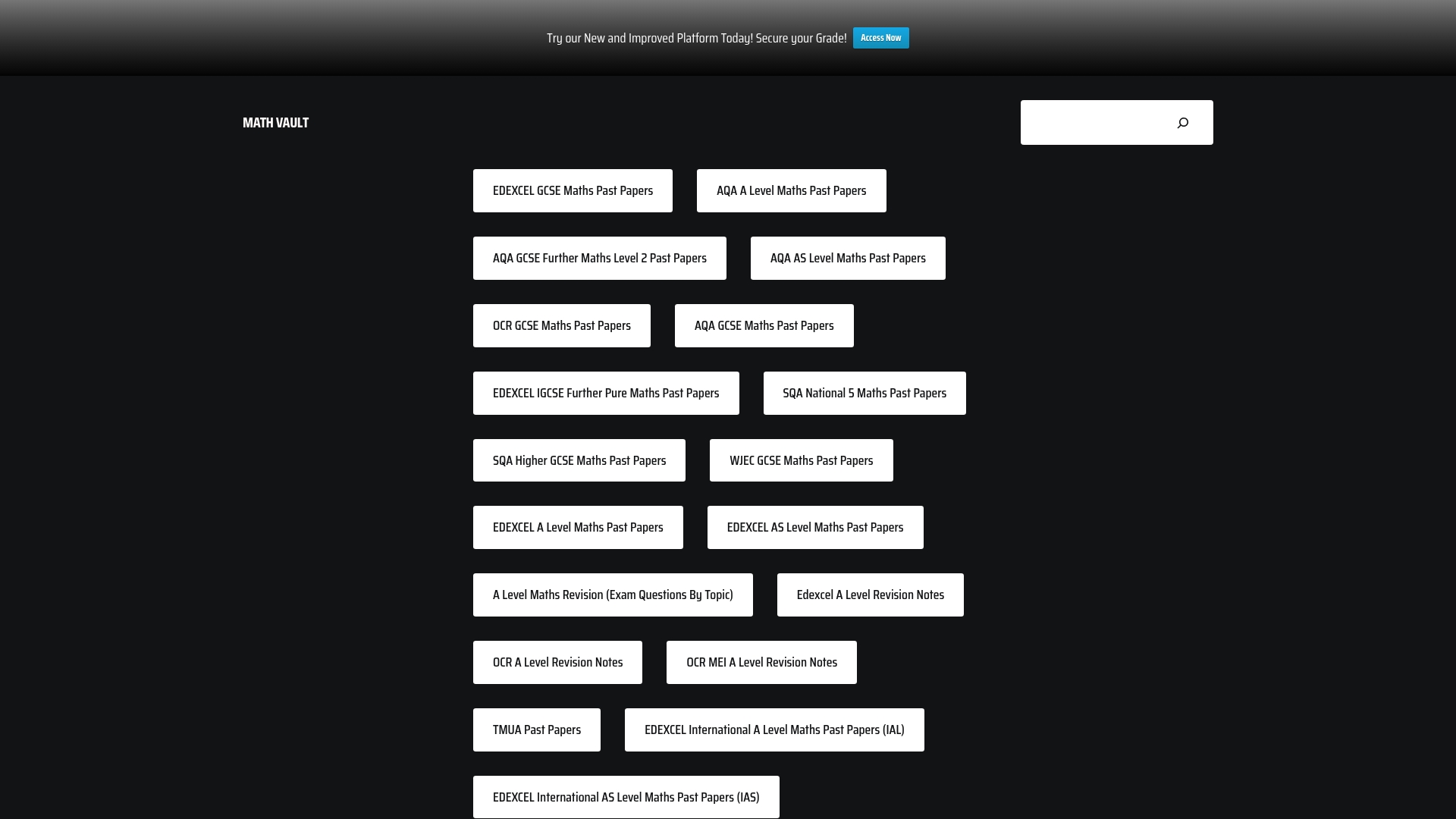
- Download Edexcel GCSE past paper questions by topic to drill the question types costing you the most time.
- Work through AQA A-Level maths papers or Edexcel A-Level past paper questions by topic to rehearse the 2-hour pacing baseline.
- Follow the 48/24/8 last-minute revision plan to sequence your final timed mocks before the exam.
Run one timed past paper today, mark it against the full solutions, and check your result against the marks-per-minute rule for your paper. That single post-mortem will tell you more about your pacing than another week of untimed revision.
FAQ
How long is a typical GCSE maths exam paper?
Most GCSE maths papers run 1 hour 30 minutes, including AQA’s three papers at 80 marks each, confirmed in AQA’s specification. Some WJEC units run longer at higher tier, so always check your specific specification.
How long is an A-Level maths paper?
Many A-Level maths papers across AQA, OCR and Edexcel run 2 hours with 100 marks on offer, based on published specifications. Check your board’s exact paper structure, since some units mix pure, statistics and mechanics content within that time.
What is the marks-per-minute rule for exam timing?
The marks-per-minute rule means dividing total marks by total minutes to set a time ceiling for each question, rather than pacing by question count. For an AQA GCSE paper, that works out to roughly 1.1 minutes per mark, based on 80 marks over 90 minutes.
Will I get a formula sheet in my GCSE maths exam?
Yes, Ofqual and JCQ guidance confirms that formulae and equation sheets will be provided in GCSE maths exams, according to the Ofqual guide for schools and colleges 2026. Practising with the actual sheet under timed conditions is faster than trying to memorise every formula.
How can I practise exam timing before the real exam?
Sit full past papers under realistic timed conditions, using the correct calculator rules for that paper, then mark your work against full worked solutions to see exactly where time was lost. Our past paper packs with step-by-step solutions are built for this kind of timed, self-marked practice.
Sources
- GCSE Mathematics 8300 | Specification | Specification at a glance | AQA
- OCR Level 1/Level 2 GCSE (9–1) in Mathematics (J560) specification
- WJEC GCSE mathematics specification (excerpts)
- Gov
Key exam-board and official pages to check
For exact durations and mark totals on your own paper, go to the primary source rather than a summary. Check AQA’s GCSE mathematics specification, OCR’s GCSE (9-1) Mathematics specification, WJEC’s GCSE mathematics specification, and Pearson’s examination timetables. For official guidance on exam conduct and support materials, see the Ofqual guide for schools and colleges 2026. For free practice matched to these specifications, visit Mathvault.
Leave a Reply