
The step from GCSE to A-Level Maths is bigger than most students expect, but it is very manageable if you prepare for it. Most sixth forms ask for a grade 6 or above at GCSE, the course leans heavily on algebra, and the pace and style of questions change. This guide explains what the entry requirements look like, what is genuinely different, which topics to strengthen first and how to use past papers to close gaps before you start.
TL;DR
- There is no single national entry grade. Schools and colleges set their own, so check the requirement for the exact course you want.
- The biggest shifts are the pace, the amount of algebra and the expectation that you will reason through unfamiliar problems rather than repeat a method.
- Secure algebra, indices, surds, graphs, trigonometry and equation-solving before September.
- Buy or borrow the calculator your exam board expects: a GCSE basic scientific model will not be enough.
- Use past papers and worked solutions to find weak spots early, then fix them topic by topic.
Table of Contents
- How big is the jump from GCSE to A-Level?
- What grade do you need in GCSE Maths?
- What actually changes: GCSE versus A-Level
- The GCSE topics worth securing before September
- Prepare over the summer: a realistic plan
- Improve your GCSE Maths grade before you start
- Using past papers and worked solutions well
- Habits that carry you through the first term
- Our perspective: what we see students struggle with
- Free practice to bridge the gap
- FAQ
- Sources
How big is the jump from GCSE to A-Level?
Big enough to be worth planning for. Research by Cambridge Assessment found that the move is widely seen as problematic, with many students dropping out during the first year or after AS results, and that teachers often believe there is a gap between the maths needed to pass GCSE and the maths needed to begin A-Level.
That does not mean A-Level is out of reach. It means the first term is where students are most likely to feel the strain, so a little preparation pays off more here than at any other point in the course.
Three things tend to cause the shock:
- Pace. At GCSE a topic may be revisited over several terms. At A-Level you meet a new idea, practise it briefly and move on, with the expectation that you keep earlier work fresh.
- Algebra everywhere. Calculus, sequences, trigonometry and coordinate geometry all rely on confident manipulation. A slip in algebra costs marks in every topic.
- Less hand-holding in questions. GCSE questions often signal the method. A-Level questions more often ask you to decide which tools to use, then justify the result.
The same research notes that one teacher linked difficulties to the long gap between the end of Year 11 lessons and the start of sixth form. Summer is the stretch where skills fade, so it is also the best window to rebuild them.
What grade do you need in GCSE Maths?
The official guidance is deliberately general. The government’s Skills for Careers page says that you usually need at least five GCSEs at grades 9 to 4, and grade 6 in the subjects you want to study, and tells students to check with the school or college for exact requirements. A levels are Level 3 qualifications and carry UCAS points, but the entry bar itself is set locally.
In practice that means:
- Grade 6 is the common minimum for A-Level Maths, though some schools accept it only with conditions or ask for more.
- Grade 7 is a frequent requirement, and many colleges treat it as the sensible starting point.
- Grade 8 or 9 is often asked for by selective schools, particularly for Further Maths.
If you are borderline, ask the sixth form how it supports students at the lower end of its range, and whether it runs a bridging unit or a maths check in the first weeks. Remember that your target university course may also state subject requirements, and you can estimate how your final A-Level results convert with our UCAS points calculator.
A note for Scotland
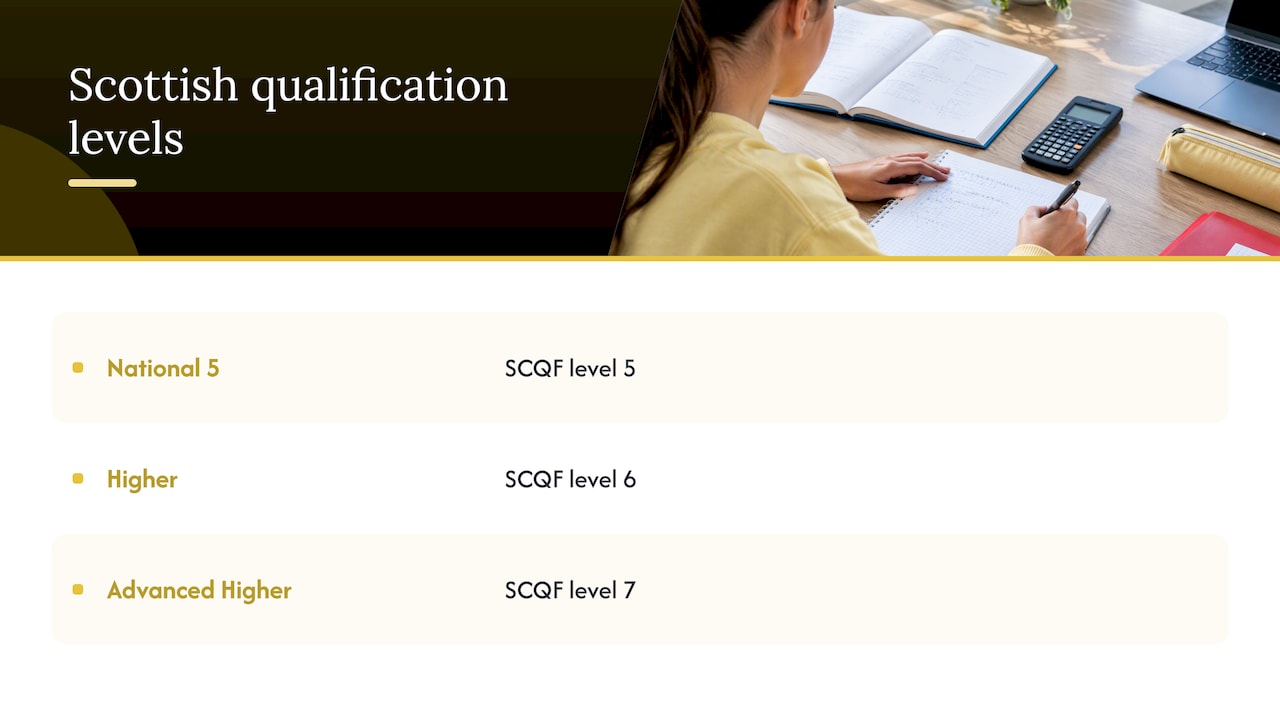
The route looks different north of the border. Scottish qualifications sit on the SCQF framework, where National 5 is level 5, Higher is level 6 and Advanced Higher is level 7. If you are moving from National 5 to Higher Maths, the principles in this guide still apply (secure your algebra, practise with exam-style questions), but the course names and assessments differ from the GCSE to A-Level route in England.
What actually changes: GCSE versus A-Level
| Area | GCSE Maths | A-Level Maths |
|---|---|---|
| Algebra | Rearranging, solving, expanding, factorising | Used constantly inside calculus, sequences, proof and trigonometry |
| Question style | Often structured with a clear method | More open: you choose the method and justify it |
| New content | Mostly consolidation of earlier work | Differentiation, integration, proof, exponentials and logarithms, vectors in new contexts |
| Calculator | Basic scientific model usually enough | Advanced scientific or graphical display calculator expected |
| Pace | Topics revisited across years | New topic roughly every few lessons |
| Independent work | Homework supports class learning | Regular independent practice is part of the course |
A-Level also introduces mathematical argument. You will be asked to prove, to show and to explain, and examiners reward clear logical steps, not only the final answer.
The GCSE topics worth securing before September
Research from Cambridge Assessment suggests schools often struggle to balance deep algebraic preparation for A-Level with a GCSE curriculum that must serve students of very different abilities. If your GCSE course did not go far on algebra, you can close that gap yourself. Prioritise these areas.
1. Algebraic manipulation
Expanding double and triple brackets, factorising quadratics (including when the coefficient of x² is not 1), completing the square, rearranging formulae where the subject appears twice and solving simultaneous equations, including one linear and one quadratic. If you do only one thing, do this.
2. Indices and surds
Fractional and negative indices appear straight away in A-Level, then again in calculus. Surds appear in trigonometry and coordinate geometry, so rationalising a denominator should feel routine. Our OCR GCSE Number revision covers both with exam-style questions.
3. Graphs and functions
Sketching quadratics, cubics and reciprocal graphs, understanding transformations and finding the equation of a straight line are the foundation for differentiation. Practise with the Graphs and Functions topic set.
4. Trigonometry
SOH CAH TOA, the sine and cosine rules and the area formula are assumed. A-Level then adds radians, identities and equations with multiple solutions, so exact values for 30°, 45° and 60° are worth memorising now.
5. Sequences
nth-term rules for linear and quadratic sequences are the stepping stone to arithmetic and geometric series. Work through our Sequences questions to check you can move between the term-to-term and position-to-term rules.
6. Vectors
Vector geometry at GCSE is the base for vectors and mechanics at A-Level. Try the Vectors question set and make sure you can write vectors in terms of a and b and argue that points are collinear.
Prepare over the summer: a realistic plan
You do not need hours a day. Three or four short sessions a week beat one marathon.
- Week 1: diagnose. Attempt a mixed set of higher-tier questions without notes. Mark honestly and list every question you got wrong or skipped.
- Weeks 2 to 4: algebra. Spend most of your time on the first two topics above, with a short daily warm-up of mixed questions.
- Weeks 5 to 6: graphs, trigonometry and sequences. Sketch graphs by hand, then check with a graphing tool.
- Final week: a timed paper. Sit a higher-tier paper under exam conditions and compare with the mark scheme.
OCR publishes a bridging resource that is a good model for what to do: it reviews GCSE algebra and includes trigonometry and graphing exercises to help you spot areas needing support before new concepts arrive. Your own school may also set bridging work, so do that first and use extra practice to fill what it leaves out.
Get the right calculator early
OCR states that GCSE basic scientific calculators will not be sufficient for A-Level Maths: students need a graphical display calculator or an advanced scientific model, naming the Casio fx991CW+ UK and TI 90X Pro as examples. Check which model your school recommends before buying, and learn it properly, including fractions, tables, equation solving and statistical functions.
Improve your GCSE Maths grade before you start
If results day left you a grade short, or you are resitting, the same principles apply: practise, find the gaps, repeat.
- Work from the mark scheme. Learn how method marks and accuracy marks are awarded. Writing clear working earns marks even when the final answer is wrong.
- Try goal-free problems. AQA’s support materials include specimen and practice papers, shadow papers and goal-free problems, and goal-free tasks encourage you to examine the information given, which can help you pick up method marks.
- Revise by topic, not by paper. Once you know your weak areas, topic sets give far more practice per hour than another full paper.
- Redo, don’t just read. Reading a solution feels productive. Closing it and reproducing the method a day later is what proves you can do it.
If you are working on a specific board, we organise questions by exam board, including AQA GCSE Maths 2018 papers and mark schemes and the Edexcel GCSE topic questions.
Using past papers and worked solutions well
Past papers are the most direct way to see where you stand. BBC Bitesize’s guidance on OCR papers suggests using past-paper practice and worked examples to identify the areas you feel confident in and those that need more practice. A simple routine makes this concrete:
- Attempt a question or paper without notes and with a timer.
- Mark it against the scheme, noting method marks (M), accuracy marks (A) and any marks for reasoning.
- Tag each lost mark: did not know the topic, knew it but slipped, or misread the question.
- Revisit the topic in a revision guide, then retry a similar question a few days later.
The tags matter. Careless slips need a different fix (checking habits) from knowledge gaps (more learning).
Taster questions from A-Level itself
Once your algebra feels steady, look ahead. Browsing early A-Level past-paper questions shows what the course will ask of you. You will not be able to solve everything, and that is the point: noticing which parts feel unfamiliar tells you what to expect. When you are further in, our AQA A-Level 2024 papers and Edexcel A-Level questions by topic give full-length practice.
Habits that carry you through the first term
- Review within 24 hours. Redo the class examples that evening. It takes ten minutes and prevents most of the falling behind.
- Keep an error log. A notebook of mistakes, with the corrected method, becomes your best revision resource.
- Ask early. If a topic did not click, speak to your teacher that week. Small gaps compound quickly at this pace.
- Write full working. Examiners cannot award method marks for steps they cannot see.
- Practise a little every day. Fifteen minutes of mixed questions beats a weekend cram.
If you want a structured long-term plan once the course is under way, our guide to getting an A* in A-Level Maths in 12 weeks lays out a revision schedule.
Our perspective: what we see students struggle with
We build resources around exam questions and fully worked solutions, and the same pattern shows up again and again. Students rarely fail at A-Level because they cannot understand a new idea. They lose marks because a GCSE skill, usually algebra, is not quite automatic, so every question carries extra risk.
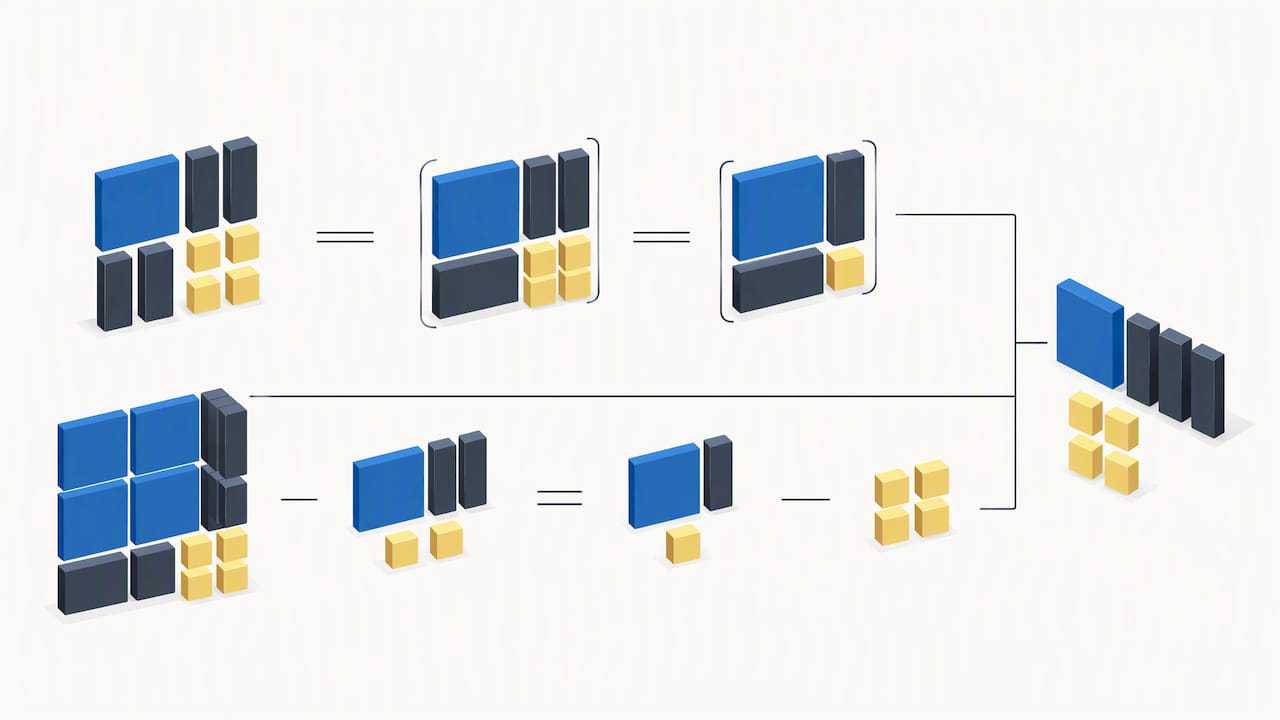
That is why we recommend treating the summer as a skills-rebuilding exercise rather than a head start on new content. Learning differentiation early can help, but only if factorising, indices and rearranging are already fluent. Otherwise the new topic simply exposes old cracks.
We also believe in making it normal to find the first term hard. A drop in marks does not mean you picked the wrong subject. It usually means you are adjusting to a different style of question, and that adjusts with deliberate practice, honest marking and good feedback from worked solutions. Good solutions show why a method is chosen, not just the steps, and that is what we aim to provide.
— Oloru
Free practice to bridge the gap
MathVault gives you free past papers, fully worked step-by-step solutions, video walkthroughs, topic-based revision guides and weekly live Q&A sessions, organised by UK exam board. You can start with the OCR GCSE Maths revision topics to rebuild the foundations, then move across to A-Level questions when you are ready. Most of what we offer is free; some full downloadable packs are available if you prefer offline revision.
Parents and tutors can use the same topic structure to set short, targeted tasks, and the MathVault homepage shows everything available by exam board.
FAQ
Is A-Level Maths much harder than GCSE Maths?
Yes, for most students it is a clear step up in pace, depth and independence. Algebra is used in nearly every topic, and questions expect you to choose and justify methods. With steady preparation and regular practice, most students who meet their school’s entry requirement cope well.
What GCSE Maths grade do I need for A-Level Maths?
There is no single national grade. Government guidance says to expect around grade 6 in subjects you want to study, but each school or college sets its own requirement, and selective ones may ask for a 7, 8 or 9. Always confirm with the sixth form you plan to attend.
What should I revise before starting A-Level Maths?
Start with algebra, then indices and surds, graphs, trigonometry and sequences. These underpin the early A-Level units. Use a diagnostic set of questions to see where you lose marks, and spend your time there.
Do I need a different calculator for A-Level Maths?
Usually, yes. OCR says a basic GCSE scientific calculator will not be enough and recommends an advanced scientific or graphical display model. Ask your school which one it prefers so that classroom demonstrations match your device.
Can I still improve my GCSE Maths grade if I am close to the boundary?
Yes. Focus on topic-by-topic practice, mark yourself against official mark schemes, and learn how method marks work. Closing a few specific gaps is usually more effective than re-reading everything.
Sources
- Teachers’ and employers’ views on the transition from GCSE mathematics to A-Level mathematics or employment (Cambridge Assessment)
- A levels | Skills for Careers
- Transition from GCSE to A Level Mathematics (OCR)
- AQA All About Maths: GCSE Maths (8300)
- How to use OCR past papers to revise GCSE maths (BBC Bitesize)
- SFR National Statistics release on qualifications frameworks
Leave a Reply