
For most GCSE maths students, Mathvault is the strongest starting point: free past papers, fully worked step-by-step solutions, video walkthroughs, and live weekly Q&A sessions, all organised by UK exam board. No subscription, no hidden paywall, and no guesswork about which board your paper belongs to.
If you want a quick shortlist before reading further:
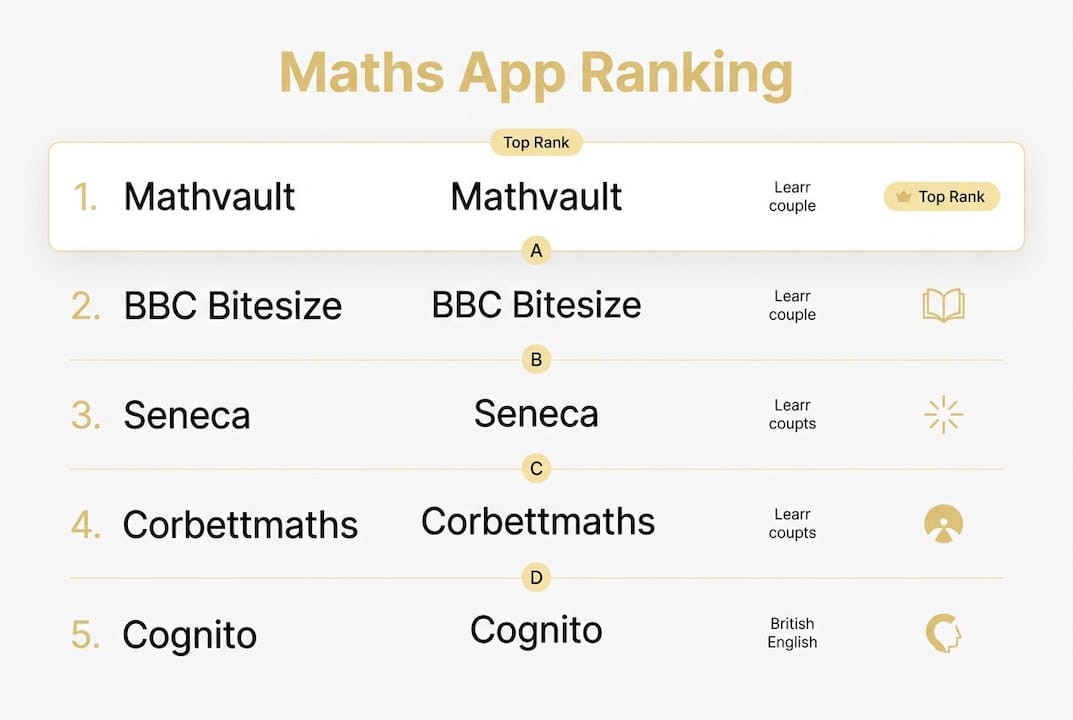
- Mathvault — best for past-paper practice with fully worked solutions and live Q&A (free)
- BBC Bitesize — best for curriculum-mapped summaries and quick quizzes across all major boards (free)
- Seneca Learning — best for spaced-repetition topic revision and gap identification (free core)
- Save My Exams — best for exam-style practice questions with mark schemes (free and paid tiers)
- Corbettmaths — best for topic-by-topic video lessons and practice papers (free)
- Cognito — best for short video explanations paired with instant-feedback questions (free)
Curriculum alignment and past-paper coverage are the single biggest determinants of an app’s usefulness for GCSE revision. The apps above all meet that bar; the rest of this guide explains which one suits your specific revision style.
Table of Contents
- Which maths revision app is right for your GCSE?
- Profiles: what each app does and when to pick it
- How do you choose the right maths revision app?
- How to use revision apps effectively for GCSE maths
- How we evaluated and selected these apps
- Why past papers and worked solutions matter most
- Key takeaways
- The honest truth about revision apps
- Start with Mathvault’s free GCSE resources
- Sources and useful links
Which maths revision app is right for your GCSE?
| App / Platform | Best for | Price model | Exam-board support | Content type | Device / offline | Standout feature |
|---|---|---|---|---|---|---|
| Mathvault | Past papers + worked solutions | Free (donations/packs optional) | AQA, Edexcel, OCR, WJEC, SQA | Past papers, worked solutions, videos, live Q&A | Web / printable | Live weekly Q&A + board-organised solutions |
| BBC Bitesize | Curriculum summaries + quizzes | Free | AQA, Edexcel, OCR, WJEC, CCEA, SQA | Videos, quizzes, revision notes | iOS / Android / web | Nation-specific content filtering |
| Seneca Learning | Spaced-repetition topic revision | Free core / paid premium | AQA, Edexcel, OCR | Notes, quizzes, spaced repetition | Web / iOS / Android | Adaptive spaced-repetition engine |
| Save My Exams | Exam-style practice questions | Free + paid tiers | AQA, Edexcel, OCR, WJEC | Practice questions, mark schemes, notes | Web | Concise mark-scheme answers |
| Corbettmaths | Topic videos + practice papers | Free | AQA, Edexcel, OCR | Videos, worksheets, practice papers | Web / printable | 5-a-day daily practice questions |
| Cognito | Short video + instant feedback | Free | AQA, Edexcel, OCR | Videos, practice questions | Web / iOS / Android | Concise video lessons with built-in questions |
| Quizlet | Flashcard-based term recall | Free core / paid | Board-agnostic | Flashcards, matching games | iOS / Android / web | Spaced-repetition flashcard sets |
| EdPlace | Personalised adaptive worksheets | Paid subscription | National Curriculum | Worksheets, adaptive questions | Web | Parent/teacher progress dashboard |
| Arc Maths | Adaptive micro-skill practice | Paid (school licence) | AQA, Edexcel | Adaptive questions, diagnostics | Web | Granular skill-gap diagnostics |
| Tassomai | Daily quiz habit building | Paid subscription | AQA, Edexcel | Daily quizzes, spaced repetition | iOS / Android / web | Streak-based daily quiz programme |
| GCSEPod | Short audio-visual pods | Paid (school licence) | AQA, Edexcel, OCR, WJEC | Short video pods, quizzes | iOS / Android / web | 3–5 minute topic pods |
| Educake | Teacher-set homework quizzes | Paid (school licence) | AQA, Edexcel, OCR | Online quizzes, instant marking | Web | Teacher-assigned quiz workflow |
| Pearson Revise | Structured revision guides | Paid (book purchase) | Edexcel | Revision notes, practice questions | Print / web | Edexcel-official revision content |
| Pearson Revise Online | Digital Pearson revision content | Paid subscription | Edexcel | Digital notes, practice questions | Web | Official Edexcel digital companion |
| SimpleStudy | Quick topic summaries | Free core | Board-agnostic | Summaries, flashcards | iOS / Android | Clean, minimal interface |
| RevisePal | AI-assisted revision planning | Freemium | Board-agnostic | AI-generated quizzes, notes | Web / iOS / Android | AI study-plan generator |
| KayScience | Science-focused revision (some maths) | Free | AQA, Edexcel | Videos, worksheets | Web | Clear worked examples |
Free vs paid at a glance: Mathvault, BBC Bitesize, Corbettmaths, Cognito, and Seneca Learning (core) are fully free for the vast majority of GCSE content. Save My Exams, Quizlet, and SimpleStudy offer meaningful free tiers with optional upgrades. EdPlace, Arc Maths, Tassomai, GCSEPod, and Educake are primarily school-licensed or subscription-based.
BBC Bitesize’s Exam Revision app reports more than 1.5 million weekly users across the UK, which reflects how widely curriculum-aligned free resources are used at GCSE level.
Profiles: what each app does and when to pick it
Mathvault

Mathvault is a free web platform built specifically for GCSE and A-Level maths in England, Wales, and Scotland. Its resources are organised by exam board, so you are never hunting through generic content to find your paper. The standout feature is the combination of past papers, fully worked step-by-step solutions, and live weekly Q&A sessions where you can ask questions in real time.
Pros: Completely free for the core resources; board-specific organisation (AQA, Edexcel, OCR, WJEC, SQA); video walkthroughs that explain method marks; live Q&A for direct support; downloadable revision packs available.
Cons: Primarily web-based rather than a dedicated mobile app; the live Q&A runs to a fixed weekly schedule.
Mathvault suits students who are ready to do timed past papers and want to understand exactly where marks are gained or lost, not just whether an answer is right or wrong.
BBC Bitesize

BBC Bitesize is the go-to free resource for broad curriculum coverage. Its Exam Revision app lets you filter by exam board and nation, which means students in Wales, Scotland, and Northern Ireland get content mapped to their specific syllabuses rather than a generic English version. Available on iOS, Android, and web with no in-app purchases.
Pros: Completely free; covers all major boards including CCEA and SQA; strong for topic summaries and quick-check quizzes; well-maintained by a trusted public broadcaster.
Cons: Lighter on exam-style practice questions; less useful for timed past-paper simulation.
Seneca Learning
Seneca uses a spaced-repetition algorithm to surface the topics you are most likely to forget, which makes it more efficient than re-reading notes. The free tier covers a substantial amount of GCSE maths content for AQA, Edexcel, and OCR. A paid Seneca Plus subscription unlocks additional features, though most students find the free version sufficient for topic consolidation.
Pros: Adaptive spaced repetition; clear topic-by-topic structure; works well on mobile.
Cons: Less past-paper focused; paid tier required for some advanced features.
Save My Exams
Save My Exams offers concise, examiner-written practice questions with mark schemes. The free tier gives access to a meaningful bank of questions; a paid subscription unlocks the full library. It is particularly strong for students who want to drill specific question types rather than sit full papers.
Pros: Examiner-written content; clean mark schemes; good for targeted topic practice.
Cons: Full access requires a subscription; not a substitute for full past-paper practice.
Corbettmaths
Corbettmaths is a teacher-built free site with an enormous library of topic videos, practice worksheets, and full practice papers. The 5-a-day feature gives you five daily practice questions at different difficulty levels, which is a low-effort way to maintain consistent practice. Printable worksheets make it one of the few genuinely offline-friendly options.
Pros: Entirely free; printable worksheets; excellent topic video library; 5-a-day habit builder.
Cons: Website design is functional rather than polished; no adaptive features.
Cognito
Cognito pairs short, clear video explanations with instant-feedback practice questions. Each topic is broken into digestible segments, which suits students who find longer video lessons hard to sustain. Free to use on web, iOS, and Android, with content covering AQA, Edexcel, and OCR.
Pros: Short, focused videos; instant question feedback; free; mobile-friendly.
Cons: Narrower board coverage than BBC Bitesize; no past-paper content.
Quizlet
Quizlet is primarily a flashcard platform. For maths, it is most useful for memorising formulae, key definitions, and notation rather than practising calculations. Student-created sets vary in quality, so check any set against your mark scheme before relying on it.
Pros: Free core tier; spaced-repetition flashcard mode; large library of existing sets.
Cons: Not designed for worked calculations; quality of user-created content varies.
EdPlace, Arc Maths, Tassomai, GCSEPod, and Educake
These five platforms are primarily delivered through schools or require a paid subscription, so most students access them via their teacher rather than independently. EdPlace offers personalised adaptive worksheets with a parent/teacher dashboard. Arc Maths provides granular skill-gap diagnostics that adapt question difficulty to the precise sub-skill where marks are being lost. Tassomai builds a daily quiz habit through streaks. GCSEPod delivers 3–5 minute audio-visual topic pods. Educake runs teacher-assigned quiz workflows with instant marking. All are worth using if your school provides access; none are the first choice for self-funded independent revision.
Pearson Revise and Pearson Revise Online
Pearson Revise is the official revision guide for Edexcel students, available as a printed book or digital subscription. The content is authoritative for Edexcel specifically, but students on AQA, OCR, or WJEC will find limited value here.
SimpleStudy, RevisePal, and KayScience
SimpleStudy offers clean, minimal topic summaries and flashcards on iOS and Android, useful for quick pre-lesson checks. RevisePal uses AI to generate personalised quiz questions and study plans, though its board alignment is generic rather than exam-specific. KayScience is primarily a science resource but includes some maths-relevant worked examples with clear step-by-step presentation.
Pro Tip: Before downloading any app, check whether it explicitly names your exam board (AQA, Edexcel, OCR, WJEC, SQA, or CCEA) in its settings or content filter. A resource that covers “GCSE maths” generically may not reflect your board’s specific mark-scheme conventions.
How do you choose the right maths revision app?
The right app depends on where you are in your revision cycle and what your exam board requires. Work through this checklist before committing to any platform.
Questions to ask first:
- Does the app explicitly support my exam board (AQA, Edexcel, OCR, WJEC, SQA, or CCEA)?
- Does it include past papers or exam-style questions, not just topic notes?
- Are worked solutions or mark schemes available, so I can see where method marks are awarded?
- Is the core content free, or does meaningful access require a subscription?
- Can I use it offline, or does it need a reliable internet connection?
- Does it offer any adaptive or diagnostic features to identify my weakest topics?
- Is there teacher endorsement or a measurable user base that signals quality?
Red flags to avoid:
- No mention of specific exam boards in the app description
- Worked solutions locked behind a subscription with no free sample
- Accessibility features absent (no font-size control, no colour-contrast options)
- Subscription-based live classes bundled into a free-looking app with in-app purchase prompts
- No update history or evidence the content reflects the current syllabus
For most students, the practical answer is to use two apps in combination: one for topic consolidation (Seneca, Corbettmaths, or BBC Bitesize) and one for past-paper practice with worked solutions (Mathvault). That pairing covers both the knowledge-building and the exam-technique phases of revision.
How to use revision apps effectively for GCSE maths
Passive scrolling through revision content rarely moves grades. The apps above are tools; how you use them determines whether they actually help. Here is a practical one-week structure that combines active practice, worked solutions, and timed papers.
Sample one-week revision timetable:
- Monday (30 min): Use Seneca or BBC Bitesize to identify a weak topic. Complete the platform’s quiz to baseline your current understanding.
- Tuesday (45 min): Watch a Corbettmaths or Cognito video on that topic, then attempt the associated practice questions without notes.
- Wednesday (20 min): Review your Tuesday answers against the mark scheme. Note every method mark you missed, not just wrong final answers.
- Thursday (60 min): Attempt a timed past-paper section on Mathvault covering the topic from Monday. Work under exam conditions: no notes, no calculator where the paper requires none.
- Friday (30 min): Go through the Mathvault worked solutions for Thursday’s paper. For every question where you lost marks, write down the specific step you missed.
- Saturday (30 min): Use Quizlet or SimpleStudy to drill any formulae or definitions that came up in the week’s practice.
- Sunday: Rest, or use a Seneca spaced-repetition session if you want a low-effort consolidation activity.
Techniques that make apps more effective:
- Active recall over passive reading. Close the notes and answer questions from memory before checking. Every app on this list supports this if you use it that way.
- Spaced repetition. Seneca and Quizlet automate this; for other apps, manually revisit topics after 2–3 days rather than the same evening.
- Timed practice. Set a timer when attempting past-paper questions. Exam technique degrades without pressure practice.
- Diagnostic use. Arc Maths and adaptive practice platforms track micro-skills; use their diagnostic output to decide which topic to tackle next rather than working through topics alphabetically.
Pro Tip: When reviewing a worked solution, cover the solution and attempt each step independently before revealing the next line. This forces active engagement with the method rather than passive reading, and it is the fastest way to convert a past-paper attempt into genuine mark gains.
How we evaluated and selected these apps
Every app and platform in this guide was assessed against the following filters before inclusion.
Selection criteria:
- Explicit GCSE curriculum alignment, with named exam-board support (AQA, Edexcel, OCR, WJEC, SQA, or CCEA)
- Availability of past papers, exam-style questions, or worked solutions relevant to GCSE maths
- Transparent pricing: free tiers, subscription costs, and in-app purchase structures clearly stated
- Accessibility considerations: font-size control, colour-contrast options, or dyslexia-friendly settings where available
- Device support: iOS, Android, web, and/or printable access verified
- Evidence of regular content updates or a maintained syllabus
Sources used for verification: App store listings and publisher pages remain the most reliable publicly available source for feature verification, including platform support, offline access, and price models. Platform feature lists, official publisher descriptions, and usage statistics were cross-referenced where available. For educational platforms reviewed by third-party sources, those references are noted in the sources section below.
This list is reviewed when major exam-board syllabus changes are announced or when a platform’s pricing or feature set changes materially. If you spot an outdated detail, the Mathvault team welcomes corrections via the site’s contact page.
Why past papers and worked solutions matter most
The most effective revision activity for GCSE maths is not watching videos or reading notes. It is attempting past papers under timed conditions and then studying the worked solutions in detail. This approach builds three things simultaneously: familiarity with the exam format, literacy with the mark scheme, and the ability to identify precisely where your method breaks down.
Mathvault is built around this principle. Its resources cover past papers and fully worked solutions organised by exam board, so you can move directly from attempting a paper to understanding every mark allocation without switching platforms.
Why this combination works:
- Exam familiarity reduces anxiety on the day and improves time management
- Mark-scheme literacy teaches you which steps examiners reward, not just whether the final answer is correct
- Worked solutions that show common error traps convert practice into mark gains faster than unaided repetition
- Video walkthroughs add a taught layer for questions where the written solution alone is not enough
BBC Bitesize’s Exam Revision app, used by more than 1.5 million students weekly across the UK, demonstrates the scale of demand for curriculum-aligned free resources. But curriculum summaries and quizzes are the starting point, not the finish line. Past-paper practice with worked solutions is where the mark gains actually happen.
A practical example: a student working on WJEC GCSE maths attempts a 2023 paper, scores 54 out of 80, and identifies algebra and ratio as weak areas. They then use Mathvault’s WJEC 2023 worked solutions to trace every lost mark back to a specific method step. The following week, they target those two topics on Corbettmaths, then attempt another timed paper. That cycle, repeated over four to six weeks, is what moves grades.
Key takeaways
Mathvault is the strongest free option for GCSE maths students who need past papers, fully worked solutions, and live support, all organised by UK exam board.
| Point | Details |
|---|---|
| Lead with past papers | Timed past-paper practice with worked solutions is the highest-impact revision activity for GCSE maths. |
| Check exam-board alignment | Always confirm an app explicitly supports your board (AQA, Edexcel, OCR, WJEC, SQA, or CCEA) before using it. |
| Combine two apps | Pair a topic-consolidation app (Seneca, Corbettmaths, or BBC Bitesize) with a past-paper resource (Mathvault) for full coverage. |
| Use active recall | Answer questions from memory before checking solutions; passive reading of notes rarely improves marks. |
| Mathvault is free | Mathvault provides past papers, worked solutions, video walkthroughs, and live weekly Q&A at no cost, organised by UK exam board. |
The honest truth about revision apps
Most students use revision apps the wrong way. They open Seneca, click through a few questions, feel productive, and close the app. Forty minutes later, they have reinforced what they already knew and avoided everything that actually challenges them. The app did not fail them; the habit did.
The apps in this guide are genuinely useful, but only when they are used to create difficulty, not to avoid it. Spaced repetition works because it forces you to retrieve information you have partially forgotten. Past papers work because they put you under the same pressure the exam will. Worked solutions work because they show you the exact step where your method diverges from the mark scheme. None of that happens if you are scrolling through notes at a comfortable pace.
There is also a tendency to over-diversify. Students who use five apps simultaneously often make less progress than those who use two well. Pick one platform for topic consolidation and one for past-paper practice. Use them consistently for four to six weeks. The combination of Mathvault for past papers and worked solutions alongside Corbettmaths or Seneca for topic work covers everything a GCSE maths student needs. Adding more apps is usually a form of productive-feeling procrastination.
The students who improve most are not the ones with the longest app list. They are the ones who sit down with a past paper, get it wrong in the right places, and then study exactly why.
Start with Mathvault’s free GCSE resources
If you are revising for GCSE maths and want to get straight into past-paper practice, Mathvault gives you everything in one place at no cost. The resources are organised by exam board, so whether you are sitting WJEC, AQA, Edexcel, OCR, or SQA, you can find your papers and solutions without searching.
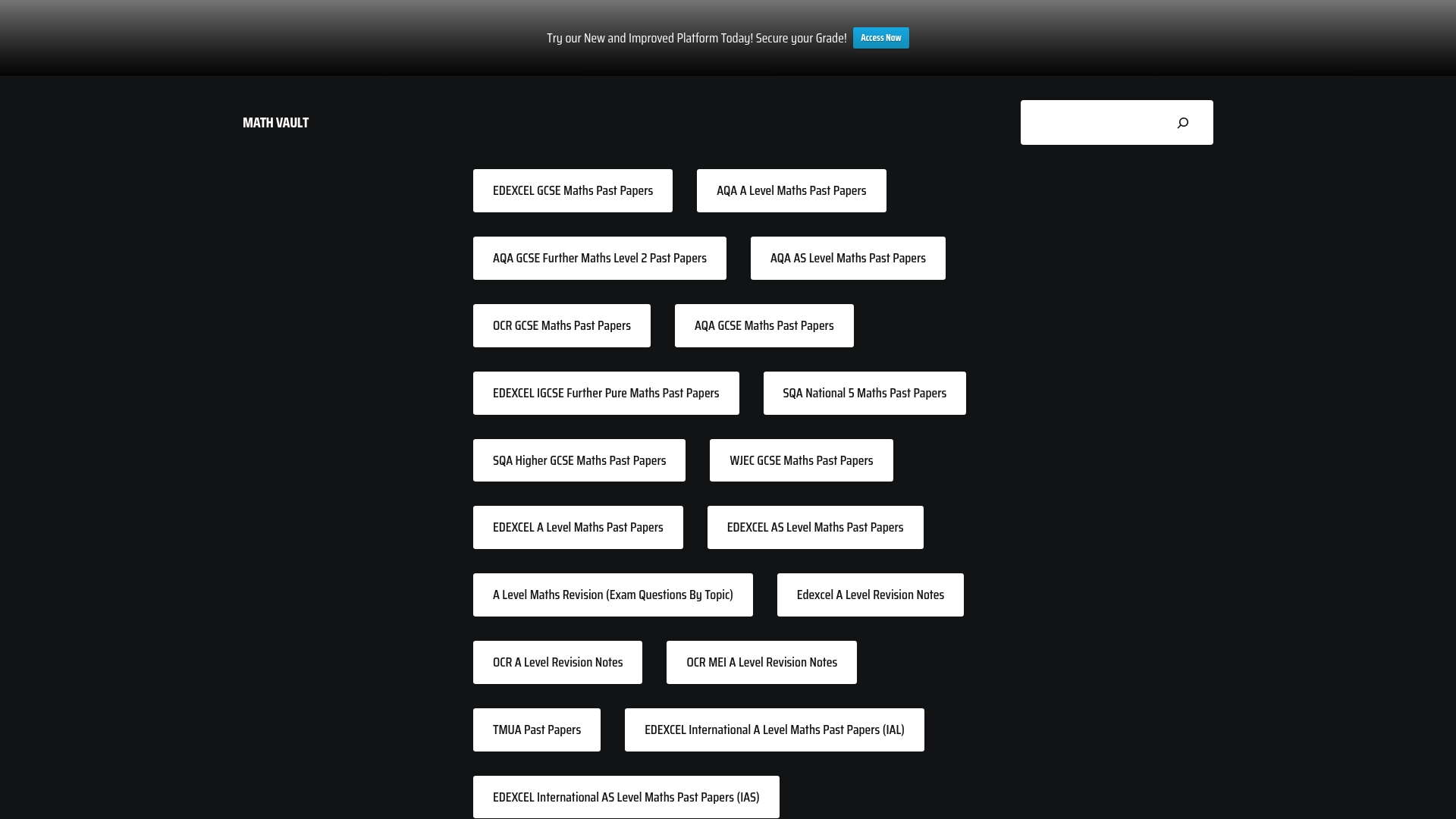
Three good starting points: the WJEC GCSE past papers and worked solutions if you are in Wales; the WJEC 2023 worked solutions for a detailed mark-by-mark breakdown of a recent paper; and the live weekly Q&A session, which lets you ask questions about specific problems in real time. For students on other boards, the Mathvault home page organises all resources by board and level. Attempt a past paper, study the worked solution, and bring your remaining questions to the live session. That three-step cycle is half the battle.
Sources and useful links
Mathvault resources:
- Mathvault home — past papers, worked solutions, video walkthroughs, and live Q&A organised by UK exam board
- WJEC GCSE past papers and solutions — board-specific landing page for students in Wales
- WJEC 2023 worked solutions — step-by-step mark-by-mark solutions for a recent WJEC paper
- Edexcel A-Level past paper questions by topic — topic-organised past-paper questions with downloadable packs
External references used for feature verification:
- BBC Bitesize Exam Revision on Google Play — app store listing used to verify board coverage, pricing, and user figures
- Cognito — platform page used to verify content type and board coverage
- Platform comparison and feature selection guidance — contextual commentary on educational platform features
App store listings and official publisher pages were used throughout to verify device support, offline access, pricing, and content type for each platform in the comparison table.
Leave a Reply