
Complex numbers revision comes down to five skills: arithmetic in x + iy form, converting to modulus-argument form, using de Moivre’s theorem, finding nth roots (including roots of unity), and sketching loci on an Argand diagram. Learn these in that order and practise each on exam-style questions with full mark schemes. This guide walks through each skill with worked examples, shows where the topic sits in the AQA, Edexcel and OCR specifications, and points you to free past-paper practice.
TL;DR
- Complex numbers are compulsory content on every Further Maths A-Level specification, so questions can appear in more than one paper.
- Master the conversion between x + iy and r(cos θ + i sin θ) first. Almost every harder topic builds on it.
- Multiplying complex numbers multiplies the moduli and adds the arguments. De Moivre’s theorem and nth roots follow from that one rule.
- Roots of unity sit on the unit circle and are evenly spaced, so you can sketch them before you calculate anything.
- Practise with mark schemes open, so you can see exactly where method and accuracy marks are awarded.
Table of Contents
- Where complex numbers sit in A-Level Further Maths
- Step 1: Arithmetic and conjugates
- Step 2: Modulus-argument form
- Step 3: Multiplying, dividing and powers
- Step 4: nth roots and roots of unity
- Step 5: Loci and regions on the Argand diagram
- How to revise complex numbers in a week
- Practise on real exam questions
- Our approach to complex numbers
- Free practice and packs from MathVault
- FAQ
- Sources
Where complex numbers sit in A-Level Further Maths
The topic is compulsory, whichever board you sit. AQA lists complex numbers as compulsory section B, with content points B1 to B11. Edexcel’s 9FM0 specification places it in Core Pure, points 2.1 to 2.11. OCR’s H245 includes it in the mandatory Pure Core, section 4.02.
The three lists are very close. Each covers:
- Solving quadratics with real coefficients, and cubics or quartics when you are given enough information to deduce a root or factor.
- Arithmetic in x + iy form, conjugates and Argand diagrams.
- Conversion between Cartesian and modulus-argument form, and multiplying and dividing in that form.
- Loci and regions (AQA and Edexcel list these explicitly).
- De Moivre’s theorem, Euler’s formula, nth roots and geometric problems using roots of unity.
How the papers are structured
The exam structure affects how you revise, because you cannot predict which paper a complex numbers question will land in.
- AQA 7367: Papers 1 and 2 are each two hours and 100 marks, worth 33⅓% of the A-Level, and either may assess complex numbers.
- Edexcel 9FM0: Core Pure Mathematics 1 and 2 are each 1 hour 30 minutes, 75 marks and 25% of the qualification, and either may contain complex numbers questions.
- OCR H245: you take the two mandatory Pure Core papers, Y540 and Y541, and complex numbers belong to the Pure Core.
The practical message: revise the whole topic, not a favourite corner. A question can combine complex numbers with trigonometry, series or polynomials, so the topic often earns marks in places you do not expect.
Step 1: Arithmetic and conjugates
Every later skill depends on being quick and accurate with z = x + iy, where i² = −1.
- Add and subtract the real and imaginary parts separately.
- Multiply by expanding the brackets and replacing i² with −1.
- Divide by multiplying the numerator and denominator by the conjugate of the denominator.
- The conjugate of x + iy is x − iy. The product z × z* is the real number x² + y².
Worked example: division
Write (3 + 2i) / (1 − i) in the form x + iy.
Multiply top and bottom by 1 + i:
- Numerator: (3 + 2i)(1 + i) = 3 + 3i + 2i + 2i² = 1 + 5i
- Denominator: (1 − i)(1 + i) = 1 + 1 = 2
So the answer is 1/2 + (5/2)i. The usual lost mark is forgetting that i² = −1 in the numerator, so write that line out every time.
Conjugate roots
If a polynomial has real coefficients and a + bi is a root, then a − bi is also a root. This is the engine behind the “deduce a root or factor” questions in the specifications.
Example: a quadratic with real coefficients has a root 2 + 3i. The other root is 2 − 3i. The sum of roots is 4 and the product is 4 + 9 = 13, so the quadratic is z² − 4z + 13 = 0.
For a cubic or quartic, use the conjugate pair to build a real quadratic factor, then divide it out to find the remaining roots.
Step 2: Modulus-argument form
This is the skill that most readers search for, and it is the gateway to the rest of the topic.
For z = x + iy, the modulus is r = |z| = √(x² + y²). The argument θ is the angle from the positive real axis to the line joining the origin to z. As the OpenStax Precalculus text explains, x = r cos θ and y = r sin θ, so z = r(cos θ + i sin θ). To convert back, evaluate the trigonometric functions and multiply through by r.
Which interval for the argument?
The argument is only unique within a chosen interval. [OCR’s H245 specification takes the principal argument in either (−π, π] or 0, 2π) unless the question states an interval. Read the question, then state your interval in your answer if it is not given.
Worked example: Cartesian to modulus-argument
Express z = 1 + i√3 in modulus-argument form.
- r = √(1 + 3) = 2.
- The point (1, √3) is in the first quadrant, and tan θ = √3, so θ = π/3.
- z = 2(cos π/3 + i sin π/3).
The quadrant trap
Take z = −1 − i. Your calculator gives arctan(1) = π/4, but the point is in the third quadrant. The principal argument in (−π, π] is −3π/4, and r = √2.
The habit that protects you: sketch the point on an Argand diagram before you pick the angle. It takes five seconds and removes the most common method error in the topic.
Exponential form
The form z = re^(iθ) is equivalent to r(cos θ + i sin θ). AQA content B9 requires you to know and use e^(iθ) = cos θ + i sin θ. In practice, exponential form is shorter to write, so use it once you are confident, especially for roots.
Step 3: Multiplying, dividing and powers
Here is the key rule: when you multiply two complex numbers, you multiply the moduli and add the arguments. When you divide, you divide the moduli and subtract the arguments. The PPLATO de Moivre notes show that de Moivre’s theorem follows directly from this rule, which generalises to any number of complex numbers.
Worked example: division
Let z₁ = 4(cos π/3 + i sin π/3) and z₂ = 2(cos π/6 + i sin π/6).
- z₁ / z₂ has modulus 4 / 2 = 2.
- Its argument is π/3 − π/6 = π/6.
So z₁ / z₂ = 2(cos π/6 + i sin π/6). No expanding brackets is needed, which is the whole point of the form.
De Moivre’s theorem
For z = r(cos θ + i sin θ), de Moivre’s theorem gives zⁿ = rⁿ(cos nθ + i sin nθ) for positive integer n.
Example: find (1 + i)⁸.
- 1 + i has r = √2 and θ = π/4.
- r⁸ = (√2)⁸ = 16, and 8θ = 2π.
- (1 + i)⁸ = 16(cos 2π + i sin 2π) = 16.
Check it another way: (1 + i)² = 2i, so (1 + i)⁸ = (2i)⁴ = 16i⁴ = 16. A second route like this is a good habit in the exam when time allows.
Multiple-angle formulae and series
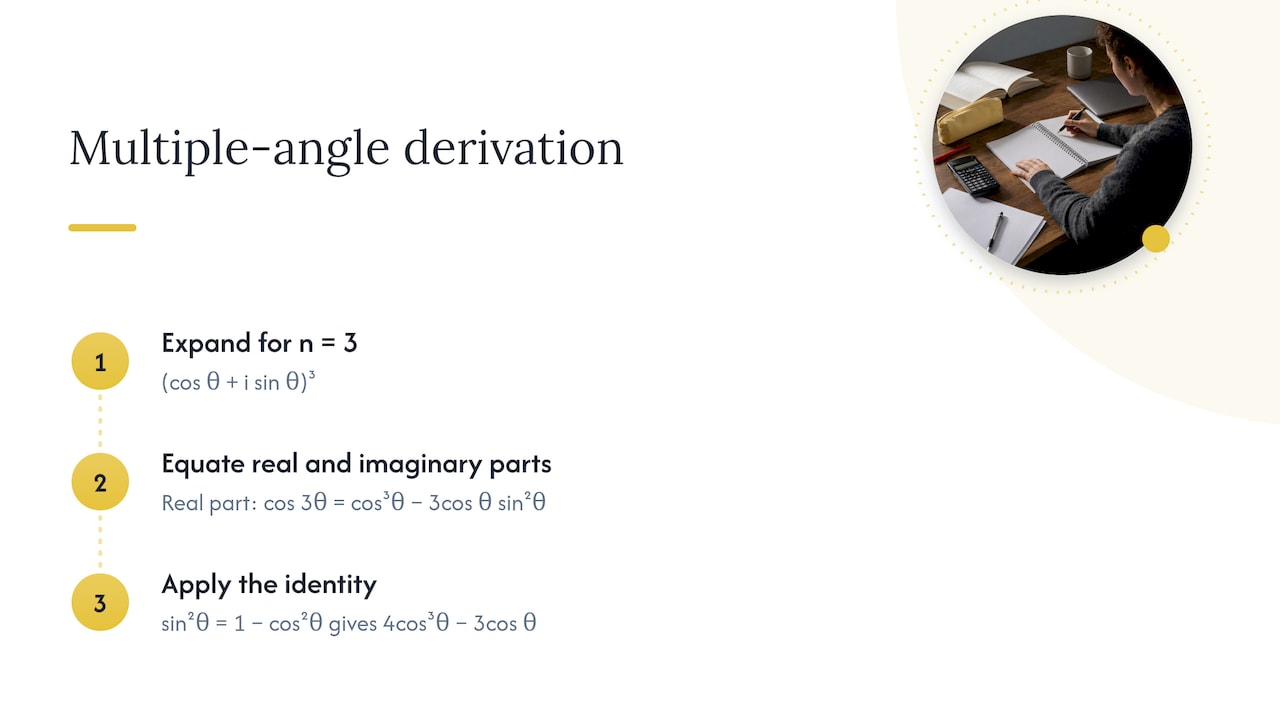
Edexcel’s specification names de Moivre’s theorem for multiple-angle formulae and series sums. The standard method is to expand (cos θ + i sin θ)ⁿ with the binomial theorem, then equate real and imaginary parts. For n = 3, the real part gives cos 3θ = cos³θ − 3cos θ sin²θ, which becomes 4cos³θ − 3cos θ using sin²θ = 1 − cos²θ.
Step 4: nth roots and roots of unity
To find the nth roots of a complex number w = re^(iθ), you want every z with zⁿ = w. There are exactly n of them, equally spaced around a circle of radius r^(1/n).
Worked example: sixth roots of −729
This is the style of question that appears in OCR’s H245 progress test material: express a number in re^(iθ) form, find its sixth roots and show them on an Argand diagram.
- −729 = 729e^(iπ), and you can add any multiple of 2π to the argument: 729e^(i(π + 2πk)).
- The sixth root of 729 is 3, since 3⁶ = 729.
- Divide the argument by 6: z = 3e^(i(π + 2πk)/6) = 3e^(i(π/6 + kπ/3)), for k = 0, 1, …, 5.
The six roots have arguments π/6, π/2, 5π/6, 7π/6, 3π/2 and 11π/6, all with modulus 3. In the interval (−π, π] the last three become −5π/6, −π/2 and −π/6. On the Argand diagram they form a regular hexagon inscribed in a circle of radius 3.
Roots of unity
The nth roots of unity are the n solutions of zⁿ = 1. Writing 1 = e^(2πki) and taking the nth root gives z = cos(2πk/n) + i sin(2πk/n) for k = 0, 1, …, n − 1. They lie on the unit circle.
Two cases to know by heart:
- Fourth roots: 1, i, −1, −i.
- Cube roots: 1, e^(2πi/3) and e^(4πi/3). Their arguments are 120° apart.
The roots always sum to zero for n ≥ 2, which you can see from the symmetry of the diagram. Exam questions use this to find exact values such as cos(2π/5) + cos(4π/5) = −1/2, and to solve geometric problems on regular polygons, a topic both AQA and Edexcel name directly.
Step 5: Loci and regions on the Argand diagram
Loci questions reward you for recognising the shape from the equation. Learn these four:
| Equation | Shape | What to do |
|---|---|---|
| |z − a| = r | Circle, centre a, radius r | Plot the centre, draw the circle |
| |z − a| = |z − b| | Perpendicular bisector of the line from a to b | Mark a and b, bisect the line |
| arg(z − a) = θ | Half-line from a at angle θ | Start at a, do not include a itself |
| |z − a| ≤ r | Shaded disc | Solid boundary for ≤, dashed for < |
The fixed-angle and fixed-radius idea has a neat geometric reading. As the University of Manchester notes put it, keeping θ fixed and changing r moves you along a straight line, while keeping r fixed and changing θ moves you around a circle.
For a region such as |z − 2| ≤ 3 together with 0 ≤ arg(z) ≤ π/4, sketch each condition on its own axes first, then shade the overlap. Mark the boundary type clearly, because accuracy marks often depend on it.
How to revise complex numbers in a week
A sensible plan for a topic this size, adjusted to your own timetable:
- Day 1: arithmetic, conjugates and Argand diagrams. Ten division questions.
- Day 2: conversion to modulus-argument form, with a sketch every time. Include at least five third- and fourth-quadrant points.
- Day 3: multiplication, division and de Moivre’s theorem for powers.
- Day 4: multiple-angle formulae and series sums.
- Day 5: nth roots and roots of unity, with diagrams.
- Day 6: loci and regions.
- Day 7: mixed exam questions under timed conditions, then mark them line by line.
When you mark, split each lost mark into method or accuracy. Method marks reward the right approach even if arithmetic slips. Accuracy marks need correct values. Knowing which kind you lose tells you whether to revise the idea or to slow down.
Common mistakes to log
- Forgetting i² = −1 when expanding.
- Choosing the wrong quadrant for the argument.
- Giving only one root when the question asks for all n.
- Mixing degrees and radians. Further Maths expects radians unless told otherwise.
- Drawing a loci boundary solid when the inequality is strict.
Practise on real exam questions
Reading a method is not the same as using it under pressure. The most efficient revision loop is: try the question cold, check against the mark scheme, then study the worked solution for anything you missed. Our guide on how to use worked solutions to revise explains how to do this without just copying the answer, and our piece on A-Level maths walkthroughs shows how video explanations can pick up the marks you drop.

If you sit Edexcel, our topic-by-topic past paper questions let you work through one area at a time, and the free Edexcel A-Level and Further Maths textbooks give you the full content in PDF.
Our approach to complex numbers
Complex numbers are a topic where students often feel they understand the idea but then lose marks on presentation. In our experience of building MathVault’s resources, the gap is almost always the same: the method is sound, but the sketch is missing, the quadrant is wrong or the final answer is not in the requested form.
That is why we put fully worked solutions beside every past paper, and why we organise material by exam board. A worked solution shows you the line where the mark was earned, not only the final answer. Used after an honest attempt, it turns a wrong answer into a lesson you keep.
We keep our revision materials free because we want every student in England, Wales and Scotland to have the same chance to practise on real questions, with live weekly Q&A sessions for the moments when a solution still does not make sense.
Oloru
Free practice and packs from MathVault
MathVault gives you free access to past papers organised by exam board, fully worked step-by-step solutions, video walkthroughs, topic-based revision guides and weekly live Q&A sessions. Start with our A-Level maths past-paper questions, or browse all maths past papers by exam board to find your own specification.

If you prefer to work offline, downloadable revision packs for an exam board and year range are also available, and small donations help us keep the free material growing.
FAQ
Is complex numbers hard in A-Level Further Maths?
Most students find it manageable once the Argand diagram clicks, because each skill builds on the one before. The hardest parts tend to be loci sketches and multiple-angle questions, which combine several ideas. Steady practice on past questions is the best preparation.
What is the difference between modulus-argument form and exponential form?
They describe the same number. Modulus-argument form is r(cos θ + i sin θ), and exponential form is re^(iθ), which AQA lists as equivalent via Euler’s formula. Exponential form is shorter, so it is quicker for powers and roots.
How do I find the argument of a negative real or imaginary number?
Sketch it. A negative real number such as −5 has argument π, and a negative imaginary number such as −3i has argument −π/2 in the interval (−π, π]. Check which interval your question or board uses.
How many roots does a complex number have?
A non-zero complex number has exactly n distinct nth roots. They are equally spaced on a circle centred on the origin, so you can find the first and then add 2π/n to the argument each time.
Do GCSE students need complex numbers?
No. Complex numbers belong to A-Level Further Maths. If you are preparing for GCSE or AS-Level maths, our AQA past papers and mark schemes are the best place to start.
Sources
- AQA A-Level Mathematics 7367, compulsory content
- AQA A-Level Further Mathematics specification
- Pearson Edexcel 9FM0 Further Mathematics specification
- OCR Further Mathematics A H245 specification
- OCR H245 support highlights
- OpenStax Precalculus 2e, polar form of complex numbers
- PPLATO FLAP, de Moivre’s theorem and complex numbers
- University of Manchester maths notes
Leave a Reply