
Take Further Maths if you are aiming for a maths-heavy degree at a competitive university and single Maths already feels comfortable, not stretching. Skip it if a fourth subject risks pulling down the three grades your offer actually depends on. Between those two poles sits most of the real decision, and this guide, along with support from the Advanced Mathematics Support Programme (AMSP) and MathVault, will help you work out which side you’re on before you commit.
TL;DR:
- Most students should only consider Further Maths if they find single Maths comfortable and aim for a highly competitive degree in a math-heavy field.
- It covers advanced pure maths topics, with options in mechanics, statistics, decision maths, and extra pure content, often demanding faster connections and higher abstraction.
- It is especially valuable for applicants to top universities in mathematics, engineering, physics, or computer science, and it helps with entrance tests like STEP and MAT.
- A strong GCSE Maths grade (8 or 9) and enjoyment of proof and pattern are important indicators of suitability, along with good mock results and willingness for independent study.
- Students without school provision can use support programs or sit exams independently, emphasizing the importance of documented need and early preparation.
Table of Contents
- What does choosing Further Maths actually involve?
- Who actually benefits from taking Further Maths?
- Can you handle it? A practical suitability checklist
- How is Further Maths taught and examined?
- What if your school doesn’t offer Further Maths?
- How MathVault can help with Further Maths preparation
- A final word on making the call
- Sources
What does choosing Further Maths actually involve?
Further Maths is not an extension module bolted onto A level Maths. It is a separate A level in its own right, sat alongside standard Maths, and most schools allocate roughly the equivalent of two subjects’ worth of teaching time to cover both courses together.
The core content pushes further into pure mathematics: complex numbers, matrices, formal proof, and more advanced differential equations than you meet in single Maths. On top of that pure core, schools choose from a menu of options, typically drawn from:
- Further mechanics (forces, momentum, circular motion at a deeper level)
- Further statistics (probability distributions, hypothesis testing beyond the standard course)
- Decision maths (algorithms, graph theory, network problems)
- Extra pure content (additional proof techniques and complex analysis)
Which options you get depends on your exam board and, just as much, on what your school decides to teach. The step up in abstraction and pace is real. Ideas that get one lesson in single Maths might get three in Further Maths, and you are expected to make the connections faster.
Who actually benefits from taking Further Maths?
The honest answer is that some courses want it and most don’t. Where a school offers Further Maths, top mathematics departments frequently expect applicants to have taken it, and it carries real weight for:
- Mathematics at Oxford, Cambridge, Imperial, and similarly selective departments
- Engineering degrees, particularly at Russell Group universities
- Physics, where the further mechanics content maps directly onto first-year modules
- Computer science, especially where decision maths options are offered
Medicine, law, most humanities, and the majority of arts degrees rarely ask for it. Take it there and you are adding workload without moving your application forward.
Where it does matter, the payoff is practical rather than symbolic. Students who arrive at university having already met matrices, complex numbers, and formal proof tend to find the first term less of a shock, and the extra fluency helps directly with entrance tests like STEP, MAT, and TMUA.
A rates tell part of the story.* As of 2025, 28.9% of Further Maths students achieved an A*, against a smaller proportion in standard A level Maths. That gap doesn’t mean Further Maths is easier. It reflects a self-selecting cohort of students who were already strong enough in Maths to choose the harder option in the first place.
Can you handle it? A practical suitability checklist
Before committing, run through a few honest checks rather than going on gut feeling alone.
- Check your GCSE grade. Most schools want a grade 8 or 9 in Maths, because the fluency demands are considerably higher than for single Maths alone.
- Ask whether single Maths is your easiest subject. If it already feels like the A level you have to work hardest at, adding Further Maths will likely intensify that struggle and put your other grades at risk.
- Consider your appetite for abstraction. Do you enjoy proof and pattern for their own sake, or do you prefer maths that stays tied to a concrete application? Further Maths leans firmly towards the former.
- Weigh up independent study. Further Maths classes are often small, which means more self-directed work and a faster pace than you might be used to.
- Talk to your Maths teacher before deciding. Ask about your homework completion rate and mock results specifically in Maths, not your overall average. Those two figures are a far better predictor of Further Maths readiness than how you feel about the subject in general.
Pro Tip: Ask your school if you can see a sample Further Maths lesson or worksheet before you choose. Ten minutes with real content tells you more than any prospectus description.
How is Further Maths taught and examined?

Schools deliver Further Maths in one of two ways: parallel teaching, where Maths and Further Maths run alongside each other from Year 12, or consecutive teaching, where Further Maths is compressed into a shorter period once core Maths content is secure. Some schools also offer it as a standalone AS level rather than the full A level, which lightens the workload but carries less weight with universities.
Assessment is exam-only across every major board. You will typically sit:
- Two papers covering the pure core content
- One or two further papers covering your school’s chosen options
Exam boards (AQA, Edexcel, and WJEC among them) differ slightly in how they split content between papers, so it’s worth checking your specific board’s specification rather than assuming they’re interchangeable. When you do get a say in which options to study, match them to your intended degree: further mechanics for engineering or physics, decision maths for computer science, further statistics for economics or data-heavy courses.
What if your school doesn’t offer Further Maths?
Plenty of good schools simply don’t have the timetable capacity or specialist staff to run it. That’s not a dead end. Students in this position have two established routes:
- AMSP support, which provides structured tuition and resources across England for students whose schools cannot offer Further Maths in-house
- Private candidate entry, where you study independently or with a tutor and sit the exam through a centre that accepts external candidates
Whichever route you take, document the lack of provision clearly on your UCAS application. Admissions tutors read context, and a genuine gap in provision is treated very differently from a subject you simply avoided. Start arranging tuition in Year 12, not Year 13, and lean on structured resources such as MathVault’s further maths past papers to keep your self-study organised against real exam content.
How MathVault can help with Further Maths preparation
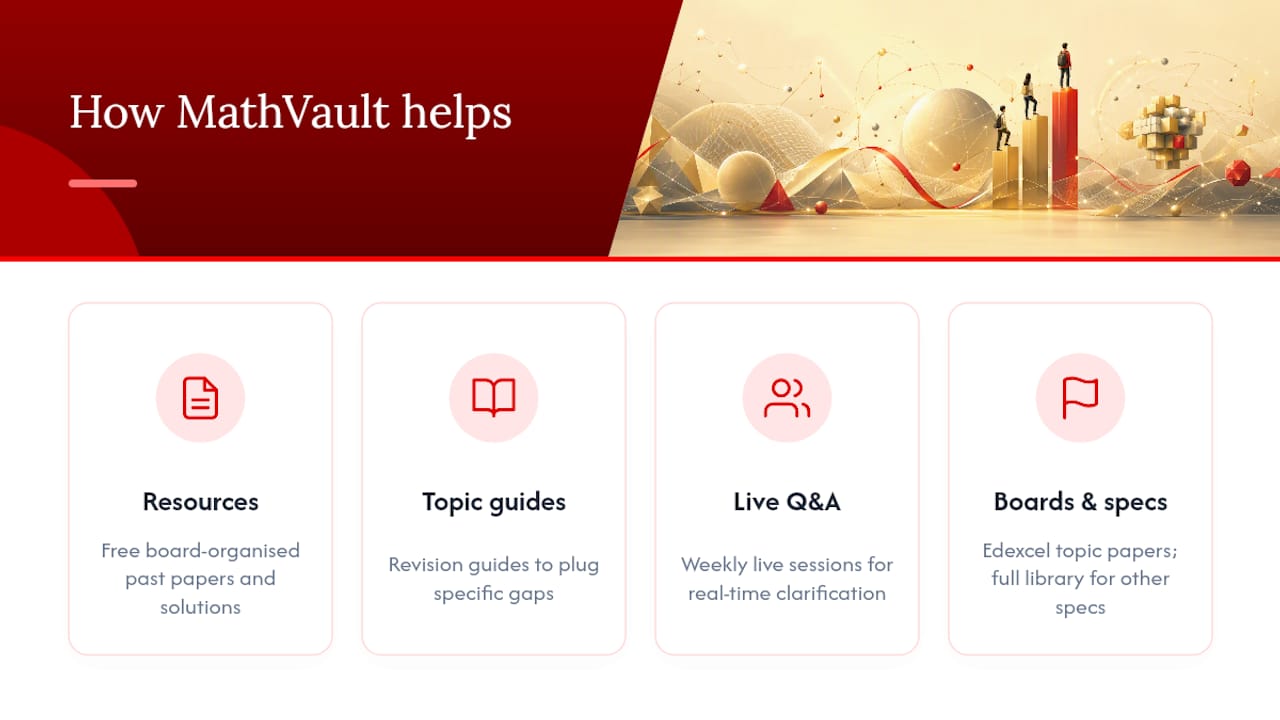
Whether you’re studying Further Maths at school, working through it as a private candidate, or self-teaching options your school doesn’t offer, MathVault provides free, board-organised past papers, fully worked solutions, and video walkthroughs built specifically around the syllabuses students actually sit.

Private candidates get the most obvious benefit, since exam boards don’t provide the classroom-level support a school normally would. But you don’t need to be studying alone to find it useful. Students in small Further Maths classes, or working through options their school didn’t fully cover, use MathVault’s topic revision guides to plug specific gaps rather than re-revising everything from scratch. Live weekly Q&A sessions add the kind of real-time clarification a lone learner would otherwise have to go without entirely.
If you’re on Edexcel, the Edexcel A-level past paper questions organised by topic let you drill matrices or proof in isolation before tackling a full paper. For AQA GCSE Further Maths as groundwork, or once you’ve chosen your A level board, browse MathVault’s full resource library to find the paper sets, guides, and walkthroughs that match your specification.
A final word on making the call
Prioritise three strong grades over four mediocre ones, unless Further Maths is genuinely comfortable and your target degree actually asks for it. That single rule resolves most of the doubt students bring to this decision, and it’s more reliable than any prospectus line about “keeping doors open.”
If you’re still unsure, try some real Further Maths content before committing on paper alone. A past paper question on complex numbers will tell you more in twenty minutes than a week of deliberating, and a short conversation with your Maths teacher about your actual mock performance will settle most of what’s left.
— Oloru
Sources
- Undergraduate study FAQs — Mathematical Institute, University of Oxford
- Go far with A level further maths — Wyke Sixth Form College
Leave a Reply