
Matrices in Further Maths come down to five skills: reading the notation, multiplying conformable matrices, finding determinants and inverses, using matrices as transformations, and solving simultaneous equations with an inverse. Learn them in that order and practise each on real exam questions, with fully worked solutions to check your method line by line. Our free past-paper questions and worked solutions on MathVault are organised by exam board for exactly that kind of practice.
This guide covers each skill with a worked example, shows where marks are lost, and points out what the exam boards say you must be able to do.
TL;DR
- A matrix is a rectangular array of numbers. Its size is always written rows × columns, so a 2×3 matrix has 2 rows and 3 columns.
- You can add or subtract only matrices of the same size. You can multiply A by B only when the number of columns in A equals the number of rows in B, and AB is usually not equal to BA.
- The identity matrix I leaves any conformable matrix unchanged, and the inverse A⁻¹ is the matrix that gives I when multiplied by A.
- Specifications ask you to use matrices for 2D and 3D transformations, determinants as scale factors, and solving three simultaneous equations.
- Check every inverse by multiplying back to I. It is the cheapest way to protect method and accuracy marks.
Table of Contents
- What a matrix is and how to read the notation
- Adding, subtracting and scalar multiplication
- Multiplying matrices
- The identity matrix
- Determinants
- Inverse matrices
- Matrices as transformations
- Solving simultaneous equations with matrices
- Common mistakes examiners report
- How to practise matrices so it sticks
- Where MathVault fits in your matrices revision
- Our view: why worked solutions matter most in matrices
- FAQ
- Sources
What a matrix is and how to read the notation
A matrix is a rectangular array of numbers. Its size is given as rows × columns, so an m×n matrix has m rows and n columns, and the entry in the ith row and jth column is written with the row index first and the column index second (Stanford matrix primer). The same convention appears in OpenStax College Algebra.
So if
A = (1 2 3 / 4 5 6)
then A is 2×3, and the entry in row 2, column 3 is 6. Writing it as a₂₃ is the standard way to say this.
Three habits save marks from the first lesson:
- Say the size aloud before doing anything else: “two by three”, rows first.
- Label which matrix is which. When a question has A, B and C, write down their sizes beside them.
- Write matrices neatly in aligned columns. Many slips in multiplication come from misaligned entries.
Adding, subtracting and scalar multiplication
Two matrices can be added or subtracted only when they are the same size, which is what “compatible” means (Loughborough MathCentre leaflet). The operation is done entry by entry, so A + B = [aᵢⱼ + bᵢⱼ], and multiplying by a scalar k multiplies every entry: kA = [kaᵢⱼ] (UNL matrix operations notes).
Let A = (1 2 / 3 4) and B = (0 1 / 5 2). Then:
- A + B = (1 3 / 8 6)
- 2A = (2 4 / 6 8)
- A − B = (1 1 / −2 2)
This is the easy part of the topic, and exam questions rarely stop here. They tend to hide it inside a larger problem, such as finding an unknown matrix X from an equation like X + 2A = B. Treat it as you would an algebraic equation: isolate X, then do the entry-by-entry arithmetic carefully, watching negative signs.
Multiplying matrices
If A is m×n and B is n×p, then AB exists and is m×p. Each entry is the sum of products along a row of A and a column of B: (AB)ᵢⱼ = Σ aᵢₖbₖⱼ (UNL notes; the size rule is also set out in the Hakim linear algebra primer).
A quick size check tells you whether a product exists before you start. Write the sizes side by side, for example (2×3)(3×4). The inner numbers must match, and the outer numbers give the size of the answer, here 2×4.
With the same A and B as before:
- AB = (1×0 + 2×5, 1×1 + 2×2 / 3×0 + 4×5, 3×1 + 4×2) = (10 5 / 20 11)
- BA = (0×1 + 1×3, 0×2 + 1×4 / 5×1 + 2×3, 5×2 + 2×4) = (3 4 / 11 18)
AB and BA are different. Matrix multiplication is not commutative, and that is why order matters in every later topic, especially transformations. Examiners deliberately set questions where reversing the order gives a different answer.
Where marks are lost in multiplication
- Multiplying entry by entry (as in addition) instead of row by column.
- Using the wrong order, so that a product that should be AB is calculated as BA.
- Arithmetic slips with negatives. Write each product term out before summing it.
- Not stating that a product is undefined when sizes do not match, if the question asks you to comment.
The specifications are explicit that this is core content. AQA requires you to add, subtract and multiply conformable matrices and multiply by a scalar (AQA 7367 compulsory content, C1), and the Pearson Edexcel 9FM0 Pure Core lists the same skills (specification, Issue 4, June 2023).
The identity matrix
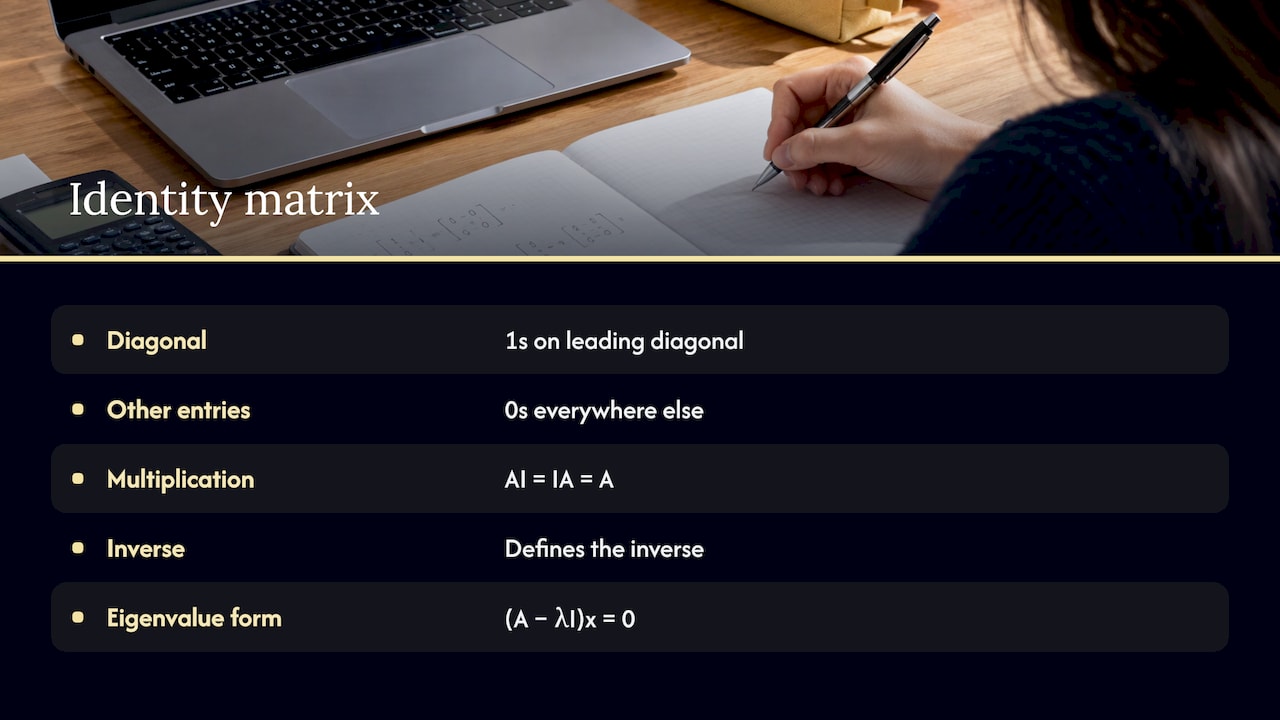
The identity matrix is a square matrix with 1s on the leading diagonal and 0s everywhere else, and multiplying a conformable matrix A by I gives AI = IA = A (STEP matrices topic notes). For 2×2 matrices:
I = (1 0 / 0 1)
It plays the role that 1 plays in ordinary multiplication. Its importance is practical: it defines the inverse, and it lets you rewrite equations. The same STEP notes show that writing x = Ix allows Ax = λx to be rewritten as (A − λI)x = 0, the starting point for eigenvalues and eigenvectors, which some boards include in their Further Maths content.
Determinants
For a 2×2 matrix (a b / c d), the determinant is ad − bc. For A = (1 2 / 3 4):
det A = (1×4) − (2×3) = −2
For a 3×3 matrix, expand along the top row using the 2×2 determinants left after deleting each entry’s row and column, with signs +, −, + (MathCentre matrices leaflet). Write each 2×2 minor separately and combine at the end. Trying to do all of it in one line is where sign errors creep in.
What the determinant tells you
The determinant is not just a number to feed into the inverse. AQA lists interpreting determinants as scale factors as a requirement (C5 in the AQA 7367 content). In 2D, the absolute value of the determinant is the factor by which areas change under the transformation, and a negative sign means orientation is reversed. Our matrix A has det −2, so it doubles areas and reflects the shape.
A determinant of zero means the matrix has no inverse (it is singular). That single fact decides whether a set of simultaneous equations has a unique solution.
Inverse matrices
The inverse of a square matrix A satisfies A⁻¹A = AA⁻¹ = I (STEP notes). If it exists it is unique.
The 2×2 inverse, step by step
For (a b / c d) with determinant Δ = ad − bc ≠ 0, swap a and d, change the signs of b and c, then divide by Δ.
For A = (1 2 / 3 4), Δ = −2:
- Swap the diagonal and negate the others: (4 −2 / −3 1).
- Divide by −2: A⁻¹ = (−2 1 / 3/2 −1/2).
- Check: A × A⁻¹ gives row 1 as (1×−2 + 2×3/2, 1×1 + 2×−1/2) = (1, 0), and row 2 as (3×−2 + 4×3/2, 3×1 + 4×−1/2) = (0, 1). That is I, so the inverse is right.
The check takes under a minute. Multiplying back to the identity is the standard way to verify an inverse (LibreTexts, identity and inverses).
The 3×3 inverse
The method has more steps but no new ideas: compute the matrix of minors, apply the alternating sign pattern, transpose, and divide by the determinant (MathCentre). On a calculator paper you can check with the matrix function, but you still need to show the method when a question says “show that” or asks for working.
Inverse of a product
If you need the inverse of a product, reverse the order: (AB)⁻¹ = B⁻¹A⁻¹. Examiners use this to test whether you understand that order matters, not just that you can calculate.
Matrices as transformations
AQA expects you to represent linear transformations in 2D, including successive transformations, to use certain single transformations in 3D, and to find invariant points and lines (AQA 7367 content, C3 and C4). The 3D work is confined to reflection in one coordinate plane or rotation about one coordinate axis. Pearson Edexcel 9FM0 lists reflections, rotations about the origin, stretches parallel to the axes and enlargements about the origin, and states the rule that the transformation represented by AB is B followed by A (specification).
Finding the matrix from the images of the unit vectors
The columns of a 2×2 transformation matrix are the images of (1, 0) and (0, 1). That one idea builds almost every standard matrix:
- Reflection in y = x: (1,0) goes to (0,1) and (0,1) goes to (1,0), so M = (0 1 / 1 0).
- Rotation of 90° anticlockwise about the origin: (1,0) goes to (0,1) and (0,1) goes to (−1,0), so R = (0 −1 / 1 0).
A successive transformation
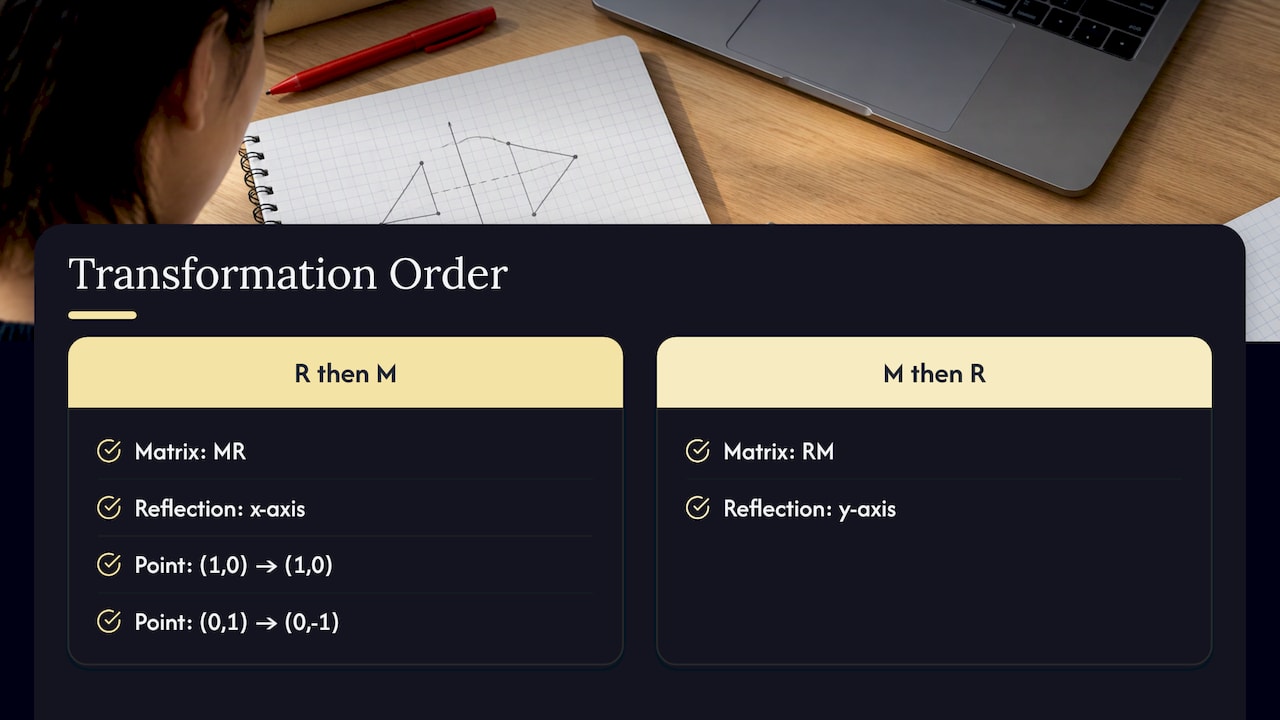
Suppose a shape is rotated by R and then reflected by M. Because the first transformation is applied first and sits on the right, the single matrix is MR:
MR = (0 1 / 1 0)(0 −1 / 1 0) = (1 0 / 0 −1)
That is a reflection in the x-axis. Check it with a point: (1,0) rotates to (0,1), which reflects to (1,0). The point (0,1) rotates to (−1,0), which reflects to (0,−1). Both agree with (1 0 / 0 −1). The reversed product RM is a different matrix, a reflection in the y-axis, so getting the order right is worth marks on its own.
Invariant points and lines
A point is invariant if the matrix leaves it where it is. An invariant line maps to itself, though the points on it may move. For lines of the form y = mx, substitute (x, mx) into the transformation and require the image to satisfy the same equation. This produces an equation in m. Solve all of its roots, because one of them may be easy to overlook.
Solving simultaneous equations with matrices
AQA requires solving three simultaneous equations using the inverse matrix, and interpreting geometrically the solution, or the failure of a solution (AQA 7367 content, C7 and C8).
Write the system as Ax = b. If det A ≠ 0, then x = A⁻¹b, and the order matters: A⁻¹ goes on the left of b. If det A = 0, there is no unique solution. Geometrically, the three planes either have no common point or share a line (or coincide), and the question will usually ask you to say which.
A method that holds up under pressure:
- Write the system in matrix form.
- Calculate the determinant first. If it is zero, stop and interpret.
- Find the inverse, using the 3×3 method above.
- Multiply A⁻¹ by b on the left.
- Substitute back into the original equations to check.
Common mistakes examiners report
The Cambridge International Further Mathematics examiner report for June 2024 is a useful picture of how marks slip, even if you are sitting a UK board. It notes candidates giving inverse matrices incorrectly, for instance treating the inverse of a product as a single matrix without the right order, and missing an invariant line or discarding a valid root too early (such as m = 0). It also says eigenvector answers should be checked by performing the matrix multiplication, not assumed correct (examiner report, June 2024).
Turn that into a checklist:
- Order: write whether the product is AB or BA before multiplying.
- Sizes: confirm they are conformable first.
- Roots: keep every root of an equation until you have tested it.
- Verification: multiply back, whether it is A × A⁻¹ or A times your eigenvector.
- Method marks: show the determinant and the minors even when your calculator can do the inverse.
How to practise matrices so it sticks
Matrices are a skill topic: you improve by doing questions, then comparing your method with a full solution. A sensible weekly pattern:
- Learn one idea (for example, the 2×2 inverse) from your notes or textbook.
- Do five short questions on it without help.
- Mark your work against a worked solution, looking at method as well as the final answer.
- Redo any question you missed, two days later.
- Mix in one past-paper question that combines matrices with another topic, such as complex numbers or vectors.
Our A-Level past-paper questions are free to work through, and the fully worked solutions let you see where method and accuracy marks are earned. If you learn better from watching, our guide to A Level maths walkthroughs explains how to use video solutions to gain marks, and written versus video solutions explains how to try a question first, then check. If you would rather ask a question than search for the answer, there is a page on A Level maths live Q&A. For textbooks, see the Edexcel A-Level Maths and Further Maths PDFs.
Where MathVault fits in your matrices revision
MathVault gives students free access to past exam papers, fully worked step-by-step solutions, video walkthroughs, topic-based revision guides, downloadable revision notes and weekly live Q&A sessions, organised by UK exam board. For matrices, that means you can learn a method, attempt exam-style questions, and compare your working with a full solution. If you want a complete pack for offline use, downloadable revision packs are available for an exam board and year range.

Start with the A-Level past-paper questions, or visit mathvault.io to see everything in one place.
Our view: why worked solutions matter most in matrices
Matrices reward students who can see why a step is taken, not only what the answer is. A final answer of (−2 1 / 3/2 −1/2) tells you nothing about whether the student understood the swap, the sign change and the division by the determinant. A fully worked solution shows all three.
That is why we build MathVault around past papers with complete, step-by-step solutions, video walkthroughs and live Q&A, and why we keep all of it free to learn from. When you can compare your own working with a model solution line by line, you spot the habit that costs you marks: the wrong order in a product, the missed root, the inverse you never checked.
Our advice is simple. Attempt the question first. Check your method against the solution. Then explain the step you got wrong in your own words. Repeat it with a fresh question a few days later.
Oloru
FAQ
What matrix topics are in A-Level Further Maths?
Core content includes adding, subtracting and multiplying conformable matrices, 2D linear transformations and successive transformations, determinants as scale factors, inverse matrices and solving three simultaneous equations. AQA also lists single 3D transformations and invariant points and lines (AQA 7367). Always check your own board’s specification for the exact list.
Why is AB not the same as BA?
Matrix multiplication combines rows of the first matrix with columns of the second, so swapping the order changes which entries are multiplied. In our example, AB is (10 5 / 20 11) and BA is (3 4 / 11 18). For transformations, AB means B is applied first, then A.
How do I check that an inverse matrix is correct?
Multiply the matrix by your answer. If the product is the identity matrix, the inverse is right. This works for any size, and it is quick enough to do in the exam.
What does a determinant of zero mean?
The matrix has no inverse. A set of simultaneous equations written with it has no unique solution, and geometrically the planes do not meet at a single point. In a transformation question it means the shape is flattened onto a line or a point.
Sources
- Matrix terminology and notation (Stanford)
- Matrices and matrix operations (OpenStax College Algebra 2e)
- Addition, subtraction and scalar multiplication of matrices (Loughborough MathCentre)
- Matrix operations (UNL MathBooks)
- Linear algebra primer (Hakim, University of Washington)
- AQA A-level Further Mathematics 7367 compulsory content
- Pearson Edexcel A Level Further Mathematics 9FM0 specification
- STEP matrices topic notes
- MathCentre matrices leaflet
- The identity and inverses (LibreTexts)
- Cambridge International Further Mathematics examiner report, June 2024
Leave a Reply