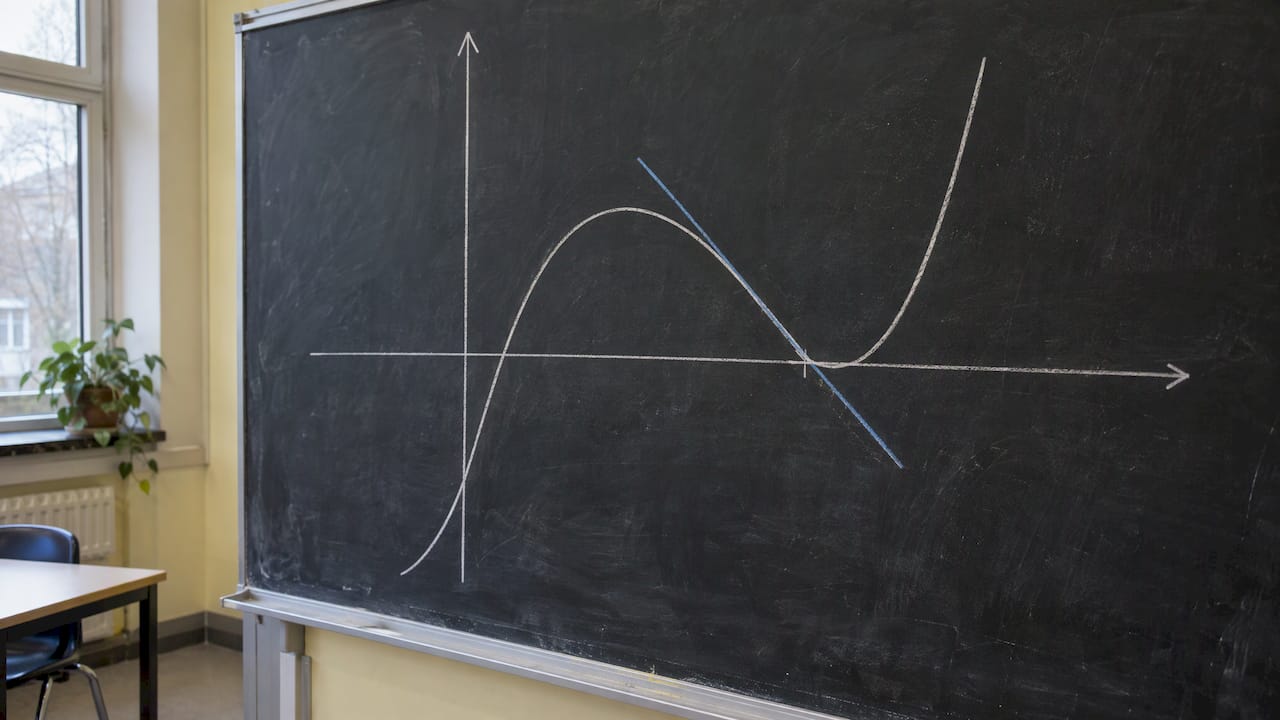
Numerical methods are the A-level toolkit for equations you cannot solve algebraically. You locate a root with a change of sign, refine it with iteration or Newton-Raphson, and estimate areas with the trapezium rule. Students often revise sequences, series and sigma notation alongside them, so this guide covers those too, with worked examples you can check line by line.
TL;DR
- A change of sign in f(x) over an interval tells you a root lies there, provided f is continuous on that interval.
- Iteration uses x_{n+1} = g(x_n). Newton-Raphson uses x_{n+1} = x_n − f(x_n)/f’(x_n) and usually converges faster.
- The trapezium rule estimates ∫ f(x) dx with strips of width h = (b − a)/n. Whether it over- or underestimates depends on the curve’s shape.
- A sequence is a list of terms, a series is their sum, and sigma notation is shorthand for writing a series.
- Show every iteration to more decimal places than the answer asks for, and always state your conclusion.
Table of Contents
- What numerical methods are in A-level Maths
- Locating a root with a change of sign
- Iteration: rearranging and repeating
- The Newton-Raphson method
- The trapezium rule
- Sequences and series
- Sigma notation
- How to revise numerical methods effectively
- Our perspective
- Practise with real exam questions
- FAQ
- Sources
What numerical methods are in A-level Maths
Some equations have no exact algebraic solution. Try solving x³ − x − 3 = 0 by factorising and you will get nowhere. Numerical methods give you an approximate root to a stated accuracy instead.
AQA’s A-level specification asks students to locate roots of f(x) = 0 by considering changes of sign and to solve equations approximately using simple iterative methods and the Newton-Raphson method. It also expects you to understand how these methods can fail. That last point is where exam marks are often lost, so we return to it below.
A reliable strategy, set out in the CIMT A-level iteration chapter, runs in four steps:
- Draw a graph to locate the root approximately.
- Use a change of sign and a single linear interpolation for a good first approximation.
- Apply Newton’s method once or twice, or more.
- Verify that the answer has the required accuracy.
The rest of this guide follows that order.
Locating a root with a change of sign
If f(x) is continuous on [a, b] and f(a) and f(b) have opposite signs, there is at least one root in the interval. In an exam, you need four things:
- the calculation of f(a) and f(b), written out;
- the statement that they have opposite signs;
- the statement that f is continuous;
- the conclusion that a root lies in the interval.
Worked example
Show that x³ − x − 3 = 0 has a root between 1 and 2.
Let f(x) = x³ − x − 3. Then f(1) = 1 − 1 − 3 = −3 and f(2) = 8 − 2 − 3 = 3. There is a change of sign and f is continuous, so a root lies in the interval 1 < x < 2.
When change of sign fails
AQA’s specification specifically requires you to understand how change of sign methods can fail. Typical situations:
- A discontinuity. f(x) = 1/x changes sign between −1 and 1, but there is no root. The graph jumps across an asymptote.
- Two roots in the interval. The signs at the ends match, so you see no change even though two roots exist.
- A repeated root. The curve touches the axis and turns back, with no sign change at all.
When a question asks you to comment on why a method fails, name the specific cause and refer to the graph.
Iteration: rearranging and repeating
To solve f(x) = 0 by iteration, rearrange it into the form x = g(x). Then use the recurrence x_{n+1} = g(x_n) from a starting value x₀.
Take x³ − x − 3 = 0. Rearranging gives x³ = x + 3, so x = (x + 3)^(1/3).
Starting with x₀ = 1.5:
| n | x_n |
|---|---|
| 0 | 1.5 |
| 1 | 1.651 |
| 2 | 1.669 |
| 3 | 1.672 |
The values settle towards 1.672 (to 3 decimal places). If a question asks for the root to 3 decimal places, keep going until two successive values agree to that accuracy. Then confirm the answer with a change-of-sign check on a tight interval, such as [1.6715, 1.6725].
Cobweb and staircase diagrams
AQA expects you to draw associated cobweb and staircase diagrams. You plot y = g(x) and y = x on one set of axes. From x₀, go vertically to the curve, horizontally to the line y = x, and repeat.
- A staircase appears when the iteration approaches the root from one side.
- A cobweb appears when it spirals in, alternating either side of the root.
- If the path moves away from the intersection, the iteration diverges, and a different rearrangement is needed.
A useful rule of thumb: the iteration tends to converge when the gradient of g near the root is smaller than 1 in size. Sketching g and its intersection with y = x will show you that quickly.
The Newton-Raphson method
Newton-Raphson uses the tangent to the curve to produce a better estimate. The iteration, as printed in the OCR Further Maths formulae booklet, is:
x_{n+1} = x_n − f(x_n)/f’(x_n)
Worked example
Use Newton-Raphson on f(x) = x³ − x − 3 with x₀ = 1.5.
f’(x) = 3x² − 1.
- x₀ = 1.5: f = −1.125 and f’ = 5.75, so x₁ = 1.5 + 0.19565 = 1.69565.
- x₁ = 1.69565: f ≈ 0.17965 and f’ ≈ 7.62575, so x₂ ≈ 1.69565 − 0.02356 = 1.67209.
After only two steps, x₂ = 1.672 to 3 decimal places. The simple iteration above needed three steps to reach the same value, and the gap widens on harder equations. The CIMT chapter notes that Newton’s method converges much faster than other iterative methods.
When Newton-Raphson goes wrong
The same chapter explains that the method can become unreliable if the graph has a turning point or an inflexion close to the root. The reason is in the formula. At a turning point f’(x) = 0, so you would divide by zero. Near one, the tangent is almost flat and throws the next estimate far from the root.
If an exam question gives a starting value where f’(x₀) = 0, or one that sends the iteration to a different root, describe exactly that. Mention the tangent, the gradient, and where the next value lands.
Calculator tips
- Store x₀ using the answer key, then type the Newton-Raphson expression using ANS in place of x. Each press of equals gives the next iterate.
- Work with the full calculator value, not rounded intermediate values.
- Write down at least one more decimal place than the question demands.
The trapezium rule
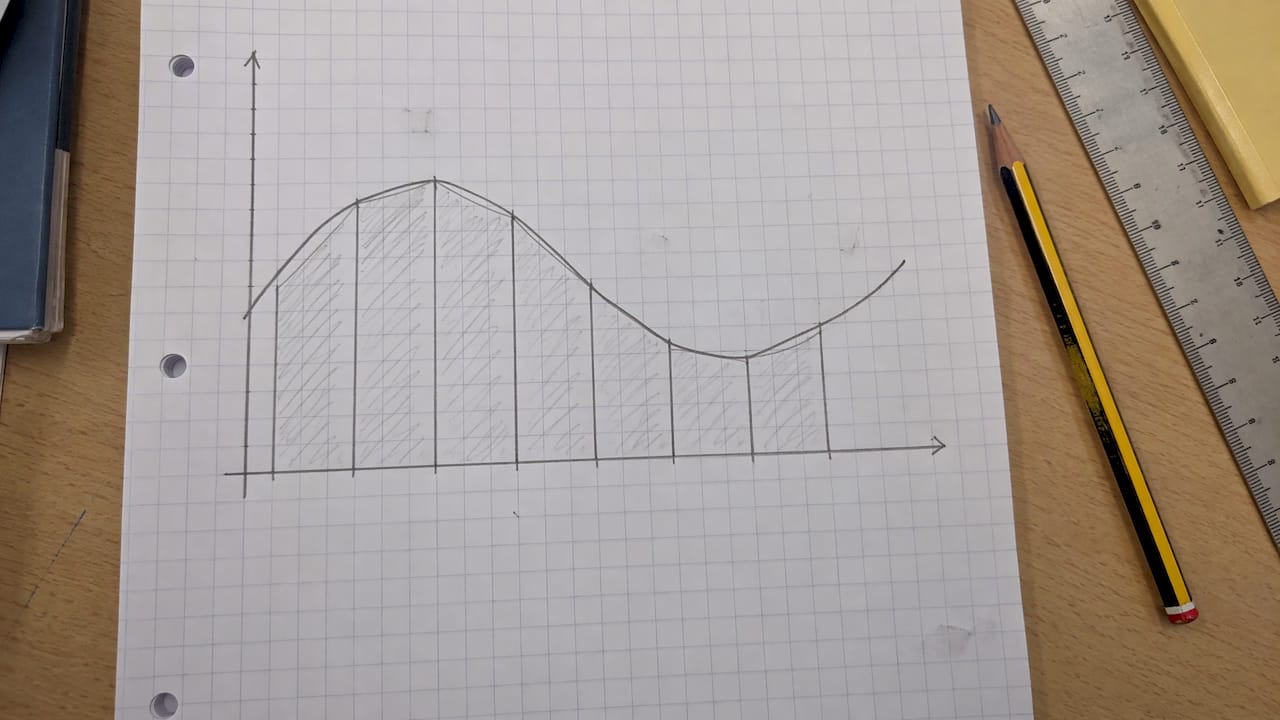
Some integrals have no neat antiderivative, and others are given only as a table of values. The trapezium rule estimates the area using strips. The OCR formulae booklet gives it as:
∫ from a to b of y dx ≈ (h/2){(y₀ + y_n) + 2(y₁ + y₂ + … + y_{n−1})}, where h = (b − a)/n.
Think of it as: half the strip width, times (first + last), plus twice all the middle ordinates.
Worked example
Estimate ∫ from 0 to 2 of x² dx using 4 strips.
h = (2 − 0)/4 = 0.5, so the ordinates are:
| x | 0 | 0.5 | 1 | 1.5 | 2 |
|---|---|---|---|---|---|
| y = x² | 0 | 0.25 | 1 | 2.25 | 4 |
Area ≈ (0.5/2){(0 + 4) + 2(0.25 + 1 + 2.25)} = 0.25 × {4 + 7} = 2.75.
The exact value is 8/3 ≈ 2.667, so the rule overestimates here. For a curve that bends upwards (convex), the tops of the trapezia lie above the curve, giving an overestimate. For a concave curve it underestimates. Examiners often ask which one applies, and a short sketch with one trapezium drawn on it earns the mark.
Common slips
- Confusing the number of strips with the number of ordinates. There is always one more ordinate than strips.
- Doubling the first and last values by mistake.
- Forgetting to put the calculator in radians when the integrand involves trigonometry.
- Improving accuracy: use more strips, which gives a smaller h.
If you want to practise integration questions in exam style, our Edexcel A-level questions by topic include an integration section, and the calculus revision page groups questions by sub-topic.
Sequences and series
Sequences and series are often searched alongside numerical methods because recurrence relations sit at the heart of iteration. Iteration is just a sequence defined by x_{n+1} = g(x_n).
The difference between the two words matters. A sequence is an ordered list of numbers. A series is the sum of a number of terms of a sequence.
Arithmetic and geometric formulae
| Arithmetic | Geometric | |
|---|---|---|
| nth term | a + (n − 1)d | ar^(n−1) |
| Sum of n terms | n/2[2a + (n − 1)d] | a(1 − rⁿ)/(1 − r), r ≠ 1 |
| Sum to infinity | not defined | a/(1 − r), when |r| < 1 |
The nth-term and sum formulae come from the CIMT sequences chapter. AQA’s specification also requires the sum to infinity of a convergent geometric series, including the condition on r with modulus notation.
Recurrence relations and types of sequence
Sequences can be given by a formula for the nth term or by a relation of the form x_{n+1} = f(x_n). AQA also expects you to recognise increasing, decreasing and periodic sequences.
A quick example: u_{n+1} = 1/(1 − u_n) with u₁ = 2 gives 2, −1, 1/2, 2, and so on. The sequence repeats every three terms, so it is periodic with order 3.
For exam-style practice, try our sequences and series revision page, which sets questions out by topic.
Sigma notation
Sigma notation is shorthand for a sum. The expression Σ from r = 1 to 4 of (2r + 1) means: substitute r = 1, 2, 3, 4 into 2r + 1 and add.
3 + 5 + 7 + 9 = 24
Check it with the arithmetic series formula. Here a = 3, d = 2 and n = 4, so S₄ = 4/2 × [6 + 3 × 2] = 2 × 12 = 24. The two routes agree, which is a good habit for checking.
A few points that cost marks:
- Read the limits carefully. The sum from r = 0 has one more term than the sum from r = 1.
- The number of terms is (top limit − bottom limit + 1).
- A constant summed n times is n times that constant. For example, Σ from r = 1 to n of 5 equals 5n.
- For a geometric series, identify a and r first, then decide between the finite and infinite formula.
Geometric example
Evaluate Σ from r = 1 to infinity of 8(1/2)^(r−1).
The first term is 8 and the common ratio is 1/2. Since |r| < 1, the sum to infinity exists: 8/(1 − 1/2) = 16.
How to revise numerical methods effectively
The topic rewards a routine more than a flash of insight. A sensible pattern:
- Learn the three formulae cold: Newton-Raphson, the trapezium rule and the recurrence form of iteration.
- Do a handful of change-of-sign proofs until the wording is automatic.
- Practise one iteration question per sitting, on a calculator, writing every iterate.
- Attempt the question first, then compare against a fully worked solution and mark your own working for method and accuracy.
Our guide on using worked solutions to revise explains how to do step four properly, and written versus video solutions helps you decide when to read and when to watch.
Our perspective
Numerical methods look procedural, and that is exactly why they reward practice. Most lost marks come from presentation: a missing statement of continuity, an iterate rounded too early, a conclusion never written down.
We built MathVault around the idea that students improve fastest when they can attempt real past-paper questions and then see every step of a fully worked solution. For this topic, that means seeing how an examiner expects a change-of-sign argument to be laid out, and how method marks and accuracy marks are earned separately.
Our materials are organised by exam board and topic, and they are free to use. Our video walkthroughs and weekly live Q&A sessions are there for the moments when a worked solution is not quite enough and you want to ask why.
Oloru
Practise with real exam questions
We offer free A-level past-paper questions organised by topic, with fully worked solutions, video walkthroughs and weekly live Q&A sessions. Start with the A-level maths past-paper questions, or browse the Edexcel A-level revision topics to find numerical methods, integration and sequences in one place.
If you prefer to work on paper, the textbooks page and our A-level walkthrough guide show how to get the most from each question. Some downloadable packs and recent papers are paid, and donations help us keep the rest free.
FAQ
What are numerical methods in A-level Maths?
They are techniques for finding approximate solutions to problems that cannot be solved exactly, such as equations like x³ − x − 3 = 0. They include change of sign, iteration and Newton-Raphson. The trapezium rule is the numerical tool for integration.
How do I know if Newton-Raphson will work?
It usually works well when your starting value is close to the root and the gradient there is not near zero. It can become unreliable near a turning point or inflexion. A quick sketch of the curve before you choose x₀ is the best precaution.
Does the trapezium rule over- or underestimate?
That depends on the curve. For a convex curve, which bends upwards, the trapezia lie above the curve and the estimate is too large. For a concave curve, the estimate is too small. Sketch one strip to justify your answer.
What is the difference between a sequence and a series?
A sequence is a list of numbers in order. A series is the sum of terms of a sequence. Sigma notation is the standard way of writing a series compactly.
How many decimal places should I use in iterations?
Use at least one more than the question asks for, and keep the full calculator value in memory between steps. Round only at the end, then check the final answer with a change of sign.
Sources
- AQA A-level Mathematics 7357: Numerical methods
- AQA A-level Mathematics 7357: Sequences and series
- OCR A Level Further Mathematics A formulae booklet
Leave a Reply