To revise GCSE vectors well, learn three things in order: how to read and write a column vector, how to add, subtract and scale vectors, and how to travel along routes in a shape to express one vector in terms of others. Proofs are simply that third skill with a conclusion written in words. This guide takes you through each stage with worked examples, then shows you how to practise on real exam questions.
TL;DR
- A vector is a movement with size and direction. In a column vector, the top number is the horizontal move and the bottom number is the vertical move.
- Add and subtract vectors component by component. Multiplying by a scalar multiplies both numbers.
- In vector geometry, find a route from the start to the finish, add the vectors head to tail, and reverse an arrow by changing its sign.
- For a proof, define your vectors, show each route, simplify, spot the scalar multiple, then state the geometric conclusion in words.
- Practise by topic using past-paper questions, and always check your method against a fully worked solution.
Table of Contents
- What a vector is and how a column vector works
- Adding, subtracting and scaling column vectors
- Vector geometry: expressing one vector in terms of others
- Vector proofs at GCSE
- Question types to practise
- A one-week revision plan for vectors
- Where vectors lead next
- Practise vectors with MathVault
- FAQ
- Sources
What a vector is and how a column vector works
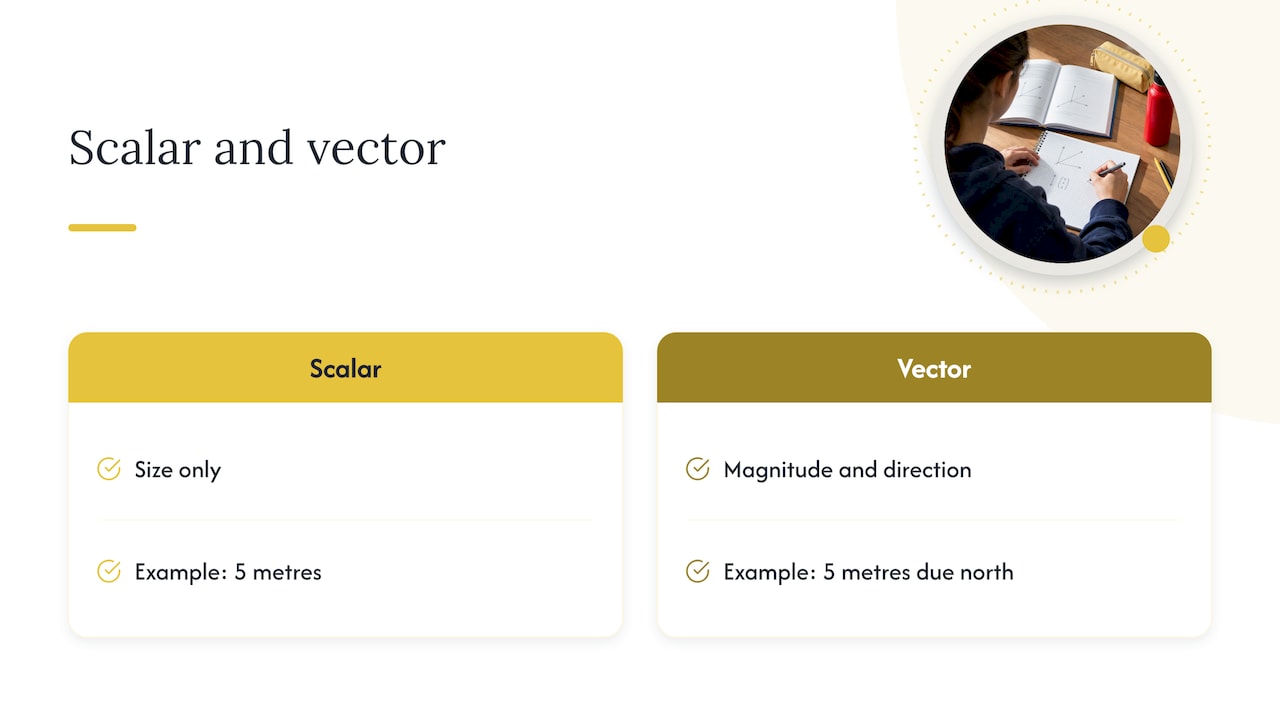
A vector describes a movement that has both magnitude and direction. Compare this with a scalar, which is just a size: “5 metres” is a scalar, while “5 metres due north” is a vector. NCETM guidance for Key Stage 4 also presents vectors as a way to describe displacement, meaning the change in position from one point to another.
In a column vector, the top number tells you the horizontal movement and the bottom number tells you the vertical movement. Positive values mean right or up. Negative values mean left or down, as set out in the BBC Bitesize explanation of vectors.
So the column vector (3, -2), written with the 3 above the -2, means “3 right, 2 down”. The order never changes: across first, then up or down.
Reading vectors from a diagram
When a vector is drawn as an arrowed line on a grid, count squares from the tail of the arrow to the head:
- Count the horizontal squares. Right is positive, left is negative.
- Count the vertical squares. Up is positive, down is negative.
- Write the horizontal count on top and the vertical count underneath.
A common slip is to read the arrow from the wrong end. The direction of the arrow matters: the vector from A to B is the exact opposite of the vector from B to A.
Vectors between coordinates
If you know the coordinates of two points, you can find the vector between them by subtracting. The displacement from (x1, y1) to (x2, y2) is (x2 – x1, y2 – y1). Always take the finish minus the start.
Example: A is (1, 5) and B is (4, 2). The vector AB is (4 – 1, 2 – 5), which is 3 across and -3 vertically, so 3 right and 3 down.
The same Oxford notes give the length of that displacement as the square root of ((x2 – x1) squared plus (y2 – y1) squared). That is Pythagoras’ theorem applied to the two components, so for AB above the length is the square root of 18, or 3√2.
Adding, subtracting and scaling column vectors
The BBC Bitesize Edexcel GCSE guide confirms that vectors can be added, subtracted and multiplied by a scalar, and then used to solve geometrical problems. The arithmetic is gentle. The skill is in knowing when to use it.
Addition and subtraction
Work on the top numbers together, then the bottom numbers together. Take a = (3, 2) and b = (-1, 4):
- a + b = (3 + -1, 2 + 4) = (2, 6)
- a – b = (3 – -1, 2 – 4) = (4, -2)
Watch the double negative in the subtraction. Writing the brackets around -1 before you subtract saves marks.
Multiplying by a scalar
A scalar is an ordinary number. Multiply both components by it. Using the same vectors:
- 2a = (6, 4)
- -3b = (3, -12)
- 2a – b = (6 – -1, 4 – 4) = (7, 0)
Multiplying by a positive scalar keeps the direction and changes the length. Multiplying by a negative scalar also reverses the direction. This is the idea behind every parallel-vector question, so it is worth being completely secure on it.
Reversing a vector
To reverse a vector, change both signs. The worked examples on Bitesize show this alongside finding a resultant by adding corresponding components. If AB = (3, -2), then BA = (-3, 2).
Vector geometry: expressing one vector in terms of others
This is where most marks are lost, and where the question is often worth four or five marks. Instead of numbers, the question gives you letters. For example, OA = a and OB = b, and you must find AB, or the position of a midpoint, in terms of a and b.
The method is the same every time. A vector describes movement from one point to another, so you can follow any route through the diagram, adding vectors along the route and reversing them by changing their signs.
The route method, step by step
- Mark the start and finish of the vector you need.
- Find a route between them using vectors you already know.
- For each step, write the vector. If you travel against an arrow, write it with a negative sign.
- Add the steps and simplify.
Worked example: OA = a and OB = b. To find AB, go from A back to O, then from O to B.
AB = AO + OB = –a + b = b – a
This is exactly the worked pattern shown by BBC Bitesize, and it is the foundation of nearly every vector geometry question.
Midpoints and ratios
Suppose M is the midpoint of AB. You already know AB = b – a, so AM is half of that.
OM = OA + AM = a + ½(b – a) = ½a + ½b = ½(a + b)
For a point that divides a line in a ratio, convert the ratio to a fraction of the whole line first. If P is on AB with AP : PB = 2 : 1, then AP is two thirds of AB, so AP = ⅔(b – a). Then go from O to A to P.
Common traps in vector geometry questions
- Wrong direction. Check each arrow before you write a sign. If in doubt, sketch the route again.
- Not simplifying. Collect like terms, so write 2a + 3b – a as a + 3b.
- Mixing numbers and letters. Keep the answer in terms of a and b when the question gives you letters.
- Stopping early. Many questions have a part (a) that sets up part (b). Use your earlier answer.
Vector proofs at GCSE
A proof question usually says “show that” or “prove that”. NCETM guidance says students should use vectors to construct geometric arguments and proofs. The good news is that GCSE proofs follow a small number of patterns.
A five-step structure
Bitesize’s guidance on solving geometric problems with vectors can be turned into this routine:
- Define the vectors you are using.
- Show each route explicitly, without skipping lines.
- Simplify the expressions.
- Identify the algebraic relationship between your results.
- Conclude in words about the shape, not just the algebra.
That last step is the one students forget. An equation on its own does not finish a proof.
Proving two lines are parallel
If one vector is a scalar multiple of another, the two are parallel. Adding and subtracting vectors around a shape is how you reach that point, as Bitesize explains.
Example: in a trapezium, you find that PQ = 2a + 4b and SR = a + 2b. Then PQ = 2 × SR, so PQ and SR are parallel, and PQ is twice as long.
A model conclusion: “PQ is a scalar multiple of SR, so the two lines are parallel.”
Proving three points are collinear
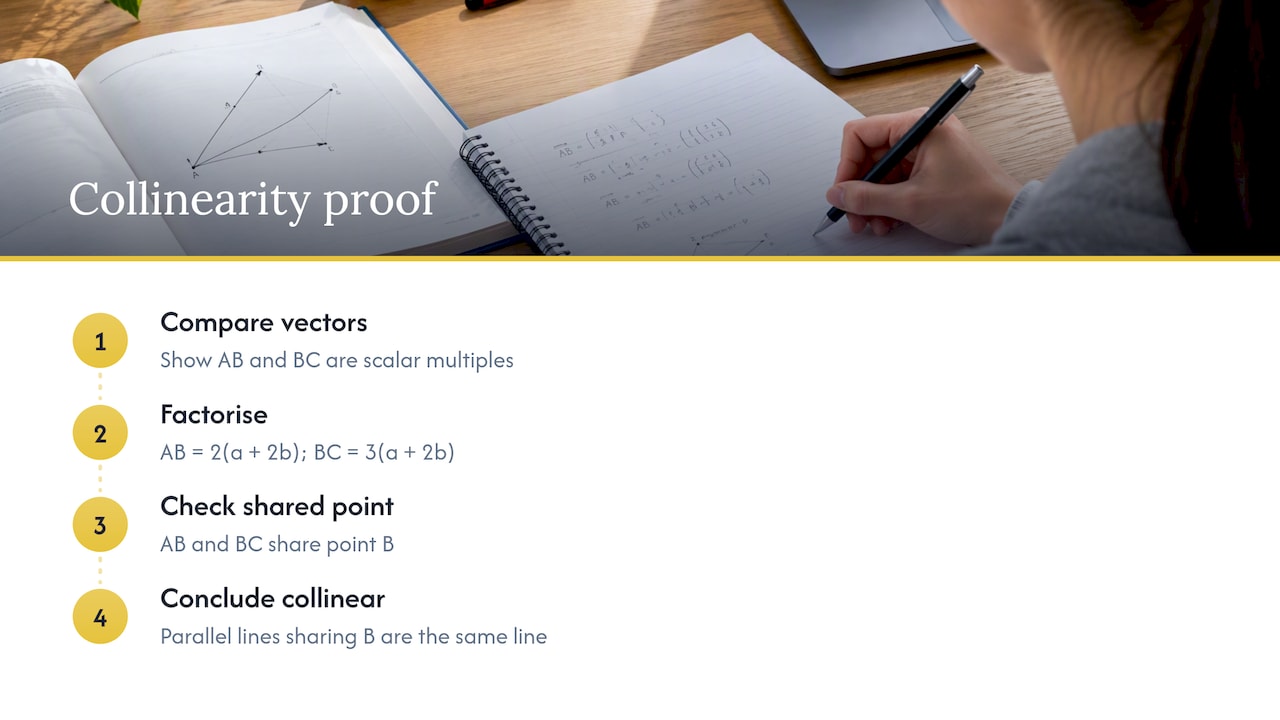
To show that A, B and C lie on one straight line, show that AB and BC are scalar multiples of each other and share the point B. The scalar multiple tells you the lines are parallel. The shared point then means they must be the same line.
Example: suppose AB = 2a + 4b and BC = 3a + 6b. Factorise each: AB = 2(a + 2b) and BC = 3(a + 2b). So BC = 1.5 × AB.
Conclusion: “AB and BC are parallel and share the point B, so A, B and C are collinear.”
Notice that a scalar multiple alone is not enough for collinearity. Two parallel lines can be in different places, so you must mention the shared point.
Writing a proof the examiner can follow
- Give each line of working its own line on the page.
- Name every vector you use in the route, for example “AC = AB + BC”.
- Show the factorised form before you state the scalar.
- Finish with a sentence that uses the words from the question, such as “parallel”, “collinear” or “midpoint”.
Question types to practise
Once the methods feel familiar, practise by question type rather than by random paper. Here is a sensible order:
| Stage | Question type | What it trains |
|---|---|---|
| 1 | Reading and drawing column vectors | Direction and sign |
| 2 | Adding, subtracting and scaling numerical vectors | Arithmetic with negatives |
| 3 | Finding a vector between two coordinates | Finish minus start |
| 4 | Expressing a vector in terms of a and b | Route method |
| 5 | Midpoints and ratio points | Fractions of a line |
| 6 | “Show that” parallel and collinear proofs | Scalar multiples and conclusions |
Tackle stage 4 for several days before moving on. It is the engine behind stages 5 and 6.
Practising on past papers
Past papers are the best source of real exam wording, which matters because vector questions often hide the method inside a long diagram. Our GCSE past papers and mark schemes let you pull out the vector questions from each paper, and the full past papers index covers other exam boards too. If you sit OCR, our OCR GCSE vectors topic page gathers the relevant questions in one place.
Because exam boards word things differently, treat the specification for your own board as the final word on what is examined. The skills in this guide, such as column vectors, the route method and proofs, are the core you will build on whichever board you sit.
Checking your own solutions
Marking your own answer is a skill in itself. Try this routine:
- Attempt the question without notes.
- Compare the final answer with the mark scheme.
- Even if you are right, read the worked solution to check the method. Marks in maths are often awarded for method as well as accuracy.
- If you are wrong, find the first line where your working and the solution differ. That is usually where the real error lives.
We have written about how to balance reading and watching solutions in our guide to written versus video solutions. The short version is to try the question first, then check.
A one-week revision plan for vectors
If you have a week before a mock or the real exam, this schedule fits around other subjects at about 30 to 40 minutes a day:
- Day 1: Column vectors. Read, draw, add, subtract and scale.
- Day 2: Vectors between coordinates, and length using Pythagoras.
- Day 3: Route method with a and b on simple triangles.
- Day 4: Midpoints and ratios.
- Day 5: Parallel proofs.
- Day 6: Collinear proofs.
- Day 7: A mixed set of exam questions under timed conditions, then mark and correct.
For a longer run-up, our 4 to 6 week plan with video walkthroughs shows how to fit topics like this into a wider timetable.
Where vectors lead next
Vectors do not stop at GCSE. They return in A-Level maths in three dimensions, and in physics for forces and velocity. If you are thinking ahead to a mathematics and physics degree programme, the column vector skills you build now are the same ones you will keep using. Students heading to A-Level can preview the next step in our Edexcel A-Level vectors revision page.
Our perspective
We built MathVault because vector questions are rarely hard for lack of ability. They are hard because students never see enough fully worked solutions that show every step of the route. When a mark scheme says “M1 for a correct route”, the student has to know what a correct route looks like.
That is why we pair past-paper questions with step-by-step solutions and video walkthroughs, all free. We want you to be able to try a question, compare your method line by line and see exactly where the method marks are earned. Vector proofs in particular improve quickly once you have seen the same five-step structure applied to a dozen different diagrams.
We also run live weekly Q&A sessions, because a stuck student often needs someone to talk through just one line of working. Used together, practice, solutions and live support turn a feared topic into one of the most predictable sources of marks on the paper.
Oloru
Practise vectors with MathVault
All our revision materials are free, with past papers organised by exam board and fully worked solutions to check against. If you are ready to start, head to our GCSE past papers and work through the vector questions first, or explore the full platform at MathVault.
Stuck on a particular proof? Our guide to asking maths questions live explains where to get help in real time, and you can see how the sessions work in our live Q&A guide.
FAQ
How do I know whether to add or subtract when finding a vector?
Think about the route. If you travel along the direction of an arrow, add that vector. If you travel against it, add the negative of that vector. To find the vector between two points, always take the finish minus the start.
What is the difference between a vector and a scalar?
A scalar has size only, such as 5 metres. A vector has size and direction, such as 5 metres north. In column vectors, you multiply by a scalar to change the length, and a negative scalar also reverses the direction.
How do I prove that three points are collinear?
Find two vectors, such as AB and BC, that share a point. Show that one is a scalar multiple of the other. Then write a conclusion in words: the vectors are parallel and share a point, so the three points lie on a straight line.
How do I find the length of a vector?
Square both components, add them and take the square root. For the vector (3, -3), the length is the square root of 9 plus 9, which is 3√2. This is Pythagoras applied to the components.
Why do I lose marks on vector proofs even when my algebra is right?
The usual reasons are skipped routes, unsimplified expressions and a missing conclusion. Show each route on its own line and end with a sentence about the shape, such as “so PQ is parallel to SR”.
Sources
- What is a vector? – BBC Bitesize
- Vectors – Edexcel GCSE Maths Revision – BBC Bitesize
- How to solve geometric problems using vectors – BBC Bitesize
- 11.1 Transformations and relative position – NCETM
- Geometry – University of Oxford Mathematical Institute
Leave a Reply