The best GCSE maths Paper 1 strategy is simple to state: treat it as a working-out paper, not an answer paper. Paper 1 is the non-calculator paper, so you win marks by choosing efficient methods, writing every step clearly and keeping to a steady pace of about 1.1 minutes per mark. This guide gives you a plan for the 90 minutes, a method for revising towards it and the exam-hall rules that catch students out.
A note on scope: “Paper 1” means different things in different subjects. On this page it means GCSE Maths Paper 1, the non-calculator paper. If you are revising English Language Paper 1, the structure and skills are completely different.
TL;DR
- Paper 1 is the non-calculator paper. On AQA it lasts 1 hour 30 minutes and carries 80 marks, so budget roughly 1.1 minutes per mark.
- Write your working on every question. Method marks are awarded even when the final answer is wrong, and lost when there is no working to credit.
- Make three passes: bank the quick marks first, then the middle questions, then the hardest ones, leaving 10 minutes to check.
- Revise by attempting questions cold, then marking against a mark scheme and logging the mistakes you actually make.
- Prepare the practical side: black pen, instruments, a clear understanding of your formulae sheet and no calculator surprises in the hall.
Table of Contents
- What Paper 1 asks of you
- Set your timing before you open the paper
- The three-pass method
- Show your working: how method marks really work
- Non-calculator techniques worth rehearsing
- Revise for Paper 1 by testing yourself
- A four-week plan before the exam
- Exam-hall rules that catch students out
- Our perspective: what we see students lose marks on
- Practise with free papers and worked solutions
- FAQ
- Sources
What Paper 1 asks of you
The AQA Higher Paper 1 from June 2023 is a good model. It runs for 1 hour 30 minutes, is worth 80 marks and tells you to bring mathematical instruments and to use the enclosed formulae sheet. It also tells you to use black ink or a black ball-point pen and to draw diagrams in pencil. Your own board’s paper will differ in layout and, for some boards, in total marks, so check the front page of a past paper from your specification before you plan your timings.
What changes without a calculator is the type of difficulty. You are tested on:
- Fluency with number: fractions, percentages, ratio, powers, roots, surds and standard form, all by hand.
- Exact answers: leaving results in terms of π, as a surd or as a fraction when the question asks.
- Algebra: expanding, factorising, solving and rearranging, where a slip in a sign costs the whole line.
- Reasoning and communication: showing why a result is true, not simply stating it.
The skill that connects all of these is clarity of working. Our guide to banking AO3 marks by showing working in GCSE maths explains how reasoning and communication marks are earned and why a tidy line of working is worth more than a lucky answer.
Set your timing before you open the paper
The arithmetic is straightforward. Ninety minutes for 80 marks gives 1.125 minutes per mark. Round that to about 1.1 minutes per mark and keep 8 to 10 minutes at the end for checking. That leaves roughly 80 minutes of working time, or one minute per mark.
| Question worth | Time to aim for | Warning sign to move on |
|---|---|---|
| 1 mark | About 1 minute | Still stuck after 90 seconds |
| 2 marks | About 2 minutes | Nothing written after 2 minutes |
| 3 marks | About 3 minutes | No clear method after 4 minutes |
| 4 marks | About 4 minutes | No clear method after 5 minutes |
| 5 to 6 marks | 5 to 6 minutes | Nothing credited after 7 minutes |
This is a planning aid, not a rule. Some 1-mark questions take 20 seconds and some 5-mark problems take eight minutes. The point is that you notice when a question is eating the time that belongs to others. Our page on pacing UK GCSE and A-level papers by 1.1 minutes per mark goes deeper on checkpoints and how to recover if you fall behind.
Checkpoints that work
Write these on the front of your paper in the first minute, in the margin:
- After 30 minutes: you should be around the 27 to 30 mark point.
- After 60 minutes: you should be around 54 to 60 marks, with only the hardest questions outstanding.
- After 80 minutes: stop new questions and start checking.
If you are behind at a checkpoint, do not rush the question you are on. Skip to the next question you can start confidently and come back.
The three-pass method
GCSE papers are built to rise in difficulty, but not perfectly. Early questions are usually accessible, the middle mixes topics and the final stretch is where problem solving and proof appear. A three-pass approach uses that structure without wasting your first minutes on a question that will not move.
Pass 1: bank the marks (about 35 minutes)
Work through from question 1 and answer everything you can start within about ten seconds of reading it. If you can see how to begin, do it fully. If you cannot, put a small star beside the question number and move on. Do not sit and stare. Most students find that the first pass collects well over half the marks.
Pass 2: the starred questions (about 35 minutes)
Return to the starred questions, easiest first. Now you are warm, and often the topic that blanked you earlier makes sense. For multi-step problems, write down what you know before you try to solve anything: values given, a diagram sketched, a relevant formula. Those lines can earn marks even if you do not finish.
Pass 3: check and rescue (about 10 minutes)
Use the last ten minutes to:
- Reread every question’s command words and units.
- Test your answers where you can with a quick reverse check (substitute a solution back into an equation, or estimate to see whether a magnitude is sensible).
- Add a first line of working to any blank question. A method started correctly can still be credited.
Show your working: how method marks really work
Most multi-mark questions award method marks (usually written M in the mark scheme), accuracy marks (A) and sometimes marks for reasoning. A correct answer with no working may still earn full marks on a 1-mark question, but on longer questions the working is where the marks sit. The AQA paper itself reminds candidates that they must show their working, which is why a clearly written method matters on a non-calculator paper.
Habits that protect your marks:
- One step per line. Do not squash three operations into one. If you make a slip, the examiner can still see your intention.
- Keep your rough work in the answer book. Your paper’s instructions ask you to do all rough work in the book and to cross through anything you do not want marked. Do not erase it, because crossed-out work is ignored but unfinished correct work can earn credit.
- Never leave a blank. A start, a diagram or a relevant formula often earns something.
- Do not round early. Without a calculator, exact fractions and surds are usually kinder than decimals.
- Write the final answer clearly, with units and in the form requested.
For a full set of techniques, see our guide on how to stop losing method marks on GCSE and A-level non-calculator papers.
Non-calculator techniques worth rehearsing
You do not need clever tricks. You need a small set of reliable routines that you have done so many times they cost you no thought.
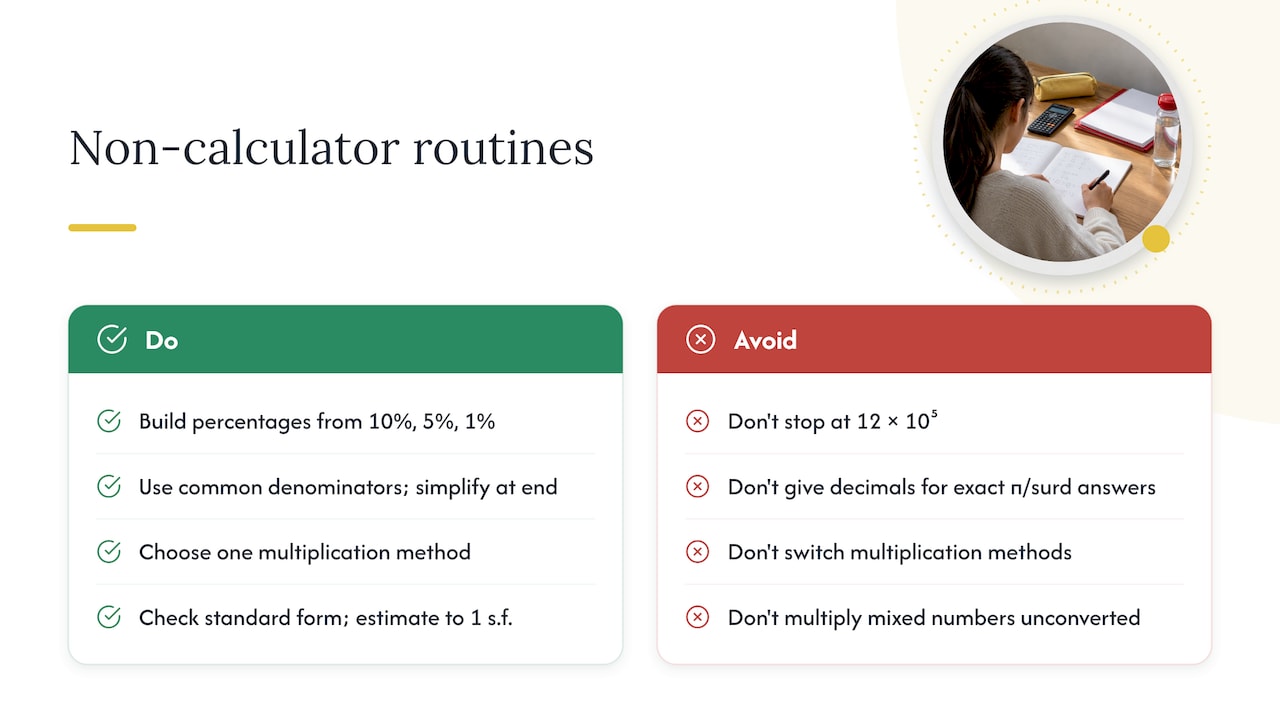
Percentages. Build any percentage from 10%, 5% and 1%. For 35% of 240: 10% is 24, so 30% is 72, 5% is 12, total 84.
Fractions. Use a common denominator, simplify at the end and convert mixed numbers to improper fractions before multiplying or dividing.
Multiplication of large numbers. Choose one method (grid or column) and stay with it. Switching methods under pressure is how errors arrive.
Standard form. Convert, calculate, then check the first number is between 1 and 10. A very common slip is stopping at 12 × 10⁵.
Surds and π. If a question says “give your answer in terms of π” or “in surd form”, a decimal answer will lose the accuracy mark.
Estimation. Round to one significant figure to see whether your answer is of the right size. This is a cheap check that catches misplaced decimal points.
Our daily routine of 20 to 30 minutes of practice without a calculator is a good way to make these automatic.
Revise for Paper 1 by testing yourself
The Education Endowment Foundation’s guidance points to metacognitive strategies, including checking whether your chosen approach suits the task, as part of high-quality teaching. In practice, that means stopping before you calculate to ask: “Which method am I using, and is it the efficient one here?”
The EEF also discusses retrieval practice, and its piece on whether the research translates to classrooms makes the point that retrieval works best when you recall actively rather than passively re-reading. Applied to maths:
- Pick a topic and close your notes.
- Write down the method steps or a worked example from memory.
- Attempt three or four questions on it without help.
- Only then compare with your notes and mark scheme.
Do not lean on worked solutions too early
Worked solutions are valuable, but there is a trap: you read the solution, think “obvious”, and move on. The EEF’s teaching guidance is a reminder that students need to move from studying examples to applying methods independently. Try the question first, even if you only get one line down. Then read the solution and ask where your method and the mark scheme’s diverged.
Hunt for examiner traps
When you mark a past paper, do not just count marks. Keep an error log with three columns: the topic, what went wrong and the fix. Typical entries are missing units, a negative sign dropped when expanding brackets, using the wrong formula for the area of a sector or forgetting to give an answer in the form requested. After three or four papers, your log shows your personal traps, which is more useful than any generic list.
Our guide to self-marking past papers with board-aligned solutions shows how to do this properly, and you can use a GCSE maths exam checklist covering topics, formula sheets and tier rules to make sure nothing is missed.
A four-week plan before the exam
If you have a month, this structure is realistic alongside school and other subjects.
| Week | Focus | Output |
|---|---|---|
| 1 | Weak topics from your error log: number, ratio, algebra | Short daily sets, no calculator, marked the same day |
| 2 | Geometry, probability and statistics by hand | One topic test per day, cold start |
| 3 | Full Paper 1 under timed conditions, twice | Marked papers and updated error log |
| 4 | Mixed questions, then another full paper | Final checklist, light revision the day before |
If you are short on time, our 48/24/8 last-minute revision plan condenses this into the final two days. For a broader overview of methods, read our guide to GCSE maths revision strategies.
Exam-hall rules that catch students out
Paper 1 has no calculator, but the other two papers do, and mixing up routines costs marks. The practical rules matter:
- Pens and pencils. The JCQ information for candidates says you must write clearly in black ink, with coloured pencils or inks allowed only for diagrams, maps and charts, unless the paper’s front-page instructions say otherwise.
- Formulae sheet. AQA’s paper tells you the formulae sheet is enclosed. Know what is on it and what is not, so you are not hunting for a formula or assuming one is given. Our exam checklist lists the formulae you must memorise.
- Calculator for Papers 2 and 3. The JCQ’s Instructions for Conducting Examinations set the rules on what calculators can do, including that they must not offer symbolic algebra or pre-stored data. Graphical calculators must be compliant, and many need exam mode. Check your model’s manufacturer instructions well before exam day, and clear any covers or cases that hold printed formulae or notes before you enter the hall.
The best habit is to pack the night before and run through a checklist: two black pens, pencil, ruler, protractor, compasses, eraser, water and a watch if the room allows one.
Our perspective: what we see students lose marks on
We built Mathvault around the idea that mark schemes teach more than any summary. When students move from reading solutions to self-marking past papers, the pattern we notice is consistent: the marks lost on Paper 1 are rarely about missing knowledge. They are about missing structure. Answers appear without working, steps are squashed together, and students spend ten minutes on a 2-mark question because they have not decided when to move on.
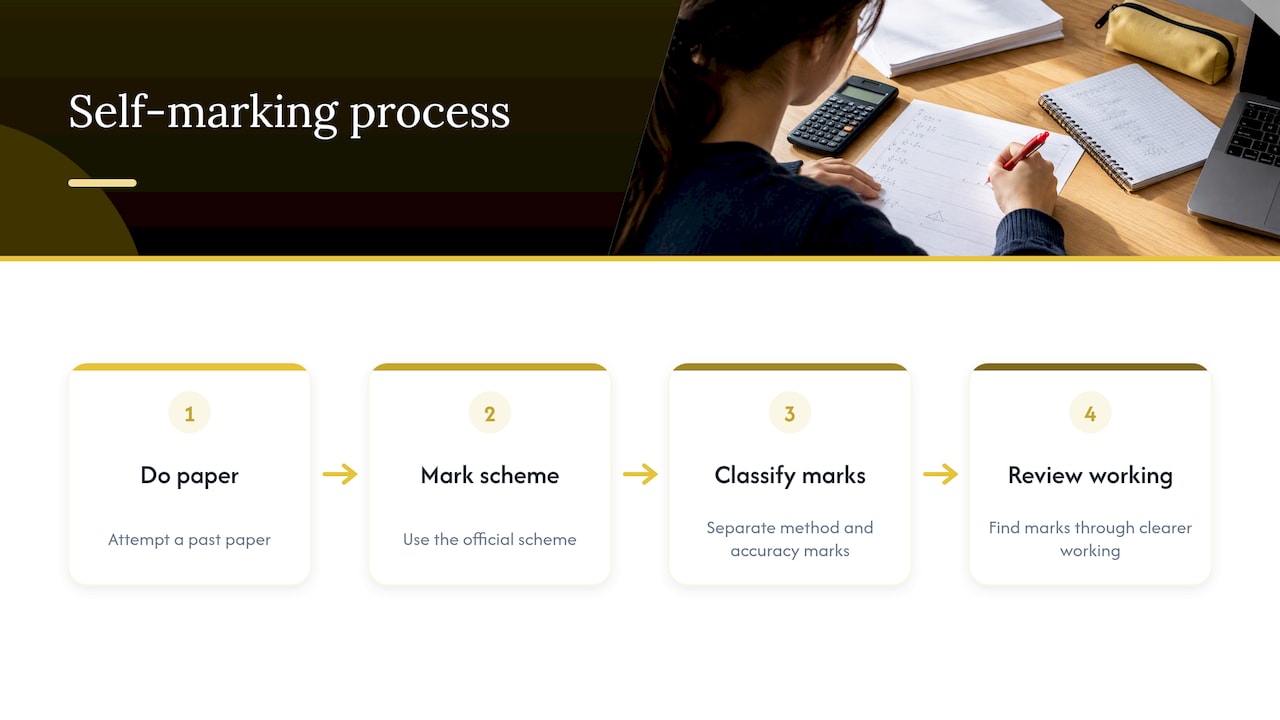
Our advice is to practise the exam as a process, not just a topic list. Do a paper, mark it with the official scheme, note which marks were method marks and which were accuracy marks, and ask where you would have earned something with a clearer line of working. A student who can do that calmly, in 90 minutes, has a real strategy rather than a hope.
And be kind to yourself. Paper 1 feels harder because you lose your safety net, but the same questions are assessed at the same standard, and the marks are earned by method. Confidence comes from rehearsal.
— Oloru
Practise with free papers and worked solutions
Mathvault offers free GCSE and A-level past papers, fully worked step-by-step solutions, video walkthroughs, topic revision guides and weekly live Q&A sessions, organised by exam board. If you are on OCR, start with the OCR GCSE maths revision topics, or sharpen your number skills with OCR Number questions. Edexcel students can use our Edexcel GCSE past paper questions by topic, and everyone can start from the GCSE maths revision guides. Revision materials and most papers are free. Some recent or advanced resources and downloadable packs are available as one-off purchases, and donations are welcome but never required.
FAQ
Is GCSE Maths Paper 1 harder than Papers 2 and 3?
Not in content. All three papers cover the same specification and are designed to the same standard. Paper 1 feels harder because you have no calculator, so arithmetic accuracy and clear method matter more. Students who practise by hand regularly usually find the gap closes quickly.
How many marks is Paper 1 worth, and how long is it?
On AQA, Paper 1 lasts 1 hour 30 minutes and carries 80 marks. Other boards may use a different mark total, so check the front page of a past paper for your own specification and plan your time per mark from that.
What should I do if I get stuck on a question?
Write what you know: the given values, a sketch, a relevant formula or a first step. Then star the question and move on. Come back in your second pass with a fresh head. A partial method often earns marks, but an empty space never does.
Should I rush so that I finish early?
No. Aim to finish your first two passes with about ten minutes left, then use that time to check. Finishing early with errors is a worse outcome than using the full time. A quick estimate, a substitution check and a reread of the command words catch most avoidable slips.
Sources
- AQA GCSE Mathematics Higher Paper 1 Non-calculator, June 2023
- JCQ: Information for candidates, written exams
- JCQ: Instructions for Conducting Examinations
- EEF: High-quality teaching
- EEF: Does research on retrieval practice translate into classroom practice?
Leave a Reply