
To succeed without a calculator, focus on number sense, exam technique and targeted past-paper practice. Three priorities matter most: build flexible mental arithmetic, show your working so examiners can award method marks, and practise timed non-calculator papers every week. This applies directly to GCSE, where a defined share of marks sits on non-calculator questions, and still pays off for A-Level students who need fast, reliable checks. Worked solutions and past papers from Mathvault can support every stage of that practice.
TL;DR:
- Recognizing which mental shortcuts to apply is more valuable than memorized tricks when solving non-calculator questions.
- Drawing diagrams, simplifying problems, and estimating answers help translate complex questions into manageable steps and reduce reliance on calculations.
- Showing clear working, managing time, and checking answers can earn method marks and improve accuracy under exam conditions.
- Building a consistent practice routine of timed, self-marked past papers and targeted drills leads to more reliable score improvements.
- Resources like fully worked solutions and board-specific past papers support focused, checkable practice aligned with exam requirements.
Table of Contents
- High-value mental maths techniques to practise
- Problem-solving heuristics that remove the calculator need
- Exam technique: showing working, checking and managing your time
- Practice plan and resource checklist aligned to UK exam boards
- What reliably improves marks in non-calculator papers
- How MathVault.io supports non-calculator preparation
- FAQ
- Sources
High-value mental maths techniques to practise
Non-calculator papers reward flexibility more than memorised tricks. The most useful skill is recognising which shortcut fits the numbers in front of you, then applying it without reaching for a pen until you need to record a step.
Rounding to one or two significant figures gives you a fast sanity check before you commit to a full calculation, and swapping awkward numbers for compatible ones (changing 198 × 5 into 200 × 5 minus 2 × 5, for instance) often turns a messy sum into an easy one. For addition and subtraction, clump digits into tens, carry values forward in groups rather than one at a time, and use a balancing technique: add the same amount to both numbers in a subtraction to make one of them round.
Multiplication and division benefit from breaking numbers into factors, doubling one number while halving the other, and using near-base strategies for numbers close to 10, 100 or 1,000. Multiplying by 25 becomes multiplying by 100 and dividing by 4; multiplying by 125 becomes multiplying by 1,000 and dividing by 8.
- Convert between fractions, decimals and percentages early so you work in whichever form is fastest for the question.
- Use unit fractions (find one part, then scale) for proportion and ratio problems.
- Keep scratchwork minimal: jot the key intermediate value, not every step of your mental process.
These habits echo the structured rapid-calculation rules behind systems such as the Trachtenberg system, though real exam flexibility usually beats rote tricks, since questions rarely arrive in the neat form a fixed rule expects.
Pro Tip: Practise estimating the answer before you calculate it properly. If your final answer is wildly different from your estimate, you have caught an error before the examiner does.
Problem-solving heuristics that remove the calculator need
Many non-calculator questions feel harder than they are because the numbers look unfriendly. The fix is rarely a faster calculation, it is a better translation of the problem.
- Read the question and identify exactly what is unknown, then write a short equation or expression before touching numbers.
- If the problem feels abstract, try a simpler version with smaller or rounder numbers to see which method works, then apply that method to the real figures.
- Draw a diagram, number line or table for anything involving ratio, proportion or geometry. A sketch often reveals a relationship that pure arithmetic hides.
- Work through steps in order and write each intermediate value clearly, since partial credit depends on an examiner being able to follow your logic.
- Use estimation and bounding to rule out answers that cannot be right, particularly useful when a question offers several options.
This approach matches established problem-solving strategies, including trying something concrete, drawing a picture, simplifying the problem and working systematically rather than jumping to a calculation.
Pro Tip: When a question gives you an answer to check against, work backwards from that answer first. It is often faster than solving forwards.
Exam technique: showing working, checking and managing your time
Technique separates students who understand the maths from students who bank the marks for it. Examiners award method marks for a clear, logical sequence, even when the final answer is wrong, so legible structure matters as much as correct arithmetic.
- Label each step and write intermediate values on their own line rather than cramming several operations together.
- Check your answer by reversing the calculation, estimating a sensible range, or confirming the units and format match what the question asked for.
- Set a rough time limit per question based on its mark value, and if you are stuck, note your best attempt and move on rather than reworking the whole method.
- Watch for common pitfalls: overcomplicated scratchwork that obscures your method, forgetting to simplify a fraction, and misapplied rounding partway through a multi-step calculation.
Clear structure like this is exactly what examiners are trained to reward, as outlined in guidance on showing your working in GCSE maths.
Practice plan and resource checklist aligned to UK exam boards
A short, consistent routine beats occasional long revision sessions. Build a week around daily mental arithmetic, regular timed papers and honest review.
- Daily: 20 to 30 minutes of mixed mental arithmetic drills covering arithmetic, fractions and percentages.
- Twice a week: a timed non-calculator past-paper section completed under exam conditions.
- Once a week: a review session using worked solutions to mark your own attempts and spot repeated mistakes.
- Match your practice papers to the correct exam board, using resources such as board-organised past papers by topic so the content lines up with your specification.
- After each timed attempt, ask yourself what type of problem it was, which method you used, and how you checked the answer, a habit shown to improve reasoning and transfer to new problems in the IES practice guide on mathematical problem solving.
What reliably improves marks in non-calculator papers
Repeated, short practice with honest self-checking improves marks far more than collecting clever tricks. Most students lose marks not from weak arithmetic but from rushing the setup: misreading what the question asks, or skipping the check that would have caught an error. The simplest fix is also the most boring one: slow down at the start of each question and mark your own work against a worked solution afterwards so the same mistake does not repeat.
— Oloru
How MathVault.io supports non-calculator preparation
We built our resources around exactly this kind of consistent, checkable practice. Many online past papers come with fully worked solutions, allowing you to run timed non-calculator sections and then mark them yourself against step-by-step answers rather than guessing whether your method was right.
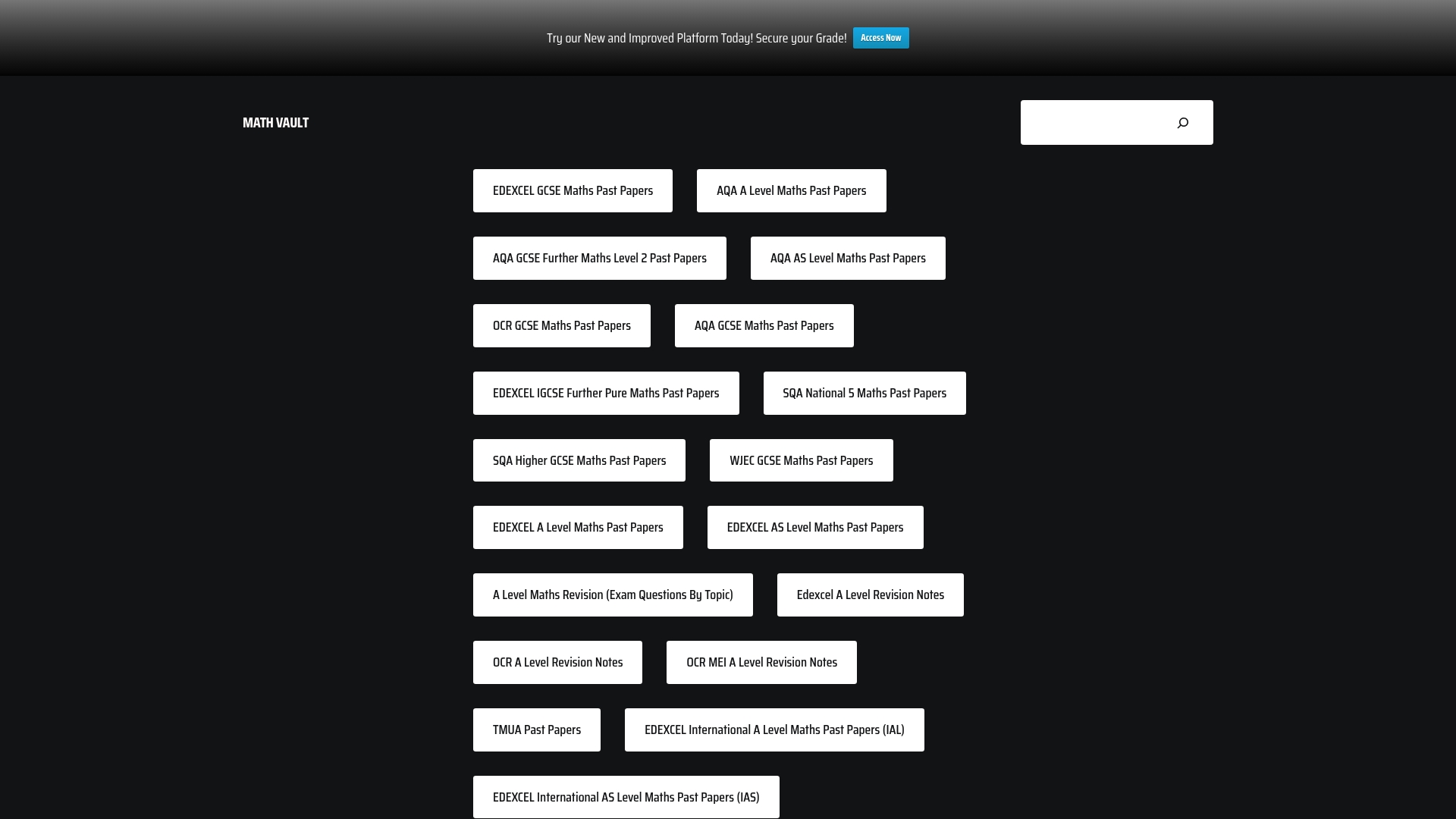
A typical session: pick a paper from our GCSE revision guides, time yourself on the non-calculator sections, then check your answers against the worked solutions before moving to the next topic. For extra timed drills outside full papers, a short numerical reasoning session on TESTUNO works well as a warm-up.
| Resource | What it gives you |
|---|---|
| GCSE revision guides | Structured topic sequencing and worked solutions |
| Board-organised past papers | Timed practice matched to your specification |
| Self-mark past papers with live Q&A | Instant feedback and direct support on tricky questions |
- Start with a past paper in your own board and year group.
- Time the non-calculator section strictly.
- Self-mark using the worked solution before reviewing with live Q&A support.
FAQ
What topics are in GCSE maths non-calculator?
GCSE non-calculator papers cover the same topic range as the rest of the specification, including number, algebra, ratio, geometry and statistics, but questions are chosen so they can be solved with mental and written methods alone. Specifications require that a defined share of total marks, between 33% and 50%, comes from questions completed without a calculator.
Is there a non-calculator paper in A-Level maths?
A-Level maths specifications generally expect calculator use to run throughout the course, but calculator-free skills remain important for problem solving and for checking answers quickly. Guidance from the DfE and Ofqual on GCE mathematics confirms that fluency without a calculator still supports strong performance across papers.
Is Paper 1 GCSE maths foundation non-calculator?
Across the main exam boards, Paper 1 is the non-calculator paper at both foundation and higher tier, with Papers 2 and 3 allowing calculator use. Always confirm this against your specific board’s paper structure, since labelling can vary slightly year to year.
What is on maths Paper 1 non-calculator higher?
Paper 1 higher tier draws from the full higher-tier content range, including algebra, ratio, geometry and number, with questions designed to be solvable through mental arithmetic, estimation and written methods. The exact balance of topics varies by exam series, so practising full past papers from your own board gives the most accurate picture.
How do I get faster at non-calculator questions?
Speed comes from repeated, short practice rather than memorising isolated tricks, since recognising which mental method fits a given set of numbers takes exposure to many question types. Frequent timed drills combined with immediate self-marking against worked solutions build that recognition faster than occasional long revision sessions.
Sources
- GCSE subject level conditions and requirements for mathematics (Ofqual)
- GCE subject level conditions and requirements for mathematics (DfE/Ofqual)
- Improving mathematical problem solving in grades 4 through 8: instructional tips (IES practice guide)
- Problem solving strategies (LibreTexts)
Leave a Reply