
AQA GCSE Mathematics (8300) is assessed by three 1 hour 30 minute papers, each worth 80 marks and one third of your final grade, with Paper 1 non-calculator and Papers 2 and 3 calculator. You sit either Foundation (grades 1 to 5) or Higher (grades 4 to 9), and the qualification is linear, meaning every paper is taken in the same exam series. Content is tested across three assessment objectives and six topic areas, and your best revision tools are the official past papers and AQA’s All About Maths hub.
TL;DR:
- Students should focus revision on topic areas they struggle with, as content from different domains appears across all three papers.
- The exam heavily emphasizes fluency in core techniques, with half the marks allocated to standard procedures tested through AO1 questions.
- Practice with official past papers under timed conditions and review examiner reports to identify common errors and misconceptions.
- Since the GCSE is linear, continuous, broad revision across all topics is essential, as content can reappear at any point in the exam series.
- Resit students must retake all three papers together in the same series, and targeting specific weaknesses with past-paper analysis improves chances of success.
Table of Contents
- What the specification actually covers
- Scheme of assessment: papers, timings and calculator rules
- Assessment objectives and how marks are weighted
- How papers ramp in difficulty, and the rules around resits
- Using AQA’s official past papers and mark schemes properly
- How MathVault fits the AQA specification
- Why the linear structure changes how you should revise
- Where students typically lose marks and what to change now
- Start with MathVault’s GCSE maths revision guides
- Sources
- FAQ
What the specification actually covers
The AQA 8300 specification splits the entire GCSE Maths curriculum into six topic areas, each with its own reference code. Understanding this map matters because it tells you exactly where to focus your revision time, rather than reading through a textbook cover to cover.
The six areas are:
- N (Number): place value, fractions, indices, standard form, surds
- A (Algebra): expanding and factorising, solving equations, sequences, graphs
- R (Ratio, proportion and rates of change): percentages, compound measures, direct and inverse proportion
- G (Geometry and measures): angles, area and volume, Pythagoras, trigonometry, vectors
- P (Probability): sample space diagrams, tree diagrams, conditional probability
- S (Statistics): averages, cumulative frequency, scatter graphs, sampling
The official specification sorts content within each area into “basic foundation,” “additional foundation,” and “higher” columns. Basic foundation content applies to everyone; additional foundation and higher content stretches into more demanding territory, though items from lower columns can still resurface on Higher papers.
Scheme of assessment: papers, timings and calculator rules

Every candidate sits three papers of identical length and value. Each lasts 1 hour 30 minutes and carries 80 marks, contributing exactly one third of your overall GCSE grade. No paper counts for more than another, so a weak Paper 1 can still be recovered across Papers 2 and 3.
The calculator rules are straightforward but easy to forget under pressure:
- Paper 1 is non-calculator throughout.
- Papers 2 and 3 both allow calculator use.
- A formula sheet is provided in the exam for all three papers, though it only covers a limited set of formulae, not everything you might need.
- Any topic area, from probability to geometry, can appear on any paper. AQA does not confine algebra to one paper and statistics to another.
Question styles range from short, single-mark calculations to multi-step problems worth six or more marks that blend two or three topic areas together. That blending is deliberate. It rewards students who can move fluidly between topics rather than memorising isolated procedures.
Assessment objectives and how marks are weighted
Three assessment objectives sit behind every question on the paper, and they carry unequal weight. AO1 tests whether you can use and apply standard techniques, worth 50% of the total marks.
Half of your marks come from AO1 alone, which is why fluency with core techniques, solving equations, calculating percentages, applying the sine rule, still decides most grades before reasoning even enters the picture.
Topic weightings also shift between tiers. Foundation papers lean more heavily on Number and Ratio, while Higher papers shift weight towards Algebra and Geometry, since these areas carry the greater conceptual demand at that level.
This has a direct consequence for how you answer questions. AO2 and AO3 marks are awarded for showing your reasoning, not just landing on the right number. A correct final answer with no working can lose marks that a wrong answer with valid method retains.
How papers ramp in difficulty, and the rules around resits
Both Foundation and Higher papers follow a deliberate structure: earlier questions lean on straightforward AO1 recall and procedure, while later questions demand AO2 reasoning and AO3 problem solving, often stacking two or three topics into a single question.
Grade boundaries are set only after each exam series has been marked, based on how the whole cohort performs that year. You cannot know your grade from raw marks alone until boundaries are published, so it pays to check how grade boundaries convert to grades rather than guessing at fixed cutoffs.
A few administrative points matter if you are resitting:
- GCSE Maths is linear, so you must retake all three papers together in the same series. You cannot resit a single paper to top up a grade.
- November resit entries are restricted to candidates who were 16 or over on the previous 31 August, which effectively limits that window to post-16 students.
- Most students resitting will do so the following June, alongside the standard cohort.
Pro Tip: If you’re resitting, don’t just repeat your old revision. Pull your previous exam’s examiner report and target the exact question types where you lost AO2 or AO3 marks, not just the topics you found “hard.”
Using AQA’s official past papers and mark schemes properly
AQA publishes past papers, specimen papers, mark schemes, and examiner reports for every series, and treating these as your primary revision tool beats almost any textbook. Mark schemes show precisely how method marks are awarded even when a final answer is wrong, which matters given how much weight AO2 and AO3 carry.
The All About Maths teaching guidance hub, written by senior examiners, includes route maps that show how topics connect and exemplar answers that reveal what a strong response actually looks like on the page.
A practical routine:
- Sit a past paper under full timed conditions.
- Mark it strictly against the official scheme, not your gut feeling.
- Read the matching examiner report for common errors on that exact paper.
- Redo only the questions you got wrong, then move to a fresh paper.
Pro Tip: Examiner reports are more useful than most students realise. They name the exact misconceptions that lost marks that year, often the same ones that trip up the next cohort.
How MathVault fits the AQA specification
MathVault organises its resources by exam board and topic, which maps directly onto the six AQA topic areas and the papers described above. Rather than hunting across scattered PDFs, you can work through content in the order the specification itself is structured.
Useful starting points include:
- The AQA GCSE Maths hub, with topic pages and past-paper walkthroughs aligned to 8300.
- Self-marking past papers with board-aligned solutions and live Q&A for questions you get stuck on.
- Fully worked solutions that show the exact method steps examiners reward, useful for seeing where AO2 marks are actually earned.
A workable revision template: drill AO1 fluency first, review worked solutions to see examiner expectations, then attempt AO2 and AO3 questions untimed before finally testing yourself against the clock.
Why the linear structure changes how you should revise
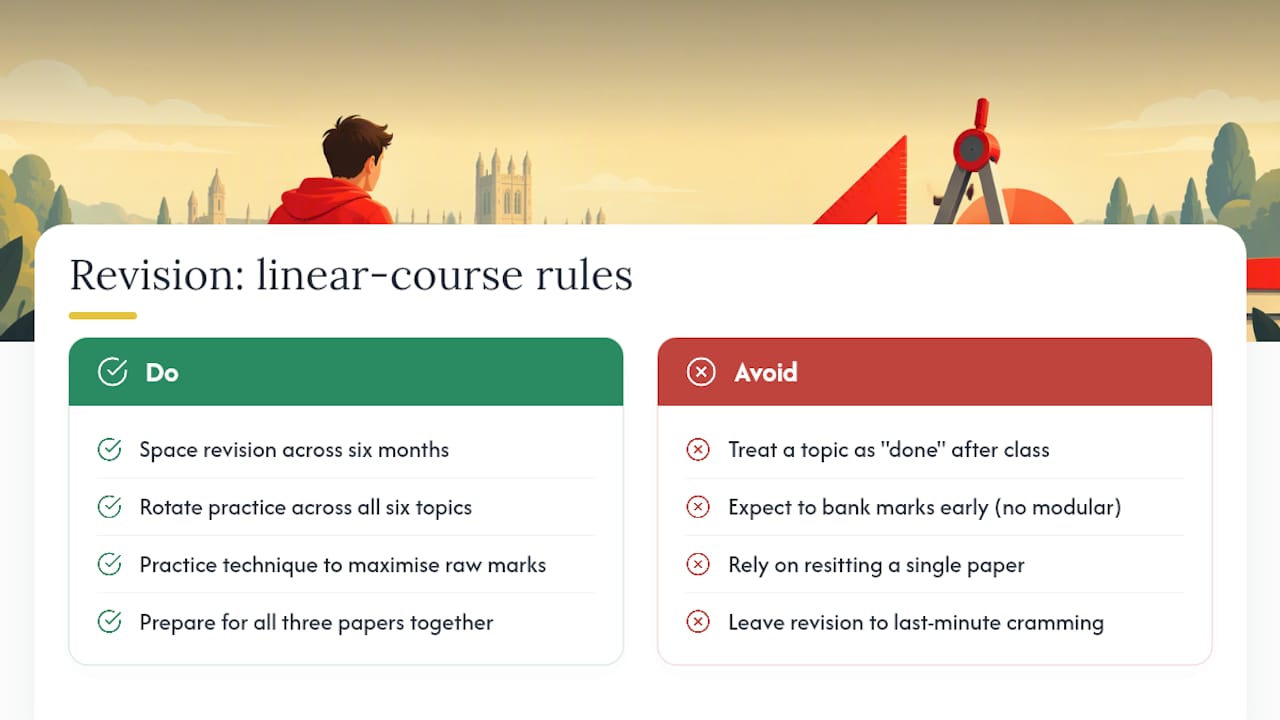
AQA 8300 is a linear qualification, which means there is no modular option and no early-entry unit to bank marks ahead of time. Every paper is sat in the same series, and your grade is calculated from the combined 240 marks across all three papers together, not from any single paper in isolation.
This has a practical consequence that catches students out every year. You cannot treat any topic as “done” once you’ve covered it in class, because content from Number, Algebra, Ratio, Geometry, Probability, and Statistics can all resurface across any of the three papers, at any point in the series. A student who nails algebra in September but has not touched probability since October is not actually exam-ready, even if their mock grade looks strong.
The linear format also means there’s no safety net between papers. If Paper 1’s non-calculator questions go badly, you cannot resit that single paper while keeping your Paper 2 and 3 scores. All three are locked together for that series. That’s precisely why spaced revision across the full six months before exams tends to outperform last-minute topic cramming; the specification simply doesn’t reward narrow, recent knowledge over broad, retained knowledge.
Because grade boundaries are only fixed after the series is marked, focus stays on maximising raw marks through solid technique across every topic area, rather than trying to predict where the cutoffs will land.
Where students typically lose marks and what to change now
Most lost marks aren’t about not knowing the maths. They’re about AO1 speed not being automatic enough to leave headroom for AO2 and AO3 reasoning, and about skipping working on questions that clearly need it. Build fluency first, then layer in examiner-style reasoning practice, and write every intermediate step even when you’re confident of the answer.
— Oloru
Start with MathVault’s GCSE maths revision guides
Once you know how AQA 8300 is structured, the fastest way to act on it is to work through content that’s already organised the same way. MathVault’s GCSE maths revision guides are built around exam board and topic, so you move straight from “I need to fix my Ratio, proportion and rates of change score” to the exact papers and worked solutions that address it.
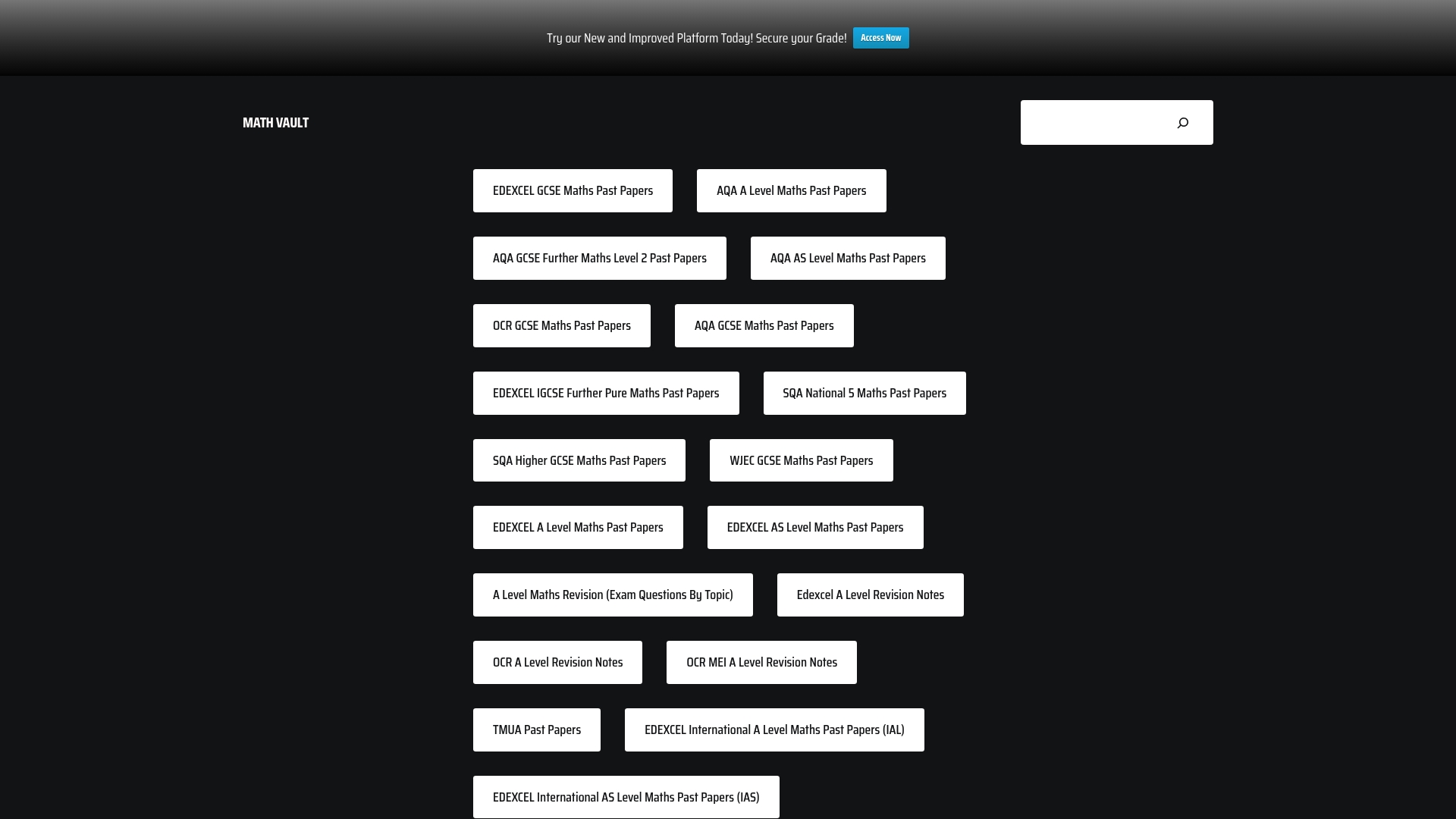
The hub brings together topic-indexed past papers, worked solutions, video walkthroughs, and weekly live Q&A sessions, available to access. If method marks are where you’re losing the most, the non-calculator paper strategy guide is worth a look too, since Paper 1 catches out students who rely too heavily on calculator habits elsewhere.
Head to the GCSE maths revision guides hub, pick your weakest topic area from the six covered above, and work through a timed past paper with the matching solutions open alongside it.
Sources
- AQA GCSE Mathematics 8300 specification (PDF)
- GCSE Mathematics 8300 | Specification at a glance | AQA
FAQ
What is the AQA 8300 specification?
AQA 8300 is the specification code for AQA GCSE Mathematics, the official document setting out the six topic areas, three assessment objectives, and exam structure. You can read the full specification PDF directly from AQA.
How many papers are there in AQA GCSE Maths?
There are three papers, each 1 hour 30 minutes and worth 80 marks. Paper 1 is non-calculator, and Papers 2 and 3 both allow calculators.
What’s the difference between Foundation and Higher tier?
Foundation tier covers grades 1 to 5, while Higher tier covers grades 4 to 9, with Higher papers shifting more weight towards Algebra and Geometry. Both tiers use the same three-paper structure and AO weightings.
What are AO1, AO2 and AO3 in AQA maths?
AO1 tests standard technique fluency, AO2 tests reasoning and communication, and AO3 tests problem solving, weighted at 50%, 25%, and 25% respectively. Losing AO2 or AO3 marks usually comes down to missing working, not wrong answers.
Can I resit AQA GCSE Maths in November?
November entry is restricted to candidates who were 16 or over on the previous 31 August, so most school-age students resit the following June instead. All three papers must be retaken together since the qualification is linear.
Does MathVault cover the AQA specification?
MathVault organises past papers, worked solutions, and video walkthroughs by exam board, including a dedicated AQA GCSE Maths hub aligned to the 8300 topic areas. All core resources are free, including live weekly Q&A sessions.
Leave a Reply